- 240 pages
- English
- ePUB (mobile friendly)
- Available on iOS & Android
eBook - ePub
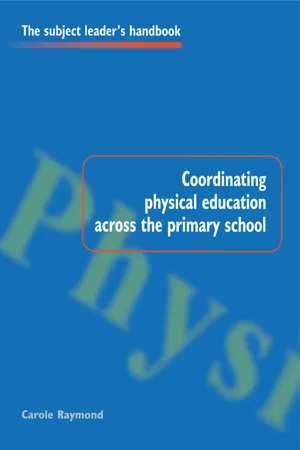
Coordinating Physical Education Across the Primary School
About this book
A book to promote the talents of teachers and help them explore and share their skills. All aspects of Subject Leadership are covered in the five parts of the book:
* the role of the PE Coordinator
* what the PE Coordinator needs to know
* whole school policies and schemes of work
* monitoring for Quality
* resources for teaching and learning.
Case studies provide ideas on best practice and material to be used for reflection is drawn from schools, practising coordinators, OFSTED inspectors, advisers and teacher-educators.
Information
Part one
The role of the PE coordinator
Chapter 1
What does being a PE coordinator involve?
What does being a PE coordinator involve?
Chapter 2
Developing management skills
Developing management skills
Chapter 3
Evaluation and development
Evaluation and development
Chapter 1
What does being a PE coordinator involve?
The class teacher has always been seen at the very heart of British primary education (Harrison and Theaker, 1989; Wragg, 1993; McNamara, 1994). However, an explosion of knowledge in both traditional and new subjects, the use of computers, cross-curricular themes such as health and safety, and the development of personal transferable skills, have all contributed to increasing the complexity of the primary school curriculum. This, coupled with society’s expectations, have made it difficult, if not impossible, for the class teacher to keep up to date. The idea that primary teachers need support no longer seems to be in doubt and the value of delegating curriculum responsibility to subject coordinators has gained momentum as one way of offering this support. In 1986 the House of Commons Select Committee endorsed the role of coordinators in curriculum management and school development. It would appear that there is no longer a place for a teacher whose sole responsibility is his or her class.
By 1989 all initial teacher education courses in England and Wales had to prepare primary training students to be ready, when qualified, to take on the role of leading other teaching staff in a specialist subject area. What a challenge! This was also recognised by the Department of Education and Science (DFE)
To meet the requirements of the National Curriculum, and the need for more systematic coverage of all subjects in all classes, many schools now find it helpful to identify ‘co-ordinators’ with strengths in particular subjects who can assist and help train staff
(DFE, 1995, Circular 14/93)
Most recently the Teacher Training Agency (TTA) proposals for a qualification for subject leaders recognised different sources of evidence that has shown
…pupil achievement is higher when the role of the subject leader is clearly identified and effectively implemented. Effective leaders make a major contribution to improving schools and raising the levels of pupil achievement.
(1996, p. 4)
Extensive work by researchers such as Holly and Southworth (1989), Day, Whitaker and Johnson (1990), Alexander, Rose and Woodhead (1992), Day and Norman (1993), Davies (1995) and Harrison (1995) have all contributed to improving our understanding about the role of subject coordinators. This new ‘middle’ management role has become firmly established in the primary school. But who are these coordinators? What are they expected to do?
This chapter will address the role of the PE coordinator, sometimes referred to in other documents as subject managers or subject leaders, and offer guidance on what is recognised as good practice. Many of the skills discussed are generic and common to all subject areas. The subject specific advice is based on my own experiences and research into existing practice promoted by colleagues with varied levels of experience. Throughout the research process I was keen to identify not only what coordinators are required to do in terms of their job specification, but what they felt they ought to do and how.
What type of person is the coordinator?
Over a period of four weeks I analysed sixty-six Times Educational Supplement advertisements, and fifteen follow-up job descriptions for coordinators. It became evident that the emphasis placed on certain qualities varies considerably from School to school. The most popular expectations can be summarised in a few extracts:
The Governors of this expanding first and middle school are seeking to appoint a highly motivated, experienced and enthusiastic teacher with an ability to lead a Year 6 team of 5 classes.
The successful applicant will be a member of the management team having personal responsibility for the co-ordination of physical education throughout the school.
The successful applicant will be a member of the management team having personal responsibility for the co-ordination of physical education throughout the school.
An enthusiastic and energetic professional with… experience across the primary phase, excellent class teacher skills, ability to work co-operatively as part of a team … is required for this large multicultural primary school.
We require a suitably qualified, experienced and enthusiastic teacher
initially for Year 4, who is able to co-ordinate the P.E. and P.S.H.E. work throughout the school.
initially for Year 4, who is able to co-ordinate the P.E. and P.S.H.E. work throughout the school.
‘Experience’ appeared in 90 percent of the advertisements and was the most frequently mentioned quality, with ‘enthusiasm’ including ‘highly motivated’ following closely behind. This is not surprising information if coordinators are to be responsible for
…raising standards of achievement and be able to demonstrate excellent teaching and interpersonal skills…
…leading curriculum development…
…to lead colleagues…
This is not to ignore ‘sense of hum our’, ‘vision’, ‘reliable’, ‘innovative’, ‘able to raise standards’, ‘organisational and managerial skills’, ‘good class teacher’, ‘commitment to after school clubs’, ‘equal opportunities’ and ‘integration of SEN pupils’. This data also identifies the range of responsibilities and the type of environment that coordinators will be working in. No two schools are the same.
What is certain is that being a coordinator involves a great deal more than being a good class teacher. You can be an excellent classroom teacher yet a poor coordinator. Your skills in the classroom may be what earns you the respect of your colleagues and contributes to your promotion, but you will need some new and different skills to succeed as a coordinator. These ‘skills’ will be addressed throughout various chapters of this book.
The responsibilities associated with being subject co-ordinator are described in many ways. Any job description should include
- a statement of intent;
- a reference to how the role fits in to school policy and management;
- a list of areas of responsibility, general and specific;
- the process of review.
The third area listed above might include: review of policy; reporting to staff, head and governors; development of continuity and progression; differentiation and access; assessment, recording and reporting; ordering and managing resources; liaison with outside agencies. The key skills, roles and responsibilities will be determined by the school needs and authority within which you work. This was confirmed by Webb (1994) whose research showed that ‘the amount and nature of the work fulfilled by co-ordinators varied enormously from school to school, and often between co-ordinators in the same school’ (para. 5.9) The exact duties a PE coordinator will be asked to perform and the expectations made of an NQT will differ from those made on a more experienced teacher. At least, this is how it should work in practice!
Understanding the role of the coordinator
You will need to have a clear understanding of what your job as a coordinator involves in your school. It will be easier for you if your colleagues also have a clear understanding of the more general role of subject leaders and how they feature in the management of the school. The current school inspection framework reports on leadership and management and
…how well staff with management responsibilities contribute to the quality of education provided.
(OFSTED, 1995, p. 100)
They claim that in a well-managed school, responsibilities are clearly defined, there is effective delegation and staff understand the role they are encouraged to play in the development and running of the school (p. 101). A useful starting point is to look at whether job descriptions are clear and realistic and the extent to which staff understand and are committed to them. Look at the following descriptions. They clearly identify areas of responsibility. How do they relate to your own description? Do you need more detail in your own description?
Suggestion
Do you have a job description? What does it say?
This is the first thing to look at. It should outline what is expected of you and will give you a guide as to how the role of the PE coordinator is viewed in your school. How does it relate to the areas identified above?
This is the first thing to look at. It should outline what is expected of you and will give you a guide as to how the role of the PE coordinator is viewed in your school. How does it relate to the areas identified above?
Job description for Woodstock Primary School—PE Coordinator
The duties of the PE coordinator will involve:
- keeping up to date with best practice in physical education teaching and the national and local curriculums;
- monitoring of the school’s physical education policy and updating this where necessary;
- auditing, ordering and taking care of the school’s physical education resources;
- arranging staff development, INSET or focused discussions on agreed practices;
- talking to the governors and advisers about the school’s physical education teaching;
- attending courses provided by the LEA or Higher Education Institute.
Job description for Avondale Primary School—PE Coordinator
The main responsibilities are:
- to take responsibility for managing the subject in the school as delegated through the headteacher;
- to organise and monitor learning in PE, not only what children are learning but why and how they are learning it;
- to work with staff, teaching and non teaching to help them develop their skills, knowledge and understanding of the subject and how it can be taught so that children’s learning is at the focus of their work;
- to offer advice and guidance on standards of achievement and the assessment of pupil learning;
- to facilitate the coordination of resources;
- to highlight links with other subjects on the curriculum also with other agencies in the community and how to maximise learning opportunities;
- to support teachers’ ongoing professional development.
Both job descriptions tell us what the headteacher expects from the coordinator. But not all descriptions are as helpful. During an interview one co-ordinator outlined her job in much broader terms:
When I was appointed I was told that I was coordinator for PE and that was that.
(HC)
She went on to say that she received a one-day induction course and was then left to her own devices; ‘learning on the job’ was very much her responsibility.
You need to be clear about what you are expected to do and this will involve talking to the headteacher and negotiating a detailed description.
The TTA (1996) description for a subject ...
Table of contents
- Cover Page
- Half Title page
- series
- Title Page
- Copyright Page
- Contents
- Figures
- Acknowledgments
- List of acronyms
- Series editor's preface
- Introduction
- one The role of the PE coordinator
- two What the PE coordinator needs to know
- three Whole school policies and schemes of work
- four Monitoring for Quality
- five Resources for teaching and learning
- References
- Index
Trusted by 375,005 students
Access to over 1.5 million titles for a fair monthly price.
Study more efficiently using our study tools.
Frequently asked questions
Yes, you can cancel anytime from the Subscription tab in your account settings on the Perlego website. Your subscription will stay active until the end of your current billing period. Learn how to cancel your subscription
No, books cannot be downloaded as external files, such as PDFs, for use outside of Perlego. However, you can download books within the Perlego app for offline reading on mobile or tablet. Learn how to download books offline
Perlego offers two plans: Essential and Complete
- Essential is ideal for learners and professionals who enjoy exploring a wide range of subjects. Access the Essential Library with 800,000+ trusted titles and best-sellers across business, personal growth, and the humanities. Includes unlimited reading time and Standard Read Aloud voice.
- Complete: Perfect for advanced learners and researchers needing full, unrestricted access. Unlock 1.5M+ books across hundreds of subjects, including academic and specialized titles. The Complete Plan also includes advanced features like Premium Read Aloud and Research Assistant.
We are an online textbook subscription service, where you can get access to an entire online library for less than the price of a single book per month. With over 1.5 million books across 990+ topics, we’ve got you covered! Learn about our mission
Look out for the read-aloud symbol on your next book to see if you can listen to it. The read-aloud tool reads text aloud for you, highlighting the text as it is being read. You can pause it, speed it up and slow it down. Learn more about Read Aloud
Yes! You can use the Perlego app on both iOS and Android devices to read anytime, anywhere — even offline. Perfect for commutes or when you’re on the go.
Please note we cannot support devices running on iOS 13 and Android 7 or earlier. Learn more about using the app
Please note we cannot support devices running on iOS 13 and Android 7 or earlier. Learn more about using the app
Yes, you can access Coordinating Physical Education Across the Primary School by Carole Raymond in PDF and/or ePUB format, as well as other popular books in Education & Education General. We have over 1.5 million books available in our catalogue for you to explore.