eBook - ePub
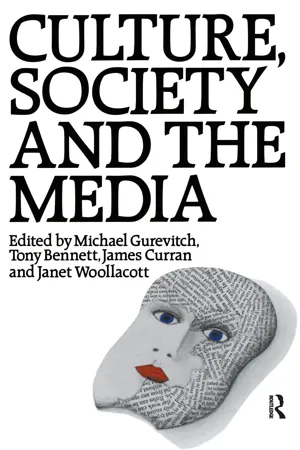
Culture, Society and the Media
- 319 pages
- English
- ePUB (mobile friendly)
- Available on iOS & Android
eBook - ePub
Culture, Society and the Media
About this book
This book discusses two related themes concerning the role and processes of mass communication in society. The first deals with questions regarding the power of the media: how should it be defined? how is it wielded and by whom? are previous approaches and answers to such questions adequate? The second theme revolves around the divisions between the liberal pluralist and Marxist approaches to the analysis of the nature of the media. These divisions have, in recent years, been fundamental to the debate concerning the understanding of the role of mass communication, and the examination of them in this book will challenge the reader to look more closely at a number of assumptions that have long been taken for granted.
Information
III
THE POWER OF THE MEDIA
Introduction
As the preceding section showed, the view taken of the relationship between media and society influences the way in which the power of the media is perceived. Two of the essays in this section—those by James Curran and Tony Bennett—see the media primarily in terms of a struggle for power between competing social forces in which the media are both shaped by, and in turn influence, the course of this struggle. The remaining two essays in this section, by Peter Braham and Jay Blumler/Michael Gurevitch, analyse the influence of the media in a more eclectic way in terms of their effectiveness in shaping human behaviour and consciousness, viewed from a pluralist perspective.
The opening essay by James Curran considers schematically the impact of the mass media over more than a millenium of history. He maintains that the development of new techniques or institutions of communication has given rise to new power centres, ranging from the medieval papacy to modern press magnates. The emergence of these new power centres, he argues, has often generated new tensions within the dominant power bloc. Thus, the priesthood provoked dissension in the middle ages by seeking to transform the power structure; the rise of the book undermined, in turn, the authority of the priesthood in early modern Europe; and more recently professional communicators have become, in some ways, rivals to professional politicians. More generally, he examines the different social contexts in which mass media have amplified or contained class conflicts. In early nineteenth-century Britain, he maintains, conflicts between a substantial section of the press and the dominant class both reflected and reinforced growing fissures within the social structure. More recently, he argues, the media have come to occupy a central role in maintaining support for the social system as a consequence of the close integration of control of the media into the hierarchy of power in contemporary Britain.
Jay Blumler and Michael Gurevitch's examination of the political effects of the mass media draws upon a different research tradition—survey-based research into media effects in western liberal democracies. Their essay challenges the ‘limited’ model of media influence advanced in the pioneering, highly influential studies into media political effects. The development of television, they argue, has resulted in political communications regularly reaching a segment of the mass audience that is particularly susceptible to political influence. A general decline in the strength and stability of political allegiances has also enabled the media to exercise a more effective influence. And new ways of conceptualizing media influence in terms of their impact on political cognitions rather than in terms of persuasion and behaviour change, they argue, have revealed significant media effects that once tended to be neglected. Their essay concludes with a discussion of convergences between recent pluralist and Marxist approaches to the study of media audiences.
Peter Braham's examination of how the media handle race illustrates two important aspects of the influence of the mass media referred to by Blumler and Gurevitch, namely the power of the media to influence the political agenda and to shape perceptions of reality. The massive media publicity given to Enoch Powell's notorious speech on immigration during the late 1960s helped to define race as a central issue on the political agenda—a place which it has held ever since. The concentration of the media on the manifestations of racial tension has also arguably influenced public perceptions of immigration by tacitly defining the presence of coloured immigrants as constituting a social problem or threat to the white majority. But Braham is at pains to emphasize the limitations of media influence. Enoch Powell, he argues, did not create (though he may have amplified) racial tension: his speech produced an ‘earthquake’ largely because it expressed anxieties and discontents about race and immigration which were already widespread, but which had received ‘insufficient attention in the mass media’. Braham also quarrels with the view that by focusing on the manifestations, rather than the causes of racism, the media are playing a central role in fanning racial hostility. What these causes of racial conflict are, Braham argues, is far from self-evident. But what is clear from historical evidence, according to Braham, is that ethnocentrism and hostility to foreigners are deep-rooted and widely diffused phenomena for which the media cannot be held responsible.
The last essay by Tony Bennett differs from the two preceding it in that it links media systems of representation to their political and social contexts, viewed from a Marxist perspective. He considers the ways in which the mass media—both communist and capitalist controlled—suppressed information about the revolutionary and socialist character of the Republican side during the Spanish Civil War for different propagandist reasons. This profoundly influenced, he argues, the response of the European working class to the Civil War, thereby ‘shaping the contours of the political map of prewar Europe’. He also examines the ways in which ‘outsiders’ such as youth gangs have been stereotyped and stigmatized in the mass media, arguing that their representations have served to strengthen commitment to dominant social norms. His analysis concludes with an examination of the different ways in which the media sustain the dominant political consensus, drawing upon examples of media coverage of industrial relations and the political process.
Bennett also explicitly contests a number of arguments advanced in the two preceding essays. Peter Braham's characterization of the media as ‘a searchlight illuminating some areas, while leaving others in shadow’ implies a differentiation between objective reality and the media as selective definers of that reality. Bennett argues, however, that ‘the “real” that is signified within the media is never some raw, semantically uncoded, “outthere” real. Signification always takes place on a terrain which is always already occupied and in relation to consciousnesses which are always already filled’. Indeed, it is precisely because the media's influence is greatest, according to Bennett, when people are least conscious of its influence—when the ideological categories projected by the media appear neutral and objective—that the measurement and assessment of media influence through survey techniques is so problematic. While these techniques do not generally rely on asking respondents to assess the influence of the media upon them, but rather seek to infer processes of influence by examining the statistical relationships between variables derived from respondents’ replies, the value of these techniques remains an outstanding issue of disagreement amongst researchers.
Yet despite these and other disagreements, all four essays in this section are unanimous in opposing the view that the media ‘mirror’ society, based on the media professionals’ claim that they ‘report the news as it is’. News does not exist as external reality that can be objectively portrayed on the basis of ascertainable fact: for facts have to be selected and then situated, whether explicitly or implicitly, within a framework of understanding before they ‘speak for themselves’. This process of selection and interpretation is culturally encoded and social determined. Yet such constructions largely define our knowledge of the external world of which we have no first-hand experience. This power of definition, all these essays argue, is the basis of ‘the power of the media’. All four essays are also at one in repudiating—though in different ways, and with different emphases—the once prevalent academic view that the media have only a marginal influence. They are thus symptomatic of the process of rethinking and reappraisal which has shaped this book, and which is now reshaping more generally the field of mass communications research.
8
Communications, power and social order
JAMES CURRAN(1)
Mass communications are generally discussed as if they were exclusively modern phenomena. Indeed, this assumption is embodied in most social scientific definitions of the mass media. According to McQuail (1969, p. 2), for instance, ‘mass communications comprise the institutions and techniques by which specialized groups employ technological devices (press, radio, films, etc.) to disseminate symbolic content to large, heterogeneous, and widely dispersed audiences’. Only modern technology, it is widely assumed, has made possible the transmission of communications to mass audiences; for, as Maisel (1973, p. 160) amongst others would have us believe, ‘in the pre-industrial period, the communication system was restricted to direct face-to-face communication between individuals’.
In fact, a variety of signifying forms apart from face-to-face interaction—buildings, pictures, statues, coins, banners, stained glass, songs, medallions, rituals of all kinds—were deployed in pre-industrial societies to express sometimes highly complex ideas. At times, these signifying forms reached vast audiences. For instance, the proportion of the adult population in Europe regularly attending mass during the central middle ages was almost certainly higher than the proportion of adults in contemporary Europe regularly reading a newspaper(2). Since the rituals of religious worship were laid down in set liturgies, the papal curia exercised a much more centralized control over the symbolic content mediated through public worship in the central middle ages than even the controllers of the highly concentrated and monopolistic press of contemporary Europe.
Centralized control over mass communications is thus scarcely new. An historical comparison with older communication forms—including communications reaching small élites as well as mass audiences—serves, moreover, to throw into sharp relief certain aspects of the impact of communication media that the ‘effects’ research tradition, relying upon survey and experimental laboratory research techniques, has tended to ignore. Our concern will be with the impact of communications on the power structures of society. In particular, attention will be focused upon the effect of new media in bringing into being new power groups whose authority and prestige have derived from their ability to manipulate the communications under their control; the consequences of their rise in generating new tensions and rivalries within the dominant power-bloc; the wider dislocative effects of new media which by-pass or displace established mediating organizations and groups; the emergence of new media which reflect and amplify increasing conflicts within the social structure; and the central role of the media, when there has been a close integration between the hierarchy of power and control over communications, in maintaining consent for the social system.
This examination will concentrate mainly upon three historical periods—the central middle ages, early modern Europe and modern Britain. It will take the form of a schematic analysis in which we will move backwards and forwards in time in order to elucidate particular aspects of the impact of the media(3). Inevitably a survey covering so broad a canvas will be highly selective and, in places, conjectural. But hopefully it will serve as a mild antidote to the conventional approach to examining media influence, in which media institutions are tacitly portrayed as autonomous and isolated organizational systems transmitting messages to groups of individuals with laboriously-measured and often inconclusive results, that has dominated media research for so long(4).
COMMUNICATIONS AND POWER
The rise of papal government is one of the most striking and extraordinary features of the middle ages. How did the See of Rome, which even in the early fourth century was merely a local bishopric with no special claim to legal or constitutional pre-eminence, become the undisputed sovereign head of the western Christian Church? Still more remarkable, how did a local church with no large private army of its own and initially no great material wealth and which for long periods of time was controlled by minor Italian aristocrats develop into the most powerful feudal court in Europe, receiving oaths of allegiance from princes and kings, exacting taxes and interfering in affairs of state throughout Christendom and even initiating a series of imperialist invasions that changed the face of the Middle East?
The See of Rome had, of course, certain initial advantages which provided the basis of its early influence. It was sited in the capital of the old Roman empire; it was accorded a special status by the emperors in Constantinople who were anxious to unite their Christian subjects in the west; and it was the only church in western Europe which was thought to have been founded by St Peter.
The papacy capitalized on this initial legacy by spearheading the missionary expansion of the church and by skilfully exploiting the divisions within the deeply fissured power-structure of medieval Europe to its own advantage. Successive popes played off rival monarchies against each other, exploited the tensions and conflicts between monarchies and feudatories and even, on rare occasions, backed popular resistance to aristocratic repression. The papacy also utilized to its own advantage the desire of some leading ecclesiastics to increase their independence from lay control as well as the tensions and rivalries within the Church itself, notably between the episcopacy and the monastic order. The rise of papal government, as a number of scholars (for example, Brooke, 1964; Southern, 1970; Richards, 1979) have convincingly shown, was thus partly the result of the dexterity with which the papacy harnessed the interests and influence of competing power-groups to build up its own power.
But neither the papacy's imperial and apostolic legacy nor its policy of divide and rule adequately account for the transformation of a local bishop into a papal emperor. In particular, it does not explain why (as opposed to how) the papacy should have profited so greatly from its interventions in the power politics of medieval Europe, nor does it adequately explain why the papacy managed quite rapidly to expand its power over the Church far beyond the authority accorded to it by the Roman emperors. The rise of the papacy can only be properly understood in terms of its early dominance over institutional processes of ideological production that created and maintained support for its exercise of power. As St Bernard of Clairvaux wrote perceptively to the Pope in 1150: ‘Your power is not in possessions, but in the hearts of men’ (quoted in Morris, 1972, p. 14).
The expansion of the Christian Church in early modern Europe provided the institutional basis of papal hegemony. It created a new communications network capable of transmitting a common ideology throughout western Europe. Rome could not exploit this network, however, until it had asserted its authority over the western Church(5). During the fourth century, the papacy upgraded the status accorded to it by the emperors in the east by claiming leadership of the Church on the basis of scriptural authority. Its claim rested upon a passage in St Matthew's Gospel in which Jesus hails St Peter as ‘this rock (upon) which I will build my church…’ As a title-deed, it left much to be desired, not least because it made no reference to the See of Rome. The omission was made good, however, by the production of a spurious letter, the Epistola Clementis, whose author was stated to be Clement, the first historic bishop of Rome, informing St James of the last dispositions of St Peter which designated the bishops of Rome as his successors. This was followed by additional forgeries of which the most influential was the Donation of Constantine, which purported to document how the Emperor Constantine had formally handed over large, but mostly unspecified, provinces in the western hemisphere to Pope Silvester; and a collection of canon law called Pseudo-Isidore, which included fraudulent canons of the early Christian Councils and equally spurious decrees of early bishops of Rome, representing the pope as the primate of the early Christian Church. Distinguished early popes added to this myth-making by proclaiming as fact obviously false stories about the development of the early Christian Church(6). The papacy and its allies thus set about reinterpreting history—a practice common to all great ideologies, although in this case conducted with unusual thoroughness by the actual fabrication of historical sources.
The ideological strength of the papacy was based, however, not so much on a single biblical text (important though this was), or on a selective view of history, but on what Kantorowicz (1957) calls ‘the monopolization of the Bible’—the selective interpretation of the Bible...
Table of contents
- Cover Page
- Half Title page
- Title Page
- Copyright Page
- Contents
- Acknowledgements
- Preface
- I Class, Ideology and the Media
- Introduction
- 1 The study of the media: theoretical approaches
- 2 Theories of the media, theories of society
- 3 The rediscovery of ‘ideology'; return of the repressed in media studies
- 4 Messages and meanings
- II Media Organizations
- Introduction
- 5 Large corporations and the control of the communications industries
- 6 Negotiation of control in media organizations and occupations
- 7 Cultural dependency and the mass media
- III The Power of the Media
- Introduction
- 8 Communications, power and social order
- 9 The political effects of mass communication
- 10 How the media report race
- 11 Media, ‘reality', signification
- Index
Trusted by 375,005 students
Access to over 1.5 million titles for a fair monthly price.
Study more efficiently using our study tools.
Frequently asked questions
Yes, you can cancel anytime from the Subscription tab in your account settings on the Perlego website. Your subscription will stay active until the end of your current billing period. Learn how to cancel your subscription
No, books cannot be downloaded as external files, such as PDFs, for use outside of Perlego. However, you can download books within the Perlego app for offline reading on mobile or tablet. Learn how to download books offline
Perlego offers two plans: Essential and Complete
- Essential is ideal for learners and professionals who enjoy exploring a wide range of subjects. Access the Essential Library with 800,000+ trusted titles and best-sellers across business, personal growth, and the humanities. Includes unlimited reading time and Standard Read Aloud voice.
- Complete: Perfect for advanced learners and researchers needing full, unrestricted access. Unlock 1.5M+ books across hundreds of subjects, including academic and specialized titles. The Complete Plan also includes advanced features like Premium Read Aloud and Research Assistant.
We are an online textbook subscription service, where you can get access to an entire online library for less than the price of a single book per month. With over 1.5 million books across 990+ topics, we’ve got you covered! Learn about our mission
Look out for the read-aloud symbol on your next book to see if you can listen to it. The read-aloud tool reads text aloud for you, highlighting the text as it is being read. You can pause it, speed it up and slow it down. Learn more about Read Aloud
Yes! You can use the Perlego app on both iOS and Android devices to read anytime, anywhere — even offline. Perfect for commutes or when you’re on the go.
Please note we cannot support devices running on iOS 13 and Android 7 or earlier. Learn more about using the app
Please note we cannot support devices running on iOS 13 and Android 7 or earlier. Learn more about using the app
Yes, you can access Culture, Society and the Media by Tony Bennett, James Curran, Michael Gurevitch, Janet Wollacott, Tony Bennett,James Curran,Michael Gurevitch,Janet Wollacott in PDF and/or ePUB format, as well as other popular books in Social Sciences & Media Studies. We have over 1.5 million books available in our catalogue for you to explore.