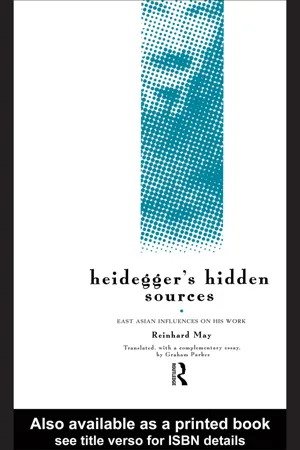
Heidegger's Hidden Sources documents for the first time Heidegger's remarkable debt to East Asian philosophy. In this groundbreaking study, Reinhard May shows conclusively that Martin Heidegger borrowed some of the major ideas of his philosophy - on occasion almost word for word - from German translations of Chinese Daoist and Zen Buddhist classics.
The discovery of this astonishing appropriation of non-Western sources will have important consequences for future interpretations of Heidegger's work. Moreover, it shows Heidegger as a pioneer of comparative philosophy and transcultural thinking.
- 144 pages
- English
- ePUB (mobile friendly)
- Available on iOS & Android
eBook - ePub
About this book
Information
1
Indications
But if human language is in the word, only then is it in order. If it is in order, there is a chance of access to the hidden sources.a
Martin Heidegger
1 We are indebted to Chang Chung-yuan,1 Paul Shih-yi Hsiao,2 Tezuka Tomio,3 Hans A. Fischer-Barnicol,4 and Heinrich Wiegand Petzet,5b as well as to others among Heidegger’s contemporaries for manifold indications of his interest in East Asian thought, and in Daoism and Zen Buddhism especially. We are also informed about Heidegger’s numerous contacts with the East Asian world, with a world to which, according to Petzet, he felt himself drawn and ‘which gladly accepted him’ (P 166/175f). Neither Heidegger’s interest nor his contacts have been contested; moreover, Petzet remarks that Heidegger was also familiar with East Asian thinking.6 Heidegger himself draws our attention to his acquaintance with this topic, in so far as he speaks directly, in several passages in works from the 1950s that have been published, about ‘East Asian language’, the notion of dao, and Laozi (Lao Tzu).7c All this is known well enough.
Less well known are two further references to Laozi. First, we learn from Petzet that Heidegger quoted a large part of Jan Ulenbrook’s translation of Chapter 47 of the Laozi in a letter to Ernst Jünger (P 182/191). Petzet does not, however, note that Heidegger departs from Ulenbrook’s translation8 in the fourth line of his citation and apparently gives his own version at this point: instead of Ulenbrook’s ‘seeing the way of heaven’ he writes ‘seeing the whole of heaven’, thereby eliminating the word ‘way’ (dao). The rendition is thus in part an Ulenbrook-Heidegger version. Second, there is a similar instance in Heidegger’s letter to Hsiao of 9 October 1947 (reproduced in HAT 102). Here Heidegger paraphrases Hsiao’s translation of Chapter 15 of the Laozi, which runs:
Who is able to make still and gradually clarify what is muddy?
Who is able to move and gradually animate what is at rest?
(EMH 127)d
At Heidegger’s request, Hsiao had earlier made a calligraphy of these lines for him.
I inscribed these two lines of eight characters each on such parchment as was then available; ‘the dao of heaven’, which is not in the text, I wrote as a decorative device in the middle. I gave a careful etymological explanation of all the characters, so that he could grasp everything in detail. The Heideggerian version again shows the depths of his thinking (HAT 100).
In his letter to Hsiao, Heidegger performs the following two variations of his own:
Who is able to be still and from and through stillness put something on the way (move it) such that it comes to light?e
While this version, which Heidegger puts in quotation marks, is apparently a product of the collaboration between Heidegger and Hsiao (guided by the latter’s competence in sinology), the version that immediately follows in the letter can be ascribed to Heidegger alone. In his own handwriting it reads:
Who is able by making tranquil to bring something into Being?
The dao of heaven.f
Three further chapters from the Laozi (18, 76, and 7) that are brought into the conversation (as communicated by Hsiao) shed further light on Heidegger’s acquaintance with this text. Hsiao also reports his saying, in his lecture on culture and technology:
one would have to see old things with a newer, farther look. If we were to attempt, for example, to ‘ground’ God through the traditional proofs of His existence—the ontological, cosmological, or teleological—we would then diminish God, who is more, and ineffable ‘like the dao’ (EMH 127).
Further indications can be drawn from Petzet’s accounts. For example:
In the conversation [1950] about the ‘fourfold’ we touched on the topic of Laozi, to which a young woman made an essential contribution. In the end the guests…had perhaps sensed something about that ‘turn’ that…could eventuate in a memorial thinking. The meeting with Heidegger thus became for many participants a sign (P 73/80).
Finally, Petzet draws our attention to two other informative remarks of Heidegger’s. First, in conversation with a Buddhist monk from Bangkok in September 1964, Heidegger said that ‘he himself would often hold to Laozi—but that he knew him only through the German intermediaries, such as Richard Wilhelm’.9 Second, Petzet reports that on hearing the Buddhist monk say that ‘nothingness is not “nothing”, but rather the completely other: fullness. No one can name it. But it—nothing and everything—is fulfillment’, Heidegger responded with the words, ‘That is what I have been saying, my whole life long’ (P 180/190). Heidegger apparently said something similar in connection with one of D.T. Suzuki’s books.10
We learn from Petzet again that Heidegger was familiar as early as 1930 with a German version of the Zhuangzi (Chuang Tzu), a selection edited by Martin Buber. This edition, a slim volume of 124 pages and the first German book edition of the Zhuangzi, was published in 1910 by Insel Verlag in Leipzig under the title Speeches and Parables of Tschuang-Tse.11g Heidegger responded to a certain issue by quoting and interpreting a passage half a page long entitled ‘The Joy of the Fishes’.12 Thirty years later Heidegger once again deals publicly with a passage from Buber’s edition of the Zhuangzi, the one-page episode entitled The Chimes-Stand’.13 And on the occasion of a visit from Chang Chung-yuan in Freiburg in 1972, Heidegger showed his guest, according to the latter’s report, a German translation of the Zhuangzi and posed a number of questions which they then discussed (PEW 27:419).
It is clear from all this that Heidegger valued and appreciated East Asian thought, and Daoist ideas above all. Nor, obviously, was there a dearth of relevant information available, which he could easily have gleaned from the literature in German and English. Heidegger received numerous visits from East Asian colleagues over a period of about fifty years, and in the course of conversations with them he apparently listened with patient attention to the responses they would give to his precisely formulated and penetrating questions. 14 Hsiao’s report, in particular, underscores this assumption (EMH 126f). Just how well Heidegger was actually acquainted with Daoist ideas can only be surmised at this point, and so we shall leave this question aside.15
2.1 Heidegger’s thinking definitely exhibits not insignificant similarities with East Asian thought. An indication of this comes, again, from Hsiao, who writes as follows: ‘Much of what [Heidegger] has “brought to language” has…been said often in the same or a similar way in the thinking of the Far East’.16 While these kinds of considerations are gradually coming to the attention of Heidegger studies in Europe, they are rarely given further discussion. Nor has there been much response to the astonishing fact that the reception of his thought in Japan has been for over sixty years as thorough as it has been comprehensive—a fact that can and should be taken as importantly indicative of Heidegger’s relations to East Asian thought.
By comparison with the enormous amount of secondary literature on Heidegger, comparative philosophical studies in Western languages play only a very minor role even though they are sometimes of high quality, as evidenced by the 1987 volume Heidegger and Asian Thought edited by Graham Parkes. Heidegger himself did not fail to acknowledge such attempts to show correspondences17 and agreement18 between a thinking that overcomes metaphysics and an East Asian philosophical tradition that lacks metaphysics19 in the Western sense.20 And yet, while on the one hand he treated such attempts with a certain scepticism,21 on the other, as Otto Pöggeler has written (HAT 49), he ‘gladly acknowledged to visitors the closeness of his thinking to the Taoist tradition and Zen Buddhism’.
2.2 Considering all the indications adduced above, it is reasonable to ask whether the manifest correspondences and similarities are simply a matter of chance, or whether, put pointedly, they were deliberately elaborated by Heidegger and thus represent the unrecognized or merely unacknowledged result of a reception and integration of East Asian thought on his part. It is in any case no longer possible peremptorily to dismiss the carefully formulated question of the influence of East Asian thought on Heidegger, especially since Hsiao remarks that the collaboration on a partial translation of the Laozi (undertaken at Heidegger’s request!) had some influence on him.22
Hsiao has reported at some length on his 1946 collaboration with Heidegger in two closely concurrent versions, the first of which appeared only in 1977, a year after Heidegger’s death, when it elicited considerable astonishment.23 Since Hsiao’s account is readily available and may be well known, there is no need for a lengthy recapitulation here. Both reports make clear (the second was written specially for the Parkes volume in 1987) that the eight chapters of the Laozi that they worked on translating ‘exercised some influence’ on Heidegger (EMH 127). Unfortunately, even if one restricts consideration to the chapters on dao, one can only speculate about which of these they may have worked on.24 Collaboration on the project was not resumed after the summer of 1946. According to Fischer-Barnicol, Heidegger attempted to produce with Hsiao a German version of the Laozi ‘and abandoned it after eight chapters’.25 Their extremely thorough attempts at translation were based, according to Hsiao, on the version of the original text edited and with a commentary by Zhiang Xi-zhang.26 Heidegger did not give Hsiao any of the texts of their tentative translations, and it is questionable whether they still exist. According to Pöggeler (HAT 77), they have not yet been found in Heidegger’s Nachlass.
In this context the following remark by Chang Chung-yuan deserves particular attention: ‘Heidegger is the only Western philosopher who not only thoroughly intellectually understands but has intuitively grasped Taoist thought’.27 Even if one is dubious about Chang’s assessment, which is hardly susceptible of substantive proof, the fact remains that the question of inf...
Table of contents
- Cover
- Title
- Copyright
- Contents
- Translator’s preface
- List of abbreviations
- Introduction
- 1. Indications
- 2. The ‘Conversation’
- 3. Nothing, emptiness, and the clearing
- 4. Dao: way and saying
- 5. A kind of confession
- 6. Conclusions
- 7. Tezuka Tomio, ‘An Hour with Heidegger’159: Translationd
- Translator’s notes
- Glossary of Chinese and Japanese characters (in alphabetical order of the words in romanization)
- Bibliography
- Rising sun over Black Forest: Heidegger’s Japanese connections
- Index
Trusted by 375,005 students
Access to over 1.5 million titles for a fair monthly price.
Study more efficiently using our study tools.
Frequently asked questions
Yes, you can cancel anytime from the Subscription tab in your account settings on the Perlego website. Your subscription will stay active until the end of your current billing period. Learn how to cancel your subscription
No, books cannot be downloaded as external files, such as PDFs, for use outside of Perlego. However, you can download books within the Perlego app for offline reading on mobile or tablet. Learn how to download books offline
Perlego offers two plans: Essential and Complete
- Essential is ideal for learners and professionals who enjoy exploring a wide range of subjects. Access the Essential Library with 800,000+ trusted titles and best-sellers across business, personal growth, and the humanities. Includes unlimited reading time and Standard Read Aloud voice.
- Complete: Perfect for advanced learners and researchers needing full, unrestricted access. Unlock 1.5M+ books across hundreds of subjects, including academic and specialized titles. The Complete Plan also includes advanced features like Premium Read Aloud and Research Assistant.
We are an online textbook subscription service, where you can get access to an entire online library for less than the price of a single book per month. With over 1.5 million books across 990+ topics, we’ve got you covered! Learn about our mission
Look out for the read-aloud symbol on your next book to see if you can listen to it. The read-aloud tool reads text aloud for you, highlighting the text as it is being read. You can pause it, speed it up and slow it down. Learn more about Read Aloud
Yes! You can use the Perlego app on both iOS and Android devices to read anytime, anywhere — even offline. Perfect for commutes or when you’re on the go.
Please note we cannot support devices running on iOS 13 and Android 7 or earlier. Learn more about using the app
Please note we cannot support devices running on iOS 13 and Android 7 or earlier. Learn more about using the app
Yes, you can access Heidegger's Hidden Sources by Reinhard May, Graham Parkes in PDF and/or ePUB format, as well as other popular books in Philosophy & Eastern Philosophy. We have over 1.5 million books available in our catalogue for you to explore.