eBook - ePub
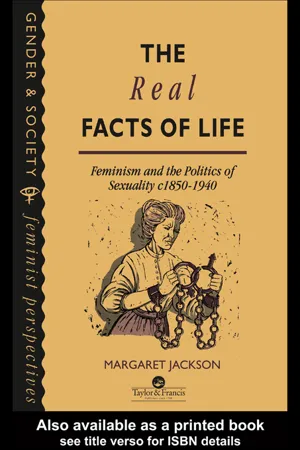
The Real Facts Of Life
Feminism And The Politics Of Sexuality C1850-1940
- 216 pages
- English
- ePUB (mobile friendly)
- Available on iOS & Android
eBook - ePub
About this book
During the last twenty years feminist research into the history of sexuality has made important contributions to the theoretical understanding of the relationship between sexuality and male power. When sexology became established as a science, feminists had for many years been engaged in a struggle to change male sexuality, by waging campaigns against male sexual violence and abuse of women and children; by challenging the institutions of marriage and prostitution; and by asserting in theory and in practice the right to female sexual autonomy. Despite the excellent research published in this important and fascinating aspect of feminist history, there are still gaps in our knowledge.; "The Real Facts of Life" aims to fill these gaps: Why and when did sexuality become an important political issue for the 19th century feminist?; What was the history of campaigns against double standards of sexual morality?; Why were feminists so divided in their views about sexual freedom and its relationship to women's emancipation? The analysis of these issues illuminates past and present feminists' ideas and theories about sexuality. Margaret Jackson's main aims in "The Real Facts of Life" are to make a contribution towards understanding the history of the struggle for female sexual autonomy; to provide a revolutionary feminist analysis of the social construction of sexuality and its relationship to male power, and to provide a critique of sexology and the male-defined concept of sexual "liberation".
Information
Publisher
Taylor & FrancisYear
2005Print ISBN
9780748401000
9780748400997
Edition
1eBook ISBN
9781135749712
Chapter 1
Sex, Class and Hetero-Relations
Feminism and the Politicization of Sexuality in Victorian and Edwardian England
The process of politicizing sexuality is as old as feminism itself, though it has been given varying degrees of emphasis at different times and by different individuals and groups of feminists. In histories of British feminism there has been a tendency to regard the campaigns against the Contagious Diseases Acts in the late nineteenth century as marking the beginning of the process, but the political and intellectual roots of these campaigns go back much further, before the development of an organized Women’s Movement. Issues such as prostitution, spinsterhood, celibacy, the double standard of sexual morality, and critiques of male sexual behaviour have been recurrent themes in feminist writing since at least the seventeenth century. The first British feminist to articulate an analysis of female sexual slavery as an integral part of a general analysis of women’s oppression was Mary Wollstonecraft, and there is a strong continuity between her ideas and those of Victorian and Edwardian feminists. Wollstonecraft’s feminist rationalism, and specifically her insistence that sexual passion could and should be tempered by reason, laid the groundwork for the campaigns around marriage, prostitution and the sexual double standard which began during the second half of the nineteenth century and continued right up to and beyond World War I.
A Vindication of the Rights of Woman, which was first published in 1792, was as far as we know the first theoretical statement of the link between sexuality and women’s oppression. In it Wollstonecraft described marriage as ‘legal prostitution’, arguing that wife and prostitute were both equally oppressed, since both were forced by social and economic necessity to earn their keep by selling their bodies. She also argued that it was male passion, or sensuality, which was responsible for the political subordination of women: ‘All the causes of female weakness, as well as depravity…branch out of one grand cause, want of chastity in man’. She frequently described women as ‘slaves of casual lust’, forced to be ‘slaves to their persons’, sometimes comparing women directly with African slaves. She also made it clear that she saw male behaviour as socially constructed, a product of tyranny rather than nature, just as she saw women’s many faults and weaknesses as a result of oppression. She advocated passionless friendship between husband and wife, after a brief period of passion which she believed would naturally die if not artificially stimulated. She believed that sexual passion, or appetite, could be transformed into love and affection, which alone could lay the foundations for a reasonable and virtuous relationship between the sexes. She did not believe that passion was in itself a bad thing, but that the sexuality of both sexes could be rationally controlled and that women’s emancipation required that men cease to be sensualists. As long as men were sensualists, she thought, women would be their slaves.1
As we shall see it was this feminist rationalism, rather than sexual puritanism or prudery, which underpinned the demands of Victorian and Edwardian feminists for chastity, purity, and an end to the double moral standard. It is important to be clear that there was a crucial distinction between puritanical and feminist demands for chastity. Puritanical demands for chastity were based on the assumption that sexuality is a natural or animal instinct which must be controlled in the interests of the ‘social order’; in other words in the interests of the maintenance of patriarchy, class, and other forms of social inequality. Feminists’ demands for chastity, in contrast, stemmed from the belief that sexuality was socially constructed and that male sexuality was a political weapon used to maintain male power. For feminists, the struggle for equality entailed challenging patriarchal definitions of what was natural in male sexual behaviour and heterosexual relations. To Wollstonecraft, as to later feminists, male sensuality was a means of enslaving women and, far from being natural, a violation of nature’s laws.
The notion that passion should be tempered by reason was also a major theme in the Utopian Socialist movement of the early nineteenth century, particularly within Owenite Socialism, where there is clear evidence of a struggle between feminists and others around marriage and sexuality. Anna Wheeler, for instance, argued that woman’s love had ‘fixed and perpetuated the degradation of her sex’ and that the ‘invigorating influence of a cooperating reason’ needed to be brought to bear in sexual relationships. Most of the men, and some of the women, espoused a libertarian sexual philosophy, underpinned by a male-defined concept of sexuality as a compulsive urge or instinct which must have an outlet. It was only the institution of marriage which they saw as oppressive; sexuality itself, freed from the constraints of marriage, was assumed to be a natural phenomenon, and therefore outside the realm of the political. The feminists within the Owenite movement challenged this male-centred form of sexual radicalism by arguing that only when all other sources of sexual inequality had been eliminated would greater sexual freedom be possible without greater sexual exploitation of women. Despite male protestations about ‘natural laws’ they not only questioned the masculine concept of sexual liberation but dared to critique male sexual behaviour. They pointed out the differences between women’s sexual feelings and needs and those of men, emphasizing the importance of affection and respect as against the ‘animal propensities’ of the men. This suggests that they were beginning to challenge the patriarchal model of sexuality and to redefine sexuality in a more woman-centred way.2
It is clear then that long before the development of an organized Women’s Movement some women (and probably many more than we actually know about) recognized that heterosexual relations were power relations. Although it was not until the late nineteenth century that feminists directly confronted the sexual double standard and the patriarchal model of sexuality, feminists within the early Women’s Movement did not ignore issues of sexuality. The institution of marriage was for them a critical area of debate and struggle and provided a context in which they were able to continue to articulate their concerns about male sexuality, and to explore the relationship between sexuality and male power.
Marriage and the Sexual Economics of Male Power
Feminist ideas about sexuality are inextricably linked to feminist struggles around marriage, which has always been seen as the pivotal institution of male power. As the Women’s Movement gained momentum from the mid nineteenth century onwards, the institution of marriage became a central focus of feminist criticism and challenge. Most historians have viewed the significance of their campaigns primarily in terms of the legal reforms that were achieved, such as the Married Women’s Property Acts. What women gained however needs to be measured not simply in terms of reforms but also in terms of consciousness-raising and theorizing the relationship between marriage, sexuality, and male power. Most feminists viewed marriage as a form of institutionalized female sexual slavery, the legalized equivalent of prostitution. In all the key feminist texts of the period which dealt with the issue, the marriage relation was conceptualized in terms of a power relation: women were forced to earn their living by selling their bodies to men. Although most feminists sought to reform marriage rather than abolish it, the challenge to marriage represented an attack on the sexual-economic basis of male power. Coupled with the campaigns for women’s economic independence, for equal access to education, and for women’s suffrage, it threatened the system of hetero-relations through which male power is constituted.
When an organized women’s movement emerged in the 1850s a protracted campaign for the legal reform of marriage was immediately launched. Barbara Bodichon, the main instigator of the first Married Women’s Property Bill of 1856, simultaneously launched a campaign for women’s economic independence, which incorporated a critique of marriage as an institution. She attacked the assumption that woman was only made for man, and that marriage was her one true vocation, insisting that the practice among men of exchanging women and forcing women into economic dependence on them was prostitution, and was degrading to women: ‘Fathers have no right to cast the burden of the support of their daughters on other men… It lowers the dignity of women; and tends to prostitution, whether legal or on the streets’.3 This first attempt at feminist reform of the institution of marriage was frustrated by the Matrimonial Causes Act of 1857. Although this legislation gave wives very limited rights in respect of their property and earnings, its anti-feminist implications in terms of sexuality and male power were quite profound. It represented in effect the encoding into statute law of the double standard of sexual morality. Under the provisions of the Act a husband could divorce his wife for adultery alone, but a wife needed to have additional grounds such as cruelty or desertion. The fundamental assumption underlying the Act was that marital infidelity on the part of husbands could not in itself constitute grounds for divorce because it was natural and therefore to be expected; in women, however, such behaviour was unnatural and unacceptable and therefore could constitute grounds for divorce. Elizabeth Blackwell commented in 1902 that the Act had a very bad effect in terms of legitimizing the double standard and encouraging the myth that men were physiologically incapable of controlling their sexual impulses: ‘In our own country the unjust condonation of adultery, by law, in 1857, against the strenuous opposition of far-seeing statesmen, has educated more than one generation in a false and degrading idea of physiology’.4
One of the unintended consequences of the Act of 1857 was that the newly-established divorce courts highlighted the issue of wife-battering, stimulating the development of a feminist analysis of the politics of male violence. Frances Power Cobbe, a spinster and member of the Married Women’s Property Committee, publicized cases in which men who brutally assaulted or murdered their wives for trivial acts of ‘disobedience’ or ‘nagging’ received only light sentences or even escaped scot-free; while women who had done no more than defend themselves from their husbands’ brutality received harsh sentences. She argued that violence against women was not the aberrant behaviour of a few isolated males but an extension of a system of laws and practices, encoded by men, which decreed that whatever women had was available to them as of right. She maintained that the relationship between husband and wife was that of master and slave, that marriage was a structure created by men for men, to give them absolute power over women; and that they exercised control in two ways—by purse or stick.5
There was little pressure from feminists for easier divorce. This seems to have been partly for religious reasons, and partly because they were aware that until women were able to be economically independent of men, divorce would almost invariably make them even more vulnerable. The issue of free love was also avoided for similar reasons. During the 1880s and 1890s however there was a revival of the ideology of free love, and some individual feminists were prepared to debate the issue publicly. A few even dared to flout conventional morality and enter into free unions with men because they believed that it would enable them to have greater control over their own lives and bodies. They were careful however to make a clear distinction between the feminist concept of free love, which was based on rejection of the notion of women as the sexual property of their husbands, and the maledefined libertarian concept, which they associated with sexual irresponsibility or ‘excess’. John Stuart Mill, whose writings were, strongly influenced by Harriet Taylor and much quoted by feminists, declared: ‘Among the barbarisms which law and morals have not yet ceased to sanction, the most disgusting surely is, that any human being should be permitted to consider himself as having a right to the person of another’. He considered that wives, being ‘but personal body-servants of a despot’, were in some respects less privileged than the female slave, who in Christian countries had at least in theory the right and the moral obligation to refuse her master ‘the last familiarity’. Not so the wife:
however brutal a tyrant she may be chained to—though she may know that he hates her—though it may be his daily pleasure to torture her, and though she may feel it impossible not to loathe him—he can claim from her and enforce the lowest degradation of a human being, that of being made the instrument of an animal function contrary to her inclinations.
Harriet Taylor and Mill attempted their own private reform of marriage by making a written declaration that Mill disclaimed and repudiated ‘all pretensions to have acquired any rights whatever by virtue of such marriage’, and that Harriet ‘retains in all respects whatever the same absolute freedom of action and disposal of herself and of all that does or may at any time belong to her, as if no such marriage had taken place’.6
Those feminists who chose ‘free love’ as a strategy for overcoming the institutionalized sexual slavery inherent in marriage made it clear that control over their own bodies was paramount and that the concept of ‘conjugal rights’ was the most abhorrent aspect of marriage. Annie Besant, for instance, declared:
A married woman loses control over her own body; it belongs to her owner, not to herself; no force, no violence, on the husband’s part in conjugal relations is regarded as possible by the law; she may be suffering, ill, it matters not; force or constraint is recognised by the law as rape, in all cases save that of marriage; the law ‘holds it to be a felony to force even a concubine or harlot’ …but no rape can be committed by a husband on a wife; the consent given in marriage is held to cover the life…
Elizabeth Wolstenholme also insisted that sexual coercion of the wife by the husband was rape, and that ‘Only with the full recognition of the wife’s continuing right of physical inviolability will the institution be accepted by either party in the near future’. Most leading feminists publicly disapproved of what they regarded as ‘irregular’ lifestyles and the movement as a whole, being concerned to maintain an image of respectability, distanced itself publicly from advocates of ‘free love’. When Elizabeth Wolstenholme became pregnant as a result of her relationship with Ben Elmy she yielded to pressure and married him, though both took the name Wolstenholme Elmy as a gesture against patriarchal marriage. What women said in public, however, was not necessarily the same as what they said in private. Henrietta Muller, for instance, told Maria Sharpe privately that she was against marriage, but at the Men and Women’s Club, of which they were both members, she argued only for legal reform. She believed that only in the future, after women were free, would alternatives to marriage be possible. The name originally proposed for the Club, which was founded in 1885, was the ‘Wollstonecraft Club’, but the women members objected because of the possibly damaging association with Wollstonecraft’s ‘irregular’ lifestyle. They were concerned to avoid being branded ‘free lovers’ and opposed the membership of Eleanor Marx because of her free union with Edward Aveling. Women in the Club expressed their abhorrence at men’s conjugal rights, but ‘they were also resolute that for the present, given women’s vulnerability and disadvantage, reformed legal marriage was infinitely preferable to a non-marital relationship’. They also made it clear that marriage reform required, first and foremost, the reform of the man, especially his sexual behaviour, and that once economically independent, women would refuse marriage, unless men reformed.7
As feminist activism and radicalism became stronger and more visible, so the analysis of the relationship between the institution of marriage and the sexual-economic basis of male power gained in depth and clarity. By the turn of the century a class analysis of women’s position was being articulated, though not in the narrow economic sense in which that term is normally used. Women’s class position in relation to men was seen by many feminists as deriving ultimately from their sex. There were two aspects to this: first, women as a sex were subord...
Table of contents
- Cover
- Half Title
- Title Page
- Copyright
- Dedication
- Acknowledgments
- Contents
- Introduction: Feminism, Sexuality and Male Power: The Political versus the Natural
- Chapter 1: Sex, Class and Hetero-Relations: Feminism and the Politicization of Sexuality in Victorian and Edwardian England
- Chapter 2: ‘The Real Facts of Life’: Militant Feminism and the Double Standard of Sexual Morality
- Chapter 3: Towards a Feminist Model of Sexuality: Elizabeth Blackwell
- Chapter 4: ‘Sex Freedom’ or Female Sexual Autonomy?: Tensions and Divisions within Feminism in the Late Nineteenth and Early Twentieth Centuries
- Chapter 5: Eroticizing Women’s Oppression: Havelock Ellis and the Construction of the ‘Natural’
- Chapter 6: The Unhappy Marriage of Feminism and Sexology: Marie Stopes and the ‘Laws of Love’
- Chapter 7: ‘Teaching What Comes Naturally?’: The Politics of Desire in the Marriage Manuals of the ‘20s and ‘30s
- Conclusion: Feminism and the Power to Define our own Sexuality
- Bibliography
- Index
Trusted by 375,005 students
Access to over 1.5 million titles for a fair monthly price.
Study more efficiently using our study tools.
Frequently asked questions
Yes, you can cancel anytime from the Subscription tab in your account settings on the Perlego website. Your subscription will stay active until the end of your current billing period. Learn how to cancel your subscription
No, books cannot be downloaded as external files, such as PDFs, for use outside of Perlego. However, you can download books within the Perlego app for offline reading on mobile or tablet. Learn how to download books offline
Perlego offers two plans: Essential and Complete
- Essential is ideal for learners and professionals who enjoy exploring a wide range of subjects. Access the Essential Library with 800,000+ trusted titles and best-sellers across business, personal growth, and the humanities. Includes unlimited reading time and Standard Read Aloud voice.
- Complete: Perfect for advanced learners and researchers needing full, unrestricted access. Unlock 1.5M+ books across hundreds of subjects, including academic and specialized titles. The Complete Plan also includes advanced features like Premium Read Aloud and Research Assistant.
We are an online textbook subscription service, where you can get access to an entire online library for less than the price of a single book per month. With over 1.5 million books across 990+ topics, we’ve got you covered! Learn about our mission
Look out for the read-aloud symbol on your next book to see if you can listen to it. The read-aloud tool reads text aloud for you, highlighting the text as it is being read. You can pause it, speed it up and slow it down. Learn more about Read Aloud
Yes! You can use the Perlego app on both iOS and Android devices to read anytime, anywhere — even offline. Perfect for commutes or when you’re on the go.
Please note we cannot support devices running on iOS 13 and Android 7 or earlier. Learn more about using the app
Please note we cannot support devices running on iOS 13 and Android 7 or earlier. Learn more about using the app
Yes, you can access The Real Facts Of Life by Margaret Jackson in PDF and/or ePUB format, as well as other popular books in History & Women in History. We have over 1.5 million books available in our catalogue for you to explore.