This book provides readers with the knowledge in fundamentals of nanoelectronic devices. The authors build the principles of nanoelectronic devices based on those of microelectronic devices wherever possible and introduce the inherently nanoelectronic principles gradually. They briefly review quantum mechanics and solid-state physics that can form
In the late 19th century, scientists started to notice that there were phenomena that could not be explained by the classical theory of mechanics. One of them was the spectrum of absorption and emission by atoms. According to classical mechanics, the spectrum should be continuous, i.e., the emitted or absorbed light could have any frequency (wavelength). The experimental results, however, were surprising. The atoms emitted and absorbed light with discrete values of frequency only.
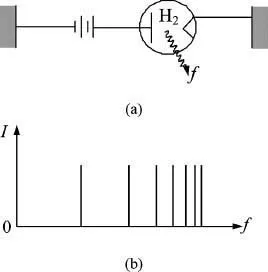
Let us examine the situation in more detail. Figure 1.1(a) shows an experimental setup to measure the emission spectrum of a hydrogen discharge lamp. If we pump out the air in a vacuum tube and fill it with a small amount of hydrogen (H2) gas, an arc discharge can be initiated by supplying sufficient bias voltage to the electrodes in the tube. The electrons in the hydrogen atoms absorb energy from the arc discharge and emit light with various frequencies. One startling feature of this process is that the emitted light has certain discrete frequencies only, as shown in Fig. 1.1(b).
Many people studied this phenomenon and some came up with the following formula for the observed frequencies.
where n1 and n2 are integers (n1 < n2). Depending on the value of n1, the discrete frequencies form distinctive groups, called Lyman (n1 = 1), Balmer (n1 = 2), and Paschen (n1 = 3) series after their early investigators.
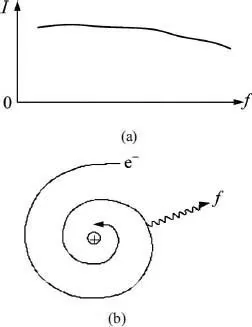
This phenomenon, however, cannot be understood at all in terms of classical mechanics. Maxwell’s theory of electromagnetic radiation predicts that there should be an emission of radiation since the electron is accelerated toward the positively charged nucleus. The electron loses its energy due to the emission of radiation and forms a continuously shrinking orbit. The continuous motion of the electron should generate a continuous emission spectrum as shown in Fig. 1.2(a). There is no way of explaining the discrete spectrum in the frame of classical mechanics. Furthermore, the electron should eventually settle down on the surface of nucleus (Fig. 1.2(b)). This conclusion again contradicts Rutherford’s well-known experiment that showed that there is a vast space between the electron and the nucleus.
Figure 1.2. Classical explanation of the emission spectrum of atoms: (a) emission intensity as a function of frequency, (b) mechanism of photo emission. Since the electron is accelerated toward the positively charged nucleus, it emits electromagnetic radiation and loses energy. The radius of electron orbit should shrink rapidly and the electron will eventually come in contact with the nucleus.
In order to explain the emission spectrum of atoms, Niels Bohr proposed a model for the hydrogen atom, based on the motion of the planetary system. His main hypothesis concerning the electron motion in an atom was the existence of quantized stable orbits. The condition for a stable orbit is that the phase integral of the electron angular momentum, Ρφ, should be an integer multiple of Planck’s constant, h.
In the case of a circular orbit with radius r, mass me, and velocity v, we can easily evaluate the phase integral, using the definition of angular momentum
.
For a circular motion, the Coulomb attraction between the electron and the nucleus should be balanced by the centrifugal force of the electron:
where e is the charge of an electron and ε0 is the permittivity of vacuum. Combining Eqs. (1.3) and (1.4), we can obtain the velocity of the electron.
Thus, the velocity of the electron in a stable orbit is quantized and the corresponding energy is also quantized as
By the time Bohr proposed his model, it was well established that light is emitted as an energy quantum (E = hf) called the photon, and he postulated that a photon is emitted when an electron jumps from one stable orbit (with higher energy En2) to another (with lower energy En1).
Now this equation is the same as Eq. (1.1) and the atomic spectrum is explained finally.
There was one major deficiency in Bohr’s theory, however, since he could not provide any reason why the angular momentum should be quantized....
Table of contents
Cover
Title Page
Copyright Page
Contents
Preface
1 Quantum Mechanics for Nanoelectronic Devices
2 Electron Transport and Device Physics
3 MOS Structure and CMOS Devices
4 Quantum Well Devices
5 Quantum Wire Devices
6 Quantum Dot Devices
7 MOSFET as a Molecular Sensor
Appendix I Physical Constants
Appendix II Dirac Delta Function
Appendix III Gamma Function
Appendix IV Effective Mass Matrix
Appendix V Density-Of-States (DOS) and Conductivity Effective Masses
Index
Color Insert
Trusted by 375,005 students
Access to over 1.5 million titles for a fair monthly price.
Study more efficiently using our study tools.
Frequently asked questions
Yes, you can cancel anytime from the Subscription tab in your account settings on the Perlego website. Your subscription will stay active until the end of your current billing period. Learn how to cancel your subscription
No, books cannot be downloaded as external files, such as PDFs, for use outside of Perlego. However, you can download books within the Perlego app for offline reading on mobile or tablet. Learn how to download books offline
Perlego offers two plans: Essential and Complete
Essential is ideal for learners and professionals who enjoy exploring a wide range of subjects. Access the Essential Library with 800,000+ trusted titles and best-sellers across business, personal growth, and the humanities. Includes unlimited reading time and Standard Read Aloud voice.
Complete: Perfect for advanced learners and researchers needing full, unrestricted access. Unlock 1.5M+ books across hundreds of subjects, including academic and specialized titles. The Complete Plan also includes advanced features like Premium Read Aloud and Research Assistant.
Both plans are available with monthly, semester, or annual billing cycles.
We are an online textbook subscription service, where you can get access to an entire online library for less than the price of a single book per month. With over 1.5 million books across 990+ topics, we’ve got you covered! Learn about our mission
Look out for the read-aloud symbol on your next book to see if you can listen to it. The read-aloud tool reads text aloud for you, highlighting the text as it is being read. You can pause it, speed it up and slow it down. Learn more about Read Aloud
Yes! You can use the Perlego app on both iOS and Android devices to read anytime, anywhere — even offline. Perfect for commutes or when you’re on the go. Please note we cannot support devices running on iOS 13 and Android 7 or earlier. Learn more about using the app
Yes, you can access Nanoelectronic Devices by Byung-Gook Park,Sung Woo Hwang,Young June Park in PDF and/or ePUB format, as well as other popular books in Physical Sciences & Biology. We have over 1.5 million books available in our catalogue for you to explore.