- 208 pages
- English
- ePUB (mobile friendly)
- Available on iOS & Android
eBook - ePub
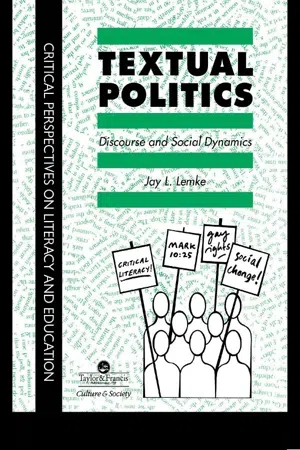
Textual Politics: Discourse And Social Dynamics
About this book
Texts record the meanings we make: in words, pictures and deeds, and politics chronicles our uses of power in shaping social relationships large and small. Textual politics is about meaning - the meaning we make with words and with the symbolic values of every object and action.; The book begins with an introduction which discusses the relationship between Discourse And The Notions Of Power And Ideology. These Concepts Are Then applied to major issues: the social construction of class, gender and individuality; the rhetoric of polarizing social controversies religious fundamentalism vs. gay rights; and the abuse of technical language in policy arguments educational research vs. conservative politics. The book ends with chapters which extend the theory to processes of large- scale social change and apply it to the challenges facing education and political action in the new global information century.
Information
Chapter 1
Textual Politics:
An Introduction
This book is about meaning. It is about the meanings we make with words and with the symbolic values of every object and action. It is also about social relationships, from the temporary or enduring relationships among individuals to the more general and pervasive relationships between men and women, old and young, rich and poor, straight and gay, ‘our kind’ and ‘their kind’. I believe that matters of meaning and matters of social relationship are so interdependent that we must understand both to understand either.
Texts record the meanings we make: in words, pictures and deeds. Politics chronicle our uses of power in shaping social relationships large and small.
When we think of power in the social world, we imagine the power to do things: the power to buy and sell, to command obedience, to reward and punish, to give or take, to do good to others or do them harm, physically or emotionally. In all of these, language can and often does play a critical role. We know that we do not need ‘sticks and stones’ to hurt others; words can cause pain that cuts just as deeply. The language we speak to ourselves decides whom we will help or hurt, and why. The language we speak to others can enlist their aid or provoke their enmity. The language others speak to us, from childhood, shapes the attitudes and beliefs that ground how we use all our powers of action.
The textual, in the broad sense of all the meanings we make, whether in words or by deeds, is deeply political. Our meanings shape and are shaped by our social relationships, both as individuals and as members of social groups. These social relationships bind us into communities, cultures and subcultures. The meanings we make define not only our selves, they also define our communities, our age-groups, our genders, and our era in history. Even more, they define the relationships between communities, age-groups, genders, social classes, cultures, and subcultures—all of which are quintessentially political relationships.
The political, in the broad sense of all the social relationships within and between communities and individuals that are shaped by our powers to help and to hurt, is in turn also profoundly textual. Power itself is both material and symbolic; its force over individuals arises from our vulnerability to pain and our need for the support of others, but its larger social effects are multiplied by our hopes and fears, our beliefs and expectations, our sensitivities and values. The power of actions and events is grounded both in their material effects on us and in their cultural meanings for us.
Most of this chapter is about a single concept which links the textual and the political: the concept of ideology. Ideology is a protean notion. It can mean what we wish it to mean; it can be fit into many theories, many texts, many politics. I want to enrich rather than narrow its meanings for us, to show many different ways in which this concept can help us understand the relations of meaning and power.
The central insight which the concept of ideology tries to sum up is simply this: there are some very common meanings we have learned to make, and take for granted as common sense, but which support the power of one social group to dominate another.
If common sense itself can be politically biased, can we still trust it as a guide? Can we continue to rely on it when we analyze social relationships and how they are shaped by power and meaning? And if we need to be cautious or skeptical even about what we take for granted as common sense, then how can we proceed and where can we safely begin?
Ideology and Us
From roughly the time of Descartes’ Meditations, European intellectual traditions have sought to escape from the radical skepticism that ended the earlier age of religious faith. The principal strategy for this escape has been to find some basis of certainty other than faith in religious revelation: some common or uncommon sense way of proceeding toward understanding, some safe place from which to begin. This strategy produced a new faith in logic and logical inquiry, first in philosophy, then in mathematics, and finally in science. Each claimed to have discovered a trustworthy method of proceeding, a safe initial set of assumptions. These methods claimed to be universal: valid by logical necessity, in all times and all places, for all people and all purposes. They became our modern common sense.
Our modern common sense. But who is this we? Does it include people whose cultural background is non-European? people who have not been fundamentally influenced by the educational system and philosophical perspectives of the upper-middle class? people who are not male, masculine and heterosexual? people who are younger than the age at which this common sense starts to make sense? or older than the age at which it ceases to?
Whose strategy for life produced this common sense? Whose needs did the strategy address? Whose problems did it aim to solve? What did it replace? How did it displace the common sense that came before it? Did it become common sense for all of us, or only for some communities and categories of persons?
The modern European quest for a universally valid method of inquiry was a particular historical response to a particular historical need by a very small fraction of the population. One of the circumstances that shaped this enterprise was the need to best a specific political opponent: the theological worldview of a universalizing religion. It would not have made sense to the people of seventeenth and eighteenth-century Europe to construct purely local principles of truth, nor would the intellectual ideas that supported the rise of the new middle class have made much headway against those of the secular and clerical aristocracy if they had not also claimed universal validity.
The makers of our modern intellectual common sense were Europeans. They were mainly upper-middle class. They were mostly middle-aged (for their times). They were nearly all males. They shared common intellectual problems, they belonged to social groups and communities that shared common political problems, and they would hardly have seen the one as being very much separate from the other. They transformed the distinction between body and soul into one between body and mind. They transformed the universal truth of revelation into the universal truth of science. They transformed the superiority of the Christian religion over all others into the superiority of European culture over all others. They created and rationalized the radically unequal relations of labor and capital, the working class and the owning class. They preserved and found new rationalizations for the unequal relations between men and women, and between adults and children.
Their common sense, our common sense, was in large measure the product of their needs, their times, their point of view. This common sense has evolved from their day to ours, it has been elaborated into many more sophisticated and scientific forms, and all along the way it has been produced from the point of view of one particular segment of humanity. It is the product of a particular subgroup, a particular subculture. It is their product because they alone had, until very recently, the power to produce philosophy, science, logic, government, industry, education. Their common sense, our common sense, is part of their subculture. Their claim for its universal validity is also part of their subculture.
What about our cultures and subcultures? Will not whatever I write also be a product of my position in the system of social relationships that have shaped my attitudes and values, my beliefs and interests? Will not your responses to what I write also depend in part on your position in the social system? Yes, indeed they will—or so it seems to me from where I stand.
It also seems to me however, and, as we will see, to many other more or less postmodern writers on the subject, that this interdependence of the meanings we make and the social and political positions we occupy is a useful thing for humanity (and perhaps even for interests that transcend the merely human). We have become aware of this interdependence mainly because the relative power of non-European cultural traditions, of women, the elderly and the very young, gays and lesbians, subordinated social classes, and all the Other cultures, subcultures and communities in our world has increased significantly in the last few decades. Their growing power enables them to challenge more effectively the universal pretensions of modern European assumptions about logic, truth, science, mind, individuality, culture, gender, age, education, politics, literacy etc. Their challenges open up the intellectual space in which all of us can entertain a greater diversity of possible ways of making sense of life.
Perhaps this postmodern critique of the fundamental assumptions of a dominant subculture, our ruling ideology, will help us to redress further the imbalance of power between different cultures and different social groups in our world: between West and East, North and South, between men and women, younger and older, straighter and gayer, richer and poorer etc. Some even hope it can help us re-envision the relations between human interests and the larger interests of the ecosystems of which we are integral parts.
Ideology and Me
I am writing from a particular social position, making meanings that are shaped by the kinds of life experiences people in my position tend to have. Whatever I write is written from a viewpoint within the culture and subcultures to which I belong. I do not, no one can, write from an objective God’s-eye view. No one sees the world as it is. We see the worlds our communities teach us how to see, and the worlds we make, always a bit uniquely, within and sometimes just a bit beyond what we’ve been taught.
It is not customary for authors to present themselves candidly as writing from a limited viewpoint, or to say in very specific terms where they are socially and culturally positioned. The authority of an author is reduced in the eyes of many readers if he or she ‘intrudes’ personally into what our modern common sense says should strive to be an impersonal, objective account of the ways things are, the way they would be seen by anybody. I do not believe, however, that the matters I am writing about could be seen the same way by everybody.
The traditional assumption is that only one view can be the right view, and so I should argue vehemently against all the others, to show that I must be right and they must be wrong, but I only believe that some views are more useful to some people for some purposes. I will try to show what I think my views are useful for, to whom, and why. I will also occasionally try to show what others’ views are useful for, and sometimes I will conclude that these uses are not good for many of us, some of them perhaps not good for any of us.
For example, I do not believe that intellectual dialogue should be conducted as an adversarial process. I believe that the adversarial approach reinforces the notion that only one view can be the right one. Such a notion is most useful to those who wish to impose their views on others. I do not believe that imposing your views on others is a good thing to do in the interests of the community as a whole. I also believe that the adversarial approach reinforces a traditional view of the masculinity of the writer as a fighter who can best his opponent. This in turn serves to exclude many women, and men who find this view of masculinity distasteful, from influence in academic and intellectual communities. It reserves the power positions in these communities for aggressive males. This view of masculinity was perhaps once useful for the survival of earlier communities, but such atavistic views are now long overdue for critique and transformation (see Chapter 5).
Perhaps if I were more centrally a member of the power-wielding groups in our society, I would not be as critical of the common sense of their traditions. I would not resent the symbolic and material pressures to accept their point of view about gender, logic, science, truth and social relationships as natural, correct and inevitable.
So, where do I stand? From what standpoint do I observe, analyze and desire? I am in early middle-age, but my sympathies are mainly with those either younger or much older. I have always thought that most of the serious harm done in the world is done by those in later middle-age. My immediate family was of the American middle-middle class, which to the rest of the world is really the topmost fraction of the working class, white-collar office workers. Both my parents worked. My extended family included a fair number of genuinely upper-middle class small-business proprietors and one millionaire entrepreneur. Two of my grandparents were Central European immigrants, two were American-born of first-generation European immigrant parents. Their cultures were German, Danish, and East European Jewish. My family was an uncommon mix of Jews and Christians, none particularly religious. My personal religious beliefs are abstract and idiosyncratic, partly the product of what some might call firsthand spiritual experiences.
I was raised to be male and heterosexual and only became conscious of gender as an issue when I began a long relationship with a newly liberated woman in the 1970s. Feminist claims of oppression and arguments for equality seemed to me entirely justifiable, and I never felt threatened by them, but then I had never strongly identified with traditional masculinity. My viewpoint on gender issues has also been shaped by relationships with men. My personal experience of sexual orientation has never been as simple as being attracted only to men or only to women. I have never looked at the world solely from a straight or solely from a gay point of view. The identity I construct for myself remains that of a mostly masculinized male with a strong dislike for the excesses of traditional masculinity and for the limitations of exclusive categories of gender and sexuality.
These are the dimensions of social difference that matter to most of the people I know or read: age, social class, ethnic and religious background, national culture, gender and sexual orientation. In most of these respects, I fit the profile of our society’s dominant caste closely enough to have been able to gain a fair understanding of how it sees itself. I was a scholarship student at a prestigious private university and acquired a good, Eurocentric liberal education and a doctorate in theoretical physics. I am a tenured full professor in a large urban university, and marginally upper-middle class. I have some small measure of power and respect in a few specialist academic communities.
I do not read the social world from dead center, however; my viewpoint is displaced from that of the sorts of people I would consider the true powerbrokers. They would probably consider me somewhat alienated or just slightly perverse in my views. On the other hand, I cannot see the world at all from the viewpoint of women, of truly working class people, of today’s youngest or oldest Americans, or of any other culture, particularly a non-European one. I can only interpret what people who do see the world from these viewpoints tell me about how it looks to them, and try to find my own relationship to their realities.
Language, Discourse and Meaning
When we talk to one another, face-to-face or through various technological media from print to teleconferencing, we are engaged in discourse. Discourse is another protean concept. It can be used to mean something as specific as spoken language, or something as general as the social process of communication. It can refer to a general phenomenon, the fact that we communicate with language and other symbolic systems, or to particular kinds of things we say (e.g. the discourse of love, or the discourse of political science).
When I speak about discourse in general, I will usually mean the social activity of making meanings with language and other symbolic systems in some particular kind of situation or setting. I will also have in mind the participants in the discourse, whether they speak and write or only listen and read, and whether they are considered actually present in or only potentially relevant to the situation. As a writer, I address many sorts of potential readers, including other writers I have read. As a ‘thinker’, various viewpoints within me address other viewpoints that I may or may not identify with or even agree with, but that are also in a way parts of ‘me’. In this sense all discourse, indeed all meaning-making, can be seen as social and communicative, whether or not it is addressed to a specific audience, and whether or not whomever it is addressed to is physically present, or even exists.
I will also speak about particular kinds of discourses, however, which are produced as the result of certain social habits that we have as a community. There are particular subjects some of us are in the habit of talking about in particular ways, often as part of particular sorts of social activity. Think of all the discourses we have as a community about, say, sexuality. There are biological, medical and psychoanalytic ways of talking about sexuality; there are religious, literary and pornographic discourses of sexuality; and there are the many discourses of sexuality between sexual partners as they engage in all the various kinds of sexual activity human ingenuity can construct, with all the diverse viewpoints about preferences and attitudes that exist in our community.
On each occasion when the particular meanings characteristic of these discourses are being made, a specific text is produced. Discourses, as social actions more or less governed by social habits, produce texts that will in some ways be alike in their meanings. They may be alike in the content of what they say about topics and subjects. They may be alike in their values, attitudes and stances toward their subjects and audiences. The...
Table of contents
- Cover Page
- Title Page
- Copyright Page
- Series Editor’s Introduction
- Chapter 1: Textual Politics
- Chapter 2: Discourse and Social Theory
- Chapter 3: Discourses in Conflict
- Chapter 4: Technical Discourse and Technocratic Ideology
- Chapter 5: The Social Construction of the Material Subject
- Chapter 6: Discourse, Dynamics and Social Change
- Chapter 7: Critical Praxis
- Retrospective Postscript
- References
Trusted by 375,005 students
Access to over 1.5 million titles for a fair monthly price.
Study more efficiently using our study tools.
Frequently asked questions
Yes, you can cancel anytime from the Subscription tab in your account settings on the Perlego website. Your subscription will stay active until the end of your current billing period. Learn how to cancel your subscription
No, books cannot be downloaded as external files, such as PDFs, for use outside of Perlego. However, you can download books within the Perlego app for offline reading on mobile or tablet. Learn how to download books offline
Perlego offers two plans: Essential and Complete
- Essential is ideal for learners and professionals who enjoy exploring a wide range of subjects. Access the Essential Library with 800,000+ trusted titles and best-sellers across business, personal growth, and the humanities. Includes unlimited reading time and Standard Read Aloud voice.
- Complete: Perfect for advanced learners and researchers needing full, unrestricted access. Unlock 1.5M+ books across hundreds of subjects, including academic and specialized titles. The Complete Plan also includes advanced features like Premium Read Aloud and Research Assistant.
We are an online textbook subscription service, where you can get access to an entire online library for less than the price of a single book per month. With over 1.5 million books across 990+ topics, we’ve got you covered! Learn about our mission
Look out for the read-aloud symbol on your next book to see if you can listen to it. The read-aloud tool reads text aloud for you, highlighting the text as it is being read. You can pause it, speed it up and slow it down. Learn more about Read Aloud
Yes! You can use the Perlego app on both iOS and Android devices to read anytime, anywhere — even offline. Perfect for commutes or when you’re on the go.
Please note we cannot support devices running on iOS 13 and Android 7 or earlier. Learn more about using the app
Please note we cannot support devices running on iOS 13 and Android 7 or earlier. Learn more about using the app
Yes, you can access Textual Politics: Discourse And Social Dynamics by Jay L. Lemke in PDF and/or ePUB format, as well as other popular books in Education & Education General. We have over 1.5 million books available in our catalogue for you to explore.