Animation doesn't come with instructions; Rowland B. Wilson demanded guidelines. Trade Secrets offers a never before published peek into the personal journals of Rowland B. Wilson (1930-2005), a legend in the world of Cartooning, Advertising, Illustration and Animation. Trade Secrets is a compendium of tips, tricks, philosophies and techniques garnered over a lifetime of professional animation and artistry. Study one-on-one with a mentor whose Walt Disney film credits include The Little Mermaid, Tarzan, Atlantis and Treasure Planet. These writings represent the quintessential refresher for fine artists and animation professionals, and are vital tutorials for students who are now poised to be part of another new generation in the art form. Have a seat and let an amiable, respected mentor reveal his keys to success. Develop your professional creative toolset with a focus on foundational animation techniques. Inspiration in your pocket; Trade Secrets includes a digital pocket guide, filled with charts and diagrams as well as helpful tools and tips.
eBook - ePub
Rowland B. Wilson’s Trade Secrets
Notes on Cartooning and Animation
- 320 pages
- English
- ePUB (mobile friendly)
- Available on iOS & Android
eBook - ePub
Rowland B. Wilson’s Trade Secrets
Notes on Cartooning and Animation
About this book
Information

1
THE ACT
Reproduced by Special Permission of Playboy magazine.
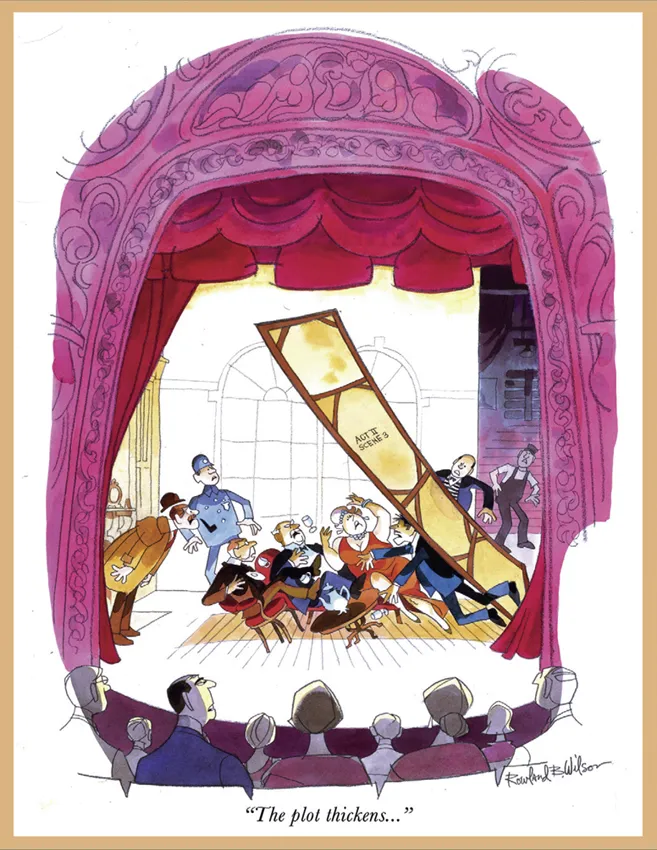
Copyright © 1968 by Playboy.
Story: A cause and effect (plot!) series of linked events told (exposition: everything is exposition!) in an uncertain or unpredictable way (suspense, forward motion, foreshadowing, dramatic irony, surprise) intended to involve the audience (empathy, subjectivity!) with the characters to the end (forward motion!) and make a satisfying statement (and statements along the way: the author’s viewpoint can’t be wholly explored in one end-theme) on life. The thematic statement X leads to Y.
Told how? With words expressed by characters and pictures that show the situations: what, where, when, and how (—and why!—).
Story
It’s all about “Story”! This is the heart and the nucleus of the work from which the visualization springs. Whether it is a script, a book, opera, cartoon, game, commercial or illustration—this is your springboard. The act is the basic unit of the story or script and often you will find more than one act. The artist’s job is to translate from written word to the pictorial.
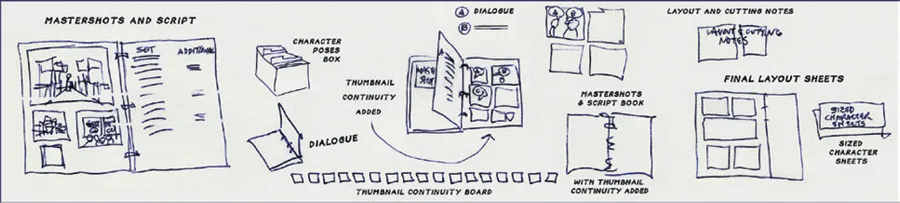
The script is the “written half” and answers the “what,” “why,” “how” and “who.” It contains the plot, exposition or sequence of events, suspense, forward motion, foreshadowing, dramatic irony, surprise and characters. There is usually an overall theme and short themes. The “picture half” is continuity and comprises a number of elements. Character design is akin to actors and acting—who are they and how do they embody the story? Locale illustrates the “where” of the action and often creates and enhances the dramatic mood. Action can be comic, dramatic, entertaining or adventure. Plot themes are the “And then…” of the story, moving along to the next scene.
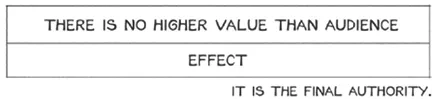
An additional consideration is the audience point of view. It is important for manipulation of subjective effects, suspense, and empathy in characters and events.
Storytelling: The Point of View
Where To Put Time Camera?
We the audience have to be somewhere in order to see and hear the story.
Sometimes we can hear but not see or see but not hear… for some story reason.

Amateur storytelling puts the camera (audience) in some silly or cute place that draws attention to itself or conversely always puts the audience in the same place regardless.
When you position the audience to look at a scene, imagine you are there. How would you be there? In what capacity?
Would you look down omnipotently?
Look up like a mouse?
Would you be in close like a participant?
Would you be hiding like a voyeur?
Would you be a passerby?
Are you sitting or standing?
Or flying?
Are you short or tall?
Are you one of the characters?
If so, what would you notice?
Why do the good directors put the audience where they do? Always consider if there could be more effective camera/audience work.
The Aspects of Pictorial Storytelling
Subject Matter
1. Genre: The type of story: Romantic Comedy, Drama, Western, Science Fiction, etc.
2. Characters: The performers.
3. Plot: Such as competition for the desired object.
4. Theme: For example: Metaphor, Power, Personal Aggrandizement, Pride, Love.
5. Style: Farce, Operatic, Slapstick and others. (Farce is said to be derived from the word for stuffing… can it be styled in the sense of “stuffed” or “over-overstuffed”?)
Chain of Event
1. Linked together actions written out.
2. Dialogue written into script.
3. Visuals: Main themes of each section indicated as thumbnails establishing atmosphere, look, style.
4. Pacing: Variations and development.
Story Rendition
(Actions, dialogue and visuals woven together by continuities with focal points.)
1. Focal points and themes determined by examination.
2. The Unfolding: Shots and continuities chosen for theme and focus from the diagrams.
Story Themes
(Story themes run from the largest to the intermediate down to the specific.)
1. Overall: The “Grand Scheme.” What is the over-riding concept, philosophy and totality? (Described in a few words or single sentence.)
2. General: Comedy, Suspense, and Action.
3. Specific:
A. Attitudinal such as vindictive, superiority complexes, bluster, greed.
B. Atmospheric: the mystic sea, outer space.
C. Contradictions, such as false love and true love; flawed people in action.
4. Character: Display of personality.
5. Plot: Goals.
Story Focal Points
1. Revelations.
2. Turning Points.
3. Emotional acts and effects.
Story Focus
1. Story Focus means: “The point is this.”
2. Story Focus changes as you go through the story. It can be long or short. (Pages or a panel.)
3. Story Focus can be cross cut:
A. For contrast: Dramatic irony or comic effect.
B. For suspense: Converging with danger; converging with relief.
4. Story Focus can be examined. It should answer the questions:
A. What is happening?
B. What is the most important aspect of what is happening?
C. What is the most satisfying way to show the most important aspect?
i. Is it more satisfying to show the story focus ...
Table of contents
- Cover
- Halftitle
- Title
- Copyright
- Contents
- Foreword
- Introduction: The Flow Charts
- 1. The Act
- 2. The Scene
- 3. Caricature
- 4. Composition
- 5. Shape, Line and Tone
- 6. Color
- 7. Rendition
- 8. The Process
- 9. Studio Posters and Charts
- 10. Miscellaneous Notes
- 11. Gallery
- Index
- Acknowledgments
Trusted by 375,005 students
Access to over 1.5 million titles for a fair monthly price.
Study more efficiently using our study tools.
Frequently asked questions
Yes, you can cancel anytime from the Subscription tab in your account settings on the Perlego website. Your subscription will stay active until the end of your current billing period. Learn how to cancel your subscription
No, books cannot be downloaded as external files, such as PDFs, for use outside of Perlego. However, you can download books within the Perlego app for offline reading on mobile or tablet. Learn how to download books offline
Perlego offers two plans: Essential and Complete
- Essential is ideal for learners and professionals who enjoy exploring a wide range of subjects. Access the Essential Library with 800,000+ trusted titles and best-sellers across business, personal growth, and the humanities. Includes unlimited reading time and Standard Read Aloud voice.
- Complete: Perfect for advanced learners and researchers needing full, unrestricted access. Unlock 1.5M+ books across hundreds of subjects, including academic and specialized titles. The Complete Plan also includes advanced features like Premium Read Aloud and Research Assistant.
We are an online textbook subscription service, where you can get access to an entire online library for less than the price of a single book per month. With over 1.5 million books across 990+ topics, we’ve got you covered! Learn about our mission
Look out for the read-aloud symbol on your next book to see if you can listen to it. The read-aloud tool reads text aloud for you, highlighting the text as it is being read. You can pause it, speed it up and slow it down. Learn more about Read Aloud
Yes! You can use the Perlego app on both iOS and Android devices to read anytime, anywhere — even offline. Perfect for commutes or when you’re on the go.
Please note we cannot support devices running on iOS 13 and Android 7 or earlier. Learn more about using the app
Please note we cannot support devices running on iOS 13 and Android 7 or earlier. Learn more about using the app
Yes, you can access Rowland B. Wilson’s Trade Secrets by Rowland Wilson,Rowland B. Wilson,Suzanne Lemieux Wilson, Suzanne Lemieux Wilson in PDF and/or ePUB format, as well as other popular books in Computer Science & Digital Media. We have over 1.5 million books available in our catalogue for you to explore.