Chapter 1
Introduction
This book is the result of a three-year longitudinal study of children’s spelling. The project was sponsored by the Mercers’ Company in the City of London and carried out by Olivia O’Sullivan and Anne Thomas of the Centre for Language in Primary Education.
The project involved working with three London primary schools:
- Berger Primary School, Hackney
The school has 14 classes, ages 5–11 (two-form entry), and a Nursery
- Gallions Mount Primary School, Greenwich
The school has 14 classes, ages 5–11 (two-form entry), and a Nursery.
- St Luke’s Church of England Primary School, Lambeth
The school has 7 classes, ages 5–11 (one-form entry).
All of the schools were interested in developing their understanding of children’s spelling development and in promoting effective teaching and learning strategies in the classroom.
There were two main strands to the project:
- an investigation into the teaching and learning of spelling from Reception to Year 6
- case studies of a small number of children in Years 4, 5 and 6 who read competently but were experiencing difficulties with spelling.
The context of the inquiry
Much research in the area of children’s spelling has tended to focus on children as individuals in isolation from their progress as readers and writers in the classroom and school context, or it has focused primarily on children with difficulties – especially pupils of secondary age who have difficulties in spelling and/or reading. Our inquiry aimed to examine the cognitive aspects of children’s development in spelling, and to do so in the living contexts of their many different classrooms, when they were working with teachers and alongside peers. We were also aware of the very important role played by their families.
Over the three years schools were visited twice per term for the first two years and once per term in year three. Additionally, staff meetings or inservice training days were held at least once per term in order to discuss current issues in spelling and the work of the project. Regular discussions were held with headteachers, English co-ordinators, and in one school the Special Needs co-ordinator, to review and plan the work of the project.
Research methods
Case studies
Thirty-one case study children were identified initially, from across the primary age range. In the second year, twelve of these children were selected for closer study while we continued to collect writing samples from all of the original 31 children. We talked with the main case study children about their writing and spelling development on each visit.
Writing samples
Approximately 2–3 writing samples (from a range of writing contexts) were collected each term from each case study child. Some of these were selected by teachers, but increasingly they were selected by the project team as we focused on particular features of children’s development.
CLPE Spelling Assessment Framework
We analysed children’s development using a diagnostic grid drawn from the work of Peters and Smith (1993). The CLPE Spelling Assessment Framework that we developed was a tool for analysing children’s spelling development and their patterns of learning. The framework was invaluable, both as a framework for looking at development and as an inservice training tool for teachers. The framework is discussed both in Chapter 4, which discusses the case studies and in Chapter 6, ‘Monitoring spelling’.
Reading samples
Throughout the project we discussed children’s reading interests with them and their teachers. Reading samples were carried out with the principal case study children and these were tape recorded in the third year of the project.
Teacher interviews
Teacher interviews were carried out at the beginning of the project as part of developing an overview of their thinking about spelling and teaching approaches. A smaller group of teachers was interviewed in greater depth in the third year of the project.
Classroom observations
Regular classroom observations were carried out of teachers teaching, children learning and provision for spelling (e.g. the resources in the classroom and their use).
Questionnaire
A questionnaire, based on some draft guidelines for teaching spelling, was developed to help teachers reflect on their practice.
Staff meetings and inservice training
Staff meetings and inservice training were an important part of the project. We met with whole school staffs to discuss ideas about spelling development and teaching approaches, to present findings and to share key aspects of the project such as the CLPE Spelling Assessment Framework.
The case study data
In order to track children’s spelling development over the three years of the project, 31 children were initially chosen as case studies, ten from two schools and eleven from the third. Over the three years a number of children from the case study group left the schools. If they were from the core group, they were replaced by a child from the broader group.
The case studies served a number of purposes in the project:
- to observe and collect evidence on the spelling development of a range of children between 5 and 11 years old on a longitudinal basis;
- to observe and collect evidence on individual children between 7 and 11 years old who were competent readers but who were experiencing difficulties with the spelling system; also included in this group were a few children experiencing both spelling and reading difficulties;
- to highlight any key issues in teaching and learning which arose in the course of the project.
The case study children came from a variety of socio-economic, cultural and linguistic backgrounds. Girls and boys were evenly represented in both case study groups.
Our research not only allowed us to consider the cognitive dimensions of spelling development in the primary age range but also raised our awareness of the range of experiences – both outside and within the school – which contributed to children’s spelling knowledge.
Approximately one quarter of the original group of case study children were either from homes where English was not the dominant language, or from homes where languages additional to English were spoken; other children were English-speaking children, of whom eight were from African or Caribbean backgrounds. Many children attended community or religious schools, often for substantial periods. Quite often, in these settings, children encountered different models of literacy learning, such as in learning to read and write the Qu’ran. Because of its religious importance, this kind of teaching precludes experimentation and is based on learning the text by heart.
Although the spelling development of bilingual children was not a central focus of our project, we felt it important that this issue formed part of our discussion.During the project some of the bilingual case study children moved on. The remaining bilingual children were those for whom English was the dominant rather than an additional language.
Table 1.1 The case study children by gender, and by ethnicity and languages spoken at home
Data analysis
From the second year of the project the analysis of the case study data began. This involved analysis of all the pieces of writing collected from each main case study child over the year, using an analysis framework. Using the framework (see fig. 1.1), analysis was carried out under the following headings:
- Date of writing/child’s age
- Kind of writing
- Observations: general
- Main strategies
- Developing competences
- Teacher strategies
This data provided information about the overall development of children’s writing, and included information about spelling, handwriting and punctuation. The CLPE Spelling Assessment Framework (see Chapter 6) was used to analyse in detail children’s developing spelling strategies. Further analysis of features of some children’s writing, such as word length, was also carried out. For a full discussion of six case studies, see Chapter 5.
Effective teaching
As a result of our analysis of the case study data we arrived at conclusions about the most effective teaching approaches being used in the project schools. Conclusions and recommended teaching approaches based on these conclusions are in Chapter 6.
Figure 1.1 Example of case study analysis
Chapter 2
Learning and teaching spelling
How do children learn to spell and how can teachers work most effectively to support their progress in spelling? The CLPE/Mercers Spelling Project focused on these two main questions. The evidence which most influenced our understanding of these questions came from observations of the case study children and interviews with them over a period of three years. The following brief snapshots of two children’s development over that time highlight some of the main issues which arose from the case studies.
Shareen – a ‘correct’ speller
At the age of five Shareen wrote carefully, spelling each word in standard form.
Year 1, Term 1, 5 years 10 months
On Saturday I went to the school fair and on my way home I saw my mummy
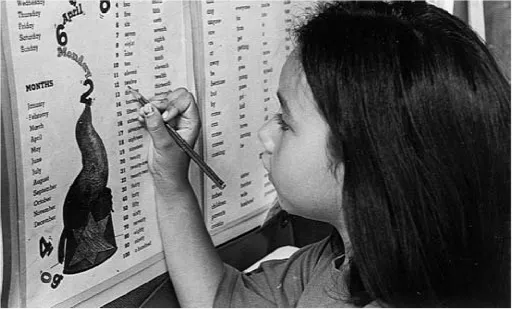
At this stage Shareen was very reluctant to write unless she could make sure of the standard spelling of each word, either by asking adults or by referring to her personal word book. The presentation of her work – accurate spelling and very neat, well-controlled handwriting – reflected this sense of purpose, of the importance of getting things right. This unwillingness to take risks limited her writing. There was no possibility of assessing her spelling development as she relied totally on copying correct spellings.
Year 2, Term 1, 6 years 9 months
On Satday I went to the senmar. With my mum and my friend as wll and It was fany as wll. But it was good.
This piece of writing from the first term of Year 2 contained the very first signs of Shareen taking risks with spellings: e.g. Satday (Saturday), senmar (cinema), fany (funny) and wll (well). In fact these misspellings represented a minor breakthrough as far as Shareen’s approach to learning spelling was concerned: she was now confident enough to draw upon her knowledge of the spelling system in order to hypothesise how some words might be spelt.
Year 2, Term 1, 6 years 11 months
One evng Juese and his disipolls was salln in a boat. . The boat began to roc baka and foth and the desaplls was rardu (worried). They acst Juese dut (don’t) you cer (care). (Extract)
This sample, also from the first term of Year 2, represents a more extended piece of writing: a story about Jesus and his disciples. Shareen had obviously enjoyed the story and in her retelling her focus was very definitely on composition rather than transcription. On this occasion she was less concerned with total accuracy in spelling – she was writing a first draft – whereas previously at whatever stage of writing, she would have relied almost entirely on using known words or on copying. Although at a first glance it may seem that in this piece Shareen’s ability to spell had deteriorated from her work in Year 1, this extract shows that her knowledge of the system was increasing. She was now engaging more actively in learning to spell and in thinking about unknown spellings.
The next example, from the third term of Year 2, shows Shareen drawing on her phonological knowledge of the links between sounds and letters as a way of encoding unfamiliar words. This was the approach that she began to adopt more frequently when she was not able to use known spellings.
Year 2, Term 3, 7 years 4 months
On Saturday my dad was going to cut the grass … I asct (asked) can I help you dad yes but don’t cut my best cholips (tulips) … we staed (started) to cut the grass … I codet (couldn’t) cip (keep) a proms (promise) I cut the heds (heads) off … my dad was furis (furious) … I was very upset apte (about) it. (Extracts)
Shareen’s preferred strategy as a speller over three years remained that of building up a substantial vocabulary of known spellings. On the one hand this strategy supported her writing development – through increasing her confidence – but on the other hand it may also have curbed her progress to some extent. Although she became somewhat more prepared to take risks (and therefore make errors) in her spelling, she was still inclined to limit much...