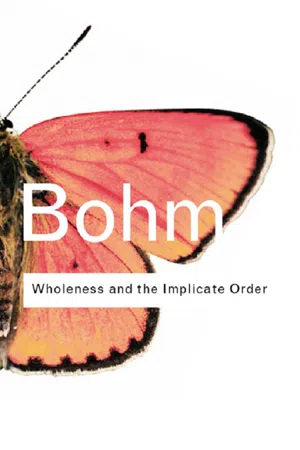
- 304 pages
- English
- ePUB (mobile friendly)
- Available on iOS & Android
eBook - ePub
Wholeness and the Implicate Order
About this book
David Bohm was one of the foremost scientific thinkers and philosophers of our time. Although deeply influenced by Einstein, he was also, more unusually for a scientist, inspired by mysticism. Indeed, in the 1970s and 1980s he made contact with both J. Krishnamurti and the Dalai Lama whose teachings helped shape his work. In both science and philosophy, Bohm's main concern was with understanding the nature of reality in general and of consciousness in particular. In this classic work he develops a theory of quantum physics which treats the totality of existence as an unbroken whole. Writing clearly and without technical jargon, he makes complex ideas accessible to anyone interested in the nature of reality.
Information
1
FRAGMENTATION AND WHOLENESS
The title of this chapter is ‘Fragmentation and wholeness’. It is especially important to consider this question today, for fragmentation is now very widespread, not only throughout society, but also in each individual; and this is leading to a kind of general confusion of the mind, which creates an endless series of problems and interferes with our clarity of perception so seriously as to prevent us from being able to solve most of them.
Thus art, science, technology, and human work in general, are divided up into specialities, each considered to be separate in essence from the others. Becoming dissatisfied with this state of affairs, men have set up further interdisciplinary subjects, which were intended to unite these specialities, but these new subjects have ultimately served mainly to add further separate fragments. Then, society as a whole has developed in such a way that it is broken up into separate nations and different religious, political, economic, racial groups, etc. Man’s natural environment has correspondingly been seen as an aggregate of separately existent parts, to be exploited by different groups of people. Similarly, each individual human being has been fragmented into a large number of separate and conflicting compartments, according to his different desires, aims, ambitions, loyalties, psychological characteristics, etc., to such an extent that it is generally accepted that some degree of neurosis is inevitable, while many individuals going beyond the ‘normal’ limits of fragmentation are classified as paranoid, schizoid, psychotic, etc.
The notion that all these fragments are separately existent is evidently an illusion, and this illusion cannot do other than lead to endless conflict and confusion. Indeed, the attempt to live according to the notion that the fragments are really separate is, in essence, what has led to the growing series of extremely urgent crises that is confronting us today. Thus, as is now well known, this way of life has brought about pollution, destruction of the balance of nature, over-population, world-wide economic and political disorder, and the creation of an overall environment that is neither physically nor mentally healthy for most of the people who have to live in it. Individually there has developed a widespread feeling of helplessness and despair, in the face of what seems to be an overwhelming mass of disparate social forces, going beyond the control and even the comprehension of the human beings who are caught up in it.
Indeed, to some extent, it has always been both necessary and proper for man, in his thinking, to divide things up, and to separate them, so as to reduce his problems to manageable proportions; for evidently, if in our practical technical work we tried to deal with the whole of reality all at once, we would be swamped. So, in certain ways, the creation of special subjects of study and the division of labour was an important step forward. Even earlier, man’s first realization that he was not identical with nature was also a crucial step, because it made possible a kind of autonomy in his thinking, which allowed him to go beyond the immediately given limits of nature, first in his imagination and ultimately in his practical work.
Nevertheless, this sort of ability of man to separate himself from his environment and to divide and apportion things ultimately led to a wide range of negative and destructive results, because man lost awareness of what he was doing and thus extended the process of division beyond the limits within which it works properly. In essence, the process of division is a way of thinking about things that is convenient and useful mainly in the domain of practical, technical and functional activities (e.g., to divide up an area of land into different fields where various crops are to be grown). However, when this mode of thought is applied more broadly to man’s notion of himself and the whole world in which he lives (i.e. to his self-world view), then man ceases to regard the resulting divisions as merely useful or convenient and begins to see and experience himself and his world as actually constituted of separately existent fragments. Being guided by a fragmentary self-world view, man then acts in such a way as to try to break himself and the world up, so that all seems to correspond to his way of thinking. Man thus obtains an apparent proof of the correctness of his fragmentary self-world view though, of course, he overlooks the fact that it is he himself, acting according to his mode of thought, who has brought about the fragmentation that now seems to have an autonomous existence, independent of his will and of his desire.
Men have been aware from time immemorial of this state of apparently autonomously existent fragmentation and have often projected myths of a yet earlier ‘golden age’, before the split between man and nature and between man and man had yet taken place. Indeed, man has always been seeking wholeness – mental, physical, social, individual.
It is instructive to consider that the word ‘health’ in English is based on an Anglo-Saxon word ‘hale’ meaning ‘whole’: that is, to be healthy is to be whole, which is, I think, roughly the equivalent of the Hebrew ‘shalem’. Likewise, the English ‘holy’ is based on the same root as ‘whole’. All of this indicates that man has sensed always that wholeness or integrity is an absolute necessity to make life worth living. Yet, over the ages, he has generally lived in fragmentation.
Surely, the question of why all this has come about requires careful attention and serious consideration.
In this chapter, attention will be focused on the subtle but crucial role of our general forms of thinking in sustaining fragmentation and in defeating our deepest urges toward wholeness or integrity. In order to give the discussion a concrete content we shall to some extent talk in terms of current scientific research, which is a field that is relatively familiar to me (though, of course, the overall significance of the questions under discussion will also be kept in mind).
What will be emphasized, first of all in scientific research and later in a more general context, is that fragmentation is continually being brought about by the almost universal habit of taking the content of our thought for ‘a description of the world as it is’. Or we could say that, in this habit, our thought is regarded as in direct correspondence with objective reality. Since our thought is pervaded with differences and distinctions, it follows that such a habit leads us to look on these as real divisions, so that the world is then seen and experienced as actually broken up into fragments.
The relationship between thought and reality that this thought is about is in fact far more complex than that of a mere correspondence. Thus, in scientific research, a great deal of our thinking is in terms of theories. The word ‘theory’ derives from the Greek ‘theoria’, which has the same root as ‘theatre’, in a word meaning ‘to view’ or ‘to make a spectacle’. Thus, it might be said that a theory is primarily a form of insight, i.e. a way of looking at the world, and not a form of knowledge of how the world is.
In ancient times, for example, men had the theory that celestial matter was fundamentally different from earthly matter and that it was natural for earthly objects to fall while it was natural for celestial objects, such as the moon, to remain up in the sky. With the coming of the modern era, however, scientists began to develop the viewpoint that there was no essential difference between earthly matter and celestial matter. This implied, of course, that heavenly objects, such as the moon, ought to fall, but for a long time men did not notice this implication. In a sudden flash of insight Newton then saw that as the apple falls so does the moon, and so indeed do all objects. Thus, he was led to the theory of universal gravitation, in which all objects were seen as falling toward various centres (e.g. the earth, the sun, the planets, etc.). This constituted a new way of looking at the heavens, in which the movements of the planets were no longer seen through the ancient notion of an essential difference between heavenly and earthly matter. Rather, one considered these movements in terms of rates of fall of all matter, heavenly and earthly, toward various centres, and when something was seen not to be accounted for in this way, one looked for and often discovered new and as yet unseen planets toward which celestial objects were falling (thus demonstrating the relevance of this way of looking).
The Newtonian form of insight worked very well for several centuries but ultimately (like the ancient Greek insights that came before) it led to unclear results when extended into new domains. In these new domains, new forms of insight were developed (the theory of relativity and the quantum theory). These gave a radically different picture of the world from that of Newton (though the latter was, of course, found to be still valid in a limited domain). If we supposed that theories gave true knowledge, corresponding to ‘reality as it is’, then we would have to conclude that Newtonian theory was true until around 1900, after which it suddenly became false, while relativity and quantum theory suddenly became the truth. Such an absurd conclusion does not arise, however, if we say that all theories are insights, which are neither true nor false but, rather, clear in certain domains, and unclear when extended beyond these domains. This means, however, that we do not equate theories with hypotheses. As the Greek root of the word indicates, a hypothesis is a supposition, that is, an idea that is ‘put under’ our reasoning, as a provisional base, which is to be tested experimentally for its truth or falsity. As is now well known, however, there can be no conclusive experimental proof of the truth or falsity of a general hypothesis which aims to cover the whole of reality. Rather, one finds (e.g., as in the case of the Ptolemaic epicycles or of the failure of Newtonian concepts just before the advent of relativity and quantum theory) that older theories become more and more unclear when one tries to use them to obtain insight into new domains. Careful attention to how this happens is then generally the main clue toward new theories that constitute further new forms of insight.
So, instead of supposing that older theories are falsified at a certain point in time, we merely say that man is continually developing new forms of insight, which are clear up to a point and then tend to become unclear. In this activity, there is evidently no reason to suppose that there is or will be a final form of insight (corresponding to absolute truth) or even a steady series of approximations to this. Rather, in the nature of the case, one may expect the unending development of new forms of insight (which will, however, assimilate certain key features of the older forms as simplifications, in the way that relativity theory does with Newtonian theory). As pointed out earlier, however, this means that our theories are to be regarded primarily as ways of looking at the world as a whole (i.e. world views) rather than as ‘absolutely true knowledge of how things are’ (or as a steady approach toward the latter).
When we look at the world through our theoretical insights, the factual knowledge that we obtain will evidently be shaped and formed by our theories. For example, in ancient times the fact about the motions of the planets was described in terms of the Ptolemaic idea of epicycles (circles superimposed on circles). In Newton’s time, this fact was described in terms of precisely determined planetary orbits, analysed through rates of fall toward various centres. Later came the fact as seen relativistically according to Einstein’s concepts of space and time. Still later, a very different sort of fact was specified in terms of the quantum theory (which gives in general only a statistical fact). In biology, the fact is now described in terms of the theory of evolution, but in earlier times it was expressed in terms of fixed species of living beings.
More generally, then, given perception and action, our theoretical insights provide the main source of organization of our factual knowledge. Indeed, our overall experience is shaped in this way. As seems to have been first pointed out by Kant, all experience is organized according to the categories of our thought, i.e., on our ways of thinking about space, time, matter, substance, causality, contingency, necessity, universality, particularity, etc. It can be said that these categories are general forms of insight or ways of looking at everything, so that in a certain sense, they are a kind of theory (but, of course, this level of theory must have developed very early in man’s evolution).
Clarity of perception and thought evidently requires that we be generally aware of how our experience is shaped by the insight (clear or confused) provided by the theories that are implicit or explicit in our general ways of thinking. To this end, it is useful to emphasize that experience and knowledge are one process, rather than to think that our knowledge is about some sort of separate experience. We can refer to this one process as experience-knowledge (the hyphen indicating that these are two inseparable aspects of one whole movement).
Now, if we are not aware that our theories are ever-changing forms of insight, giving shape and form to experience in general, our vision will be limited. One could put it like this: experience with nature is very much like experience with human beings. If one approaches another man with a fixed ‘theory’ about him as an ‘enemy’ against whom one must defend oneself, he will respond similarly, and thus one’s ‘theory’ will apparently be confirmed by experience. Similarly, nature will respond in accordance with the theory with which it is approached. Thus, in ancient times, men thought plagues were inevitable, and this thought helped make them behave in such a way as to propagate the conditions responsible for their spread. With modern scientific forms of insights man’s behaviour is such that he ceases the insanitary modes of life responsible for spreading plagues and thus they are no longer inevitable.
What prevents theoretical insights from going beyond existing limitations and changing to meet new facts is just the belief that theories give true knowledge of reality (which implies, of course, that they need never change). Although our modern way of thinking has, of course, changed a great deal relative to the ancient one, the two have had one key feature in common: i.e. they are both generally ‘blinkered’ by the notion that theories give true knowledge about ‘reality as it is’. Thus, both are led to confuse the forms and shapes induced in our perceptions by theoretical insight with a reality independent of our thought and our way of looking. This confusion is of crucial significance, since it leads us to approach nature, society, and the individual in terms of more or less fixed and limited forms of thought, and thus, apparently, to keep on confirming the limitations of these forms of thought in experience.
This sort of unending confirmation of limitations in our modes of thinking is particularly significant with regard to fragmentation, for as pointed out earlier, every form of theoretical insight introduces its own essential differences and distinctions (e.g., in ancient times an essential distinction was between heavenly and earthly matter, while in Newtonian theory it was essential to distinguish the centres toward which all matter was falling). If we regard these differences and distinctions as ways of looking, as guides to perception, this does not imply that they denote separately existent substances or entities.
On the other hand, if we regard our theories as ‘direct descriptions of reality as it is’, then we will inevitably treat these differences and distinctions as divisions, implying separate existence of the various elementary terms appearing in the theory. We will thus be led to the illusion that the world is actually constituted of separate fragments and, as has already been indicated, this will cause us to act in such a way that we do in fact produce the very fragmentation implied in our attitude to the theory.
It is important to give some emphasis to this point. For example, some might say: ‘Fragmentation of cities, religions, political systems, conflict in the form of wars, general violence, fratricide, etc., are the reality. Wholeness is only an ideal, toward which we should perhaps strive.’ But this is not what is being said here. Rather, what should be said is that wholeness is what is real, and that fragmentation is the response of this whole to man’s action, guided by illusory perception, which is shaped by fragmentary thought. In other words, it is just because reality is whole that man, with his fragmentary approach, will inevitably be answered with a correspondingly fragmentary response. So what is needed is for man to give attention to his habit of fragmentary thought, to be aware of it, and thus bring it to an end. Man’s approach to reality may then be whole, and so the response will be whole.
For this to happen, however, it is crucial that man be aware of the activity of his thought as such; i.e. as a form of insight, a way of looking, rather than as a ‘true copy of reality as it is’.
It is clear that we may have any number of different kinds of insights. What is called for is not an integration of thought, or a kind of imposed unity, for any such imposed point of view would itself be merely another fragment. Rather, all our different ways of thinking are to be considered as different ways of looking at the one reality, each with some domain in which it is clear and adequate. One may indeed compare a theory to a particular view of some object. Each view gives only an appearance of the object in some aspect. The whole object is not perceived in any one view but, rather, it is grasped only implicitly as that single reality which is shown in all these views. When we deeply understand that our theories also work in this way, then we will not fall into the habit of seeing reality and acting toward it as if it were constituted of separately existent fragments corresponding to how it appears in our thought and in our imagination when we take our theories to be ‘direct descriptions of reality as it is’.
Beyond a general awareness of the role of theories as indicated above, what is needed is to give special attention to those theories that contribute to the expression of our overall self-world views. For, to a considerable extent, it is in these world views that our general notions of the nature of reality and of the relationship between our thought and reality are implicity or explicitly formed. In this respect, the general theories of physics play an important part, because they are regarded as dealing with the universal nature of the matter out of which all is constituted, and the space and time in terms of which all material movement is described.
Consider, for example, the atomic theory, which was first proposed by Democritus more than 2,000 years ago. In essence, this theory leads us to look at the world as constituted of atoms, moving in the void. The ever-changing forms and characteristics of large-scale objects are now seen as the results of changing arrangements of the moving atoms. Evidently, this view was, in certain ways, an important mode of realization of wholeness, for it enabled men to understand the enormous variety of the whole world in terms of the movements of one single set of basic constituents, through a single void that permeates the whole of existence. Nevertheless,...
Table of contents
- Cover
- Title
- Copyright
- Contents
- Acknowledgments
- Introduction
- 1. Fragmentation and Wholeness
- 2. The Rheomode – An Experiment with Language and Thought
- 3. Reality and Knowledge Considered as Process
- 4. Hidden Variables in the Quantum Theory
- 5. Quantum Theory as an Indication of a New Order in Physics: Part A: The Development of New Orders as Shown Through the History of Physics
- 6. Quantum Theory as an Indication of a New Order in Physics: Part B: Implicate and Explicate Order in Physical Law
- 7. The Enfolding-Unfolding Universe and Consciousness
- Notes
- Index
Trusted by 375,005 students
Access to over 1.5 million titles for a fair monthly price.
Study more efficiently using our study tools.
Frequently asked questions
Yes, you can cancel anytime from the Subscription tab in your account settings on the Perlego website. Your subscription will stay active until the end of your current billing period. Learn how to cancel your subscription
No, books cannot be downloaded as external files, such as PDFs, for use outside of Perlego. However, you can download books within the Perlego app for offline reading on mobile or tablet. Learn how to download books offline
Perlego offers two plans: Essential and Complete
- Essential is ideal for learners and professionals who enjoy exploring a wide range of subjects. Access the Essential Library with 800,000+ trusted titles and best-sellers across business, personal growth, and the humanities. Includes unlimited reading time and Standard Read Aloud voice.
- Complete: Perfect for advanced learners and researchers needing full, unrestricted access. Unlock 1.5M+ books across hundreds of subjects, including academic and specialized titles. The Complete Plan also includes advanced features like Premium Read Aloud and Research Assistant.
We are an online textbook subscription service, where you can get access to an entire online library for less than the price of a single book per month. With over 1.5 million books across 990+ topics, we’ve got you covered! Learn about our mission
Look out for the read-aloud symbol on your next book to see if you can listen to it. The read-aloud tool reads text aloud for you, highlighting the text as it is being read. You can pause it, speed it up and slow it down. Learn more about Read Aloud
Yes! You can use the Perlego app on both iOS and Android devices to read anytime, anywhere — even offline. Perfect for commutes or when you’re on the go.
Please note we cannot support devices running on iOS 13 and Android 7 or earlier. Learn more about using the app
Please note we cannot support devices running on iOS 13 and Android 7 or earlier. Learn more about using the app
Yes, you can access Wholeness and the Implicate Order by David Bohm in PDF and/or ePUB format, as well as other popular books in Physical Sciences & Mind & Body in Philosophy. We have over 1.5 million books available in our catalogue for you to explore.