- 328 pages
- English
- ePUB (mobile friendly)
- Available on iOS & Android
eBook - ePub
Practical Project Management for Building and Construction
About this book
Practical Project Management for Building and Construction covers the 14 knowledge areas of project management that are essential for successful projects in the construction industry. For each knowledge area, it explains the processes for scope, time, risk, cost, and resource management. Filled with work and process flow diagrams, it demonstrates h
Information
1

Introduction

To pursue projects takes more than willpower and a great deal of ambition. You also need knowledge and the right information at the right moment.
The construction industry has been doing projects since Pharaoh Zozer’s time, about 3000 BC. Imotep is, as far as I know, the first documented project manager. He was also an architect and the builder of the first pyramid, a stepped pyramid. With thousands of years of accumulated knowledge, you must wonder if we builders really have anything new to learn.
In the mid-1900s space flights, technologically advanced weapons systems, and the computer industry began to run large and complex projects. New tools and techniques to succeed in complex projects were developed, primarily by NASA, the US military, and the IT industry.
Clients began to require some form of knowledge for project managers of complex projects. Needs and requirements for certification of project managers began to emerge. It is as obvious that a project manager should have a basic knowledge of how to run a $3 million project as it is that someone driving a motorcycle have a driving license.
Project management is a profession that requires specific knowledge and skills. Local certification has existed for some time, but has not been widely practiced. Today, there are two major international certification agencies that certify project managers: the Project Management Institute (PMI) and the International Project Management Association (IPMA).
At the end of the 1960s, the PMI compiled tools and processes so that it would be easier to manage various projects. The information was gathered in the PMBOK’s® “A Guide to the Project Management Body of Knowledge.” This publication, which has been revised several times, is the knowledge base for PMI certification. PMI has certified project management professionals (PMPs) since the certification started in 1984. This certification is limited over time and the PMP must demonstrate that he or she has continued to work with projects in order to retain certification. In 2012, PMI had more than half a million members and credential holders in more than 185 countries.
Another organization that certifies project managers is IPMA. Its certification is done at four different levels, depending on skills and experience. This certification is also time limited. By the end of 2010, there were more than 130,000 IPMA-certified professionals worldwide.
The old dominant team leader with his boots and his helmet, instead of cowboy hat, was very much a John Wayne type. When he saw a problem, he made a swift arc, made a decision, and shot the problem dead. If this in turn created new problems, he shot them down as well. Too often, this resulted in delays, cost, and quality problems.
The new generation of project members with their computer knowledge and easy access to a wealth of information will not accept work in this way. Although there is continuous development of a large number of computer programs as project aids, knowledge of project management tools is often missing. This means that the tools are not used optimally. The new IT tools have allowed employees to become fantastic equilibrists at the keyboard; however, without knowledge of building materials, building physics, design, and management, they are easy prey for marketers of new materials. We must therefore have risk analysis and quality control to help us design and build the right things.
This book describes the processes and knowledge areas that are necessary in order to run successful projects. It also includes basic information about various tools and techniques such as work breakdown structure, earned value, and how to use a network diagram with its gaps and critical paths.
The examples in Chapter 6, “Knowledge Areas,” are from industrial construction projects. The knowledge areas, however, are the same for any type of project. The material can therefore easily be applied to other construction projects.
The processes, tools, and methods presented in this book are general and should be used by clients, project managers, team leaders, and designers in their control of work. Large parts of the book describe general project management. The book can also be used by project managers outside the building and construction industry.
Remember to suit the planning work to the size and complexity of the project. If you know WHAT to do, HOW to do it, WHEN to do it, and WHO should do it, you are in control of your project. Then execute with your brain, heart, and guts.
Hans Ottosson
2
General Information on Projects in the Building, Construction, and Installation Industries
In the building and construction industry, there are many stakeholders: real estate developers, architects, engineers, contractors, subcontractors, etc. There are also many established types of organizations, contracts, and remuneration. Building/construction is often a local business, which means that names, procedures, etc., have developed differently in different countries and areas. This chapter tries to sort out many of the expressions and procedures and give them names to be used in this book; they may vary from those with which the reader is familiar.

2.1 PROJECT ROLES
When I talk about project managers, subproject managers, contractors, consultants, customers, and clients, I have attempted to facilitate the understanding of the text by using the following terms (organizational charts are shown in Figures 2.1–2.3):
• The owner is the client organization.
• Users and end-users are those who use the product (e.g., tenants, researchers, drivers, train companies, travelers, athletes, and spectators).
• The project owner is the person in the client organization who has received the board’s mandate to implement an investment. The person is sometimes called the “sponsor,” “project sponsor,” or “authorizing sponsor.” This can be the president, the plant manager, or another person designated to implement the project. Sometimes the project owner is replaced with a program governance board.
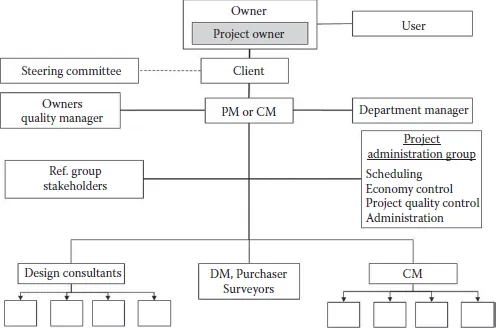
FIGURE 2.1
Project owner organization (project roles; see Section 2.1).
Project owner organization (project roles; see Section 2.1).
• The client or customer is the owner or ordering organization’s representative who orders work and services. This may be the plant manager or another person designated to implement the project.
• The project manager (PM) is the client’s project manager. Sometimes, the project owner, client, and the project manager—or the client and project manager—are the same person.
• The task leaders (TLs) are the architect’s and consultant’s project managers (one of the project manager’s subproject leaders) for the project.
• The site manager (SM) is the client’s representative on the building site, a subproject leader to the PM. In many areas, he or she is called a team leader, but I have chosen SM so that this will not be confused with the design task leader.
• The contracts manager (CM) is the main contractor’s project manager (one of the project manager’s subproject leaders) for the project. In many areas, he or she is called a team leader but I have chosen the CM so that this will not be confused with the design task leader or the SM.
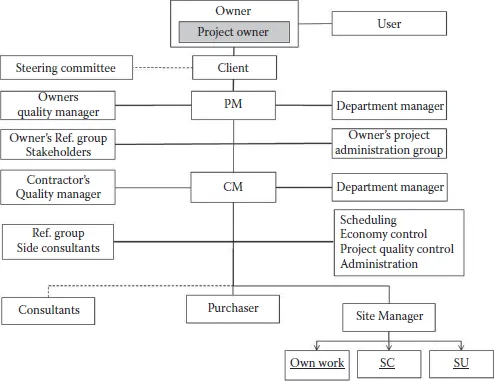
FIGURE 2.2
Main contractor’s organization. Note that the project manager is the contractor’s customer. The dotted line to the consultants is valid for FuP/DC contracts (SC = subcontractor and SU = supplier).
Main contractor’s organization. Note that the project manager is the contractor’s customer. The dotted line to the consultants is valid for FuP/DC contracts (SC = subcontractor and SU = supplier).
• The installations managers (IMs) are the installation contractors’ project managers (the project manager’s subproject managers and/or the main contractor’s submanagers).
• The designs manager (DM) is the subproject leader responsible for all the design work. Responsibility for the technical solutions is usually left with the respective design consultant. In smaller projects, the PM often has the role of DM.
• Project members are those working on the project. Members can be the client, users, project planners, contractors, installers, and suppliers.
• The steering committee is a management team assembled to support the project owner and project manager in all matters regarding the project. The project owner is often the president of this committee.
• The reference group is an advisory group of interested parties and experts and often represents future users of the project result.
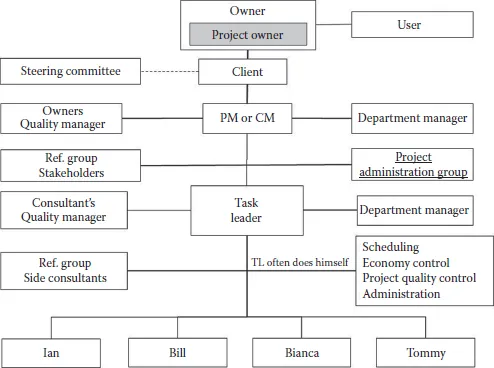
FIGURE 2.3
The task leader’s organization. Project roles: the purchaser of the design is either the project manager (design–bid–build contracts) or the contracts manager (at FuP/DC contracting). (See Section 2.5.2.) Types of contract: often, the task leader (TL) is doing many of the project administration tasks in the design office.
The task leader’s organization. Project roles: the purchaser of the design is either the project manager (design–bid–build contracts) or the contracts manager (at FuP/DC contracting). (See Section 2.5.2.) Types of contract: often, the task leader (TL) is doing many of the project administration tasks in the design office.
2.2 STAKEHOLDERS AND ORGANIZATIONS
Project stakeholders. Everyone involved in a project is called a project stakeholder. In the building/construction industry, there are
• Property owners
• Developers, owners, project owners
• Steering committee members
• Clients or customers
• Users and end-users
• Operations and maintenance staff
• Project members:
• Project managers, schedulers, calculators, design managers, purchasers, construction managers, inspectors, surveyors
• Planners; architects; structural, electrical, and HVAC engineers; electricians; land developers; etc.
• Contractors, builders, installers
• Suppliers, carriers
• Consultants in various specialized areas
• People in areas such as finance, purchasing, and production departments
• Authorities involved in the procurement of a third-party interest
• The public affected by the project
• Project members’ families
• Trade unions, employer organizations, and trade organizations
Although all stakeholders are affected in one way or another in our projects, all stakeholders are not equally important. The most important group (core stakeholders) will vary from project to project but usually include:
• Owner/project owner
• Client or customer users of the product
• Project manager, main contractor, installation managers, and task leaders
• Project members (including consultant’s and contractor’s employees)
• Steering committee members
• Authorities
Traditionally, the client focus is very strong. Occasionally, a PM even forgets the end-users (customers’ customers) when working on a project. Therefore, when houses are built, it is necessary to focus on the entire product user chain, from the global to the local.
Other key stakeholders are
• Partners (client partners, the consortium)
• Secondary suppliers to the project (e.g., subcontractor’s suppliers’ suppliers)
• The public
Among the secondary stakeholders are
• Competitors to clients, designers, contractors, suppliers, etc.
• Associations (e.g., political, trade, and advocacy organizations)
• Competing projects
• Media (information; ...
Table of contents
- Cover
- Title Page
- Copyright
- Contents
- The Author
- Chapter 1 Introduction
- Chapter 2 General Information on Projects in the Building, Construction, and Installation Industries
- Chapter 3 Projects
- Chapter 4 Generic Main Processes
- Chapter 5 Project Phases
- Chapter 6 Knowledge Areas
- Common Acronyms
- Appendices
- Index
Trusted by 375,005 students
Access to over 1.5 million titles for a fair monthly price.
Study more efficiently using our study tools.
Frequently asked questions
Yes, you can cancel anytime from the Subscription tab in your account settings on the Perlego website. Your subscription will stay active until the end of your current billing period. Learn how to cancel your subscription
No, books cannot be downloaded as external files, such as PDFs, for use outside of Perlego. However, you can download books within the Perlego app for offline reading on mobile or tablet. Learn how to download books offline
Perlego offers two plans: Essential and Complete
- Essential is ideal for learners and professionals who enjoy exploring a wide range of subjects. Access the Essential Library with 800,000+ trusted titles and best-sellers across business, personal growth, and the humanities. Includes unlimited reading time and Standard Read Aloud voice.
- Complete: Perfect for advanced learners and researchers needing full, unrestricted access. Unlock 1.5M+ books across hundreds of subjects, including academic and specialized titles. The Complete Plan also includes advanced features like Premium Read Aloud and Research Assistant.
We are an online textbook subscription service, where you can get access to an entire online library for less than the price of a single book per month. With over 1.5 million books across 990+ topics, we’ve got you covered! Learn about our mission
Look out for the read-aloud symbol on your next book to see if you can listen to it. The read-aloud tool reads text aloud for you, highlighting the text as it is being read. You can pause it, speed it up and slow it down. Learn more about Read Aloud
Yes! You can use the Perlego app on both iOS and Android devices to read anytime, anywhere — even offline. Perfect for commutes or when you’re on the go.
Please note we cannot support devices running on iOS 13 and Android 7 or earlier. Learn more about using the app
Please note we cannot support devices running on iOS 13 and Android 7 or earlier. Learn more about using the app
Yes, you can access Practical Project Management for Building and Construction by Hans Ottosson in PDF and/or ePUB format, as well as other popular books in Negocios y empresa & Operaciones. We have over 1.5 million books available in our catalogue for you to explore.