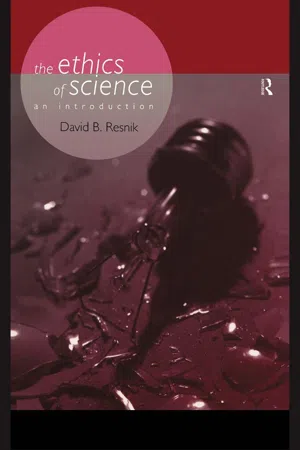
Ethics of Science is a comprehensive and student-friendly introduction to the study of ethics in science and scientific research. The book covers:
* Science and Ethics
* Ethical Theory and Applications
* Science as a Profession
* Standards of Ethical Conduct in Science
* Objectivity in Research
* Ethical Issues in the Laboratory
* The Scientist in Society
* Toward a More Ethical Science
* Actual case studies include: Baltimore Affair * cold fusion * Milikan's oil drop experiments * human and animal cloning * Cold War experiments * Strategic Defence Initiative * the Challenger accident * Tobacco Research.
- 232 pages
- English
- ePUB (mobile friendly)
- Available on iOS & Android
eBook - ePub
About this book
Information
CHAPTER 1
Science and Ethics
During the past decade, scientists, laypeople, and politicians have become increasingly aware of the importance of ethics in scientific research. Several trends have contributed to these growing concerns. First, the press has covered stories on ethical issues raised by science, such as the United States (US) government’s secret experiments on human beings during the Cold War, genetic engineering, the Human Genome Project, studies on the genetic basis of intelligence, the cloning of human embryos and animals, and global warming. Second, scientists and government officials have investigated, documented, and adjudicated cases of ethical misconduct and ethically questionable conduct in many aspects of research, and a perceived lack of ethics in science has threatened the stability and integrity of research (PSRCR 1992, Hilts 1996, Hedges 1997). These cases include allegations of plagiarism, fraud, violations of the law, mismanagement of funds, exploitation of subordinates, violations of recombinant DNA regulations, discrimination, conflicts of interests, and problems with the FBI’s crime lab. Despite a growing body of evidence on unethical research, the data still indicate that the frequency of misconduct in science is quite low when compared to the frequency of misconduct in other professions, such as business, medicine, or law (PSRCR 1992).1
A third reason why ethics has become a pressing concern is that science’s increasing interdependence with business and industry has generated ethical conflicts between scientific values and business values (PSRCR 1992, Reiser 1993). These conflicts have raised concerns about the funding of science, peer review, scientific openness, the ownership of knowledge, and the sharing of resources. Universities have expressed concerns about scientists who use their facilities to conduct secret research for private industry or personal economic gain (Bowie 1994). In some cases, universities have fought lengthy court battles with businesses and individuals over patents and intellectual property rights. University administrators also complain that scientists who work for business are spending less time on their other duties, such as education. Scientists in various fields worry that the relationship between science and business will redirect research toward the solution of applied problems and that basic research will suffer. Government watchdogs have objected to allowing companies to profit from publicly funded research (Lomasky 1987).
In response to concerns about ethical improprieties and issues in science, various scientific institutions and societies, such as the National Science Foundation (NSF), the National Institutes of Health (NIH), the American Association for the Advancement of Science (AAAS), the National Academy of Sciences (NAS), and Sigma Xi have commissioned committees to study ethical issues and improprieties in science and make policy recommendations (Sigma Xi 1986, 1993, AAAS 1991, PSRCR 1992, Committee on the Conduct of Science 1994). Additionally, universities, businesses, and scientific societies have sponsored workshops and conferences that address ethical issues in science, scientists have initiated efforts to integrate ethics into the science curriculum at the graduate and undergraduate level of instruction, scholars from various sciences and the humanities have written books and articles about the ethics in research, and new journals have been started that address ethical issues in science (Reiser 1993, Bird and Spier 1995, Garte 1995). Finally, scientific societies and organizations have adopted codes of ethics and have recommended that scientists integrate ethics into the science curriculum (Sigma Xi 1986, US Congress 1990, PSCRC 1992).
Despite this new awareness about the importance of ethics in science, some scientists do not take ethical improprieties very seriously because they regard misconduct as very rare and insignificant and view confirmed reports of misconduct as isolated incidents or anomalies. Some scientists invoke the “psychological pathology” theory to explain misconduct: scientists who behave unethically must be mentally deranged because only a crazy person would think that they could get away with fraud, plagiarism, and other forms of misconduct (Broad and Wade 1993). Crime does not pay in science, because the scientific method, the peer review system, and the public nature of scientific research serve as mechanisms for catching people who break science’s ethical rules. Thus, misconduct is not a problem in science because it does not occur often, and when it does, it does not reflect any significant flaws in the research environment.
Many scientists believe that no significant ethical issues arise in science because they view science as “objective.” Science studies facts, employs objective methods, and produces knowledge and consensus. Ethics, on the other hand, involves the study of values, employs subjective methods, and produces only opinion and disagreement. Hence, scientists need not concern themselves with ethical issues in conducting research or in teaching science. As members of society, scientists will of course need to confront ethical issues. But as members of the scientific community, scientists do not need to address these issues. Scientists need to follow ethical standards, of course, but these rules are clear cut. Scientists do not need to engage in a philosophical/ethical discussion in order to know that they should not fabricate or falsify data. Thus, science provides an objective sanctuary from the ethical issues and ambiguities that beleaguer other spheres of human existence.
Even those scientists who take ethical improprieties and issues seriously may believe that scientists do not need to have any formal instruction in ethics. Some people hold that scientists need no formal instruction in ethics because they believe that people learn ethics when they are very young. There is little, if anything that a person can learn about ethics and morality by the time she enters college. If a person is already ethical when she enters the scientific profession, she will continue to be ethical; if she is not ethical when she enters science, then no amount of instruction can make her become ethical. Even those scientists who think that some kind of ethical learning can take place in science may still believe that there is no need to teach ethics because students learn ethics by example, practice, and osmosis. Since ethical knowledge in science is informal and tacit, scientists do not need to spend valuable class time going over ethical standards and concepts. Scientists can teach ethics by showing students how to do good science and by modeling ethical conduct in science.
All of these views I have just discussed erect barriers to the serious study of the ethics of science, and they are all deeply misguided. As more research surfaces concerning the nature of science and scientific misconduct, it is becoming increasingly clear that the science’s research environment plays a role in contributing to misconduct and in generating ethical issues (PSRCR 1992, LaFollette 1992, Grinnell 1992, Shrader-Frechette 1994, Macrina 1995, Woodward and Goodstein 1996). If science’s research environment contributes to misconduct, then reports of misconduct reflect some structural problems in the research environment and cannot be treated as isolated incidents of pathological behavior.
Several aspects of the research environment may contribute to ethical improprieties and issues. First, science is, for most scientists, a career. A successful career in science is achieved through publications, grants, research appointments, tenure, and awards. Most scientists who have academic appointments face the pressure to “publish or perish” before they earn tenure or get promoted. Nearly all tenure and promotion committees assess a scientist’s research efforts based largely on the quantity of his or her publications—the more the better. Even scientists who have earned tenure need to continue publishing at a high rate in order to gain a promotion or add to their prestige. Thus, some scientists may be tempted to violate ethical principles in order to advance their careers.
Second, government funding for research is tighter than ever, due to smaller budgets and more scientists seeking funding. In order to receive funding and to continue receiving it, scientists must produce results. If an experiment is not going well or the results have been ambiguous, scientists may gloss over these problems in applying for grants or in reporting results. Third, research in many sciences carries economic rewards. A person who patents a new process, technique, or invention can earn thousands or even millions of dollars. Thus, economic incentives may also contribute to unethical practices in science. Fourth, science’s highly touted self-correcting mechanisms—peer review, publication, and replication—often do not succeed in detecting fraud or error. Referees who review proposals or papers do not have time to thoroughly examine them for errors or fraud, many papers that are published are never read, and most experiments are not repeated (Broad and Wade 1993, Kiang 1995, Armstrong 1997).
Finally, it may also be the case that science education contributes to unethical behavior. As I noted earlier, many scientists believe that they do not need to make a serious attempt to teach research ethics. If students do not learn how to be ethical scientists, then it should come as no surprise that many of them behave unethically when they pursue careers in science. Moreover, educational practices and academic pressures can conspire to encourage misconduct (Petersdorf 1986, Sergestrale 1990, Browning 1995). Many laboratory exercises reward students for getting the right results, regardless of how they get them. Since students often know the results they are supposed to get, they may be tempted to fudge, fabricate, or trim data in order to get those results. Most students are under pressure to get good grades and they may cheat in order to get them. This is especially true among premedical students, who must get very high grades in order to be admitted to medical school.
Thus, ethical improprieties in science cannot be viewed as an anomaly since they probably result from factors operating within the research and learning environment. Although it is difficult to estimate the incidence of scientific misconduct, any misconduct should be taken seriously (PSRCR 1992). Even if misconduct is still very rare in science, the fact that it occurs at all is cause for concern since any misconduct damages science’s public image and erodes public support for science.
Ethical issues and controversies can arise in science because science is a cooperative activity that takes place within a larger social and political context (Longino 1990). Scientists cannot escape from the ethical quandaries and issues that arise in other walks of life. Purely objective science is a myth perpetuated by those who would flee from fuzzy, controversial, and vexing questions. Ethical dilemmas and issues can also arise in science because scientists often do not agree on the standards of conduct that should govern science or how standards should be interpreted or applied (Whitbeck 1995a). For instance, publication practices are an area of ethical dispute in science because they often involve disputes about how to allocate credit and responsibility (Rose and Fisher 1995). Ethical issues also arise as a result of science’s interaction with the public because scientific research often has important social, moral, and political consequences (Committee on the Conduct of Science 1994).
There are several reasons why science students need some kind of formal instruction in ethics. First, although a great deal of ethical learning takes place in childhood, evidence from developmental psychology indicates that people continue to learn about ethics and moral reasoning throughout life (Rest 1986). College age students and older adults can learn to recognize ethical issues, make moral choices in novel situations, and reason about ethics and morality. They can also learn ethical concepts, theories, and principles, they can appreciate different points of view, and they can even develop moral virtues. Moreover, some ethical concepts and principles can only be learned by understanding and practicing an occupation or profession. For example, the doctrine of “informed consent” in medical research requires some special ethics education beyond what one would learn in kindergarten or grade school. In order to learn about informed consent in research, one must begin to understand and practice medical research. Thus, some ethical learning can take place in undergraduate, graduate, and professional education (Rest and Narvaez 1994).
Second, although informal methods of instruction may be the best way to teach scientists how to be ethical, there is still a need for formal instruction in ethics because informal instruction is not getting the job done (Hollander et al. 1995). There are several reasons why informal instruction is not working adequately. Modern science is a very large and complex social institution. A typical laboratory may include dozens or even hundreds of senior and junior researchers, postdoctoral fellows and graduate students. There are too many people in most research settings to rely solely on informal instruction to transmit ethical knowledge, to insure that research standards are upheld, or to discuss important ethical concerns. Furthermore, science education at the undergraduate level is often conducted on a massive scale; introductory science classes at state universities may be filled with hundreds of students. Once again, size works against informal instruction, since students in large classes do not get enough of an opportunity to discuss ethical issues. Finally, not all scientists do a good job of modeling ethical conduct. If science students witness scientists behaving unethically, then they are less likely to learn how to behave ethically.
To illustrate the relevance of ethics to science, I will discuss several recent cases of scientific research that have generated ethical questions and controversies.
The Baltimore Affair
In one of the most highly publicized cases of alleged scientific misconduct in recent memory, which has become known as the “Baltimore Affair,” a paper coauthored by Nobel Prize winning scientist David Baltimore was suspected of containing fraudulent data. During the Summer of 1991, the New York Times gave this story front page coverage. This scandal embarrassed the organizations that sponsored the research, including the NIH and the Whitehead Institute, tarnished Baltimore’s reputation, attracted the attention of Congress, and even involved the Secret Service.2 The paper, which appeared in the 25 April 1986 issue of the journal Cell, listed six authors. Baltimore supervised the research, although he did not perform the experiments. The paper claimed that experiments showed that the insertion of a foreign gene into a mouse can induce the mouse’s genes to produce antibodies mimicking those of the foreign gene. If this claim were true, it would suggest that one could control the immune system by using foreign genes to make it produce antibodies. So far, this research has not been confirmed by other scientists. The experiments were conducted at the Whitehead Institute, a lab associated with the Massachusetts Institute of Technology (MIT) and Tufts University, and they were funded by the NIH.
Margot O’Toole, a postdoctoral student working at the Whitehead Institute at that time, was under the supervision of one of the paper’s authors, Thereza Imanishi-Kari. O’Toole grew suspicious of this research when she found seventeen pages of Imanishi-Kari’s notes that contradicted the findings of the paper. She failed in an attempt to repeat some of the experiments and she suspected that many of the experiments described in the paper had either not been done or had not yielded the results stated in the paper. O’Toole blew the whistle on this research by informing review boards at MIT and Tufts about her suspicions, and these boards investigated the research. These initial investigations found some errors in the work, but they did not conclude that the research was questionable. When O’Toole’s one year term as a postdoctoral student expired, she had difficulty finding work for quite some time and she became known as a troublemaker.
However, the NIH’s Office of Research Integrity (ORI) followed up these initial investigations and Congress also learned about this scientific scandal. Representative John Dingell of Michigan and his staff at the House Oversight and Investigations Committee held two hearings on this case and ordered the Secret Service to assist the investigation. The earlier inquiries had not examined Imanishi-Kari’s notebooks but the Congressional investigation did. This investigation found that dates in the notebooks had been altered, results had been written in different inks on different pieces of paper, and that much of the suspected research was not done when Imanishi-Kari said it had been done. The investigators concluded that Imanishi-Kari probably put together the notebooks after questions were raised about the research. In its final report on the case, the ORI concluded in 1994 that Imanishi-Kari had fabricated and falsified experimental data and results. After that report was issued, Tufts University asked Imanishi-Kari to take a leave of absence.
However, Imanishi-Kari maintained her innocence throughout this whole episode, and she was exonerated on 21 June 1996 after a research integrity appeals panel from the Department of Health and Human Services concluded that much of the evidence against her was either unreliable, uncorroborated, or inconsistent. The panel also criticized the ORI for investigating and handling the case in an irresponsible manner. Tufts University reinstated Imanishi-Kari shortly after the panel found her not guilty. In her own defense, Imanishi-Kari admits that her laboratory note-books were not always well organized or up to date, and that she put together loose papers into one laboratory notebook when she was accused of misconduct. She maintains that she never intended to deceive investigators or the scientific community. She admits to poor record keeping, but she asserts that she never fabricated or falsified data. However, the panel’s findings angered some scientists, who believe that Imanishi-Kari did fabricate or falsify data or that the NIH mishandled the case. Throughout the case, many scientists objected to governmental and bureaucratic intrusion into the investigation and adjudication
of scientific misconduct. Scientists, according to many, should be able to police themselves.
Although Baltimore had not been accused of committing fraud, he resigned his presidency of Rockefeller University in December 1992, due to his involvement in the affair that bears his name. He has defended Imanishi-Kari throughout this entire episode, and he has compared investigations of alleged fraud to scientific witch hunts. In order to remove the errors contained in the paper, Baltimore and his co-authors issued a correction of their work that appeared in the journal Cell. Baltimore has asserted that many of the discrepancies in the records were due to sloppiness, not fraud, and he admits that he did not seek independent verification of the experimental results.
The Baltimore affair raises many important ethical questions. Should Baltimore have paid closer attention to the research that was being done under his supervision? If he could not adequately supervise the research, should he have been listed as an author? Should O’Toole have been given more protection for her whistle blowing? Should the initial investigators have conducted a more thorough and careful inquiry? Should people out-side of science be allowed to investigate and adjudicate cases of scientific misconduct? Should fraud cases be decided on scientific or legal standards of evidence? Did politicians, scientists and the media “rush to judgment”? Assuming that Imanishi-Kari did not fabricate or falsify data, could her poor record keeping be viewed as irresponsible or unethical? How could one prove the allegations of fraud that were made in this case?
Cloning Research
On 13 October 1993 Jerry Hall, Robert Stillman, and three colleagues presented a paper at a meeting of the American Fertility Society that sent shock waves througho...
Table of contents
- Cover Page
- Title Page
- Copyright Page
- Acknowledgments
- Chapter 1: Science and Ethics
- Chapter 2: Ethical Theory and Applications
- Chapter 3: Science As a Profession
- Chapter 4: Standards of Ethical Conduct In Science
- Chapter 5: Objectivity In Research
- Chapter 6: Ethical Issues In Scientific Publication
- Chapter 7: Ethical Issues In the Laboratory
- Chapter 8: The Scientist In Society
- Postscripttoward a More Ethical Science
- Appendix Case Studies
- Notes
- Bibliography
Trusted by 375,005 students
Access to over 1.5 million titles for a fair monthly price.
Study more efficiently using our study tools.
Frequently asked questions
Yes, you can cancel anytime from the Subscription tab in your account settings on the Perlego website. Your subscription will stay active until the end of your current billing period. Learn how to cancel your subscription
No, books cannot be downloaded as external files, such as PDFs, for use outside of Perlego. However, you can download books within the Perlego app for offline reading on mobile or tablet. Learn how to download books offline
Perlego offers two plans: Essential and Complete
- Essential is ideal for learners and professionals who enjoy exploring a wide range of subjects. Access the Essential Library with 800,000+ trusted titles and best-sellers across business, personal growth, and the humanities. Includes unlimited reading time and Standard Read Aloud voice.
- Complete: Perfect for advanced learners and researchers needing full, unrestricted access. Unlock 1.5M+ books across hundreds of subjects, including academic and specialized titles. The Complete Plan also includes advanced features like Premium Read Aloud and Research Assistant.
We are an online textbook subscription service, where you can get access to an entire online library for less than the price of a single book per month. With over 1.5 million books across 990+ topics, we’ve got you covered! Learn about our mission
Look out for the read-aloud symbol on your next book to see if you can listen to it. The read-aloud tool reads text aloud for you, highlighting the text as it is being read. You can pause it, speed it up and slow it down. Learn more about Read Aloud
Yes! You can use the Perlego app on both iOS and Android devices to read anytime, anywhere — even offline. Perfect for commutes or when you’re on the go.
Please note we cannot support devices running on iOS 13 and Android 7 or earlier. Learn more about using the app
Please note we cannot support devices running on iOS 13 and Android 7 or earlier. Learn more about using the app
Yes, you can access The Ethics of Science by David B. Resnik in PDF and/or ePUB format, as well as other popular books in Philosophy & Ethics & Moral Philosophy. We have over 1.5 million books available in our catalogue for you to explore.