eBook - ePub
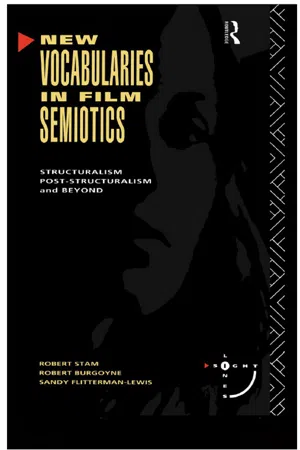
New Vocabularies in Film Semiotics
Structuralism, post-structuralism and beyond
- 256 pages
- English
- ePUB (mobile friendly)
- Available on iOS & Android
eBook - ePub
About this book
First published in 1992. New Vocabularies in Film Semiotics provides a comprehensive lexicon of semiotic concepts. With sections on linguistics, narratology, psychoanalysis and intertextuality, it constructs an indispensable dictionary for film theory, defining over five hundred critical terms. The authors address key aspects of contemporary semiotics and cultural debate, while referring to the work of key figures such as Peirce, Saussure, Derrida, Barthes, Propp, Genette, Greimas, Kristeva, Lacan, Metz, Bellour, Heath, Mulvey, Johnston, Rose, Doane, Bakhtin and Baudrillard. The semiotic concepts are illustrated by examples drawn from the films of directors such as Welles, Dreyer, Brunel, Godard, Hitchcock, Varda, Akerman and Woody Allen. Although especially geared to the needs of film students, New Vocabularies in Film Semiotics should be useful for scholars in all areas of the arts, philosophy and literature.
Information
IV
PSYCHOANALYSIS
Psychoanalytic film theory represents a development of—rather than a departure from—cine-semiotics, for, as Christian Metz points out, “both linguistic studies and psychoanalytic studies are sciences of the very fact of meaning, of signification” (Metz 1979:9). Some film theorists saw a relation between the way that the human psyche (in general) and cinematic representation (in particular) function, and felt that Freud’s theory of human subjectivity and unconscious production could shed new light on the textual processes involved in film-making and viewing. One of the aims, therefore, of psychoanalytic film theory is a systematic comparison of the cinema as a specific kind of spectacle and the structure of the socially and psychically constituted individual. This approach views psychoanalysis as a general field of investigation, a structuring matrix in which the various terms and concepts interconnect to provide a framework for elaborating this relation. For this reason, the discussion of film-specific terms will be preceded by a brief outline of psychoanalysis.
PSYCHOANALYTIC THEORY
Film theory’s use of psychoanalysis is based primarily on French psychoanalyst Jacques Lacan’s reformulation of Freudian theory, most notably his emphasis on the relations of desire and subjectivity in discourse (and it is this emphasis that allows psychoanalysis to be understood as a social theory). As Rosalind Coward puts it, “The unconscious originates in the same process by which the individual enters the symbolic universe” (Coward 1976:8). This means, first, that unconscious processes are essentially discursive in nature, and second that psychic life is both individual (private) and collective (social) at the same time. For film theory, considering the unconscious meant replacing the cinema as an “object” with the cinema as a “process,” seeing semiotic and narrative film studies in the light of a general theory of SUBJECT-formation. The term subject refers to a critical concept related to—but not equivalent with—the individual, and suggests a whole range of determinations (social, political, linguistic, ideological, psychological) that intersect to define it. Refusing the notion of self as a stable entity, the subject implies a process of construction by signifying practices that are both unconscious and culturally specific.
The emphasis on unconscious processes in film studies is what is known as the METAPSYCHOLOGICAL approach, because it deals with the psychoanalytic construction of the cinema-viewing subject. The term metapsychology was invented by Freud to refer to the most theoretical dimension of his study of psychology, the theorization of the unconscious. It involves the construction of a conceptual model (one that defies empirical verification) for the functioning of the psychical apparatus and is divided into three approaches: the dynamic (psychical phenomena are the result of the conflict of instinctual forces); the economic (psychical processes consist in the circulation and distribution of instinctual energy); and the topographical (psychical space is divided in terms of systems— unconscious, preconscious, and conscious—and agencies—id, ego, superego).
As a consequence of the shift from “object” to “process,” the focus of analysis was turned from the systems of meaning within individual films to the “production of subjectivity” in the film-viewing situation; questions about film spectatorship began to be posed from the standpoint of psychoanalytic theory. If psychoanalysis examines the relations of the subject in discourse, then psychoanalytic film theory meant integrating questions of subjectivity into notions of meaning-production. Moreover, it meant that film-viewing and subject-formation were reciprocal processes: something about our unconscious identity as subjects is reinforced in film viewing, and film viewing is effective because of our unconscious participation. Moving from the interpretation of individual films to a systematic comprehension of the cinematic institution itself, some film theorists saw psychoanalysis as a way of accounting for the cinema’s immediate and pervasive social power. For them the cinema “reinscribes” those very deep and globally structuring processes which form the human psyche, and it does so in such a way that we continually yearn to repeat (or re-enact) the experience.
PSYCHOANALYSIS is a discipline, founded by Freud, whose object of study is the unconscious in all of its manifestations. As a method of investigation, it consists in bringing repressed mental material to consciousness. As a method of therapy, it interprets human behaviour in terms of (1) RESISTANCE—the obstruction of access to the unconscious; (2) TRANSFERENCE—the actualization of unconscious wishes, typically in the analytic situation, by according a kind of value to the analyst which enables the repetition of early conflicts; and (3) DESIRE—the symbolic circulation of unconscious wishes through signs bound to our earliest forms of infantile satisfaction. As a theory of human subjectivity, psychoanalysis describes the way in which the small human being comes to establish a specific “self” and sexual identity within the network of social relations that consti tute culture. It takes as its object the mechanisms of the unconscious resistance, repression, infantile sexuality, and the Oedipal complex—and seeks to analyze the fundamental structures of desire that underlie all human activity.
For Freud, who discovered and theorized the unconscious, human life is dominated by the need to repress our tendencies toward gratification (the “pleasure principle”) in the name of conscious activity (the “reality principle”).1 We come to be who we are as adults by way of a massive and intricate repression of those very early, very intense expressions of libidinal (sexual) energy. (As a concept, LIBIDO is fairly difficult to define, first because it continually evolved in Freud’s thinking as he refined his theory of the drives, and second because a clear-cut definition does not exist in the literature. Still, several consistent features permit the provisional suggestion that libido is psychic and emotional energy associated with the transformation of the sexual instinct in relation to its objects, or more precisely, the dynamic manifestation of the sexual drive.) For Lacan, this process is also linguistic; the subject comes into being in and through language. He designates as “the OTHER” that unconscious site of speech, discourse, signification and desire that forms the matrix of this process. In Terry Eagleton’s words,
[The “Other”] is that which like language is always anterior to us and will always escape us, that which brought us into being as subjects in the first place but which always outruns our grasp…. We desire what others—our parents, for instance—unconsciously desire for us; and desire can only happen because we are caught up in linguistic, sexual and social relations—the whole field of the “Other”—which generate it.
(Eagleton 1983:174)
(Eagleton 1983:174)
For obvious reasons, then, the UNCONSCIOUS is central to both Freud and Lacan. In very general terms, the unconscious refers to the division of the psyche not subject to direct observation but inferred from its effects on conscious processes and behavior. The “unconscious” is what Freud designates as that place to which unfulfilled desires are relegated in the process of repression which forms it. As such, it is conceived as that “other scene/stage” where the drama of the psyche (or in Lacanian terms, of “subject-construction”) is played out. In other words, beneath our conscious, daily social interactions there exists a dynamic, active play of forces of desire that is inaccessible to our rational and logical selves (though this division is not as simple as it sounds—there is constant, transforming reciprocity between conscious and unconscious levels of activity).
The unconscious, however, is not simply a ready and waiting place for repressed desire—it is produced in the very act of REPRESSION—the unconscious exclusion of painful impulses, desires or fears from the con scious mind, and something which Freud considered a universal mental process because of its centrality in constituting the unconscious as a domain separate from the rest of the psyche. And its “contents” (representations of libidinal energy) are only known to us by the distorted, transformed and censored effects which are evidence of its work—dreams, neuroses (the result of an internal conflict between a defensive ego and unconscious desire), symptoms, jokes, puns and slips of the tongue. For Lacan, this unconscious is both produced and made available to us in language: the moment of linguistic capability (and the perception of a speaking self) is the moment of one’s insertion into a social realm (and one’s recognition of difference, one’s mediation by others, and one’s being taken up in a system of verbal exchange). The term “SPLIT SUBJECT” refers to this psychic division: the human subject is irremediably split between conscious and unconscious and is, in fact, produced in a series of splittings.
In describing the process by which the unconscious is formed, Freud takes the hypothetical life of the infant as it develops from an entity entirely under the sway of libidinal gratifications to an individual capable of establishing a position in a social world of men and women. This same process is formulated in Lacanian terms in this way: the subject is born in division and marked by LACK, a series of losses defining the constitution of self. These losses are activated in a number of PSYCHIC SCENARIOS— determining moments in which our identity is formed as the result of our engagement, at a very early age, with a network of family relations. “Who we are” as individuals is thus bound up with processes of desire, fantasy and sexuality.
Both Freud’s and Lacan’s descriptions present a theory of the human mind which is not simply a parable of individual development, but a general model for the way human culture is structured and organized in terms of the circulation of desire. This desiring process begins in the earliest moments of our existence. In Freud, this is seen in one of his most radical contributions to the theory of human personality, the discovery of INFANTILE SEXUALITY—eroticism exists in our earliest childhood experiences.
Even before the infant establishes a centered self (an ego, an identity), or is able to distinguish between itself and the outer world, the child is already a field across which the libidinal energy of the drives plays. Lacan reinterprets this, in the light of his linguistic emphasis, as the simultaneous birth of signification and desire—in “communicating,” the infant becomes a desiring being. It is important to note that none of these formative “experiences” can be remembered in the usual sense, for it is precisely because of repression that they become part of our unconscious psychic make-up. Rather, in outlining these psychic scenarios both Freud and Lacan are concerned with demonstrating the work of the unconscious, the production of fantasy, and the erotic component of desire underlying even our most banal (and apparently neutral) activities; they are not concerned with the development of the individual per se.
The first moment of loss in the formation of the “subject” is associated with the breast, the absence of which—in both Freudian and Lacanian accounts—initiates the ceaseless movement of desire, that unconscious force, born of lack and evoking the impossibility of satisfaction, whose perpetual displacements are impelled by an engendering loss. The Freudian scenario can be summarized as follows: from the very first moment in an infant’s life, the small organism strives for satisfaction of those biological needs (food, warmth, and so on) that can be designated as instincts for self-preservation. Yet at the same time, this biological activity also produces experiences of intense pleasure (sensuous sucking at the breast, a complex of satisfying feelings associated with warmth and holding, and the like). For Freud, this distinction indicates the emergence of sexuality; desire is born in the first separation of the biological instinct from the sexual drive. Importantly, the element of fantasy is already present, for all future yearnings for milk by the infant will be marked by a need to recover that totality of sensations that goes beyond the mere satisfaction of hunger. In other words, there is a process of hallucinating—a FANTASMATIC PROCESS—going on; each time the child cries for milk, we can say that the child is actually crying for “milk” (milk-in-quotes)—that representation or hallucinated image of the bonus of satisfaction that came when the need of hunger was fulfilled.2
Lacan discusses this moment in terms of the triad NEED/DEMAND/ DESIRE in order to show how fantasy, desire and language mark the infant even in the originary loss that engenders subjectivity, the primal separation from the breast. At first there is simply a physical need for food, which the baby expresses by crying. Once the need is abolished by the mother’s action of bringing milk, the infant connects crying to the satisfaction received, thereby making the simple signal (crying) into a demand conveyed to an “other,” someone outside and distinct from the self. The cry thus becomes a sign, existing in a chain of meaning which also includes not-crying: the cry signifies. But, as noted above, once this signifying chain is started, there will always be something in excess of the mere satisfaction of need; the memory of experienced pleasure will forever be associated with a loss, with something not under the subject’s control, and this impossibility becomes desire. Lacan calls what arises in this discrepancy between the satisfaction of need and the unsatisfied demand for love, OBJECT SMALL A (objet petit a), the object of desire caught up in the unfulfillable search for an eternally “lost” pleasure. What this means in the simplest terms is that desire will always exist in the register of fantasy, of memory, and of impossibility. The Lacanian subject (of desire) attempts, throughout its life, to recapture the fantasy of totality, wholeness and unity that is associated with the primordial experience of the breast. The original object of desire is thus created as fantasy in the difference between the need for food and the demand for love, the difference between the satisfaction of instinctual need and the elaborated memory of that satisfaction. It is never, therefore, a relation to a real object independent of subject, but a relation to fantasy. And this “fantasmatic” creation is continually repeated throughout the life of the subject as various objects “stand in” for what can never be fully achieved. Thus Lacanians describe desire as “circulating endlessly from representation to representation.”
A related concept is that of the DRIVE, or instinctual energy, defined as a dynamic process which directs the organism towards an aim. According to Freud, an instinct has its source in a bodily stimulus; its aim is to eliminate the state of tension deriving from the source; and it is in the object, or thanks to it, that the instinct may achieve its aim.3 In “Instincts and their Vicissitudes,” Freud points out that “an instinct may undergo the following vicissitudes: reversal into its opposite, turning around upon the subject, repression, sublimation” (Freud 1963c:91). What is important to note about Freud’s approach is that it distinguishes the drive from the biological instinct. The theory of component drives accounts for both the bisexual disposition of the child and the variability which will determine, through an individual’s life, the kind of representation that will be associated with the drive.
In the Freudian account, as the child grows, there is a gradual organization of the libidinal drives (which had at first circulated POLYMORPHOUSLY, unattached to a specific object and not motivated in any single direction). This organization, while still centered on the child’s own body, now channels sexuality toward various objects and aims. The first phase of sexual life is associated with the drive to incorporate objects (the oral stage); in the second, the anus becomes the erotogenic zone (the anal stage); and in the third, the child’s libido is focussed on the genitals (the phallic stage).
Our discussion of Freud and Lacan is necessarily provisional, simplified for the sake of explanation. Given this qualification, a loose connection can be made between Freud’s oral phase and Lacan’s MIRROR PHASE. The second of the moments of loss which structure the life of the child in the Lacanian formulation involves the first acquisition of “self,” that is, the way that the subject begins to establish an identity within a universe of meaning through a series of imaginary identifications, provoked by an initial sense of separation, or difference. Lacan considers this development of the self and the formation of the psyche in terms of PSYCHOANALYTIC REGISTERS that are roughly equivalent to Freud’s pre-Oedipal and Oedipal phases in the child’s life.
In what Lacan calls the IMAGINARY realm (imaginary in that, governed by visual processes, it is a repertoire of images), the child’s first development of an ego—an integrated self-image—begins to take place. It is here in the mirror phase, Lacan says, that this ego comes into being through the infant’s identification with an image of its own body. Between the ages of six and eighteen months, the human infant is physically uncoordinated; it perceives itself as a mass of disconnected, fragmentary movements. It has no sense that the fist which moves is connected to the arm and body, and so forth. When the child sees its image (for example, in a mirror—but this can also be the mother’s face, or any “other” perceived as whole), it mistakes this unified, coherent shape for a superior self. The child identifies with this image (as both reflecting the self, and as something other), and finds in it a satisfying unity that it cannot experience in its own body. The infant internalizes this image as an IDEAL EGO—an ideal of narcissistic omnipotence constructed on the model of infantile narcissism (or investment of energy in the self) and distinct from the EGO IDEAL, which is formed in relation to the parental figures in the Oedipal situation and combines with the superego as a punitive agency of prohibition and conscience. This process forms the basis for all later identifications, which are imaginary in principle. Lacan is specific about the fictive nature of this very early sense of self: “[T]he important point is that this form situates the agency of the ego, before its social determination, in a fictional direction” (Lacan 1977:2).4 Thus the Imaginary, as one of the three psychic registers regulating human experience (together with the Symbolic and the Real), involves a narcissistic structure in which images of o...
Table of contents
- COVER PAGE
- TITLE PAGE
- COPYRIGHT PAGE
- DEDICATION
- CONTRIBUTORS
- PREFACE
- I. THE ORIGINS OF SEMIOTICS
- II. CINE-SEMIOLOGY
- III. FILM-NARRATOLOGY
- IV. PSYCHOANALYSIS
- V. FROM REALISM TO INTERTEXTUALITY
- BIBLIOGRAPHY
Trusted by 375,005 students
Access to over 1.5 million titles for a fair monthly price.
Study more efficiently using our study tools.
Frequently asked questions
Yes, you can cancel anytime from the Subscription tab in your account settings on the Perlego website. Your subscription will stay active until the end of your current billing period. Learn how to cancel your subscription
No, books cannot be downloaded as external files, such as PDFs, for use outside of Perlego. However, you can download books within the Perlego app for offline reading on mobile or tablet. Learn how to download books offline
Perlego offers two plans: Essential and Complete
- Essential is ideal for learners and professionals who enjoy exploring a wide range of subjects. Access the Essential Library with 800,000+ trusted titles and best-sellers across business, personal growth, and the humanities. Includes unlimited reading time and Standard Read Aloud voice.
- Complete: Perfect for advanced learners and researchers needing full, unrestricted access. Unlock 1.5M+ books across hundreds of subjects, including academic and specialized titles. The Complete Plan also includes advanced features like Premium Read Aloud and Research Assistant.
We are an online textbook subscription service, where you can get access to an entire online library for less than the price of a single book per month. With over 1.5 million books across 990+ topics, we’ve got you covered! Learn about our mission
Look out for the read-aloud symbol on your next book to see if you can listen to it. The read-aloud tool reads text aloud for you, highlighting the text as it is being read. You can pause it, speed it up and slow it down. Learn more about Read Aloud
Yes! You can use the Perlego app on both iOS and Android devices to read anytime, anywhere — even offline. Perfect for commutes or when you’re on the go.
Please note we cannot support devices running on iOS 13 and Android 7 or earlier. Learn more about using the app
Please note we cannot support devices running on iOS 13 and Android 7 or earlier. Learn more about using the app
Yes, you can access New Vocabularies in Film Semiotics by Robert Stam in PDF and/or ePUB format, as well as other popular books in Media & Performing Arts & Linguistic Semantics. We have over 1.5 million books available in our catalogue for you to explore.