The Crisis of Conservatism 1880-1914 offers a new interpretation of Conservative politics in the period 1880-1914 and comes to the startling conclusion that, but for the intervention of the First World War, there may well have been a 'Strange Death of Tory England.'
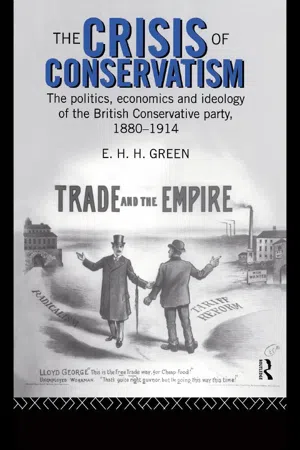
eBook - ePub
The Crisis of Conservatism
The Politics, Economics and Ideology of the Conservative Party, 1880-1914
- 432 pages
- English
- ePUB (mobile friendly)
- Available on iOS & Android
eBook - ePub
The Crisis of Conservatism
The Politics, Economics and Ideology of the Conservative Party, 1880-1914
Part I Questions of Decline
1 The Political Economy of Decline
DOI: 10.4324/9780203985540-1
The immense echo of my father’s speech in May 1903 is inexplicable unless it is appreciated that the train was already laid.(A. Chamberlain to B. Dugdale, 4 March 1931)1
The question of ‘fiscal reform’, which has now burst into so violent a flame, is not new: it has feebly smouldered for many years.(A.J. Balfour to Devonshire, 27 August 1903)2
The circumstances in which Austen Chamberlain and Arthur Balfour produced these statements could not have been more different. Chamberlain’s reflection came at the end of a long career, whereas Balfour’s was produced at the height of the Cabinet crisis sparked by the opening of the tariff debate. Yet both statements offer insights into the genesis of the tariff reform campaign. As Chamberlain argued, the train of the tariff debate was ignited long before 1903: the issues, as Balfour told Devonshire, had been part of the sub-culture of British politics and economics for some years. Indeed, one of the most important aspects about the nature and timing of the tariff controversy is that it was not a random development, but the culmination of a political and economic debate rooted in the 1880s and 1890s, which focused on the question of the continued prosperity and security of Britain and the Empire.
Military concerns should not be underestimated as a contributory factor in creating the climate of opinion which shaped the tariff controversy. The Conservative party sought to contrast its concern for Britain’s military effectiveness with the neglect of such matters by ‘Little Englander’ Liberals.3 Consequently it was effected by the fin de siècle sense of impending doom which saw unpleasant comparisons with Rome become commonplace.4 The argument for imperial organization, which was such a vital part of the tariff campaign, must be viewed as emerging from a general sense of imperial insecurity which had a particular resonance for British Conservatives. It will not be the task of this study to explore in full the military or ‘external’ aspects of the question of decline.5 Instead this book will concentrate on the internal aspect of decline, and in particular on how contemporary analysis of Britain’s economic situation in the late nineteenth century helped set the tariff controversy alight.
An Economic Crisis?
Between 1870 and 1914 the British economy underwent a number of changes. The most obvious was in the agricultural sector.6 Agriculture’s share of Britain’s GNP fell from 20 per cent in 1860 to a mere 7 per cent by 1914. This decline was matched by the fact that agricultural output did not increase in absolute terms over the period. But import penetration of the British market increased markedly, with imports of grain, for example, showing a fourfold rise. The Royal Commissions which investigated the condition of agriculture painted a portrait of decay. Even the 1885 RCDTI, which produced a fairly optimistic Final Report, noted that ‘In stating this general conclusion there is one important branch of industry which must be excepted. We refer, of course, to agriculture’.7 The rural community gave eloquent expression to their views on the situation by voting with their feet – Britain’s farm population fell by one-quarter between 1860 and 1914 and the rural population as a whole by one-third.8 There were regional variations in agricultural fortunes and in the circumstances the agricultural sector showed remarkable resilience,9 but the ‘golden age’ of high farming had passed.
For the rest of the British economy a complex picture emerges. Between 1870 and 1914 Britain slipped from a dominant first to an uneasy third place in respect of percentage share of world manufacturing production. Britain’s share of the world market for manufactured goods also declined from 41.4 per cent in the late 1870s to 29.9 per cent by 1913.10 In the same period there was a substantial increase in import penetration by foreign manufacturers. These facts seem to support claims made by many contemporaries, that the late nineteenth-century British economy was in decline.
In the light of reassessments by economic historians it can be argued that contemporary concerns were misplaced and that, on the whole, Britain’s economic performance in the period 1870–1914 was fairly good.11 But if the British economy is no longer portrayed as being in decline it is seen as undergoing structural changes as adjustments were made to an increasingly competitive international economy. This process of adaptation witnessed the British economy moving towards a concentration on those areas where it enjoyed a comparative advantage, namely in services and in the old staples of coal, textiles and heavy engineering. In other areas of manufacture, particularly in the chemical and electrical industries, Britain’s competitors are seen to have enjoyed a comparative advantage as a result of their greater concentration, economies of scale and technological lead.12
The process of adaptation described above was slow and painful for the British economy, made more so by the fact that in the period of the mid-Victorian boom Britain had been a major producer and exporter of all manufactured and consumer goods. As one recent survey of the period has argued, the main problem for the British economy was that it had enjoyed a ‘free lunch’ during the 1850s and 1860s which was taken away in the late nineteenth century.13 Thus increasingly frequent cyclical downturns after the mid-1870s, and the fall in prices between about 1873 and 1895, hit Britain harder than other countries because Britain’s position as the leading manufacturing and trading nation made her economy more vulnerable. Similarly, the emergence of strong competition and the revival of protectionism also hit Britain harder because of its reliance on international trade. The verdict of economic history is that, for the most part, there is little evidence to suggest that the closure of markets by tariffs or the upswing in competition had any drastic effect on the volume of British trade or on the British economy in general. On a disaggregated level it is not denied that some areas of manufacturing, notably the Birmingham and Black Country metal trades, the silk industry, and some elements of the iron and steel sector, suffered,14 but, it is argued, this was more than compensated for by developments in other sectors. Services enjoyed substantial growth, and trade was, it seems, successfully switched to the supply of capital goods and basic manufactures to primary-producing areas, with the result that by 1914 Britain still held a powerful position in the world economy.15
In the cold light of retrospect economic historians conclude that the British economy had its problems between 1870 and 1914 but that, overall, it faced up to them quite well.16 This was not, however, the verdict of much late nineteenth-century opinion. This clash of opinion between economic historians and contemporary observers has been attributed to the fact that contemporary analysis ‘had very little to do with any objective assessment of Britain’s needs as a great industrial power’,17 but this misreads the economic arguments advanced by those who felt the economy was in decline. The important factors to be considered are the assumptions the analysis is based upon and the criteria used to judge the economy’s performance, for they determine which facts are seen as of particular relevance and also how they are interpreted.
This chapter will outline the assumptions underpinning the arguments of those who depicted the British economy in the late nineteenth century as in decline. It will examine three movements which emerged as a direct result of the contemporary sense of crisis, the campaigns for imperial federation, fair trade and bimetallism. It will also examine aspects of the contemporary response to the late nineteenth-century ‘fiscal crisis’ of the British State, and look briefly at contemporary views of ‘the condition of the people’. By examining these varied aspects of the ‘political economy of decline’ this study will show that contemporary concern about the condition of the British economy generated criticism of established liberal orthodoxies regarded as the governing maxims of British economic policy, and that the triptych of liberal economics, free trade, the gold standard and the balanced budget, and the broader set of assumptions which underpinned them, were all threatened by the contemporary response to what was once termed ‘the Great Depression’.
Fair Trade
The protective tariffs of other countries, and even of our own colonies, have much to do with the present depression.(Huddersfield Chamber of Commerce to RCDTI, November 1885)18
The National Fair Trade League (NFTL) came into existence on 17 May 1881. The immediate cause of its appearance was the break-down of the ‘Cobden’ Treaty, and the apparent willingness of the Liberal government to negotiate a new, less favourable commercial agreement with France.19 But both the demise of the Cobden Treaty and the emergence of the NFTL were symptomatic of broader developments. The Cobden Treaty was a casualty of the wave of economic nationalism and resurgent protectionism which swept the industrialized world in the late nineteenth century; the NFTL was the most important early manifestation of this phenomenon in Britain.
The starting point for the fair trade campaign was the contention that the British economy was facing severe difficulties. Speaking in the House of Lords in November 1884 Lord Dunraven, a prominent member of the NFTL, outlined the fair traders’ view of the British economic situation when he argued that Britain’s staple industries, in particular cotton, iron and steel and shipbuilding, were all stagnating, whilst other industries, including coal-mining, wool and engineering were all experiencing lengthy periods of either complete idleness or short-time work. Dunraven argued that agriculture’s plight was more serious than that of any other industry, but ‘that the whole commercial, trading, mining, manufacturing community was suffering’.20 Such an argument found much support in the reports sent to the RCDTI by various Chambers of Commerce and trade assocations. Of fifty Chambers of Commerce sent questionnaires by the RCDTI, thirty-eight replied that in their area industry was in a state of deep depression.21
It being fair trade wisdom that British industry and agriculture were in the throes of depression, the next questions were why and how this had come about. Fair traders pointed to foreign competition and foreign tariffs as the central problems.22 Foreign competition, and in particular the influx of foreign grain, was depicted as the essential cause of the miserable condition of British agriculture. The difficulties facing British industry were seen to stem from a more complex set of problems. Industrialization of the continental powers and the USA had, it was argued, reduced the market for British goods. The fair traders contended that this ‘natural’ process was, however, being unnaturally hastened by tariff barriers which prevented British producers from competing in these markets on equal terms.23 Once again this argument was confirmed by complaints from the business community. The Sheffield iron and steel industry had been complaining about the impact of US tariffs as early as the mid-1870s, and these complaints escalated during the 1880s.24 Nor was Sheffield a lone voice. Thirty-two of the Chambers of Commerce mentioned above, and eight of the trade assocations, saw the closing of foreign markets by tariffs as a major cause of the difficulties facing industries in their districts. The fair trade diagnosis of the basic cause of Britain’s industrial malaise seemed to be one with which many British businessmen agreed.
The fair traders were unequivocal in defining a solution. The basic elements of their programme were outlined in the NFTL’s ‘manifesto’, published in The Times on 3 August 1881. The formula was simple: just as foreign competition and foreign tariffs were seen to be the main cause of Britain’s economic difficulties, so British tariffs were to be the means of reestablishing Britain’s competitive position. ‘Retaliatory’ tariffs were to be placed on imports from countries which imposed tariffs on British goods, in order to force them to reduce their tariffs and allow fair competition. At the same time a system of preferential duties was to be established between Britain and the Empire, the key impost at the British end being a ‘moderate corn duty’.25 Retaliatory tariffs were to force open markets which had been closed by protectionist regimes, whilst imperial preference was to give British producers privileged access to untapped colonial markets. Protective tariffs were not a part of the ‘official’ NFTL programme, and only appeared infrequently in impromptu statements by some leading fair traders.
Given that the fair trade analysis of the causes of ‘the present discontents’ was in harmony with the views of many British businessmen, one could be forgiven for assuming that their proposals would have gained their support. However, this was not the case. Certainly, all those Chambers of Commerce and economic groups which had complained about the impact of foreign tariffs and foreign competition agreed that it would be a good idea if both could be either reduced or removed, but that was the extent of their unanimity. The different sectors, industries and localities offered diverse and often conflicting suggestions for solutions.
The simple fact of the matter was that different aspects of the fair trade programme necessarily appealed to different sectors of the economy. One particularly obvious division was between agriculture and industry. The RCAD, which reported in 1896, concluded that between 1876 and 1894 grain prices had fallen by an average of 30–40 per cent, and foreign competition was clearly marked out as the main cause of this precipitous drop.26 British farmers made a market response to the influx of grain by diversifying into dairy farming and market gardening,27 but even here foreign competition exerted a downward pressure on prices. This emphasis on the impact of foreign competition ensured that the only tariffs to which British farmers demonstrated any commitment were protective tariffs. During the 1880s a large number of Chambers of Agriculture, especially those in the hard-hit arable districts of Lincolnshire, East Anglia and Essex, advocated com duties of varying levels of severity, and in 1886 the Central Chamber of Agriculture made the first of a series of pronunciations in favour of a tariff on corn.28 The corollary of t...
Table of contents
- Cover Page
- Half Title Page
- Title Page
- Copyright Page
- Dedication
- Contents
- Acknowledgements
- Abbreviation
- Introduction
- Part I Questions of Decline
- Part II The Nature of the Political Problem
- Part III The Nature of the Response
- Part IV Disintegration
- Conclusion
- APPENDIX 1: Conservative MPs supporting fair trade in the 1880s
- APPENDIX 2: Conservative representatives of middle- and mixedclass London and South-East Suburban seats
- APPENDIX 3: Members of the Compatriots’ Club
- APPENDIX 4: Members of the Unionist Social Reform Committee
- Notes
- reference
- Index
Trusted by 375,005 students
Access to over 1.5 million titles for a fair monthly price.
Study more efficiently using our study tools.
Frequently asked questions
Yes, you can cancel anytime from the Subscription tab in your account settings on the Perlego website. Your subscription will stay active until the end of your current billing period. Learn how to cancel your subscription
No, books cannot be downloaded as external files, such as PDFs, for use outside of Perlego. However, you can download books within the Perlego app for offline reading on mobile or tablet. Learn how to download books offline
Perlego offers two plans: Essential and Complete
- Essential is ideal for learners and professionals who enjoy exploring a wide range of subjects. Access the Essential Library with 800,000+ trusted titles and best-sellers across business, personal growth, and the humanities. Includes unlimited reading time and Standard Read Aloud voice.
- Complete: Perfect for advanced learners and researchers needing full, unrestricted access. Unlock 1.5M+ books across hundreds of subjects, including academic and specialized titles. The Complete Plan also includes advanced features like Premium Read Aloud and Research Assistant.
We are an online textbook subscription service, where you can get access to an entire online library for less than the price of a single book per month. With over 1.5 million books across 990+ topics, we’ve got you covered! Learn about our mission
Look out for the read-aloud symbol on your next book to see if you can listen to it. The read-aloud tool reads text aloud for you, highlighting the text as it is being read. You can pause it, speed it up and slow it down. Learn more about Read Aloud
Yes! You can use the Perlego app on both iOS and Android devices to read anytime, anywhere — even offline. Perfect for commutes or when you’re on the go.
Please note we cannot support devices running on iOS 13 and Android 7 or earlier. Learn more about using the app
Please note we cannot support devices running on iOS 13 and Android 7 or earlier. Learn more about using the app
Yes, you can access The Crisis of Conservatism by E.H.H. Green in PDF and/or ePUB format, as well as other popular books in History & British History. We have over 1.5 million books available in our catalogue for you to explore.