Unconventional Leadership
eBook - ePub

Unconventional Leadership

Bridging the Connected World with Meaningful Relationships

  1. 156 pages
  2. English
  3. ePUB (mobile friendly)
  4. Available on iOS & Android
eBook - ePub

Unconventional Leadership

Bridging the Connected World with Meaningful Relationships

About this book

Today's educational leaders are working with more resources, more research, and more stakeholders – all within the same, limited time in a day as we had a decade ago. Author Jessica M. Cabeen takes readers through an intentional journey of current trends and buzzwords, helping leaders understand how social media is a tool for connection, collaboration, and learning. This exciting book explores the importance of care and collaboration with all members of the educational community – students, teachers, staff, families, and community partners. Each chapter highlights examples of leaders that have made positive change in their schools, and provides key actionable strategies that can be implemented at a pace that is sustainable and tailored to fit your needs. You will discover a deeper understanding of the critical importance of your role in:

  • Elevating the student's experience
  • Building a strong school culture
  • Creating small ways to make big impacts with families
  • Advocating a clear message with community partners and legislative leaders
  • Creating time for self-care

Filled with practical examples, tools, and strategies, Unconventional Leadership is a resource school leaders can pick up today and implement tomorrow.

Frequently asked questions

Yes, you can cancel anytime from the Subscription tab in your account settings on the Perlego website. Your subscription will stay active until the end of your current billing period. Learn how to cancel your subscription.
No, books cannot be downloaded as external files, such as PDFs, for use outside of Perlego. However, you can download books within the Perlego app for offline reading on mobile or tablet. Learn more here.
Perlego offers two plans: Essential and Complete
  • Essential is ideal for learners and professionals who enjoy exploring a wide range of subjects. Access the Essential Library with 800,000+ trusted titles and best-sellers across business, personal growth, and the humanities. Includes unlimited reading time and Standard Read Aloud voice.
  • Complete: Perfect for advanced learners and researchers needing full, unrestricted access. Unlock 1.4M+ books across hundreds of subjects, including academic and specialized titles. The Complete Plan also includes advanced features like Premium Read Aloud and Research Assistant.
Both plans are available with monthly, semester, or annual billing cycles.
We are an online textbook subscription service, where you can get access to an entire online library for less than the price of a single book per month. With over 1 million books across 1000+ topics, we’ve got you covered! Learn more here.
Look out for the read-aloud symbol on your next book to see if you can listen to it. The read-aloud tool reads text aloud for you, highlighting the text as it is being read. You can pause it, speed it up and slow it down. Learn more here.
Yes! You can use the Perlego app on both iOS or Android devices to read anytime, anywhere — even offline. Perfect for commutes or when you’re on the go.
Please note we cannot support devices running on iOS 13 and Android 7 or earlier. Learn more about using the app.
Yes, you can access Unconventional Leadership by Jessica M. Cabeen,Jessica Cabeen in PDF and/or ePUB format, as well as other popular books in Education & Education General. We have over one million books available in our catalogue for you to explore.

Information

Publisher
Routledge
Year
2019
Print ISBN
9780367074463
eBook ISBN
9780429665196
Edition
1

1 Leading with Students

Who is our why in this work? What do we focus on the most in ­accomplishing our goals, mission, and vision for our school? How often do we get caught up “adulting” that we forget the real reason we have been called to this work? Michelle Obama (2018) said it best: “kids will invest more when they feel like they are being invested in.” With that in mind, in what ways can you make intentional, meaningful connections with students that produce results? When you find something that works, how do you share it with others? And how does breaking the conventional mold of leadership in unconventional ways play a role in this work?
This chapter will provide practical (and sometimes seemingly easy) ways to make deeper connections with students that will pay dividends in the work ahead. Relationships, caring leadership, and authentic leadership skills are woven throughout this key way to lead with the most important group of people in education: our students.
Relationships in education are more than stickers in the classroom, more than high-fives at the door, and certainly more than hoodies in the halls. Research continues to prove the importance of establishing a caring community in the development of a healthy school culture, relationships, and impact on student achievement.
The myth: soft skills are soft and not necessary to lead. If you are the leader who gets looked at weird when connecting with kids in intentional and creative ways, quit worrying about doing the right thing, you are.
Smylie, Murphy, and Seashore-Louis (2016) share one of the four reasons to care about caring in schools: there is the evidence that social and academic support impacts student success. When modeled with students, caring leadership includes having high expectations, no excuses, and intentional ways to demonstrate that care towards students in an individualized nature.
Even movies and pop culture celebrate caring leadership. Think about the teacher who takes their class on a field trip, the principal who does home visits, or the leader who stands up to a group of gang members – with no back up. While these can be portrayed as a little larger than life, the premise is spot on. Caring is tough love and high expectations.
Elizabeth Bondy and Dorene Ross (2008) discuss the role of the warm demander – a teacher that communicates both warmth and a nonnegotiable demand for student effort and mutual respect. If we are asking our best teachers to have this approach with the students, shouldn’t we require the same of those adults leading the schools?
As a leader, ensuring students are engaged is more than an annual satisfaction survey, it is deeper than the daily greeting at the door, and when done well with intention it has lasting impacts on the student, teacher, and school personnel.

Linking the Learning

Consequences or Punishments

Rethinking Discipline and Rebuilding Relationships

In my experience as a special education supervision, assistant principal, and principal in both middle and high school settings, I can tell you that sometimes (and some days most times) disciplining a student was my least favorite part of the job. For those of you in the role, you get this. Your investment in the halls and cafeteria, the multiple check-ins, proactive conversations, and contracts can derail at the smallest thing and most random moment. I always struggled not to take a defeat as a personal failure. I also learned that with every incident someone would struggle with my decision: the student, the guardian, the teacher, or the bystanders. Honestly it was a struggle somedays to walk out the door with my head held high knowing I did my best for those I serve.
Here is the deal. Sometimes we expect more of our students than we do of ourselves. We want to order escorts or significant consequences with that student who is always late to class, while we might be scooting into the parking lot in the morning a little late hoping we aren’t noticed. We ask our students to handle conflict with students more like adults, while we can each admit to interacting in conflict more like a kid. And social media/email, well let’s just say we could all learn how to talk, tweet, and comment on each other’s words better.
Coming back to the secondary level, with six years of kindergarten leadership, has me looking at this in a more unconventional way. Now instead of deficits I look for opportunities, and above all I do my best to care for each stakeholder I serve.
  • Customer service. What is the experience for a student when they have a “behavior event”? They made an error – big or small – walk, run, or storm up to the office and then what? Do students know what happens next? Are the expectations clear in the office to them and everyone else working in that space? Do you offer them time to regroup, reflect, and maybe even write down their account of the event or do you just start in with a series of questions, questioning every one of their answers, and escalating the situation?
During one hallway supervision I literally watched a “push/push” in the hall. Immediately staff separated the two students and I went right to the one I had a stronger relationship with – the one who historically instigated more of these “push/pushes” last year and had made a conscious effort to change this year. I walked right up to him, gave him eye contact, and quietly said, “let’s go to my office and figure this out.” At that point I made the unconventional move – I stood next to him and held his arm and we walked with purpose to the office and through 400 other students passing by us. He got into the office, we both sat quiet for about five minutes. After that he shared his side, and we found that due to some misinformation from a relative, the situation escalated. Once both students got into the same space, they talked it out, apologized, and spent the rest of the day calming down and catching up on work, which allowed the middle school drama about the huge fight to blow over before it could blow up.
The next day I followed up with that student. I had time to explain why I immediately went to him, why I got in the middle of him and any of his buddies who could have escalated the situation before I could help him solve it. And at that point I asked him this: “what could I have done differently to help you?” Completely caught off guard, he replied – you listened, you got me out of something I wasn’t going to be able to, so I think you handled it okay.
A bystander to this interaction was a family member who also has a history of more behavioral events the year previous than he is proud of and continues to work on redefining who he is in the school. During this event as his cousin and I were walking to the office, he saw a lady grabbing his cousin’s arm and directly telling him, “let me solve this for you today, please.” A week after the event I found him and talked to him about how the experience of watching the event was for him.
Ma’am, initially I was pissed, I don’t want anyone touchin...

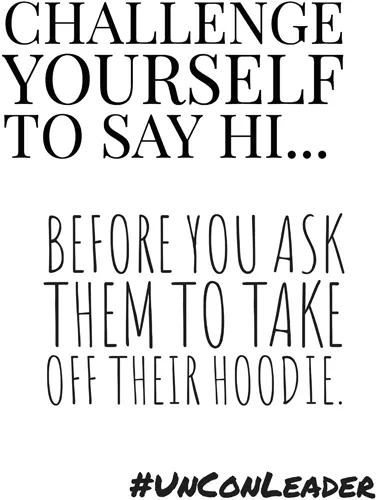
Table of contents

  1. Cover
  2. Half-Title
  3. Series
  4. Title
  5. Copyright
  6. Contents
  7. Meet the Author
  8. Acknowledgments
  9. eResources
  10. Introduction: The Case for Unconventional Leadership in Schools
  11. 1 Leading with Students
  12. 2 Leading with Staff
  13. 3 Leading with Family Members
  14. 4 Leading with Colleagues or Central Office Administrators
  15. 5 Leading with Community Members or Legislative Stakeholders
  16. 6 Leading for Yourself
  17. Conclusion
  18. Appendix: So How Do I Do That? Resources for Creating and Organizing Social Media Accounts