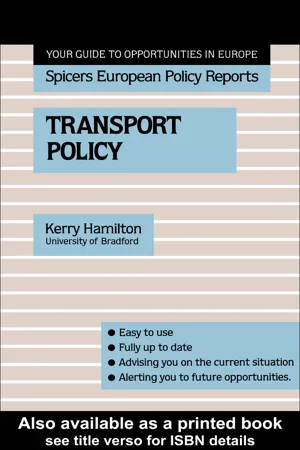
Transport in the European Community is undergoing a new revolution. The completion of the Channel Tunnel and a network of high-speed railways, the expansion of the road system, and the improvement of urban transport systems are all set to make a profound impact. The Community is actively involved in supporting improvements both in northern and southern Europe, in projects which represent a major investment of interest both to private-sector developers and to public administrators. This volume explains the involvement of the EC institutions in these matters, and how the Community's transport policy might develop in the future. Key EC policy documents are summarised, and full details of all the relevant official material is given. This comprehensive and up-to-date guide will be invaluable to all those concerned with the future of transport, either as consumers or as suppliers of systems and infrastructure.
- 87 pages
- English
- ePUB (mobile friendly)
- Available on iOS & Android
eBook - ePub
Transport Policy
About this book
Information
Section I
Introduction
Conclusion
The Common Transport Policy is one of the common policies specifically mentioned in the Treaty of Rome (1957) and as such is one of the corner-stones of EC policy. However, many commentators have stated that in comparison to common policies such as that for agriculture, the achievements of the CTP have been limited. This lack of achievement led to a judgment in May 1985 by the Court of Justice in an action brought against the Council by the European Parliament which condemned the Council for infringement of the Treaty of Rome by failing to ensure freedom to provide services in the sphere of international transport and to lay down conditions under which non-resident carriers may operate transport services in a Member State. The judgment should provide a fresh impetus to the Common Transport Policy. A Commission White Paper ‘Completing the Internal Market’ published soon after, envisages completion of the Internal Market of the Community by 1992 and includes various transport measures.
By November 1985 the Council had agreed a policy approach providing ‘for the establishment of a free market without quantitative restrictions by 1992 at the latest, and a transitional phase of gradual adjustment of bilateral quotas to make them non-discriminatory together with increases in Community quotas’. During the transitional period, distortions of competition would also be eliminated. A master plan was drawn up laying down the main objectives of the CTP to be achieved by 1992. The Single European Act of 1986 supplemented the EEC Treaty by providing that the Community is to adopt measures with the aim of progressively establishing the internal market over a period expiring on 31 December 1992 in accordance with the provisions of Article 8A and Article 84 of the Treaty. The Single European Act amended and supplemented Article 84. This provides for a system of qualified majority voting for all sectors of the CTP including sea and air transport.
In the Transport Policy of the European Communities (70), Despicht recognized the changes which have occurred in CTP thinking since 1957 and identified two phases of development between 1957 and 1969: (i) ‘the initial phase’, in which EC institutions acted as if they believed that a Community- wide transport system could be introduced by direct assault; and (ii) the ‘present phase’ in which a single Community executive is trying to reconcile the different judicial powers and to overcome the impasse of previous policy making. Despicht summarizes the Treaty articles which guide the CTP on page 38.
Summary of Specific Treaty Articles Which Guide the CTP
75(1) (a) and (b) requires common rules for frontiercrossing traffic within the Community and for the interpenetration of national transport markets
76 forbids Member States to discriminate against foreign carriers (who come from other Member States) any more than they did when the Treaty of Rome came into force
79 bans discrimination in transport charges within two years where the condition of carriage and cargo are identical and subsequently where the transport operators are equivalent in practice
81 requires the charges levied at frontier crossings to be related to actual cost (instead of to fictitious terminal charges) and provides for the actual costs of crossing frontiers to be reduced progressively
77 permits state subsidies for the co-operation of transport or as compensation for public service obligations
78 states the general principle that any measures concerning transport rates and conditions shall take account of the economic circumstances of carriers
80 prohibits specially favourable transport charges (support tariffs) for benefit of particular undertakings; it contains an exception for regional policy goals
82 permits state aid in transport in the 40km zone on the West German/East German border
Source: Despicht (1969)
The Single European Act and the CTP
The most motivating piece of recent EC legislation as far as the CTP is concerned has been the Single European Act of 1986. Since this act was passed, most areas of transport have already been assigned medium- term plans to take them up to the completion of the internal market in 1992:
Air—In December 1987 the Council reached agreement on new measures constituting the first step towards a common air transport policy in Europe. The main objectives of the policy are deregulation, safety and a common approach to non-member countries. These objectives are to be pursued in several steps between now and 1992.
Infrastructure—A five-year transport infrastructure programme designed to upgrade the main intraCommunity transport links in the years up to and beyond 1992 was proposed in June 1988. The programme follows the same principles and criteria as those agreed for the Council of Ministers for a medium- term infrastructure programme in 1987 but concentrates on twelve priority actions aimed at dealing with the anticipated traffic flows between Member States as the internal market becomes a reality.
Rail—It was decided in 1987 to go ahead with the highspeed rail network which is to link Brussels, London, Paris, Cologne and Amsterdam, and in February 1988 the EC asked EEC railways to strengthen their co-operation to help unify the market. The EEC’s rail policy aims to eliminate distortions in competition between different modes of land transport, make relations between governments and their national rail companies transparent, promote co-operation between modes of transport and develop rail infrastructure. The EC Commission’s biennial reports aim to establish the extent to which these objectives have been achieved in the run up to 1992.
Road—Much of the recent proposals on road transport are aimed at freeing the market and the CTP seems likely to encourage greater use of road vehicles for international freight.
Inland Waterways—A report on inland ports was drawn up on behalf of the Committee on Transport in May 1988. This contained the motion for a resolution which stated that although the inland waterway sector is the least compatible type of surface transport with existing frontiers it is expected to become an important feature of the Single European Market. However this form of European transport has not received very much attention from the Commission with regard to 1992.
There are still a great many changes to be made before a truly common transport policy can be claimed to exist in the EEC. If completion of the internal market on the Community is achieved by 1992 the CTP will have realized its main aims in freeing the market and fostering free competition. Whether this will mean the generation of economic development, the improvement of efficiency and improved transport provision remains to be seen. As transport is a vital component of everyday life for Europeans, transport policy holds a great potential to improve significantly living and working conditions. The real challenge for the CTP after 1992 will be to keep pace with developments in other areas of EEC policy and to ensure that sufficient transport provision is in place before it is needed. A shift in emphasis from cars and roads to more environmentally aware methods of using the limited space left in Europe will also be needed if the EEC is to avoid increased road traffic deaths, pollution, loss of countryside to new road building and limited mobility for those with no access to a car.
References
(* denotes a reference which is summarized in Section II)
Notes
Abbreviations used:

(1) EEC Treaty of Rome (1957).
(2) J. Whitelegg (1988) Transport Policy in the EEC. London: Rouledge.
(3) EEC Commission, Schaus Memorandum 1961.
(4) N. Despicht (1969) The Transport Policy of the European Communities. European Series no.2 (PEP), London: The Royal Institute of International Affairs.
(5) EC Commission (1973) Commission Communication to the Council—Progress towards a Common Transport Policy (Inland Transport) COM(73) final.
(6) J. Erdmenger (1983) The European Community Transport Policy. Aldershot: Gower.
(7) COM(88) 193 final 15.4.88.[sup]*[/sup]
(8) COM(88) 117 final 30.3.88.[sup]*[/sup]
(9) OJL 374 31.12.87, Bull EC 12–1987.
(10) European Report, 8.10.88, 1437/IV/6–7 .[sup]*[/sup]
(11) OJL 374, 31.12.87, Bull EC 12–1987.
(12) Bull EC 6–1987, point 2.1.227.
(13) Bull EC 11–1987, point 2.1.250.
(14) Bull EC 12–1987.
(15) Bull EC 11–1987, point 2.1.242.
(16) OJC 125 11.5.87, Bull EC 4–1987, point 2.1.141.
(17) OJC 288 15.11.86 257 , general reference point 693.
(18) OJC 288 28.10.87, Bull EC 10–1987, point 2.1.196.
(19) COM(88) 340 final 16.6.88.
(20) Bull EC 7/8–1987, point 2.1.259.
(21) OJL 334, 24.12.77; Eleventh General Report on the activities of the EC, point 376.
(22) OJC 105, 21.4.87; Bull EC 2–1987, point 2.4.21.
(23) EC European Parliament Reports, 27.5.87, PE DOC A 279/87[sup]*[/sup].
(24) OJC 150 , 8.10.87; Agence Europe, 8.2.88, 4717 p.11.
(25) OJL 179 , 3.7.87; Bull. EC 6–1987, point 2.1.222.
(26) OJC 87 , 2.4.87; Bull EC 3–1987, point 2.1.197.
(27) OJC 190 , 20.7.87; Bull EC 6–1987, point 2.1.222.
(28) Bull EC 10–1987, point 2.1.200.
(29) Bull EC 11–1987, point 2.1.243.
(30) OJC 144, 13.6.85; Nineteenth General Report on the activities of the EC, points 613 and 1057.
(31) OJC 77, 24.3.87; Bull EC 2–1987, point 2.1.169.
(32) OJC 120, 6.5.87; Bull EC 2–1987, point 2.1.170.
(33) OJC 281, 19.10.87; Bull EC 9–1987, point 2.4.55.
(34) OJC 232, 31.8.87; Bull EC 7/8–1987, point 2.4.55.
(35) OJC 65, 12.3.87; Twentieth General Report on the activities of the EC, point 204.
(36) OJC 232, 31.8.87; Bull EC 9–1987, point 2.4.57.
(37) Eighteenth General Report on the activities of the EC, point 504.
(38) Bull EC 11–1987, point 2.1.246.
(39) OJL 359, 22.12.83; Seventeenth General Report on the activities of the EC, point 502.
(40) Bull EC 6–1987, point 2.1.221.
(41) OJC 3, 7.1.88; Bull EC 12–1987.
(42) OJC 281, 19.10.87; Bull EC 9–1987, point 2.4.13.
(43) OJC 232, 31.8.87; Bull EC 7/8–1987, point 2.4.56.
(44) Bull EC 12–1987.
(45) OJL 370, 31.12.85.
(46) OJL 370, 31.12.85.
(47) COM(88) 49 final 18.2.88.[sup]*[/sup]
(48) OJL 2, 3.1.85; Eighteenth General Report on the activities of the EC, point 493.
(49) Bull EC 1–1987, point 2.1.125.
(50) OJC 183, 11.7.87; Bull EC 6–1987, point 2.1.223.
(51) OJC 279, 17.10.87; Bull EC 9–1987, point 2.1.182.
(52) EC European Parliament Reports, 24.5.88, PE DOC A 282/88.
(53) OJC 190, 20.7.87; Bull EC 6–1987, point 2.4.19.
(54) OJC 351, 24.12.83; Seventeenth General Report on the activities of the EC, point 500; OJC 214, 14.8.84; Eighteenth General Repor...
Table of contents
- Cover
- Half Title
- Title Page
- Copyright
- Contents
- Foreword
- The European Community: Its Role, Institutions, and Legislation
- Section I: Introduction
- Section II: Key Documents on Transport
- Section III: Commission Documents of Relevance to Transport Policy
Trusted by 375,005 students
Access to over 1.5 million titles for a fair monthly price.
Study more efficiently using our study tools.
Frequently asked questions
Yes, you can cancel anytime from the Subscription tab in your account settings on the Perlego website. Your subscription will stay active until the end of your current billing period. Learn how to cancel your subscription
No, books cannot be downloaded as external files, such as PDFs, for use outside of Perlego. However, you can download books within the Perlego app for offline reading on mobile or tablet. Learn how to download books offline
Perlego offers two plans: Essential and Complete
- Essential is ideal for learners and professionals who enjoy exploring a wide range of subjects. Access the Essential Library with 800,000+ trusted titles and best-sellers across business, personal growth, and the humanities. Includes unlimited reading time and Standard Read Aloud voice.
- Complete: Perfect for advanced learners and researchers needing full, unrestricted access. Unlock 1.5M+ books across hundreds of subjects, including academic and specialized titles. The Complete Plan also includes advanced features like Premium Read Aloud and Research Assistant.
We are an online textbook subscription service, where you can get access to an entire online library for less than the price of a single book per month. With over 1.5 million books across 990+ topics, we’ve got you covered! Learn about our mission
Look out for the read-aloud symbol on your next book to see if you can listen to it. The read-aloud tool reads text aloud for you, highlighting the text as it is being read. You can pause it, speed it up and slow it down. Learn more about Read Aloud
Yes! You can use the Perlego app on both iOS and Android devices to read anytime, anywhere — even offline. Perfect for commutes or when you’re on the go.
Please note we cannot support devices running on iOS 13 and Android 7 or earlier. Learn more about using the app
Please note we cannot support devices running on iOS 13 and Android 7 or earlier. Learn more about using the app
Yes, you can access Transport Policy by Kerry Hamilton in PDF and/or ePUB format, as well as other popular books in Politics & International Relations & Economic Theory. We have over 1.5 million books available in our catalogue for you to explore.