After the landslide election of a new Labour government in May 1997, what are the key social policy issues and problems which the new government needs to address?
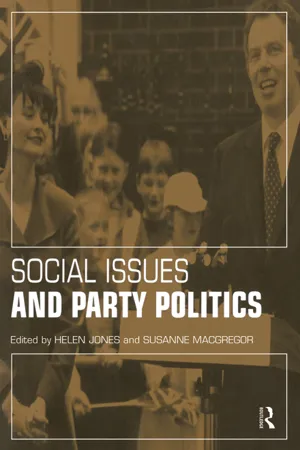
Social Issues and Party Politics looks at the manifestos of the main parties and the way social issues figured in the 1997 election campaign and the early days of the new government. Chapters discuss green issues, the management and financing of welfare in contemporary Britain, the delivery of key services in health, education, employment, criminal justice, housing, personal social services, pensions and other areas of social security. The particular circumstances of Northern Ireland, Scotland and Wales are also examined.
Social Issues and Party Politics takes social policy beyond the soundbite and provides a convincing and incisive analysis of current social policy approaches and inherited problems. It identifies the deep social questions which will need to be addressed if Labour is to deliver on its promise of a new Britain.
- 304 pages
- English
- ePUB (mobile friendly)
- Available on iOS & Android
eBook - ePub
Social Issues and Party Politics
About this book
Information
Chapter 1
The road to 1997
Helen Jones
THE SUN SHINES ON BLAIR
On 17 March John Major, and on 2 May Tony Blair, provided the 1997 General Election with a symbolic stage-managed symmetry. John Major, following a format he instigated in 1992, stood alone and isolated in Downing Street to announce 1 May as Polling Day. He used the occasion to launch the formal campaign (a phoney one had been underway for at least a year) with a party-political plea for the Conservatives. Six and a half weeks later Tony Blair walked up Downing Street (the formality and separation from the people of an official car abandoned) with a youthful and apparently happy family to the cheers and flag-waving of hand-picked party workers. These strong and contrasting images—of John Major, formal and isolated from party and people and Tony Blair, informal and surrounded by loyal supporters—were present throughout the campaign. Both parties put enormous effort into trying to control the media's presentation of their leaders. Labour succeeded, but the Conservatives failed miserably, not least because the bulk of newspapers were no longer, as in previous General Elections, the willing accomplices of the Conservative Party.
The way in which the parties presented their leaders and aimed to control the media affected the conduct of the campaign which some commentators believed signalled the growing ‘Americanisation’ of British elections with a more presidential style campaign, focusing on the leader, not the party. A live TV debate between candidates for the Presidency is an accepted event in American elections. Negotiations (conducted in private between Lord Irvine for Labour and Michael Dobbs for the Conservatives and slogged out in public between Peter Mandelson and Brian Mawhinney) to present a live TV debate between John Major and Tony Blair became a part of the campaign, foundering largely on the ‘Paddy problem’, that is, what role Paddy Ashdown, leader of the Liberal Democrats, should play. The Conservatives paid a man to dress up in a yellow chicken suit with a placard ‘Chicken Blair Won't Debate’ to chase Blair until he agreed to a live TV debate. (This was another echo of the 1992 presidential campaign.) The chicken spawned a whole zoo of animals posing for photographers, but it did little to leaven the Conservatives' gloom.
The media itself became part of the election news, not only over the negotiations for the TV debate but also, when the Sun declared early on in the campaign for Labour, with the Guardian's exposé of sleaze, and when the BBC's war correspondent, Martin Bell, stood as the Independent anti-corruption candidate to fight Tatton against Neil Hamilton. There was, too, a showbizz air to the campaigns with the parties trying to outdo each other by claiming the support of ‘personalities’. After the disastrous Sheffield rally of 1992, however, Labour trod warily in ensuring that showbizz support did not tarnish Tony Blair's carefully crafted prime ministerial image, or become triumphalist. Major's and Blair's touch of glamour came from their wives who closely shadowed them around the country.
Throughout the campaign the sun shone on Blair both literally and metaphorically. Opinion polls, even when they wobbled, gave Labour a long lead, as indeed they had done continuously for over four years. Notwithstanding this lead, Labour had learnt the lessons of 1992 and took nothing for granted. Blair and the Labour Party leadership repeatedly warned against complacency and focused their campaign, like the Conservatives, on the key marginals, roughly ninety seats, they would need to win, to form a government. Labour rarely attacked the Liberal Democrats, in order to encourage tactical voting against Conservative candidates (which paid off).
While all three parties targeted an exclusive number of constituencies, the voters they targeted were all inclusive. Both Conservatives and Labour presented themselves as the ‘one nation’ party. For the Labour Party this was part of its modernised image of catering for all sections of society but no sectional—particularly trade union—interests. The Conservatives tried to counter Labour's claims by spreading scare stories about the ghost of trade union power ready to rise from the grave where it had been buried by Mrs Thatcher. That this message was not taken seriously was largely due to the voters' lack of trust in the Conservative Party.
Voters' trust in the Conservatives had evaporated as a result of the Government's withdrawal from the Exchange Rate Mechanism (ERM) in September 1992, and rises in taxes. Good economic figures which appeared during the campaign did nothing to restore voters' faith in the ability of the Conservatives to manage the economy. Research into the links between voting behaviour and the economy from 1983 onwards suggested that voters were affected by the state of the economy over the whole life of a Parliament, not just in the run-up to an election. Voters treated the good economic news with scepticism; they did not think it would last, and anyway there was more faith in Labour's ability to manage the economy competently than there was in the Conservatives' (quoted in The Independent, 27, 30 March 1997). The Conservatives had, moreover, lost the trust of the nation as one aspect of corruption after another hit the news stands. The scandals were remorseless and continued throughout the campaign. The Labour Party exploited this lack of trust to the full, basing its whole campaign around the issue. John Prescott, Deputy leader of the Labour Party, who toured marginals in a bus, the ‘Prescott Express’, handed out cards with Labour's pledges; he explained ‘We're hoping it will help build trust’ (Independent, 27 March 1997).
Sleaze dominated the campaign and meant that both Conservative and Labour parties conducted largely negative campaigns. Only the Liberal Democrats campaigned positively on their policies, focusing on health and education. It was more difficult for Labour and Conservatives to highlight their policies because they appeared so close on many key issues. They wanted to provide the media with sound bites for the evening TV news, not expound the subtlety of their policies. On 20 January 1997, Gordon Brown, Shadow Chancellor, had ruled out rises in the basic rate of income tax for the life of the Parliament and the two main parties pledged themselves to the same spending targets for two years. Labour sought to reassure voters that their trust in the newly modernised Labour Party was well-founded and that Labour was ‘fit to govern’. It was difficult for the Conservative campaign managers to focus on policies because sleaze and divisions within the party, particularly over the EU, stayed to the forefront of the campaign. While no-one accused Major of corruption, it rebounded to his disadvantage because he was unable to stamp it out, and contradictory reports appeared in the Press as to whether senior Conservatives really supported those accused of sleaze, or whether they were furious and wanted them to stand down immediately. So, the image of the Conservative Party was not only of sleaze but also of dithering, confusion and splits. Whereas Labour played to its strengths, the Conservatives somewhat oddly gave a great deal of attention to Europe, and according to Nicholas Jones this both surprised Labour and meant that Labour did not devote as much attention as it would have liked to health, and law and order (Jones, N. 1997:234). There were good reasons for Labour avoiding too much dissection of these policies, however, because of incompletely-thought-out positions, and similarities with Conservative policies.
THE COURSE OF THE CAMPAIGN
On Monday 17 March, following a Cabinet meeting and an audience with the Queen, John Major announced 1 May as Polling Day. Standing outside No. 10, he fielded questions from the assembled journalists and in effect turned his announcement into an election broadcast. He needed the head start. The Conservatives were roughly 20 points behind Labour in the opinion polls, and had trailed badly for years. The Conservatives assumed that the longest campaign since 1918 would work to their advantage: with plenty of time for them to get their message across that the economy was booming, and for Labour to trip up. If they had been able to win in 1992 with a recession, and record bankruptcies and home repossessions, then surely the improving economy—as judged by falling unemployment, growth of roughly 2.5 per cent, consumer spending rising by 3 per cent a year, and the service sector compensating for the stagnating manufacturing sector—would be to their advantage? This assumption was challenged during the election by those who argued that voters' memories went back across the life of the whole Parliament, and that improvements in the economy might make people more willing to step into the unknown and trust Labour.
A willingness to trust Labour and widespread mistrust of the Government was fuelled when it emerged that Parliament was to be prorogued the following Friday, the very day Sir Gordon Downey, Parliamentary Commissioner for Standards, was due to present his report to the Standards and Privileges Committee on allegations that Mohamed al Fayed had bribed MPs to ask questions as part of a campaign orchestrated by Ian Greer, the political lobbyist, to discredit ‘Tiny’ Rowland of Lonhro. This meant that two former Conservative ministers, Neil Hamilton, MP for Tatton, and Tim Smith, MP for Beaconsfield along with a former Whip, Michael Brown, MP for Cleethorpes, and Sir Andrew Bowden, MP for Brighton Kemptown, could all stand for Parliament, if adopted by their constituency associations. The task for the Conservatives was now made even harder. Sleaze and Conservative divisions over Europe would dominate the campaign.
Major tried to dampen the sleaze issue in the first few days by claiming that he had not knowingly kept a minister at the heart of the cash for questions affair in his government, but this was rejected by Labour who tried to drag Major into the issue and while this was not successful, sleaze did overshadow the Conservatives' launch of their poster ‘Britain's Booming’. When John Redwood announced that for the Conservatives to win they had to show how education, health, and law and order would improve under another Conservative administration, and to explain how the Conservatives had followed the right economic policy over the previous three years, the task was to prove almost impossible because of the difficulty for the Conservatives to ‘show’ or ‘explain’ when there was so much disbelief in them.
The Conservative strategy rested largely on John Major. His winning soapbox style in 1992, when he was seen among, and of, the people was immediately revived. The raw and simple style of Major was meant to contrast with the slick (some thought smarmy) image of Tony Blair, born with a silver rosette in his mouth. On the day John Major called the election he stepped onto his soapbox, and Mrs Thatcher stepped out of her Belgravia office with dire warnings of the dangers of electing Tony Blair: ‘“New Labour” is cunningly designed to conceal a lot of old socialism. Don't be taken in’ (Independent, 18 March 1997). This warning served a dual purpose: it distanced Mrs Thatcher from the rumours that she had said that Blair would not ‘let Britain down’, and it took up the theme which the Conservatives were now going to plug, that Labour represented a new danger. Initially the Conservatives had hoped to campaign on their economic record but with no evidence that economic recovery would swing voters back to them, alternative and additional messages were required (Daily Telegraph, 17 March 1997).
An early indication of Labour's cautious style came when it emphasised that voting Labour would be quite safe as a Labour Administration would provide elements of continuity under a revitalised government (Daily Telegraph, 18 March 1997). Certainly, Labour's announcements that there would be new cabinet subcommittees to give horizontal integration to policy, and that it would prioritise employment for young people were hardly likely to frighten the shires (Financial Times, 19 March 1997).
It was also clear from the outset that the leadership package included the wives. On the evening of 19 March, Norma Major and Cherie Booth were both present, along with Diana, Princess of Wales, at the Gold Awards for Courage at the Savoy. Photos of the two wives, comments on what they allegedly did and did not say to each other, and how they behaved towards each other attracted newspaper coverage the next day. The event provided two further pointers to the campaign.
First, to a certain extent, the campaign became a ‘glamour’ event, with media, sporting and business personalities coming out for the parties. Supporters of the Conservatives included Geri of the Spice Girls; Lord Lloyd-Webber; Sir Cliff Richard; Frank Bruno; Michael Atherton; David Platt; David Seaman; Earl Attlee, grandson of the former Labour Prime Minister; Ian Gibson, Chief Executive of Nissan; and Baroness (P.D.) James. Labour supporters included Mel C. of the Spice Girls; Stephen Fry; Sir Terence Conran; Bianca Jagger; the Chief Rabbi, Jonathan Sacks; Lord Attenborough; Gerry Robinson, chairman of Granada Group; Alec Reed, founder of Reed Employment Agency; Lord Douro, chairman of Sun Life; and Jeremy Hardie, chairman of W.H. Smith (Independent, 18 March 1997). The support of leading business people was especially helpful for Labour.
Second, the two leaders' wives were the only two women to receive continuous media coverage throughout the campaign. Mrs Thatcher popped up from time to time, and Christine Hamilton had a number of walk-on parts. None of the parties pushed their female politicians into the limelight or gave them lead roles in the campaign. The campaign was a boys' own story.
During the first week of the campaign, Parliament was still sitting so there was the campaign in the House of Commons as well as the beginnings of activity in the country. At Prime Minister's Question Time, Blair and Major traded blows over the NHS much as they had done for the previous three years (Financial Times, 19 March 1997). Peter Lilley launched a £1 billion benefits pledge, the Family Benefits Guarantee, which the Conservatives claimed was further evidence that they were the party of the family. Lilley undermined this claim by laying new regulations before Parliament to cut housing benefit and funeral grants for the poorest families (Guardian, 22 March 1997).
During Week 2, when Parliament had been prorogued and the campaign really got under way around the country, both parties appeared edgy. Tony Blair urged his party not to be complacent and to reassure the country that it was safe to vote Labour. There was concern in the Blair camp that the sleaze issue would not help Labour in the end because voters (including potential Labour ones) would be turned off politicians and not vote. The Conservatives were also nervy. They twice changed a prearranged Press conference at the last minute to go with a different issue. This gave the impression that they were panicking. So, Conservative messages, such as the dangers of Labour's policy towards the trade unions, got lost in poor presentation.
One piece of negative news about the Conservatives followed hard on the next. Tim Smith resigned under pressure from local Conservatives from the third safest Conservative seat in the country, despite having support from Major, Heseltine and Portillo the previous week, a fact which seemed to underline how out of touch senior Conservatives were with the mood of the country; John Redwood published a book which was off-message on Europe and a single currency; George Gardiner, right-wing Euro-sceptic, was deselected by his constituency and slunk off to join the Referendum Party; and the Sun published pictures of Piers Merchant, a Conservative MP, which purported to show him kissing a 17-year-old girl, with allegations of an adulterous affair. Allan Stewart, a Scottish Conservative MP, and Sir Michael Hirst, a senior Scottish Conservative, both resigned amid whispering campaigns about their private lives. Negotiations over the TV debate broke down among recriminations from which neither party emerged particularly well. Only Paddy Ashdown, whose role had been at the centre of the dispute, emerged with any credibility as he set himself apart as the practical man with practical answers.
Week 2 ended with the Labour candidate in Tatton announcing that he was standing down to give a free run to an Independent anti-corruption candidate, and Labour hoped that the Liberal candidate would also stand down, which he duly did. The search for an Independent candidate led to names such as Frances Lawrence, Judge Stephen Tumim, David Attenborough, Richard Branson, Glen Hoddle, Joe Kinnear (manager of Wimbledon FC) and Chelsea Clinton being put forward, in varying degrees of seriousness.
Week 3, as all other weeks during the campaign, began badly for the Conservatives. Over the weekend there had been allegations that fellow Conservatives had stitched-up Sir Michael Hirst; Neil Hamil ton had released transcripts of his evidence to Downey, which was a breach of Parliamentary privilege; and Piers Merchant's Beckenham constituency had refused to deselect him, so flying in the face of John Major's wishes. Frederick Forsyth's likening of the single currency to the Holocaust made the right-wing of the Conservative Party look obscene with no sense of proportion. Further Conservative splits were signalled by a break-away rump of disaffected ex-Conservative Association executives.
There were two hiccups for Labour. Blair likened the proposed Scottish Parliament to a parish council, which outraged the Scots, and the Daily Mail claimed that all the trade union leaders had taken a vow of silence for the duration of the campaign so as not to embarrass Labour. Labour's Excalibur (computerised) rebuttal system was in action as soon as the claim had been made; the union leaders fell over themselves to refute any such self-denying ordinance. Less remarked on were the notable absences from the campaign of the Party's leftwingers, Tony Benn, Diane Abbott and Ken Livingstone, none of whom could be described as media-shy.
During Week 3 the main parties launched their manifestos. The Con...
Table of contents
- Cover
- Social Issues and Party Politics
- Full Title
- Copyright
- Contents
- List of figures and tables
- Notes on contributors
- Preface
- 1 The road to 1997
- 2 Managing the welfare state
- 3 Taxing and spending the people's money
- 4 Jobs, unemployment and the European Union
- 5 ‘Education, education, education’
- 6 The people's health
- 7 New partnerships for social services
- 8 Home truths
- 9 Poverty and social security in a changing Britain
- 10 Paying for pensions
- 11 Criminal justice: security, social control and the hidden agenda
- 12 The greenest election ever?
- 13 The view from Scotland
- 14 The view from Northern Ireland
- 15 The view from Wales
- 16 A new deal for Britain?
- Index
Trusted by 375,005 students
Access to over 1.5 million titles for a fair monthly price.
Study more efficiently using our study tools.
Frequently asked questions
Yes, you can cancel anytime from the Subscription tab in your account settings on the Perlego website. Your subscription will stay active until the end of your current billing period. Learn how to cancel your subscription
No, books cannot be downloaded as external files, such as PDFs, for use outside of Perlego. However, you can download books within the Perlego app for offline reading on mobile or tablet. Learn how to download books offline
Perlego offers two plans: Essential and Complete
- Essential is ideal for learners and professionals who enjoy exploring a wide range of subjects. Access the Essential Library with 800,000+ trusted titles and best-sellers across business, personal growth, and the humanities. Includes unlimited reading time and Standard Read Aloud voice.
- Complete: Perfect for advanced learners and researchers needing full, unrestricted access. Unlock 1.5M+ books across hundreds of subjects, including academic and specialized titles. The Complete Plan also includes advanced features like Premium Read Aloud and Research Assistant.
We are an online textbook subscription service, where you can get access to an entire online library for less than the price of a single book per month. With over 1.5 million books across 990+ topics, we’ve got you covered! Learn about our mission
Look out for the read-aloud symbol on your next book to see if you can listen to it. The read-aloud tool reads text aloud for you, highlighting the text as it is being read. You can pause it, speed it up and slow it down. Learn more about Read Aloud
Yes! You can use the Perlego app on both iOS and Android devices to read anytime, anywhere — even offline. Perfect for commutes or when you’re on the go.
Please note we cannot support devices running on iOS 13 and Android 7 or earlier. Learn more about using the app
Please note we cannot support devices running on iOS 13 and Android 7 or earlier. Learn more about using the app
Yes, you can access Social Issues and Party Politics by Helen Jones,Susanne MacGregor in PDF and/or ePUB format, as well as other popular books in Politics & International Relations & Health Care Delivery. We have over 1.5 million books available in our catalogue for you to explore.