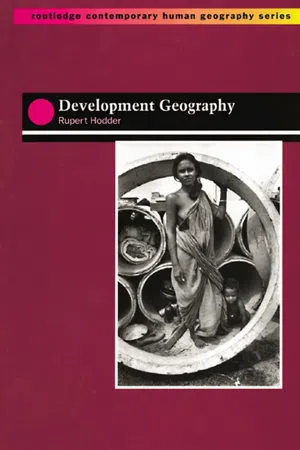
Development Geography is an informative and vibrant introductory level text, with a wealth of contrasting case-studies and illustrations. Written to stimulate critical thought and discussion about development, it does not assume any clear-cut distinction between 'developed' and 'developing' parts of the world. Case-studies highlight the problems and possible solutions at local, national and international scales. These include: * food production in Senegal * Disney in China * Hurricane Mitch in Honduras * corruption in Bulgaria * further studies from Russia, Bangladesh and Vietnam.
Development Geography is the fifth book to be published in the popular modular text series Routledge Contemporary Human Geography.
Definitions of ‘development’ and ‘the developing world’
Theories of development
Outline of approach
This short book is designed to stimulate critical thought and discussion about development and, in particular, about development in what is conventionally termed the developing world. The need for such thought and discussion has never been greater. Travelling and learning about faraway and exotic places has long been an attractive occupation, and more and more people are now able to travel and stay in the world’s poorest countries. Concern for the poor, equity and social justice and for the environment in which the poor of the world live has motivated and continues to motivate large numbers of people. But the rapidly increasing globalisation of economic, social and political life now demands a wider and deeper understanding of and perspective on the issues that face the world’s poor. There is a need for everyone to challenge many of the views, ideas and opinions which too often constitute the received wisdom or thinking about the developing world today. Moreover, the former Soviet Union, together with much of Eastern Europe, and China, are now usually counted as developing economies, and their central role in international affairs and security demands much greater knowledge and understanding in advanced countries, more particularly in the most powerful economies of the United States, Western Europe and Japan.
Three further points need to made clear about the approach adopted in this book. First, the book is necessarily very selective in its coverage, not attempting to provide a comprehensive geography of the developing world. A limit on length makes this impossible, and in any case such a task lies outside the aims and purpose of the Routledge Contemporary Human Geography series, of which this book is a part. Second, this text does not assume any clear-cut distinction between the ‘developed’ and ‘developing’ parts of the world. Some would go so far as to argue that the distinction no longer has any meaning, and, indeed, that it perpetuates the damaging ‘rich and poor’ divide in our thinking and confirms a certain patronising attitude towards the world’s poor. This viewpoint will be raised again at the end of the book. For the present, and as a study of the distribution and explanation of relative poverty and global inequalities in levels of development, the emphasis in these pages is inevitably on those parts of the world where poverty is most widespread and evident. To some degree, however, most, if not all, aspects of development geography apply universally: there are pockets of poverty and low levels of development in the richest countries, just as there are pockets of wealth and high levels of development in the poorest countries. Similarities between developed and developing countries also extend beyond the existence of islands of poor among the rich and of rich among the poor to embrace institutions, values, attitudes, patterns of behaviour and concepts of prestige, wealth and power. Reference is made to these similarities throughout this book and should help to avoid the common danger of a reader ‘switching off’ all experience and knowledge of the developed world while thinking about the developing world. It also facilitates the placing of development problems within the context of the global economy and society, and enables reference to be made, for example, to development problems in the former Soviet Union and Eastern Europe, and to the role of North America, Western Europe and Japan in reducing (or perpetuating) poverty in the developing world.
Third, the reader is encouraged to challenge many of the assumptions about development and, in particular, about the causes of poverty. The media continue to play an important role in informing us about the problems of the developing world and in encouraging a deep and often active concern for the plight of so many people in the poorest countries. Nevertheless, there is some danger that information and opinions can be too easily accepted uncritically as ‘facts’, or at least as received wisdom. This applies to development theory as much as to practical policies. No attempt is made here to direct the reader along any particular theoretical or ideological path. While some of the main theoretical approaches currently under discussion in the literature are introduced in this chapter and referred to where appropriate throughout the book, it is hoped that readers will reach their independent conclusions about the validity of the various elements in the constantly shifting theoretical debate in development studies.
Before tackling the problems of definition, it is important to make the point that there can be no ‘correct’ definition of ‘development’ or ‘the developing world’. The perspectives from which to approach development geography are many, varied and often conflicting, so that almost all statements made in these pages can be challenged by someone whose perspectives, assumptions and ideology are different from my own. Development studies generally is a fertile field for radical debate of one form or another; and geographers, like all scholars, ‘are prone to sinking their feet into the quagmire of definitions’ (Rigg et al. 1999: 581). As one group of authors puts it,
around the university world, in departments of anthropology, economics, development studies, geography and political economy, first-year students are being asked to think, debate and write about the meaning of ‘development’. As they sit earnestly at their first lectures . . . they are told that development is one of the hardest of terms to define.
(ibid.: 583–4)
Nevertheless, it is important to have some working definitions of ‘development’ and ‘the developing world’ in mind if any kind of clarity is to be achieved. All one can do in approaching the study of development geography is to start from what appears to be a sensible working definition while being prepared to reconsider one’s position as circumstances, evidence or experience suggest.
Definitions
‘Development’
There is some, though by no means universal, agreement that the term ‘development’ refers to a process which results in economic growth. But this is a very narrow definition based solely on economic criteria, and it is usual to include other, non-economic criteria and concepts. Thus development can be defined as an economic, social and political process which results in a cumulative rise in the perceived standard of living for an increasing proportion of a population. Such a definition suggests that an increased standard of living involves a social and political process as well as an economic one; that a rise in the standard of living must be cumulative, rather than just temporary; and that it has to be significant enough to be perceived by increasing numbers in a population. Clearly, this kind of definition embraces the concepts of equality and equity as crucial aims in any development process, but it does not go so far as to place the removal of all inequalities as the central aim in the development process. More simply, some argue that development is best defined as ‘growth with equity’.
Other definitions focus on technological change as a significant criterion. Thus development can be defined as the process by which a traditional society employing traditional, unsophisticated techniques is transformed into a modern, high-technology, high-income economy in which capital, labour skills and scientific knowledge replace labour-intensive methods of production. Clearly, the difficulties of trying to embody all possible criteria in a simple definition of development are immense, and one way of avoiding this problem is simply to describe the characteristics of less developed as distinct from developed economies. Thus Todaro (1997: 38) suggests that less developed economies are characterised by low levels of living, reflected in such indices as low income, high inequalities, poor health and inadequate education; by low levels of productivity; by high rates of population growth and dependency burdens; by high and rising levels of unemployment and underemployment; by substantial dependence on agricultural production and primary export products; by the prevalence of imperfect markets and limited information; and by dominance, dependence and vulnerability in international relations. However, it is easy enough to find exceptions, even to this broad list of characteristics; and though this descriptive definition has its uses in providing a checklist, it does not bring us nearer to a wholly satisfactory definition of development. Other writers place emphasis on the fact that many developing countries were formerly colonial territories, with all colonialism’s predictable economic, social, political and psychological effects. Development may also have a political perspective: that development should encompass freedom of action and expression, enabling people to have wider choices (Dickenson et al. 1996: 28). Or emphasis may be laid on three major objectives of development: sustenance, self-esteem and the ability to choose (Todaro 1997: 18).
Perhaps it is best to conclude that a wholly acceptable and universally applicable theory of development is neither possible nor desirable. As one writer has put it,
development is historical, diverse, complex and contradictory; it is the central feature of the human condition. To reduce it to a number of asocial characteristics and their interaction is to trivialize the experience of real societies and the struggle of their peoples to make a living.
(RL in Johnston et al. 1996: 130)
It is also important to realise that development can be approached from many different directions. Its study is a vast, interdisciplinary field and it attracts and demands the participation of workers whose interests and training are focused in or originate from many different disciplines. In any study of development it is sometimes difficult to decide which discipline is the most appropriate or relevant: economics, sociology, agricultural science, politics, geography or any other field of study. In practice, however, this does not raise any serious difficulties. In the case of geography, for instance, the geographer’s special interest in space, place and the environment directs, or at least informs, the issues and problems he feels most comfortable in examining. Furthermore, the geographer, like practitioners from all other disciplines, is always alive to the fact that in the study of development his or her work should be regarded as complementary to the work of colleagues from other disciplines.
‘The developing world’
‘The developing world’ is the term used here to refer to what is otherwise known as the ‘third’, ‘less developed’; ‘developing’, ‘undeveloped’, ‘underdeveloped’ or ‘backward’ world; other terms include ‘emerging economies’, ‘transitional economies’ and ‘the South’. Some of these terms have slightly different connotations, but for practical purposes they may be regarded as synonymous. All are in some ways unsatisfactory, even misleading, and it is becoming increasingly clear that we need to change quite fundamentally our thinking about the geographical division of the world implied in, for instance, the term ‘Third World’. Thus it has been pointed out that the division of the world into ‘First’, ‘Second’ and ‘Third’ worlds is now outmoded, because the past two decades
have seen the dramatic emergence of the newly industrialized economies [NICs] of South East Asia, where growth rates have far outstripped those of the advanced countries. . . . Equally profound has been the collapse of many of the former socialist countries, and their difficult transition to capitalism. In both cases, these new spaces of capitalism have proved problematic . . . crises in one area of the world now quickly spill over into other areas far removed from the original sources of instability. Yet, these instabilities notwithstanding, there can be no doubt that we are entering a new age in which the trajectory of the global economy will be much more centred on the development of Asian capitalism (especially China and India). Not only are there various shifts in the global spread of capitalism fostering all sorts of regional-bloc trading and integration agreements across the developed and developing world, their impacts at the local level are likely to be profound.
(Bryson et al. 1999: 13)
In these pages use is made of the classification of world economies adopted by the World Bank in its annual World Development Report. Figure 1.1 gives the latest picture from this source (World Bank 1998a). The data on which this figure is based have severe limitations, relying as they do on one criterion – per capita income – but they are simple and useful as long as they are taken in conjunction with other indices of development available in the World Development Report. This classification identifies four groups of economies (Table 1.1). The poorest of these – ‘low-income economies’ (such as Bangladesh or Nicaragua) – are defined as having GNP per capita incomes of less than $785; those economies with per capita incomes above this figure but below $3 125 are classified as ‘low-middle-income’ economies (including Egypt or Costa Rica); while those economies with per capita incomes above that figure but below $9 655 are classified as ‘upper-middle-income’ economies (such as Mexico or Brazil). Finally, those economies with per capita incomes above $9 655 are termed ‘high-income economies’ (for example, the United States or the United Kingdom). In a general sense, the developing world embraces the first three of these four groups. But, as Table 1.1 shows, there is some overlap between the third and fourth groups. It is clear that the main concentration of economies is at the lowest (poorest) end of the range and that they include a disproportionate number of African economies and disproportionately few Latin American economies.
These countrywide figures ignore the great range of levels of wealth and poverty within economies: spatial inequalities at different scales, urban and rural, by regions, classes and gender. This classification also depends on average per capita figures as the sole criterion. On this basis China comes well down the spectrum but, taking local purchasing power of currencies into account, China’s economy looks much bigger. According to the World Bank’s latest World Development Indicators, China’s GDP in 1997, measured at purchasing-power parity (PPP), was $3.8 trillion. This makes it the second largest economy in the world, ahead of Japan’s $3.1 trillion, and roughly half of the United States’ GDP of $7.8 trillion. Most emerging market economies look relatively larger when measured on a PPP basis, because their exchange rates tend to be undervalued relative to the dollar. Indeed, on this basis, seven of the world’s fifteen largest economies are in the developing world (China, India, Brazil, Mexico, Indonesia, Russia and South Korea) (The Economist, 8 May 1999: 142).
Figure 1.1 The four groups of world economies, by per capita income Source: After World Bank(1999)
Table 1.1 Classification of world economies into four groups, 1997
Two other attempts at classifying economies combine more than one criterion. One is the Human Development Index (HDI). This generalised index ranks economies on a scale based on three criteria: longevity, measured by life expectancy at birth; knowledge, measured by the weighted average of adult literacy and mean years of schooling; and standard of living, measured by real per capita income adjusted for the differing PPP of each country’s currency and other issues. The striking point about this classification is that the high and medium human development economies are in Latin America and that the economies with a low human development index are most characteristic of Africa and South Asia. Then there is the United Nations Development Programme (UNDP) definition of ‘Least-Developed’ economies, which focuses on the very poorest economies. In this case, as might be expected, the majority of least developed economies are in sub-Saharan Africa, with a few cases in South Asia.
Finally, mention should be made of the UN classification, which embraces the forty-four ‘least-developed’ economies as one of three groups, the other two being the eighty-eight non-oil-exporting developing countries and the thirteen petroleum-rich members of the Organization of Petroleum Exporting Countries (OPEC).
None of these classifications, attempting to give some precision to what is meant by the developing world, is entirely satisfactory. Which definition to choose must to some extent depend on the use to which any analysis is to be put. All suffer from incomplete, subjective or unreliable data. Not only are there great variations in the dates and reliability of statistical material, but some countries do not publish data regularly, or even at all. Thus in official statistical series, such as those of the World Bank, there are serious gaps in the information concerning China, Vietnam, Taiwan and Brunei. In some cases it is possible to fill in these gaps from local sources, but the problem of reliable comparative data remains. There are also difficulties arising from the different criteria used by different governments. In China, for example, GDP figures refer only to the gross value of industrial and agricultural output, ignoring services altogether.
On this basis, is ‘the developing world’ a valid or even a useful concept? Dickenson et al. (1996: 29–30) suggest that it is. They argue that international conditions, such as trade blocs, NICs and grassroots development, together with Friedmann’s focus on the ‘disempowered’ (1966), emphasising people, not places, have all tended to affect our view of the developing world. Todaro supp...
Table of contents
Cover Page
Title Page
Copyright Page
Plates
Figures
Tables
Boxes
Acknowledgements
Abbreviations
1 Approaches to Development
2 Population and Development
3 Culture and Development
4 Rural-Agricultural Development
5 Urban-Industrial Development
6 The State Context: China and Brazil
7 Regional Groupings, Trade and Aid
8 Globalisation
Epilogue
Bibliography
Trusted by 375,005 students
Access to over 1.5 million titles for a fair monthly price.
Study more efficiently using our study tools.
Frequently asked questions
Yes, you can cancel anytime from the Subscription tab in your account settings on the Perlego website. Your subscription will stay active until the end of your current billing period. Learn how to cancel your subscription
No, books cannot be downloaded as external files, such as PDFs, for use outside of Perlego. However, you can download books within the Perlego app for offline reading on mobile or tablet. Learn how to download books offline
Perlego offers two plans: Essential and Complete
Essential is ideal for learners and professionals who enjoy exploring a wide range of subjects. Access the Essential Library with 800,000+ trusted titles and best-sellers across business, personal growth, and the humanities. Includes unlimited reading time and Standard Read Aloud voice.
Complete: Perfect for advanced learners and researchers needing full, unrestricted access. Unlock 1.5M+ books across hundreds of subjects, including academic and specialized titles. The Complete Plan also includes advanced features like Premium Read Aloud and Research Assistant.
Both plans are available with monthly, semester, or annual billing cycles.
We are an online textbook subscription service, where you can get access to an entire online library for less than the price of a single book per month. With over 1.5 million books across 990+ topics, we’ve got you covered! Learn about our mission
Look out for the read-aloud symbol on your next book to see if you can listen to it. The read-aloud tool reads text aloud for you, highlighting the text as it is being read. You can pause it, speed it up and slow it down. Learn more about Read Aloud
Yes! You can use the Perlego app on both iOS and Android devices to read anytime, anywhere — even offline. Perfect for commutes or when you’re on the go. Please note we cannot support devices running on iOS 13 and Android 7 or earlier. Learn more about using the app
Yes, you can access Development Geography by Rupert Hodder in PDF and/or ePUB format, as well as other popular books in Social Sciences & Globalisation. We have over 1.5 million books available in our catalogue for you to explore.