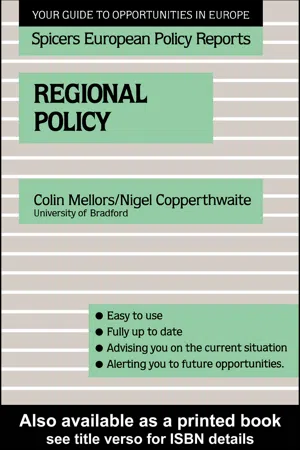
The European Community has committed itself to promoting 'economic and social cohesion' across its regions. Its expenditure - via the 'structural funds' - for these purposes is set to double by 1993. A key component of such expenditure is the European Regional Development Fund, which is receiving increasing attention from local and regional representatives and officials, as well as from companies considering where to locate their businesses. The integrated development operations of the EC involve important new initiatives at the local level. This volume explains how the ERDF operates and its relationship to other sources of funding from the EC. It offers comprehensive and up-to-date information, in a readily accessible format. Section II summarises the key EC policy documents involved, and Section III gives a full listing of all the relevant documents across a range of different aspects.
- 240 pages
- English
- ePUB (mobile friendly)
- Available on iOS & Android
eBook - ePub
Regional Policy
About this book
Information
APPENDIX 1:
COUNCIL REGULATIONS
Revised Arrangements for ERDF and its Relationship with other Structural Funds.
The following Regulations are reprinted, with the kind permission of the European Commission, from the Official Journal of the European Communities:
‘Framework’ Regulation: Regulation (EEC) No 2052/88 (1)
‘Horizontal’ Regulation: Regulation (EEC) No 4253/88 (2)
‘Implementing’ Regulation: Regulation (EEC) No 4254/88 (3)
‘Horizontal’ Regulation: Regulation (EEC) No 4253/88 (2)
‘Implementing’ Regulation: Regulation (EEC) No 4254/88 (3)
COUNCIL REGULATION (EEC) No 2052/88 of 24 June 1988
on the tasks of the Structural Funds and their effectiveness
and on coordination of their activities between themselves
and with the operations of the European Investment Bank and
the other existing financial instruments
and on coordination of their activities between themselves
and with the operations of the European Investment Bank and
the other existing financial instruments
THE COUNCIL OF THE EUROPEAN COMMUNITIES, Having
regard to the Treaty establishing the European Economic
Community, and in particular Article 130d thereof,
regard to the Treaty establishing the European Economic
Community, and in particular Article 130d thereof,
Having regard to the proposal from the Commission (1),
Having regard to the opinion of the European Parliament (2),
Having regard to the opinion of the Economic and Social Committee (3), Whereas Article 130a of the Treaty provides for the Community to develop and pursue its actions leading to the strengthening of
its economic and social cohesion and in particular for it to aim at reducing disparities between the various regions and the backwardness of the least-favoured regions;
Whereas Article 130c states that the European Regional Development Fund (ERDF) is intended to help redress the principal regional imbalances in the Community through participating in the development and structural adjustment of regions whose development is lagging behind and in the conversion of declining industrial regions;
Whereas, to that end, Article 130d of the Treaty provides for a comprehensive proposal the purpose of which will be to make such amendments to the structure and operational rules of the European Agricultural Guidance and Guarantee Fund, Guidance Section (EAGGF Guidance Section), the European Social Fund (ESF) and the ERDF as are necessary to clarify and rationalize their tasks in order to contribute to the achievement of the objectives set out in Articles 130a and 130c of the Treaty, to increase their efficiency and to coordinate their activities between themselves and with the operations of the existing financial instruments;
Whereas Community action through the Structural Funds, the European Investment Bank (EIB) and the other existing financial instruments must be in support of the objectives set out in Articles 130a and 130c;
Whereas the action taken through the Structural Funds, the EIB and the other existing financial instruments, the coordination of Member States’ economic and social policies, the coordination of national regional policies, the coordination of national schemes of assistance and other measures taken with a view to implementing the common policies and the internal market form, in accordance with Article 130b of the Treaty, part of a series of policies and measures aimed at strengthening economic and social cohesion, and whereas the Commission is called upon to make appropriate proposals in this regard;
Whereas it is necessary, in order to achieve the aim set by Article 130d of the Treaty, to direct all Community activity in this field towards the attainment of priority objectives which are clearly defined in the light of that aim;
Whereas on 11 and 12 February 1988 the European Council, with a view to strengthening the impact of Community structural measures, agreed to double in real terms commitment appropriations for the Structural Funds by 1993 as compared with the 1987 level; whereas at the same time it fixed the increases to be made up to 1992; whereas, within this context the Structural Fund contributions for regions coming under Objective 1 (see Article 1 below) are to be doubled in real terms by 1992; whereas in so doing the Commission is to ensure that, in the framework of the additional funds for the regions falling within Objective 1, a particular effort is made to assist the least-prosperous regions;
Whereas it is necessary to specify which Funds are to contribute —and to what extent and under what conditions they are to do so —to the achievement of each of the priority objectives and to determine the conditions under which the EIB and other existing Community financial instruments can make their contributions, particularly in conjunction with operations of the Funds;
Whereas, of the three Structural Funds, the ERDF is the main instrument for achieving the objective of ensuring the development and structural adjustment of regions whose development is lagging behind; whereas it plays a central role in the conversion of regions, frontier regions and parts of regions (including employment areas and urban communities) seriously affected by industrial decline;
Whereas the essential tasks of the ESF are combating long-term unemployment and the occupational integration of young people; whereas it helps to support economic and social cohesion; whereas it is also an instrument of decisive importance in the promotion of consistent employment policies in the Member States and in the Community;
(1) OJ No C 151, 9.6.1988, p. 4.
(2) OJ No C 167, 27.6.1988.
(3) OJ No C 175, 4.7.1988.
Whereas the Guidance Section of the EAGGF is, within (the context of support for economic and social cohesion, the main instrument for financing the adjustment of agricultural structures and the development of rural areas with a view to reform of the common agricultural policy;
Whereas action by the Funds, the EIB and the other financial instruments must inter alia underpin implementation of a policy of rural development;
Whereas the tasks of the Funds must be defined so as to specify the broad categories of tasks assigned to each of them respectively for the purpose of achieving the priority objectives; whereas Fund operations must be consistent with Community policies, inter alia as regards rules of competition, the award of public contract and environmental protection;
Whereas achievement of the priority objective of ensuring the structural adjustment of the regions whose development is lagging behind necessitates a significant concentration of the resources of the Community’s Structural Funds on that objective;
Whereas provisions on the indicative allocation of commitment appropriations between Member States are laid down under the ERDF so as to make it easier for the Member States to programme the measures which come within the ERDF framework;
Whereas the regions, areas and individuals in the Community eligible for Community structural assistance in connection with the various priority objectives should be determined;
Whereas a list should be drawn up of the regions whose development is lagging behind; whereas this list should comprise administrative level NUTS II (1) regions where per capita GDP measured in terms of purchasing power parity is less than 75% of the Community average, and other regions whose per capita GDP is close to that of regions under 75% and whose inclusion is justified by special circumstances;
Whereas it is necessary to drawn up criteria for defining declining industrial areas; whereas, moreover, Community action could, in order to ensure effective concentration of assistance, cover up to 15% of the Community population living outside the regions whose development is lagging behind;
Whereas criteria must be laid down for the selection of rural areas;
Whereas Community action is intended to be complementary to action by the Member States or to back up national measures; whereas, in order to impart added value to their own initiatives at the appropriate territorial level, close consultations should be instituted between the Commission, the Member State concerned at the competent authorities designated by the latter at national, regional, local or other level, with each party acting as a partner, within the framework of its responsibilities and powers, in the pursuit of a common goal;
Whereas it is necessary to specify the principal forms of structural assistance to be provided by the Community for the purposes of the objectives set out in Articles 130a and 130c of the Treaty; whereas those forms of assistance must enhance the effectiveness of the measures taken by it and at the same time, account being taken of the proportionality principle, satisfy the needs of the different situations that may arise;
Whereas the main emphasis must be placed on assistance in the form of multiannual operational programmes;
Whereas, in order to secure joint action between one or more funds, the EIB and one or more of the other existing financial instruments, those programmes may be drawn up and implemented on the basis of an integrated approach to the measures involved;
Whereas mechanisms should be established for varying Community assistance in line with the particular features of the measures to be supported and in the light of the context in which they are to be carried out and the financing capacity of the Member State concerned, having regard in particular to its relative prosperity;
Whereas, in implementing this Regulation, it is necessary to establish procedures for ensuring close association between the Commission and the Member States as well as, where appropriate, national, regional and local authorities designated by them;
Whereas it is necessary to establish effective methods of monitoring, assessing and carrying out checks in respect of Community structural operations, based on objective criteria, and to ensure that those methods are adapted to the tasks of the different Funds as...
Table of contents
- Cover Page
- Title Page
- Copyright Page
- Acknowledgements
- Foreword
- The European Community: Its Role, Institutions, and Legislation
- Section I: EC Policy Towards the Regions
- Section II: Key Documents On Regional Policy
- Section III: Official Publications and Related Documents
- Appendix 1: Council Regulations
- Appendix 2: Initial List of Areas Eligible for Objective 2
- Appendix 3: Glossary
Trusted by 375,005 students
Access to over 1.5 million titles for a fair monthly price.
Study more efficiently using our study tools.
Frequently asked questions
Yes, you can cancel anytime from the Subscription tab in your account settings on the Perlego website. Your subscription will stay active until the end of your current billing period. Learn how to cancel your subscription
No, books cannot be downloaded as external files, such as PDFs, for use outside of Perlego. However, you can download books within the Perlego app for offline reading on mobile or tablet. Learn how to download books offline
Perlego offers two plans: Essential and Complete
- Essential is ideal for learners and professionals who enjoy exploring a wide range of subjects. Access the Essential Library with 800,000+ trusted titles and best-sellers across business, personal growth, and the humanities. Includes unlimited reading time and Standard Read Aloud voice.
- Complete: Perfect for advanced learners and researchers needing full, unrestricted access. Unlock 1.5M+ books across hundreds of subjects, including academic and specialized titles. The Complete Plan also includes advanced features like Premium Read Aloud and Research Assistant.
We are an online textbook subscription service, where you can get access to an entire online library for less than the price of a single book per month. With over 1.5 million books across 990+ topics, we’ve got you covered! Learn about our mission
Look out for the read-aloud symbol on your next book to see if you can listen to it. The read-aloud tool reads text aloud for you, highlighting the text as it is being read. You can pause it, speed it up and slow it down. Learn more about Read Aloud
Yes! You can use the Perlego app on both iOS and Android devices to read anytime, anywhere — even offline. Perfect for commutes or when you’re on the go.
Please note we cannot support devices running on iOS 13 and Android 7 or earlier. Learn more about using the app
Please note we cannot support devices running on iOS 13 and Android 7 or earlier. Learn more about using the app
Yes, you can access Regional Policy by Nigel Copperthwaite,Colin Mellors in PDF and/or ePUB format, as well as other popular books in Politics & International Relations & Economic Theory. We have over 1.5 million books available in our catalogue for you to explore.