![]()
1
Newtonian Mechanics and the Principle of Relativity
1.1 INTRODUCTION
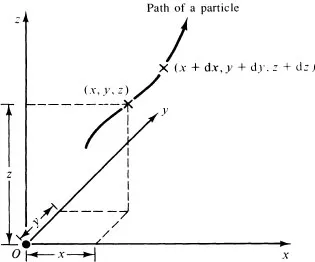
Measurements of the positions of events must be made with respect to an origin and axes (i.e. a coordinate system), which we shall call a reference frame. A typical Cartesian coordinate system is shown in Fig. 1.1. The position of an event, taking place at the time t, can be specified by the coordinates x, y and z. Suitable units must be chosen for measuring length, mass and time. Until we reach Section 4.3 in Chapter 4, we shall find it convenient to define the metre independently of the speed of light, and we shall adopt the 1960 definitions of length, mass and time, which are fully consistent with Newtonian mechanics. They are as follows:
Fig. 1.1 A Cartesian coordinate system is used to plot the path of an accelerating particle.
the metre (m) is equal to 1 650 763.73 wavelengths of the orange-red line of the krypton-86 atom;
the kilogram (kg) is defined as the mass of a cylinder of platinum-iridium kept at Sèvres, near Paris;
the second (s) is the duration of 9 192 631 770 periods of the radiation corresponding to the transition between the two hyperfine levels of the ground state of the caesium-133 atom.
Consider the measurement of the velocity of the moving particle shown in Fig. 1.1. By a particle, we mean a body of finite mass, but of such exceedingly small dimensions that it can be considered to be at one point of space at one instant of time. Such an idealization is generally a satisfactory approximation for atomic particles, such as electrons and protons. Let the position of the particle at time t be (x, y, z), and let its position a very short time dt later be (x + dx, y + dy, z + dz) as shown in Fig. 1.1. The velocity u of the particle is defined as a vector having components ux, uy and uz given by
| (1.1) |
Bold italic type is used to denote vectors. The suffixes x, y and z are used in equations (1.1) to denote the directions of the components of a vector. For example, ux is the component of the velocity u of the particle in the + x direction.
The acceleration a of the particle is defined as the rate of change of velocity:
1.2 A CRITIQUE OF NEWTON’S LAWS OF MOTION
1.2.1 Newton’s laws of motion
It is all too easy in a first course on Newtonian mechanics to go on to the applications of Newton’s laws of motion, without fully appreciating the definitions and interpretations of the quantities, such as mass and force, that appear in the theory. Before discussing the changes in the laws of mechanics that are necessitated by the theory of special relativity, we shall give a brief survey of the interpretation of Newtonian mechanics. It will be assumed that the reader has already had a course on mechanics leading up to Newton’s laws of motion, which will be taken as our starting point. Newton’s laws of motion are as follows.
(i) Every body continues in its state of rest or of uniform motion in a straight line unless it is compelled to change that state by an external impressed force.
(ii) The rate of change of momentum is proportional to the impressed force, and takes place in the direction of the force.
(iii) Action and reaction are equal and opposite. That is, between two bodies the force exerted by one on the other is equal in magnitude to the force it experiences from the other and in the opposite direction.
These laws were developed and have been applied to describe the mechanical behaviour of mac...