- 224 pages
- English
- ePUB (mobile friendly)
- Available on iOS & Android
eBook - ePub
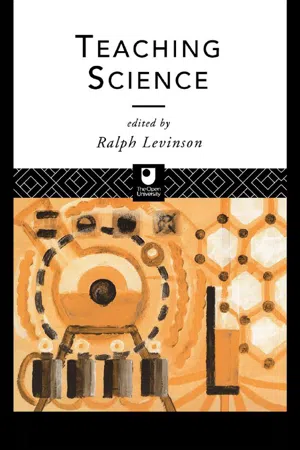
Teaching Science
About this book
Science education has undergone far-reaching changes in the last fifty years. The articles collected together in this reader examine how we have reached our present consensus and what theories we now use to explain how children learn science. The central sections of the reader examine how all this can be translated into effective and stimulating teaching, how learning can be most accurately and fairly assessed and how the impact of gender, ethnicity and other factors on children's performance can be addressed in methods of teaching which make science accessible to all. The articles in the final section of the book are a reminder that the debate is not finished yet and raise some challenging questions about what science education is and what it is for.
Information
Part I
The science curriculum Where from, where to?
Chapter 1
The laboratory comes of age
Science teaching must take place in a laboratory; about that at least there is no controversy. Science simply belongs there as naturally as cooking belongs in a kitchen and gardening in a garden. Books of recipes or gardening manuals can be read anywhere, but the smells, taste, labour and atmosphere can only be evoked in those who already know the reality. It is the same with science, and so the teaching of it must involve real contact with those aspects of nature which are to be studied. This has one great advantage: for young children the first move out of the classroom with its familiar rows of desks into the exotic atmosphere of a laboratory is immensely stimulating. Excitement and expectation stir. What should we do with these invaluable commodities?
The children themselves have no doubt about the answer; they are all agog to ‘do experiments’, to touch and use the strange new instruments and perform exciting tricks with them. To put it at its lowest level, this is a wonderful opportunity for new play! Alone amid this throng the adult teacher has another, sterner ambition—that somehow out of this rough, untaught expectancy can be forged an understanding of the insights and the methods of science. Both teacher and pupil are united only in a belief that experiment is the right tool for their objective, and indeed it is a marvellously rich instrument, if well used, with a host of possibilities. The children bring to it their gifts of imagination, curiosity and argumentativeness; the teacher hopes to add scientific purpose, logical method and practical skill. From a marriage of these two sets of qualities may issue an understanding of scientific theory.
EARLY SCIENCE TEACHING
Now theory is not an alluring concept in the educational scene. It conjures up memories of rigidly formulated statements, dry as chalk dust, emphatically underlined on the blackboard, to be learnt and reproduced by rote. Of course it can well be argued that these theories, the end product of so many years of scientific endeavour, are the intellectual heritage of our children.
The atomic theory, the laws of motion, evolution, gravitation, electromagnetic theory, the concepts of energy and entropy, these were all hard-won laurels in the continued battle of science, giving to modern humans rich and subtle ways of visualising the world around them. In the days when scientific education was still in its infancy the objective was simply to present these theories, along with their proofs, to successive generations of pupils as efficiently as possible. Here, they said in effect, is the scientific achievement, learn this.
It may be said that a boy takes more interest in the matter by seeing for himself, or by performing for himself…this we admit, while we continue to doubt the educational value of the transaction. The boy would also probably take much more interest in foot-ball than in Latin grammar; but the measure of his interest is not identical with the importance of the subjects. It may be said that the fact makes a stronger impression on the boy through the medium of his sight, that he believes it the more confidently. I say that this ought not to be the case. If he does not believe the statements of his tutor— probably a clergyman of mature knowledge, recognised ability, and blameless character—his suspicion is irrational, and manifests a want of the power of appreciating evidence.1
That extract, it must be admitted, has been included for sheer amusement. Colonel Blimp attitudes are always good for a laugh and no subject which can be as exuberant or as catastrophic as laboratory work should be viewed with exclusive sobriety! At this period science degree courses at the universities were still very new and school science was only just beginning. Some schools and technical colleges did offer a little student practical work even in those early days; at the City of London School, for example, pupils were asked to pay an extra seven shillings a term for such experimental tuition.2
Gradually school laboratories equipped for real experimental work became more common and yet, at heart, the method used to teach science differed very little from that used in history, geography or classical studies. Whatever the practical evidence that was offered to schoolchildren in the form of experiments, documents, maps, costumes, photographs or archaeological remains, it was always used to illustrate a concept or a theory which was also explicitly presented. In other words, it was evidence in support of taught theory and not designed as a child-orientated exercise in research. Until quite recently experiments performed in science lessons almost always fulfilled this supporting role; the theory was announced and then practical illustrations were paraded in its honour—some of them being notoriously obstinate in the yielding of obeisance! However, even if the experiments were not successful, it was a matter of no great importance, since all the details of procedure and the ‘correct’ results were to be found in the textbooks, which were required reading for all pupils. The discovery or establishment of a new theory was clearly far removed in spirit from any of the experiments that were taking place in the school laboratory.
ARMSTRONG AND THE DAWN OF DISCOVERY
The first attack on this approach to science teaching was made by H.E. Armstrong at the turn of the century. During this period, when Baden-Powell was trying to stimulate initiative and self-reliance in the young by his invention of Scouting for boys, Armstrong was attempting to instil the same spirit into the conduct of school experiments. It was an appeal for a new attitude towards education which sounds as fresh today as on the day it was written:
Let it be realised that an experiment is something altogether different from a demonstration or verification, just as a trial is very different from an execution…. The one involves prolonged mental activity, the other mere mechanical obedience. In schools generally the work done is scarcely ever proper experimental work but merely work involving practical demonstrations or verifications— executions not trials. Much nonsense is talked by trainers of teachers and by not a few teachers who ought to know better about the impossibility of children doing ‘original work’; it is forgotten that every conscious act done in ignorance of its consequences but with a distinct object of ascertaining what will happen is an act involving original enquiry.3
Suddenly it became possible to see a new dimension to education where experiment could be reinvested with all its original excitement and uncertainty. Not only would it be a real enquiry in itself, but it would also lead directly towards an understanding of theory. At one stroke this might both abolish the boredom of didactic instruction and also introduce the child to the new role of a scientific discovery: scientific practice elucidating scientific theory. Admittedly it was a very slow method of covering any syllabus, but for a while it did seem to be gathering support.
In the wider context Armstrong was no lone pioneering figure; it is possible to see him representing within science teaching an amalgam of many contemporary attitudes (those concerned with general child education) with the history and philosophy of science and even with the current psychology of learning. His outstanding importance, of course, lay in his application of these trends to the teaching of science.
THE NATURALIST MOVEMENT IN EDUCATION
Froebel, the originator of kindergarten education, and his mentor Pestalozzi had worked and written about their new liberal methods of teaching early in the nineteenth century, but it was only in Armstrong’s time that their influence came to be widely felt. There were many strands of Froebel’s system, but the one on which the ‘naturalists’ of the twentieth century laid most stress was the importance of allowing the latent powers of a child enough room to develop. It seemed to them that what children most needed was simply the freedom to cultivate their own individuality and exercise their own capacity for discovery. Some individuals, like Tolstoy, went so far along this path that it became hard to see much point in the continued existence of the teacher at all. Armstrong himself had been heard to complain that overdidactic teachers were one of his chief stumbling blocks but, as we shall see, he did have a definite task for instruction in his system. However, it is easy to understand how a liberal, discovery attitude towards education might well end by making the teacher seem an outmoded and redundant commodity. In more recent times also the doctrine of free discovery has often been linked with a movement to belittle or even to sweep away the interfering figure of the teacher.
THE PHILOSOPHY OF COMMON SENSE
By the first decade of the twentieth century the history of science seemed to present a gloriously uninterrupted march of progress. In particular, John Dalton’s atomic theory and Charles Darwin’s theory of evolution presented enthusiastic philosophers of science with a model of excellence for the discovery of truth in the natural world which they were anxious to transfer to every other field of study. The influence of optimistic scientism spread widely, from Bible criticism to social welfare, and a sadly mixed blessing it proved to be. Herbert Spencer, who wrote copiously about education, was also the author of an obnoxious brand of Darwinism in which he attempted to justify the absence of welfare for the urban poor by using the ‘law’ of the survival of the fittest.
The scientific method by which these prestigious laws had been discovered seemed to be no more than a simple mixture of observation, measurement and reasoning. T.H.Huxley, another colleague of Darwin, expounded a view of science which much influenced Armstrong’s thinking. ‘Science’, he wrote, ‘is nothing but trained and organised common sense.’ The philosopher Karl Pearson had written in 1892, ‘We must carefully guard ourselves against supposing that the scientific frame of mind is a peculiarity of the professional scientist.’ If this were so, there was indeed no need for specialised teaching, only the encouragement of organisation and practical training as Armstrong had proposed.
It also followed that the scientific method was similar to the best methods to be used in history, politics or the law. Skills gained in one subject could be directly transferred to another. The net result of education, they argued, was a trained mind—‘education is what is left when all that has been learnt in school has been forgotten.’ It is easy to see how welcome such attitudes would be to the traditional classics teachers in the public schools. Why then teach science at all? This was not a paradox that worried Armstrong himself, but many of his supporters struggled manfully with it on behalf of the new school study of science.
TRAINING THE FACULTIES
In the nineteenth century the infant science of psychology sought to divide the domain of the intellect into faculties which could be treated as separate and distinct elements. The task of education was to develop these faculties—the will, the imagination, the power of reasoning and the memory—by a carefully balanced programme of activities which was often compared to the training of an athlete’s muscles.
Armstrong and other reforming educationalists of the time were expected to justify their new courses by reference to these faculties. In 1896 the Oxford and Cambridge Examination Board gave their approval to a school science syllabus which had very largely been designed by Armstrong. Two years later he published an account of his method under the title Heuristic Method of Teaching or the Art of Making Children Discover Things for Themselves . The use of the word ‘making’ is slightly forbidding; how it must have jarred upon the ears of contemporary followers of Froebel! Armstrong firmly believed that children could be trained to discover, and that the process involved the faculties of observation, reasoning and memory. His pupils were set a programme of practical exercises to perform and Armstrong argued enthusiastically for the value of experimental work as a training ground for the mind.
It was fundamental to Armstrong’s whole position to believe that there was indeed a heuristic method in which pupils could be instructed. Few nowadays would be so sure that scientific discovery always chugs forward on such definite tramlines; in Armstrong’s day this belief rested upon a confident and simple philosophy of science. The subtle and revolutionary changes of scientific theory in the present century were yet to make an impact and there seemed to be no mystery about scientific discovery. Urging children to form conclusions from the results of their experiments thus appeared to be both an ideal educational process and also a likeness to science itself.
Highly trained faculties were regarded as the pinnacle of the educational achievement, producing an intellectual elite who wer...
Table of contents
- COVER PAGE
- TITLE PAGE
- COPYRIGHT PAGE
- FOREWORD
- INTRODUCTION
- PART I: THE SCIENCE CURRICULUM WHERE FROM, WHERE TO?
- PART II: A PICTURE OF REALITY
- PART III: THE ART OF TEACHING IN THE SCIENCE CURRICULUM (AND SOME PRACTICAL IDEAS)
- PART IV: ASSESSMENT A WAY THROUGH
- PART V: MAKING SCIENCE ACCESSIBLE TO ALL
- PART VI: SCIENCE EDUCATION A DEBATE
- ACKNOWLEDGEMENTS
- NOTES ON SOURCES
Trusted by 375,005 students
Access to over 1.5 million titles for a fair monthly price.
Study more efficiently using our study tools.
Frequently asked questions
Yes, you can cancel anytime from the Subscription tab in your account settings on the Perlego website. Your subscription will stay active until the end of your current billing period. Learn how to cancel your subscription
No, books cannot be downloaded as external files, such as PDFs, for use outside of Perlego. However, you can download books within the Perlego app for offline reading on mobile or tablet. Learn how to download books offline
Perlego offers two plans: Essential and Complete
- Essential is ideal for learners and professionals who enjoy exploring a wide range of subjects. Access the Essential Library with 800,000+ trusted titles and best-sellers across business, personal growth, and the humanities. Includes unlimited reading time and Standard Read Aloud voice.
- Complete: Perfect for advanced learners and researchers needing full, unrestricted access. Unlock 1.5M+ books across hundreds of subjects, including academic and specialized titles. The Complete Plan also includes advanced features like Premium Read Aloud and Research Assistant.
We are an online textbook subscription service, where you can get access to an entire online library for less than the price of a single book per month. With over 1.5 million books across 990+ topics, we’ve got you covered! Learn about our mission
Look out for the read-aloud symbol on your next book to see if you can listen to it. The read-aloud tool reads text aloud for you, highlighting the text as it is being read. You can pause it, speed it up and slow it down. Learn more about Read Aloud
Yes! You can use the Perlego app on both iOS and Android devices to read anytime, anywhere — even offline. Perfect for commutes or when you’re on the go.
Please note we cannot support devices running on iOS 13 and Android 7 or earlier. Learn more about using the app
Please note we cannot support devices running on iOS 13 and Android 7 or earlier. Learn more about using the app
Yes, you can access Teaching Science by Ralph Levinson in PDF and/or ePUB format, as well as other popular books in Education & Education General. We have over 1.5 million books available in our catalogue for you to explore.