eBook - ePub
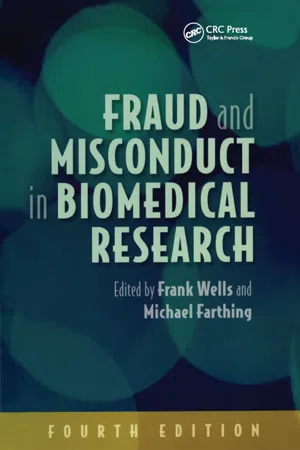
Fraud and Misconduct in Biomedical Research, 4th edition
- 312 pages
- English
- ePUB (mobile friendly)
- Available on iOS & Android
eBook - ePub
Fraud and Misconduct in Biomedical Research, 4th edition
About this book
Now in its fourth edition, Fraud and Misconduct in Biomedical Research boasts an impressive list of contributors from around the globe and introduces a new focus for the book, transforming it from a series of monographs into a publication that will quickly become an essential textbook on all areas of research fraud and misconduct.Key features inclu
Information
SECTION 1
SETTING THE SCENE
1 The concept of scientific dishonesty: Ethics, value systems, and research
Introduction
I have been interested in the problem of scientific dishonesty ever since the classic cases occurred in the USA and elsewhere from the mid-1980s onwards, and later with my involvement in the formation of the Danish Central Committee (undertaken before we had ever had a recent major case in the country). Here, however, I want to take a much broader look at the whole question, in particular trying to put it into the broader context of biomedical ethics. The publication of a fourth edition of this book creates the possibility of adding further perspectives and a broader scope of the topic, while still preserving its fundamental ethical and existential base.
The three concepts in my subtitle appear all the time in today’s publications. Research is, of course, a well-known term; ethics has acquired linguistic citizenship in medicine in the last 30–50 years, but value systems are a johnny-come-lately’ in our vocabulary. Nevertheless, the meaning of each term is often considered self-evident, and all of them are often used with a variety of different connotations. Any discussion of these key concepts in the context of scientific dishonesty needs, then, to start with definitions.
Definitions
Research
Research is defined here as an original endeavour comprising:1
• an idea leading to the first (‘original’) attempt to link two masses of knowledge (already existing or arising out of known previous research) with the aim of detecting causal relationships and not merely coincidences
• the transfer of the idea to one or more precise questions, characterized by the existence of potential answers
• a bias-controlling methodology intending to link the question(s) to potential answers (methodology is defined as the art of planning, technically carrying through, interpreting, and publishing scientific research) – good scientific methodology not only reduces the number of ‘honest mistakes’ within a project, but also makes the research more transparent; hence, it has a preventive effect on the prevalence of scientific dishonesty.
Value systems
Value systems cover all the measures of the non-material qualities of human life. Examples with a special relevance for scientific dishonesty are truth, reliability, responsibility, justice, and freedom. Values may be subgrouped into common values in a society (including those forming the basis of laws) and individual values, reflecting value diversity. The latter term is synonymous with value pluralism – on the one hand, a welcome part of citizens’ freedom; on the other, a potential cause of difficulty (e.g. for committees monitoring research ethics or scientific honesty and being faced with value judgements intending to reflect a ‘social consensus’).
If, for instance, a scientific project aiming at evaluating the reliability and risks of preimplantation diagnostic procedures in fertilized human eggs is sent to a research ethics committee, both lay and scientific members might reflect social diversity and not social consensus. Some members might find the method promising, compared with villus biopsy or amniocentesis, because infertile couples could be helped more effectively. Others might find the perspectives frightening because these represent a discrimination against people with malformations or other congenital handicaps.
When values themselves comprise spectra – such as freedom, justice, and truth – the value universe becomes even wider, and so cut-off points have to be introduced on the value scales. Such cut-off points are called norms, a typical example being the term ‘freedom’, defined as the sum of the individual citizen’s personal options. In a democratic society, another fundamental value, ‘justice’, needs the application of a norm on the freedom scale: personal freedom has to be limited at a point where any extension would reduce the freedom of other citizens. (In other words, this is a normative cut-off point.)
Ethics
As a term loaded with awe, ethics is often not defined at all – or is done so merely etymologically from its Greek derivation, ethos, meaning habits. However, again, to use the term in a serious context, we have to provide a contemporary definition. Here, ethics is defined as:
• The collection of fundamental values, attitudes, and norms considered by most of the population as essential for personal life, life with one another, and life in relation to a society’s institutions. Some of these values vis-à-vis biomedical research and national health services are equality, the ‘good Samaritan’ duty, justice, truth, responsibility, professional competence, and freedom.
• The relation between ethics and the law is bimodal. Ethics, with its fundamental values, forms the basis of legislation. Nevertheless, it also comprises values that are not controlled by the law, but are still decisive elements in societal and personal life.
Value universes of biomedical research
Until recently, science had an elite status. Scientists were considered more honest than ordinary citizens, and hence an idea was current that research dishonesty did not occur outside fiction (as in ‘Dr Jekyll and Mr Hyde’). Today, however, we know better, and so can deal with this aspect in theoretical terms. The value universes of biomedical research concern two main subgroups:
• those related to society in general – the external universe
• those related to the research community itself – the internal universe.
The former is concerned with the safety and trust of patients (not only patients in general, but also trial patients in particular, as well as healthy volunteers).
Thus, the first aspect is the ethics of the research so far as the safety of and respect for the citizens acting as subjects are concerned. The evaluation rests primarily with research ethics committees, but the necessary premises also depend on the honesty of the researchers – and hence on knowing the risks to the participants, the potential benefits of the expected results, and an up-to-date survey of the literature.
The second aspect of the honesty/dishonesty concept is how scientists recruit their trial subjects: do they fairly present all the undisputed facts to potential participants?
Thirdly, are the results interpreted totally independently of any sponsors of the research? If the results are untrue for any reason, clinicians may be misled in their treatment, even to the extent that the criminal law becomes involved should patients’ health or even lives have been endangered. In this way, the societal value universe comes into close and serious contact with research activities.
Within the internal universe, scientists’ curricula vitae form the most important basis for decisions on grants, academic appointments or promotions, travel to conferences, etc. Here, with the volume of scientific publications as the currency of the research market, any counterfeiting will have the same negative effects as in the monetary sphere. Values such as truth, justice, and responsibility are all at stake. The result may be that honest investigators sometimes lose out, because they have to spend much time on the project. Conversely, the fraudster can recruit patients faster; can work sloppily in the laboratory; or, most seriously, can fabricate the results or be a sleeping partner in several projects, but still an author in all the publications, thereby collecting much of the currency (here represented by authorship and coauthorship).
To sum up, the value spectrum of research has an external part orientated towards society, and an internal part orientated towards the research community itself. Courts and laws control the former (with problems arising from the research community’s lack of transparency). Independent bodies with experience in research must control the latter, but at the same time must work as society’s ‘open eye’. In addition, these bodies must extend their interests into the grey zone between dishonesty and good scientific practice.
Why do scientists transgress?
The motives behind scientists’ transgressions of the prevalent norms for our value universes are partly universal – in other words, similar to those behind legal and non-scientific moral transgressions – and partly special to the competitive research community. The latter aim at changing the ratio between original ideas and the necessary time and effort spent on methodology to obtain more publications for the curriculum vitae without any effort or insecurity. In a neighbouring area, there is neither frank dishonesty nor good scientific practice. Instead, there are numerous ‘me too’ projects, lacking any originality, good methodological planning, or the risk that the research will be fruitless (because the project ends not with an answer ‘yes’ or ‘no’, but with a ‘sorry, no answer’).
All this is also true for non-legitimate authorship – for instance, the practice (often considered as a right by heads of departments) of adding names to a paper. Again, such behaviour is only partly dishonest, although it is not in accordance with good scientific practice. Nevertheless, both ‘me too’ projects and gift authorship contribute to the still prevalent attitude in too many research units that ‘We know best about the good traditions in science, and no outsiders should try to teach us anything new or different.’ In other words, both of these phenomena in the grey zone are moral pollutants at a time when honest scientists and editors are trying to clean up the temple of science.
The other motive encountered in scientific dishonesty is the attempt to reduce the standing of competitors by accusing them of irregularities in their research (a euphemism for dishonesty). This is done either by a direct accusation to a national committee or, more often, by a campaign of rumour-mongering. The motive is often masked as a profound interest in the purity of science, and, even when the accused has been cleared after a thorough investigation, it often achieves its purpose through the psychological burden placed on the accused, the loss of productive time, and the lingering doubts (reflecting the old saying ‘There’s no smoke without fire’). This kind of whistleblowing has a different motive from that of the ‘ideal whistleblower’, who is usually a junior ‘hands-on’ member of the same department as the accused and is concerned about apparent irregularities. Competitive, false whistleblowing, conversely, takes place between research scientists equally highly placed in the research hierarchy.
What is the driving force for fraud?
The driving force that unites the motives into active dishonesty varies from a criminal element to more cautious attempts to buy valid currency on the black market (more publications on the curriculum vitae). For obvious reasons, we know very little about these intentions, because sanctions are often taken in proved cases without scientists disclosing their motives. Such a policy of ‘admit as little as possible’ is well known from ordinary courts of law, but it is a source of wonder how often intelligent people can embark on dishonest research, given that they ought to ‘know better’. My qualified bet is that they know very well about the consequences of such behaviour, but think that they are too smart to get detected.1
Scientific dishonesty in relation to its nature, prevalence, and consequences
The four classic examples of fraudulent behaviour are fabrication, falsification, plagiarism, and theft. All represent transgression of laws and fundamental values known to the transgressor, and so are closely related to the crimes found in a country’s penal code. Hence, it is justifiable to speak of a general intention to deceive, whether or not the transgression is admitted when the facts come to light. The consequences of such serious scientific dishonesty are most serious in clinical research dealing with life-threatening diseases, as, for instance, in an example of treating disseminated breast cancer with bone marrow transplantation. An obvious parallel is set by the so-called alternative treatments marketed for serious disease without scientific evidence and directly addressing laypeople. Here, however, there has been no professional authorization of the alternative methods, and hence a mixture of individual conceit and protective group insufficiency leads to a general blamelessness.
The next example of dishonest behaviour among scientists deals primarily with the way in which research results are evaluated and interpreted, and falls into the subgroup of biomedical ethics labelled ‘publication ethics’. Data archaeology and ‘cleansing’ of results for outliers – in other words, results that, if included, would seriously lower r-values and increase p-values – occur when scientists work with their raw data. Data massage, or archaeology, means that scientists apply enough statistical tests until one of them produces a sufficiently low p-value, without mentioning this multiple hypothesis testing in the subsequent publication. Such dishonest use of statistics is cognate with the exploitation of mass significance – for example, using a 0.05 level of significance and applying 20 significance tests on related data from the same group of subjects, not realizing or forgetting that, by chance, at least one of them will show a p < 0.05. If done by an experienced scientist, such a practice will be fraudulent; if done by a tyro, then it can be an honest mistake, caused by a lack of methodological insight.
Another dishonest practice ...
Table of contents
- Cover
- Half Title
- Title Page
- Copyright Page
- Table of Contents
- Contributors
- Preface
- SECTION 1: SETTING THE SCENE
- SECTION 2: THE HISTORICAL ASPECTS OF RESEARCH MISCONDUCT
- SECTION 3: THE PREVENTION OF RESEARCH MISCONDUCT
- SECTION 4: APPROACHES TO THE DETECTION OF RESEARCH MISCONDUCT
- SECTION 5: INVESTIGATION OF RESEARCH MISCONDUCT
- SECTION 6: THE WAY FORWARD
- Index
Trusted by 375,005 students
Access to over 1.5 million titles for a fair monthly price.
Study more efficiently using our study tools.
Frequently asked questions
Yes, you can cancel anytime from the Subscription tab in your account settings on the Perlego website. Your subscription will stay active until the end of your current billing period. Learn how to cancel your subscription
No, books cannot be downloaded as external files, such as PDFs, for use outside of Perlego. However, you can download books within the Perlego app for offline reading on mobile or tablet. Learn how to download books offline
Perlego offers two plans: Essential and Complete
- Essential is ideal for learners and professionals who enjoy exploring a wide range of subjects. Access the Essential Library with 800,000+ trusted titles and best-sellers across business, personal growth, and the humanities. Includes unlimited reading time and Standard Read Aloud voice.
- Complete: Perfect for advanced learners and researchers needing full, unrestricted access. Unlock 1.5M+ books across hundreds of subjects, including academic and specialized titles. The Complete Plan also includes advanced features like Premium Read Aloud and Research Assistant.
We are an online textbook subscription service, where you can get access to an entire online library for less than the price of a single book per month. With over 1.5 million books across 990+ topics, we’ve got you covered! Learn about our mission
Look out for the read-aloud symbol on your next book to see if you can listen to it. The read-aloud tool reads text aloud for you, highlighting the text as it is being read. You can pause it, speed it up and slow it down. Learn more about Read Aloud
Yes! You can use the Perlego app on both iOS and Android devices to read anytime, anywhere — even offline. Perfect for commutes or when you’re on the go.
Please note we cannot support devices running on iOS 13 and Android 7 or earlier. Learn more about using the app
Please note we cannot support devices running on iOS 13 and Android 7 or earlier. Learn more about using the app
Yes, you can access Fraud and Misconduct in Biomedical Research, 4th edition by Frank Wells, Michael Farthing, Frank Wells,Michael Farthing in PDF and/or ePUB format, as well as other popular books in Medicina & Etica in medicina. We have over 1.5 million books available in our catalogue for you to explore.