Act Three
A century of science
The curtain rises on the final act. Deemed by some as the “century of science,” the twentieth century launched new scientific discoveries, theories, and inventions that exceeded all the centuries before. The century framed the formation of a “scientific imaginary,” in which the discourses and discoveries of scientific research came to dominate the imagined realms of social and cultural organization. This scientific imaginary was articulated through many of the major tropes this book has sought to trace. Peopled by avatars, who dwelt in new, virtual domains, these imagined forms of embodiment managed various modes of exchange, from transformation to the transference of funds. The century began with the dominance of machines, technologies proceeding from the nineteenthcentury age of invention. As we will see, the early imaginary was a machinic one. However, the invention of electronic devices and, finally, “smart” machines, that mix the machinic with a sense of porosity, or fields, will mark a major shift in the imaginary in the later years of the century.
The greater influence of science was due, in part, to a shift in its own basic paradigm of time and space, the ruling framework of the scientific imaginary. The science of the “other” Newton, not the alchemist we reviewed earlier, but the discoverer of gravity, had permeated the understanding of time and space up until Einstein’s theory of relativity, first published in 1907. There, Einstein drastically revised Newton’s theory of gravity, altering, at base, the relationship between time and space, energy and matter. His theory of relativity troubled the stable division between time and space, creating, instead, a third term—spacetime. Space-time is not a stable, empty frame, but one that is curved, or “warped” by the distribution of mass and energy within it (Hawking 2005: 38). Abandoning the standard rule of three dimensions, Einstein introduced spacetime as a fourth dimension. Relativity revolutionized all applications proceeding from this new paradigm. For example, the great geometries that ruled the nineteenth century map-makers were altered, as straight lines became curved. Einstein’s famous metaphor for these relations, the elevator in empty space, illustrated that there is really no “up,” no “down” in space (an image that will appear later in Robert Wilson’s staging of Philip Glass’s Einstein on the Beach). If it moves with constant acceleration, you would feel a pull, which is something like gravity, BUT you would feel the same pull if it were not moving, remaining at rest in a uniform gravitational field. This “equivalence” also alters time, which can be slower and faster, depending upon these factors. Thus, there is no absolute measure of either time or space, but only an interdependent, dynamic relationship.1
As these discoveries began to permeate the cultural imaginary, new forms of composition appear in the arts, as if somehow mimetically reproducing the new paradigm of the space-time continuum. Indeed, abstraction, as it was termed, will become a new, contested form of composition, proceeding from the reception of the scientific imaginary. In theater, a new structuring of the mise en scène mimicked the schematic designs of engineering in the early part of the century, while the notion of field theory influenced composition in the later decades. Artistic replications of the research uses of “relativity,” “uncertainty,” and “field theory” guided breaks with old narrative structures, the “engines” of nineteenthcentury modalities. Heisenberg’s principle of “uncertainty” was actually staged as descriptive of his own historical situation in Copenhagen, and “relativity” became a byword of ethical determinations.
Unfortunately, the new paradigm also led to new modes of weaponry. Transformation, once the alchemical realm of mercury, took on the processual forms of fission and fusion. Anxieties surrounding the development of the atomic bomb haunted the mid-century. Transmutation was raised to the level of a global power of destruction as well as sustenance. The potential destruction of the entire planet fueled mid-century scenarios of the fear of transformation, such as alien abductions, while strategies of survival led to the construction biospheres.
In the late twentieth century, mapping, the great Enlightenment adventure of the nineteenth century, although disrupted by the notion of “curved” space, took an immediate and even individual form in global positioning systems (GPS). The omniscient view of the surveyor ascended into satellites circling the globe. On the one hand, the GPS created a global-positioning cyclorama of surveillance, upon which the sites and figures of citizens appeared before “homeland security” spectators; on the other, performances in these spaces created new entertainment, such as “geocaching,” or finding hidden treasures through clues in the GPS.
Money itself became literally virtual—its paper/metal body uploaded to somewhere behind the flickering screens of ATMs and computers. Virtual forms of money enabled fast-moving capital investment across national boundaries and currencies, untying from precious metals and “floating” financial value through rapid trading maneuvers. The rights to intellectual property became the focus of individual and national debate, as digital duplicating and downloading tested the limits of ownership.
The alchemical tradition of emblematic discourse and the numerical discourse of the “new” science conjoined to form a proliferation of codes and a cultural obsession with cryptography, from the very basis of physiological composition in DNA to critical theories concerning attributes of gender and “race,” known as cultural coding. While national agencies struggled to decode and encode their instructions to agents, grassroots performances of encoding included code rings in cereal boxes and best-selling novels, such as The Da Vinci Code to inspire pilgrimages to art museums and religious sites.
The ascendancy of the human subject continued to combine with new technologies to create earth-threatening levels of pollution, endangering the very survival of all species. Not only did humans lock themselves into biospheres in order to ensure their own mastery of nature, but they also reveled in a new space, apart from “nature” called cyberspace, or Virtual Reality. Performances within this new space sought to demarcate its transcendent, simulated technospace of ascendancy from the “real.” Cyber-space was immediately inhabited by a privileged, virtual class, as a secure and profitable realm for business and entertainment. On the one hand, what was once imagined as a spiritual realm, some integral site of vitalist, human difference, was interwoven into corporate networks of software and electronic circuitry; on the other, traditional religious beliefs sought to retain their hold on the definition of virtual space, coming into sometimes violent conflict with the modernist ideologies that supported the transnational, corporate spread of the technological virtual.
Spiritual practices both fractured into innumerable cults and amalgamated with nations into massive movements of the traditional faiths. In the late twentieth century, and into the twenty-first, debates still raged over Darwin’s theories, defining one of the contested borders between science and the spirit. At the same time, a New Age dawned in the spiritual imaginary, performing the spiritual affect of new technologies, including the healing, spiritual harmonics of electronic music, and the practice of channeling avatars. On the darker side, the Faustian paradigm continued to inform both real-life and theatrical conflicts concerning the relationship between the human subject and the virtual realms. Avatars appeared through channelers and on the internet.
Moreover, performance itself became an operative term for the interactive relationship emerging between the technological and the social. The elements of performance, from characterization to the mise en scène became useful in the expression of scientific affect. Individual scientists were fashioned as characters of human intelligence and productivity. Images of Einstein were reproduced on postage stamps, T-shirts, and posters and the biography of the scientist stood in for the social and moral dilemmas surrounding the discoveries. Einstein, Galileo, and Darwin literally took the stage at various crisis points in the scientific imaginary to figure the social inter-face with the rational processes of scientific proof and the ethical dimensions of invention. Moreover, new technologies of staging provided high levels of special effects, literally staging a spectacle of new technologies, in rock concerts, Broadway musicals, and even Las Vegas shows.
As the technological surround increasingly enclosed and perforated the postindustrial subject and the interactive relations of the social and the technological became more ubiquitous, the notion of performance came to represent both the mode of participation in the digital realm and an oppositional embodiment of the “live.” The construction of the online avatar as actor in cyberspace offered a navigational device that imagined its functions within the electronic realm as a performance. In contrast, the notion of “live” performance came to represent an urgent, rhetorical contradiction to both the archival functions of film and television and to the mediatization of the public sphere. Thus, the forms and potentialities of performance and science melded in several ways: performance created a social interface for the technological, and scientific discourses offered new forms and apparati of proximities, dependencies, and spatialities.
SCENE ONE:THE EARLY YEARS
The early years of the century were still marked by anxieties and hopes surrounding the proliferation of machines. New performance mechanics and narratives arose around the formation of the machinic consciousness. Mark Seltzer terms the anxieties of the machinic as “melodramas of uncertain agency,” inspiring performances of “the machinelikeness of persons and the personation of machines (1992: 18).” Early plays by the Expressionists and Futurists both condemned and celebrated the machine and the machine-like. Robots on stage, as in R.U.R and Sexual Electricity promise either a form of free labor, or the violent displacement of human existence. Taylorism, the schematic organization of factory work and workers as machine-like, produced social nightmares, as in the plays Machinal and The Adding Machine. Later, mid-century grassroots performances of UFO sightings and alien abductions brought powerful machines into contact with domestic settings, creating scenarios of invasion, on the one hand, and the invention of empowered interstellar personae, on the other. By the end of the century, prostheses and software developments created a cyborg imaginary that troubled the sure boundaries between human and machine, with online avatars such as Lara Croft, replicating themselves in “live” actresses.
The century began with three basic approaches to staging science and new technologies: the Expressionist depiction of scientific developments as oppressive and authoritarian; the Futurists’ ecstatic embrace of technological power as enabling and liberating, and the Soviet address to the scientist rather than the technology, testing his goals in terms of the sustenance of the social. These modes of representing science continued to inform the cultural imaginary throughout the twentieth century.
Central to each is a focus on the production of commodities that derive from scientific research. The machines invented in the late nineteenth century are now shown to dominate the economic and social realms. Some plays focus on the laborer at the machine: stenographers and clerks, garment workers, and those responsible for the production line. Others focus on the factory itself, where the machines demand constant tending. The need for more labor-intensive machines drives the growth of capital into its final form: the military-industrial complex. Here, the character of the Engineer emerges as the interface between science and development. He is depicted as power-hungry in the Expressionist plays, and, although tempted, finally responsive to the collective in the Soviet ones. He is the figure who creates the designs that result from research work. He can choose to use them for profit or for sustenance.
Expressionist schematics
Expressionist plays staged the psychic register of science and its visual culture as a dark, twisted, oppressive field that contained and enslaved the human subject. German Expressionist stage design deployed a twisted geometry to depict this force field of oppression. Based on the abstraction of the painted line and the geometric plane, the sets installed a composition of slashing diagonals and colliding planes as the representation of the force field that contained human action. Often rendered in the strict polarity of black and white, this agonized geometry disallowed any fanciful flourish, or organic referent to grace its intersections. Even when the scenes revealed a mimetic impulse, the abstracted nature of the lines suggested that the sites were twisted by the codes of oppressive social, psychic, and scientific practices. In other words, the codes could be made visual. The schematic of the codes determined the actions of the human subject, or, more precisely, the human object within them. The referents of this scenic geometry, as in geometry itself, were the postulates of authority that determined their figures. As geometric figures proceed from the authority of theorems that organize space through laws governing straight lines and angles, the Expressionist set offered a rendering of the unseen force field of authority which prescribed the angles of visibility and of social intercourse.
The schematic set participated in the larger visual culture that science and invention were creating. With the proliferation of machines came the proliferation of plans, designs, diagrams, and charts. Not only were schematics the source of machines, but they were also their results, shaping information into diagrams. The geometric lines of the Expressionist set theatricalize this mode of representation, putting the schematic into the service of the psychic and the social. Yet schematics were only the more accessible and active discourse of science. The increasing abstraction of scientific discourses that operated as authoritative codes that affected the subject but were inaccessible to “him” also inspired the Expressionist geometry of authority. The diagram the set offered was an authoritarian one, determining what played within it. While the codes were depicted as oppressive, the revelation of them through this design was considered revolutionary and liberating. The ability to actually make the operations of these codes visible was, literally, a form of revelation. Thus, the Expressionist set was established as counter-cultural—a scenic critique of dominant codes.
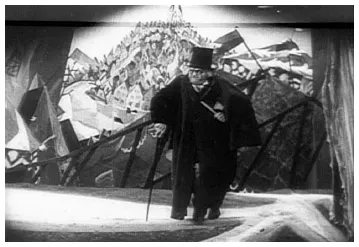
Robert Wiene’s The Cabinet of Dr. Caligari (1919) provides a film archive for the Expressionist mise en scène. The sets in Caligari were designed by three artists who had been part of the leading Expressionist painting school known as Der Sturm: Walter Reimann, Hermann Warm, and Walter Röhrig. Painted tableaux with flattened perspective represent living spaces, streets, and workspaces as colliding planes and lines. They demonstrate the violent effect of jagged diagonal lines converging in small, claustrophobic locales. The actors share in the maelstrom of the codes, wearing costumes with competing geometric designs.
At the conclusion of the film’s story, the nightmare of human relations is laid at the feet of Dr. Caligari, who is revealed to be the director of a mental hospital. The mental institution, as it was once termed, operates as the site of collusion between investigative science and the enforcement of normative social behavior. The newer science of the mind performs the scientific surround that has thoroughly penetrated the human subject, even into the deepest reserves of the subconscious. In the institution, scientific observation has become surveillance, and the scientist in a lab coat is represented by the authoritarian psychiatrist, Dr. Caligari.
The play Job (1917) by the painter and graphic artist Oskar Kokoschka offers a Faustian version of the Expressionist portrait of the psychiatrist. The psychiatrist first appears to Job as a poodle, as did Mephistopheles in Goethe’s Faust. The association, although satirical, is clear—the psychiatrist tempts the mind into a false, contorted state. The psychiatrist spies through a keyhole at Job’s wife, a take-off on psychiatric observation. He concludes his study of her through his discovery of the “Erotococcus,” a bacillus of sexuality that composes her core. He then becomes infected by this bacillus, obsessively tied to the wife. In other words, the play of scientific terminology and the science of the mind infects all those who participate in its surround with a literally twisted (Job cannot straighten out) and obsessive need to spy, diagnose, and infect.
These examples illustrate how the Expressionist mise en scène of repressive codes, together with characterizations of scientists as scientists of the mind, made the human actor a porous site, written on by the codes in costume and make-up, corporeally twisted by them, and psychically tortured through their application.
Between typewriter and electric chair: Machinal
Edison’s success in tying the scientific laboratory to its commercial products conflated, in the popular reception, science with the machine. Machines, in industry and in daily life, became the most visible effects of scientific research. Their growing numbers signaled the perforation of the social and cultural realms by scientific development, inspiring anxieties concerning their assimilation of human functions. At the same time, the Taylorist organization of labor, which treated human functions as if machinic, inspired the sense that industrial labor made men into machines.
Sophie Treadwell’s American Expressionist play Machinal (1928) stages the story of a rather innocent young stenographer who is eventually destroyed by the hierarchies and machine-like relations of the office. The title Machinal emphasizes the permeation by machine into the social and individual psyche. Treadwell’s dialog imitates the rhythm of the machines, often described as telegraphic. The adjective “telegraphic” used to describe the curt, spliced dialogue is an apt one, in its invocation of the mechanical transmission of communication.2 As Marshall McLuhan summarized many decades later, the medium indeed became the message. Take, for example, the opening scene. Stage directions indicate that the sound of machines open the scene and accompany all of the dialog, rendering a joint production of staccato rhythms. The characters are identified by their functions and their dialogue is composed of the numeric, machinic discourse appropriate to their function. The adding clerk, as we will see in another play, speaks in numbers. The stenographer in the language of another— one who has dictated language to her.
ADDING CLERK: (in the monotonous voice of his monotonous thoughts; at his adding machine) 2490,28,76,123,36842,1,¼,37,804,23,½,982.
FILING CLERK: (in the same way—at his filing desk) Accounts—A. Bonds— B. Contracts—C. Data—D. Earnings—E.
STENOGRAPHER: (in the same way—left) Dear Sir—in your letter—recent date—will state—
The tone of voice is that of the machine—monotonous and regular. None of the traditions of the grammatical structure of ideas is incorporated into these lines. The repeated dashes indicate a breakdown in continuity and logic. The scene continues, as the office workers discuss the young woman, using this same type and rhythm of language to describe social relations:
STENOGRAPHER: She’s late again, huh?
TELEPHONE GIRL: Out with her sweetie last night, huh?
FILING CLERK: Hot dog.
ADDING CLERK: She ain’t got a sweetie.
STENOGRAPHER: How do you know?
ADDING CLERK: I know.
FILING CLERK: Hot dog.
ADDING CLERK: She lives alone with her mother.
TELEPHONE GIRL: Spring 1876? Hello—Spring 1876. . . .
STENOGRAPHER: Director’s semi-annual report card.
FILING CLERK: Shipments—Sales—Schedules—S.
(Treadwell 1993: 2–3)
The discussion of human relations is fragmented b...