- 244 pages
- English
- ePUB (mobile friendly)
- Available on iOS & Android
eBook - ePub
About this book
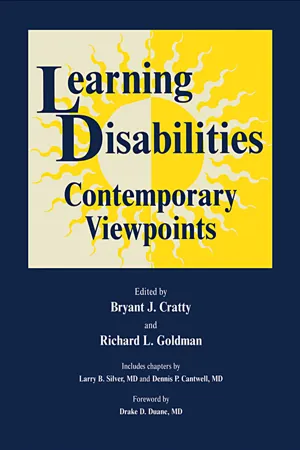
This volume examines the field of learning disabilities and the education of learning disabled (LD) children through the eyes of several experts. Contributors bring to the book such diverse academic backgrounds as education, psychology, special education and medicine. The chapters, adapted from lectures given at the Landmark West School in California, include audience questions and responses. Chapters on new medications for the LD child, contemporary research on dyslexia and educational strategies for improving reading are complemented bychapters on social and emotional issues that affect the families of learning disabled children, adolescents and young adults.
Information
THE ROLE OF THE FAMILY IN HELPING THE CHILD OR ADOLESCENT WITH LEARNING DISABILITIES
“With the understanding and often not-too-gentle persistence of my teachers I worked through my anger and confusion and became confident, secure, and even diligent”*
*Note: This and all subsequent chapter opening quotes are from individuals with learning disabilities.
Introduction by Richard L.Goldman
I would like to welcome everyone to the first installment of the Landmark West Speaker Series. Landmark’s mission is to educate the dyslexic child and to help the dyslexic cope with his or her learning disability. In addition, the school attempts to transcend the daily education of 170 students, through outreach and public awareness. Our Speaker Series helps meet this goal as experts discuss family, social and educational issues related to Learning Disabilities.
To inaugurate our series, we are fortunate to have Larry B.Silver, M.D., an internationally recognized authority on ADHD and children with learning and emotional problems. A noted author and lecturer, Dr, Silver is Clinical Professor of Psychiatry and Director of Training in Child and Adolescent Psychiatry at Georgetown University School of Medicine. He has served as Acting Director and Deputy Director of the National Institute of Mental Health. He is the author of The Misunderstood Child; Attention Deficit Hyperactivity Disorder: A Clinical Guide to Diagnosis and Treatment, and, Dr. Larry Silver’s Advice to Parents on Attention Deficit Hyperactivity Disorder. Dr. Silver currently is a board member of the Learning Disabilities Association (LDA) and other associations for children with learning disabilities and ADHD.
Tonight, Dr. Silver will discuss learning disabilities and attention deficit disorders as life disorders affecting youngsters through adolescence and in all aspects of their lives. He will demonstrate how the child can be successful within the family and with friends. Without further ado, it is a great pleasure to introduce Dr. Larry Silver.
Dr. Larry Silver
Tonight, I would like to talk about your roles as parents of a son or daughter with a learning disability. Your role in helping them is critical if they are to have the opportunities of becoming successful adults. School is only part of their lives. If they live in a family that does not understand, or live in a community that does not understand, their problems are magnified.
Several Landmark students that I talked to today made comments like, “My problem at home is that my mom knows I have a learning problem, but my dad doesn’t believe it”; or, “One of my parents is still yelling at me that if I just try harder I would do better. I wish you could help them understand I’m trying as hard as I can, but I can’t do any better than I’m doing.” If parents do not understand, there is one more hurdle for the youngster to overcome.
I would like to take a few minutes to review all the terms I will use. Just this evening you heard me introduced as talking about dyslexia, learning disabilities, and ADD. I will take the first few minutes to review an historical perspective of how we got where we are. From there, we will move to some of the key issues related to learning disabilities.
HISTORICAL BACKGROUND
In the U.S. prior to 1940, if children had trouble learning, they were put into one of three major categories: (1) those children who were mentally retarded; (2) those children who had emotional problems; or (3) those children who were socially and culturally disadvantaged. By the early 1940s, we began to recognize that there was a fourth group of children who were having trouble learning because of the way their nervous systems functioned. Initially, it was thought that the reason this group of children had trouble functioning was because their brains were damaged. Yet, these children looked normal, so the term applied to this group was Minimal Brain Damage.
Gradually, by the late 1940s and early 1950s, more and more evidence was presented that demonstrated no damage to the brains of these children. Instead, there existed “difficult” wiring, or faulty neural functioning. So the name of this disorder was changed to Minimal Brain Dysfunction.
By the early 1960s, people were so confused about what “Minimal Brain Dysfunction” meant that the National Institutes of Health brought together what was called a “Consensus Conference” to summarize all of the research and conclude what was meant by this term. The panel concluded that Minimal Brain Dysfunction referred to a group of problems often found together, where the child had trouble learning because of the way his or her nervous system operated. Secondly, many children in this group were hyperactive and/or distractible. Third, many of them had emotional, social, and family problems.
If we had stopped there, we would have been years ahead of ourselves, but like most government documents, the “Conference” report was put on the shelf, collected dust, and was ignored. We had to go through twenty years of re-inventing the wheel before we discovered the same conclusions, That is, if we look at the children and adolescents who go to a school like Landmark, we find a common theme, that they have a learning disability. We find that about twenty to twenty-five percent of them also will have Attention Deficit Hyperactive Disorder (a term I’ll de-fine for you later). In addition, many of these children have social, emotional, and family problems.
What causes these secondary emotional, social, and family problems? Let me give an example. A boy begins school. He gradually falls behind academically and is kept back. He is now a year older and a head taller than everyone else in his class. He is still not learning and begins to feel bad about himself. He becomes totally discouraged and starts to misbehave in school. His teacher then calls home telling his parents, “Your child is not doing this; your child is not doing that.” His parents begin to feel badly and become frustrated, as does the child. It’s 100% predictable that if there are two parents in the family, one will believe that the best way to help the child is to be firm and strict, while the other will believe that the best way to help the child is to be understanding and permissive. And so the parents begin to clash with each other. Eventually, the principal calls the parents in and says, “Your child is not learning due to emotional problems, obviously due to marital conflict. Go see a mental health professional.” And so these parents go to see a psychiatrist, a social worker, or a psychologist because their child is misbehaving in school. Here, everyone is looking at the smoke rather than at the fire. As such, when we talk about social, emotional, and family problems, it is critical that we determine whether the social, emotional, or family problems are causing the academic difficulty or whether the social, emotional, or family problems are consequences of the academic difficulty.
Initially, the terms that were used for these students attempted to label the presenting issue. If the problem involved reading, the child had dyslexia. If the problem involved math and calculations, the child had dyscalculia. If the problem involved written language and graphics, the child had dysgraphia.
Gradually, it became clear that these terms did not have much meaning. Dyslexia does not tell you “why” a child has difficulty reading but tells you that he or she cannot read. The child may have just moved from El Salvador and only knows Spanish. Reading problems may occur for any number of reasons. The experts decided that one had to clarify the specific learning difficulties that explain why a child has trouble with reading or writing or with math. The specific learning difficulty term used today is “learning Disabilities.” As noted earlier, some children are also hyperactive, distractible, and/or impulsive. Many different terms have been used for this behavior. The first term used in this country was “Hyperkinetic Reaction of Childhood.” Today, we call this disorder “Attention Deficit Hyperactivity Disorder.” This disorder is not my topic for tonight. It is important at this time to realize that “Learning Disability” and “Attention Deficit Hyperactivity Disorder” are two separate problems. The treatment for a learning disability will not cure ADHD. The treatment for “ADHD” will not treat the learning disability. A parent may call me and say, “My child has ADHD, he was put on Ritalin, and he still can’t read very well.” The reason is that the reading problem relates to a learning disability and is not helped with medication.
PARENT HELP
Now let me become more specific with you about what you as parents can do to help. The first thing we need to understand is that learning disabilities are “life” disabilities. Learning disabilities are not just school problems. The same learning disabilities that interfere with reading, writing, and arithmetic interfere with baseball, basketball, foursquare, jump rope, setting the dinner table, getting dressed, keeping a room neat—in short, with every aspect of life. You may have thought of a learning disability as “my child can’t read, reads backwards or reads upside-down and that’s why he goes to Landmark.” But you need to realize that his or her learning disability also explains why there are so many problems at home or with peers. Parents must broaden their thinking and realize that their son’s or daughter’s brain somehow functions differently, whether he or she is with family, playing with friends, or at school.
The second thing to keep in mind is that learning disabilities are a “life-time” disability. The child with a learning disability will become the adolescent with the learning disability, and will become the adult with the learning disability. Parents don’t like to hear this. They want to think that their child will outgrow it. If they just give the child help for a couple of years, he or she will get better. I don’t say this to make parents fell upset or depressed. I say it because, if parents face reality, they have a better chance of dealing with reality. Forty percent of the children with learning disabilities inherit the disorder from their parents. It runs in families. Parents may have the same problem. They, too, may need help.
The point is that if we get these students the right help, and if we give them the right skills and strategies for learning, they can do as well as anyone else. They might need special help through high school. They might also need to go to a college that can provide help. Today, there are graduate schools and professional schools all over the country that accommodate to youngsters with learning disabilities.
So, what is your job as a parent? Schools will deal with their academic needs. Parents need to deal with their psychological, social, family, and peer needs.
THE NATURE AND SYMPTOMS OF LEARNING DISABILITIES
I want to review what learning disabilities are, focusing on the reality that learning disabilities are not just a school disability but are a life disability. This major theme is expounded on in my book, The Misunderstood Child. This book is written for parents and contains information about what parents can do to help their child to be successful through adolescence.
Often, when I meet with parents who have children who have been in special education programs for years, they show me a very thick file. I’ll ask them to summarize the information for me. Can they give me a list of their child’s learning disabilities and, equally important, can they give me a list of their child’s abilities and strengths? Most parents cannot. This information is critical. The job of a parent is to learn how to build on their child’s strength’s rather than expose or magnify their weaknesses. The role of special education programs is to build on the strengths while helping to compensate for or overcome the weaknesses. To do this, the parents must know their child’s learning abilities as well as the child’s disabilities.
It is convenient to break the types of possible learning disabilities down into simple steps. The model used is a computer-based model.
The first step in learning is to bring information to the brain and record it. This is called “input.” The second step, once the information is in, is to make sense out of it. This is referred to as “integration” The third step, after input and integration, is to be able to store information so it can be retrieved again. This is termed “memory.” The last step, after the information is brought in, integrated, made sense out of, and stored, is to get the information out again, called “output” Thus we talk about input disabilities, integration disabilities, memory disabilities, and output disabilities.
INPUT DISABILITIES
Some children have trouble bringing information in using their eyes and recording it properly. They have “visual input problems.” Some children have trouble bringing information in using their ears and recording it properly. We call that “auditory input problems.” Some children may have a mixture of both. The teacher is writing on the blackboard, while talking, and the student can have trouble bringing information in both through the eyes and ears at the same time and making sense while recording it. The term we use for this central brain process of seeing or hearing or perceiving the world is “perception.” So the term we use to distinguish this central brain process of recording something from the outside onto the brain is “perception” Some children will have a “visual perception problem.” Others may have an “auditory perception problem.”
Visual Perception
Some children or adolescents have difficulty distinguishing differences in shapes. They may confuse b’s and d’s and p’s and 9’s. They may confuse a “3”, “W”, “M”, and an “E” where the same symbol can appear in four different positions. They may confuse a “u”and an “n” or a “6” and a “9”. This problem is normal until age six. Another visual perception problem is “visual figure-ground.” This problem refers to difficulty differentiating between the figure one is to focus on versus the entire visual field, the background. Some children, when reading, have trouble deciding what words to look at. As they read, they skip lines, or they read the same line twice. They must to go back and catch themselves. When they look up from the page, they trouble deciding where they were when they look down again. If the table is too cluttered, their eyes look at everything but the important work on the page. When sitting at the dinner table, they may have difficulty spotting the salt, if asked to pass it. The same child might not hit the nail with a hammer. Some children have trouble with visual depth perception, bringing information in through both eyes, fusing it together, and coming up with three-dimensional vision. These are the children who fall off their chairs, or who reach for a drink and misjudge it’s location, or who, after cracking an egg, let it hit the table rather than the pot.
How important is visual perception in life? What does it take to catch a ball, or hit a ball, or throw a ball? The first thing one needs to catch a ball is “visual figure-ground.” One has to look out into the field and spot the ball from an often confusing background. The second thing one must do after one spots the ball is to keep one’s eyes on it. The reason why coaches yell at children to keep their eyes on the ball is that if one’s eyes are on the ball, the brain can use depth perception to figure out how fast the ball is moving so that one can get to the right place and catch it. A child who skips words and lines when reading may also have a problem with baseball and basketball. He or she will get their hands up to catch a ball too soon or too late and get hit in the face. After a while, the child will just throw up his or her hands to protect the face, because he or she is afraid of getting hit. These children do not play sports well that require this kind of eye-hand coordination.
Auditory Perception
A child or adolescent might have difficulty distinguishing subtle differences in sounds. It is easier to understand the concept of subtle differences in shapes. There are twenty-six shapes in our alphabet, and ten shapes in our numerical system. But there are 44 units of sound in the English language, called phonemes. Some words sound very similar, “Blue” and “blow”, “ball” and “bell”, “can’t” and “can.” I might say, “How are you?” and a child, say eight years old, may appear to be thinking I said, “How old are you?” This child may not be paying attention because he or she misunderstands the sounds that are heard.
Some may have an “auditory figure-ground problem:” If there is more than one sound at any one time, will the child know ...
Table of contents
- Cover
- Half Title
- Title Page
- Copyright Page
- Table of Contents
- Foreword
- Preface
- Acknowledgments
- List of Contributors
- 1 The Role of the Family in Helping the Child or Adolescent with Learning Disabilities
- 2 Current Trends in Dyslexia Research
- 3 Understanding and Helping Learning Disabled Students to Survive and Thrive in Society
- 4 Social and Emotional Dimensions of Learning Disabilities
- 5 All Poor Readers Are Not Dyslexic
- 6 Family Dynamics and Learning Disabilities
- 7 Coordination Problems Among Learning Disabled Children: Meanings and Implications
- 8 Pharmacological Interventions for Children with Learning and Psychiatric Disorders
- 9 The Emotional and Educational Challenges of Dyslexia and Attention Deficit Disorder: One Story
- Index
Trusted by 375,005 students
Access to over 1.5 million titles for a fair monthly price.
Study more efficiently using our study tools.
Frequently asked questions
Yes, you can cancel anytime from the Subscription tab in your account settings on the Perlego website. Your subscription will stay active until the end of your current billing period. Learn how to cancel your subscription
No, books cannot be downloaded as external files, such as PDFs, for use outside of Perlego. However, you can download books within the Perlego app for offline reading on mobile or tablet. Learn how to download books offline
Perlego offers two plans: Essential and Complete
- Essential is ideal for learners and professionals who enjoy exploring a wide range of subjects. Access the Essential Library with 800,000+ trusted titles and best-sellers across business, personal growth, and the humanities. Includes unlimited reading time and Standard Read Aloud voice.
- Complete: Perfect for advanced learners and researchers needing full, unrestricted access. Unlock 1.5M+ books across hundreds of subjects, including academic and specialized titles. The Complete Plan also includes advanced features like Premium Read Aloud and Research Assistant.
We are an online textbook subscription service, where you can get access to an entire online library for less than the price of a single book per month. With over 1.5 million books across 990+ topics, we’ve got you covered! Learn about our mission
Look out for the read-aloud symbol on your next book to see if you can listen to it. The read-aloud tool reads text aloud for you, highlighting the text as it is being read. You can pause it, speed it up and slow it down. Learn more about Read Aloud
Yes! You can use the Perlego app on both iOS and Android devices to read anytime, anywhere — even offline. Perfect for commutes or when you’re on the go.
Please note we cannot support devices running on iOS 13 and Android 7 or earlier. Learn more about using the app
Please note we cannot support devices running on iOS 13 and Android 7 or earlier. Learn more about using the app
Yes, you can access Learning Disabilities by Brian J. Cratty,Richard L. Goldman in PDF and/or ePUB format, as well as other popular books in Education & Learning Disabilities. We have over 1.5 million books available in our catalogue for you to explore.