The first volume in a major new series, this book will be an essential read for all those who need to deal with the causes and consequences of rapid technological change in an increasingly globalized world, whether they be government policy-makers, managers of multi-national corporations, commentators on the international scene or specialists in and students of international politics, economics and business studies.
The authors discuss three related areas:
* How do we think about technology and international relations/international political economy? How does technology relate to competitiveness? How does it inlfuence our culture and how is it influenced by it?
* In what sense is technology a fundamental component of national competitive advantage and what ought national, local and corporate policy to be in the light of this?
* What is the relationship between technological innovation and global political and economic change?
Technology is discussed not just in an instrumental sense - as a tool of power and an object of policy - but equally in a transcendental sense - as a key to shaping and structuring how we understand and interpret reality.
The final section of the book presents case studies of three core sectors of the world political economy, finance , aviation and automobiles.
eBook - ePub
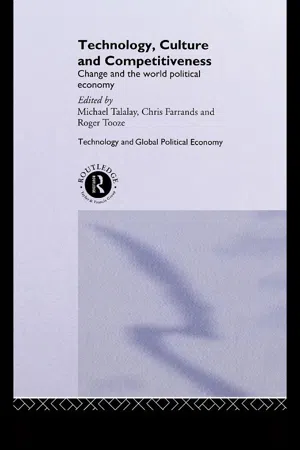
Technology, Culture and Competitiveness
Change and the World Political Economy
- 272 pages
- English
- ePUB (mobile friendly)
- Available on iOS & Android
eBook - ePub
Technology, Culture and Competitiveness
Change and the World Political Economy
About this book
Information
Subtopic
International RelationsIndex
Economics1
Technology, culture and competitiveness
Change and the world political economy
Michael Talalay, Roger Tooze and Chris Farrands
Technology has often played a decisive role in world affairs. The Roman roads held together the imperial domains. The longbow led to the English victory at Agincourt. The atomic bomb brought to an immediate end the war in the Pacific that might otherwise have dragged on for many months with far higher casualties. The combination of computers and telecommunications has revolutionised the structure of international finance and led to the seemingly dramatic erosion of national sovereignty. The manufacturing processes known as ‘lean production’ led to fundamental and far-reaching changes in the automotive industry (Womack et al. 1990) and certainly contributed to the success of the Japanese economy. The high cost of modern weaponry (notably SDI) was one of the factors that drove the Soviet Union into bankruptcy, bringing about the collapse of communism and the end of the post-1945 global structure. The industrial revolution heightened global inequality and increased by several orders of magnitude national and regional disparities of wealth and living standards (Kennedy 1993).
Indeed, the very fabric of society—the ideas, values and language that constitute it—all now reflect technological change. The printing press and movable type fundamentally altered the course of European civilisation and set it firmly on the road to secularisation. The automobile created a pattern of development responsible for the suburbanisation and strip development of the United States. Ultimately, technological change can destroy one lifestyle and create another. The Luddites tried to stop this process, but they failed; and where attempts to halt or reverse technological innovation have succeeded—as in China with the destruction of the foundries and the navy—the result has often been less than satisfactory in terms of both global power and local welfare.
Today, technology is enabling the creation of a global society. Modern developments in communications and transportation lead to ‘one world’, where local differences continue to exist but within the context of an ever-spreading global culture. Based on the English language, on Anglo-American pop culture, and on the Enlightenment concept of rationality, this global culture may not be to everyone’s taste. Its desirability may be debatable. Its existence is undeniable.
All of these developments stem from technological change. Of course, while ubiquitous, technology is not the sole causal factor of any of them. Nor are its effects inevitable. The stirrup, for example, did not mechanistically cause feudalism. However, its appearance in Western Europe in the eighth century and its adoption by the Franks under Charles Martel did lead to a number of choices being made that turned what Lynn White (1962) has called a ‘protofeudal’ situation into a fully fledged feudal system. The development of feudalism cannot be adequately explained without acknowledging the vital role of the stirrup. The same logic applies to technology in general. It clearly is not the only factor involved in explaining change. It is however a potent one. Moreover—and herein lies the rationale for this book—it is a factor that has too often been ignored or defined away by those who seek to explain International Relations (IR) and International Political Economy (IPE).
Indeed, it was our growing sense that the burgeoning literatures on ‘technology’ and ‘international political economy’ were not adequately informing each other that provided the impetus for this investigation. Although studies of specific technologies and the IPE analysis of ‘high technology’ are clearly of great and increasing importance (e.g. Tyson 1992), it is equally clear that mainstream IR/IPE does not have at present what we regard as an appropriate and articulated framework which acknowledges the key role of technology itself as an integral part of the theory and practice of the world political economy. This is not to say that IR/IPE has ignored ‘technology’. Indeed, as Ronen Palan demonstrates in the second chapter of this volume, the core of IR theory has been constructed around a series of (generally implicit) technological metaphors, and hence technology per se has been and is fundamental to theorising IR/IPE. But we would say that technology, where it has been thought important, has generally been explicitly analysed in a specific and narrow way. Technology has been defined by the discourses of IR/IPE as a particular and limited material phenomenon, largely to be treated as an exogenous and given factor—and hence all too often ‘black boxed’ (Rosenberg 1982)—and at the same time largely to be viewed as instrumental—as a tool or as an object of policy. Our unease is shared by others in IPE, notably Susan Strange who has consistently argued for a greater focus on technology and who recently observed that any real understanding of markets ‘requires some sensitivity to the implications of rapidly changing technology—an aspect of political economy that social scientists…persistently overlook’ (Strange 1994b: viii).
Of course, some branches of IR/IPE have almost fetishised certain technologies—particularly the technology of war, weapons and military power— with the associated danger of arriving at explanations/analyses from an implicit technological determinism. While the understanding of the technology of war and military systems is undoubtedly of crucial importance to our continued physical survival, all too often such an understanding has been developed in isolation from broader conceptions of security, welfare, and production (for an excellent attempt to broaden the basis of security studies see Buzan 1991). Other branches of IR/IPE have relied upon the structural changes produced and enabled by technological forces, but have not explicitly analysed these as integral to the international system—particularly the studies of transnational relations and interdependence in which technology is seen as a key part of the changed environment which produces interdependence (see for example Keohane and Nye 1977). For the most part, and with important exceptions to be discussed later, IR/IPE has not considered ‘technology’ as an endogenous and constitutive factor which forms a necessary part of our explanation and understanding of the totality of the world political economy.
A brief illustration will support this contention. Mainstream IPE consistently alludes to the importance of technology while equally consistently refusing to acknowledge this importance in the analytical frameworks utilised. Both Spero (1993) and Gilpin (1987)—two texts widely regarded as setting out the basis of IPE and very extensively used—chose not to include technology as a major factor of their analyses, and the otherwise comprehensive reader edited by Frieden and Lake (1991b) similarly ignores technology and its role, along with innovation, as a key driver of change. Exceptionally, Walters and Blake (1992) do consider technology as a core element of IPE and important enough to merit one chapter devoted specifically to it, of the nine in their book. This discussion is very welcome and, among other things, serves to demonstrate the problems of omitting such a consideration in the analysis of IPE. However, they focus almost entirely on technology as ‘an objective of foreign policy, a means to achieve military, political, and economic goals, and an instrument to carry out foreign policy’ (ibid.: 165). In other words, technology matters to IR/IPE because it alters state power and adds to the agenda and instruments of state policy—not the least because it changes the competitiveness of nationally based sectors of economic activity. This, for us, while a necessary element of the analysis of technology (see Part II of this volume), is not a sufficient conceptualisation of the relationship between technology and world political economy.
In case this argument is seen only as a comment on the orthodoxy of IR/ IPE, it is just as clear that most of the challengers to the orthodoxy have also not put technology in a central analytical position. Among those who have included technology, Susan Strange, who continues to develop the argument that technology has to be incorporated into our understanding of IPE (Strange 1994a), Richard Ashley, whose work includes a reconstructed political economy in which technology constitutes the very language of our experience (see particularly Ashley 1981) and Robert Cox are particularly noteworthy. Cox (1987) has developed a materialist analysis of production in which technology is a fundamental element of the structure of global politics. We would agree with Cox that ‘it is more realistic to see technology as being shaped by social forces at least as much as it shapes these forces’ (ibid.: 21), and that ‘technology itself is a product of society and society’s power relations’ (ibid.: 313), yet we would wish to take the focus on technology further than Cox—if only to redress its lack of attention in the mainstream. For, despite the efficacy of the analyses presented by the above, and notwithstanding the contribution of the two authors discussed below, mainstream IR/IPE has been woefully slow to develop a technologically inclusive approach or to recognise the importance of technology in providing language and metaphors of theorising.
There are two recent and important exceptions to the general lack of attention given to technology in IR/IPE. Perhaps the most comprehensive attempt to elucidate the ‘subtle and fascinating relationship between international affairs and science and technology’ is that by Eugene Skolnikoff (1993: ix). This analysis offers very real gains in our understanding of the relationships and structures involved and of the complex interplay of science, technology, economy, society and polity at the international level. It is, however, constructed on the basis that ‘the fundamentals of the nation-state system have not been altered as much as most rhetoric would lead us to believe’ (ibid.: 7). That is, it is a state-centric analysis. For our purposes this framework and conclusion are limiting—we would wish to posit structural changes that do alter the ‘fundamentals’, but in ways that make it very difficult to recognise and conceptualise using the framework of conventional, state-based political analysis. What, however, is of the greatest significance is that Skolnikoff treats technology, not as an external given, but as a dynamic, integral and constitutive element of the international, and concludes, not surprisingly, that ‘theorists must more adequately recognise the dynamic and subtle nature of the interaction of science and technology with international affairs’ (ibid.: 246).
A second significant contribution to the understanding and role of technology from within IR/IPE is James Rosenau’s iconoclastic and innovative study of systemic change and world order, Turbulence in World Politics (1990). Rosenau argues that technology has been one of the principal forces bringing about a fundamental transformation of world politics—in direct contrast to Skolnikoff’s claim of evolution rather than structural transformation. For Rosenau, technology is the major factor of explanation in his evolution of the notion of the ‘Two Worlds of World Polities’—the ‘State Centric World’ and the ‘Multicentric World’. In terms of the sources of change driving turbulence, he argues for multiple causes, but ‘all of them are seen as being initially responses to the technological upheavals that underlay the ever-growing interdependence of economic, political, and social life’ (ibid.: 15). He identifies three dynamics as exogenous sources of global turbulence, but technology is the most powerful. ‘It is technology…that has fostered an interdependence of local, national, and international communities that is far greater than any previously experienced’ (ibid.: 17). We support Rosenau’s arguments of the centrality of technology in explaining global change, but we differ in our emphasis that technology is not an exogenous force and has to be incorporated as endogenous to political economy. And where Rosenau often tends to treat technology as a given, we return to Cox’s notion of technology as social product, only understandable within the context of particular structures of political economy, in other words endogenous and not exogenous.
There is, then, a clear and important theoretical and ontological lacuna in IR/ IPE which has been exacerbated by the contemporary social construction of knowledge into science/non-science and its continued reflection and reproduction within and by academia. This tends to reinforce the notion of technology as artefact, or machine, and the production of this artefact as an autonomous phenomenon, driven by the logic of scientific and technological possibility, rather than the more persuasive view (we would claim) of technology as a social phenomenon, only understandable within the broad context of the patterns and structures of political economy, and particularly its liberal-democratic, capitalist forms in the late twentieth century.
Nor is the lack of analysis and theory helped by recourse (in classic IR fashion) to borrowing from the discipline that one might expect to have developed the most extensive and integrated analysis of technology and its generation/impact— economics. The field of economics has shared with IR/ IPE a marked reluctance to engage with the nature of technology and related social processes. The profession of formal economics has by and large restricted analysis of technology to its impact on the production function, and has conceived of technology itself in a very limited sense:
Economists have long treated technological phenomena as events transpiring inside a black box. They have of course recognised that these events have significant economic consequences, and they have in fact devoted considerable effort and ingenuity to tracing, and even measuring, some of these consequences. Nevertheless, the economics profession has adhered rather strictly to a self-imposed ordinance not to enquire too seriously into what transpires inside that box.
(Rosenberg 1982: vii)
Consequently, it is not possible or indeed desirable to turn to orthodox economics for insight; nor, it seems, can we gain improved understanding from texts on international economics, which generally reinforce the conventional restricted economic view:
An improvement in technology means that a larger output can be produced with given inputs of the factors of production. If the supply of these factors remains unchanged, such a technological change means that the production-possibility curve shifts outward to the right.
(Ingram and Dunn 1993:105–6)
While this may be true, it hardly exhausts the range of important questions that need addressing on technology!
To find greater emphasis on the role of technology, we need to turn to other broad social sciences—to political economy, to Schumpeter and the long wave theorists, to the literature on business studies (very broadly defined) and to a small but significant number of recent studies that bring together economics and technology (for example Dosi et al. 1990). However, as useful and important as these literatures are, none fully reflects and addresses the agendas and concerns of IR/IPE.
ELEMENTS OF A TECHNOLOGICALLY INCLUSIVE
IPE
Rather than work towards a highly specified theoretical model of IPE, which carries greater risks of conceptual exclusion, our view is that it is more profitable to establish certain elements of an ontology of a technologically inclusive political economy. Here, we use ontology in the sense meant by Robert Cox when he writes:
Ontology lies at the beginning of any enquiry. We cannot define a problem in global politics without presupposing a certain basic structure consisting of the significant kinds of entities involved and the form of significant relationships among them.…There is always an ontological starting point.
(Cox 1992:132)
A technologically inclusive ontology could (and should) form the starting point for the analysis of world political economy. We suggest that such an ontology should have, at least, the following elements.
The first element should identify what is included/excluded by the term ‘technology’. As with any word, meaning changes with time, space and culture, and the values, preferences and language structure historically embedded into the word ‘technology’ are of fundamental importance. It is therefore not appropriate to seek a universal definition, as any such definition would be arbitrary. We should rather identify the broad contours of meaning and practice within specific and concrete historical structures. Skolnikoff provides a good starting point for contemporary usage when he uses the work of Harvey Brooks (1980:66, quoted in Skolnikoff 1993:13) to define technology as ‘knowledge of how to fulfil certain human purposes in a specifiable and reproducible way’ and hence, elaborating on this definition, that ‘technology…does not consist of artifacts but of the…knowledge that underlies the artifacts and the way they can be used in society’.
This point is important for IR/IPE—technology is a form of knowledge, and consequently, from this conception of technology, the generation, ownership, use and control of such knowledge lies at the core of IPE (see, particularly, Strange 1994a). Further, a wide range of knowledges constitute ‘technology’, not just knowledge concerning material production: ‘What might be termed “social” technologies, such as codified systems of management or computer software, are therefore appropriately considered technologies along with those that are physical in nature’ (Skolnikoff 1993:14). So the social structures of production and services—specifiable and reproducible organisational forms and behaviour patterns—are equally included in ‘technology’. In this sense ‘technology’ should also include the notion of tacit social knowledge transmitted through informal social processes, interactions and culture. Much of our failure to properly understand the processes of economic transformation (for example in Eastern Europe) stems from an underestimation of the importance of informal knowledge as a constituent of technology. Margaret Sharp specifically argues the importance of a broad and non-formal notion of technology in this volume:
technology i...
Table of contents
- COVER PAGE
- TITLE PAGE
- COPYRIGHT PAGE
- ILLUSTRATIONS
- CONTRIBUTORS
- PREFACE
- ACKNOWLEDGEMENTS
- 1. TECHNOLOGY, CULTURE AND COMPETITIVENESS: CHANGE AND THE WORLD POLITICAL ECONOMY
- PART I: THINKING ABOUT TECHNOLOGY AND INTERNATIONAL RELATIONS
- PART II: TECHNOLOGY AS THE FOUNDATION OF INTERNATIONAL COMPETITIVE ADVANTAGE
- PART III: TECHNOLOGY AND CHANGE IN THE WORLD POLITICAL ECONOMY
- BIBLIOGRAPHY
Trusted by 375,005 students
Access to over 1.5 million titles for a fair monthly price.
Study more efficiently using our study tools.
Frequently asked questions
Yes, you can cancel anytime from the Subscription tab in your account settings on the Perlego website. Your subscription will stay active until the end of your current billing period. Learn how to cancel your subscription
No, books cannot be downloaded as external files, such as PDFs, for use outside of Perlego. However, you can download books within the Perlego app for offline reading on mobile or tablet. Learn how to download books offline
Perlego offers two plans: Essential and Complete
- Essential is ideal for learners and professionals who enjoy exploring a wide range of subjects. Access the Essential Library with 800,000+ trusted titles and best-sellers across business, personal growth, and the humanities. Includes unlimited reading time and Standard Read Aloud voice.
- Complete: Perfect for advanced learners and researchers needing full, unrestricted access. Unlock 1.5M+ books across hundreds of subjects, including academic and specialized titles. The Complete Plan also includes advanced features like Premium Read Aloud and Research Assistant.
We are an online textbook subscription service, where you can get access to an entire online library for less than the price of a single book per month. With over 1.5 million books across 990+ topics, we’ve got you covered! Learn about our mission
Look out for the read-aloud symbol on your next book to see if you can listen to it. The read-aloud tool reads text aloud for you, highlighting the text as it is being read. You can pause it, speed it up and slow it down. Learn more about Read Aloud
Yes! You can use the Perlego app on both iOS and Android devices to read anytime, anywhere — even offline. Perfect for commutes or when you’re on the go.
Please note we cannot support devices running on iOS 13 and Android 7 or earlier. Learn more about using the app
Please note we cannot support devices running on iOS 13 and Android 7 or earlier. Learn more about using the app
Yes, you can access Technology, Culture and Competitiveness by Christopher Farrands,Michael Talalay,Roger Tooze in PDF and/or ePUB format, as well as other popular books in Economics & International Relations. We have over 1.5 million books available in our catalogue for you to explore.