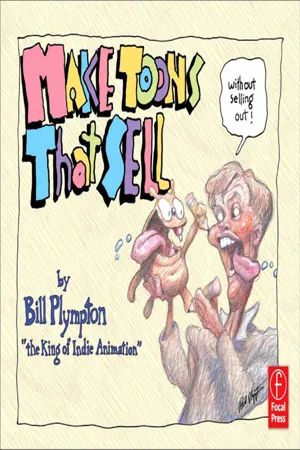
Learn the secrets behind independent animation from the "The King of Independent Animation - Academy Award-nominated Bill Plympton. This living legend breaks down how to make a career outside of the world of corporate animation - and without compromise. Learn time-saving techniques, the secrets to good storytelling, and the business-side of short and feature-length animation films.
- 241 pages
- English
- ePUB (mobile friendly)
- Available on iOS & Android
eBook - ePub
Make Toons That Sell Without Selling Out
About this book
Information
Chapter 1
INTRODUCTION
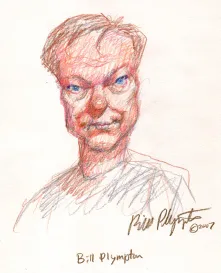
The Second Golden Age of Animation
You students today are extremely fortunate to be living in a time that many people refer to as the Second Golden Age of Animation. You should now bend down and kiss your Wacom tablet, laptop, computer workstation, or whatever you use to create cartoons in eternal thanks for being born in a blessed time for animators. As for myself, I will kiss my ancient wooden drawing table and light box.
The First Golden Age of Animation lasted from around 1930 to 1956 and pretty much coincided with Walt Disney’s rise to power, but then Walt got bored and directed his energies to television, live action, and theme parks.
In my opinion, this era created some of the most wonderful characters ever: Mickey Mouse, Goofy, Popeye, Betty Boop, Bugs Bunny, Daffy Duck, the Road Runner—and great films: Snow White and the Seven Dwarfs, Bambi, Song of the South, Dumbo, “Red Hot Riding Hood,” and “The Great Piggy Bank Robbery.”
Jobs in animation were plentiful. Because no one studied animation in school and there were no graduate programs, most early animators were political or humor cartoonists looking for extra money. Suddenly, because of Disney, these part-time cartoonists became superstars, going from studio to studio and project to project, and each time they changed jobs, they got a big bump in pay—kind of like today’s superstar athletes.
However, for many reasons, the period from the late 1950s to the 1980s became the Death Valley of animation. I think the prominence of TV animation killed off the great cartoons. All of the Hanna-Barbera and Rankin/Bass series showed that animation didn’t have to cost as much or use as many great artists. Also, movie theaters decided to cut back on showing short films before the main features. So all of this great reservoir of talent were forced to either retire or work on Hanna-Barbera’s crap.
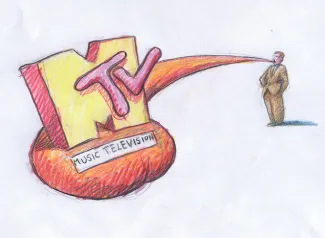
MTV LOGO: ART FOR MTV 10 SECOND PROMOTION, COLOR PENCIL, 1988
Things then mysteriously changed. For some strange reason, by the mid-1980s, animation started to wake up. The art form finally passed through the arid desert of TV cartoons and arrived in the lush valley of the Second Golden Age of Animation. I believe it was just a happy accident that all of these great influences came together in just a few short years.
MTV started showing animation in the 1980s; Who Framed Roger Rabbit? was a huge hit. Japanese animation, including Akira and Hayao Miyazaki’s films, started to invade American shores. The Disney studio decided to get back into animation with films such as The Little Mermaid and The Rescuers Down Under, which were both moneymakers. And of course, The Simpsons showed that TV animation could be biting and controversial—and not just for kids.
I believe one main reason for this huge animation revival was an audience ready for an art form that took their minds into a whole new realm of imagination. After years of true-to-life, hard-core, politically relevant films, the audience was ready for magic and fantasy, and animation was the only art form that could take the viewer to different worlds so easily—luckily for you, dear readers, because animation is now ubiquitous and extremely profitable. In 2010, five of the top ten grossing films were animated: Toy Story 3, Despicable Me, Shrek Forever After, How to Train Your Dragon, and Tangled.
Animation studios are starting up all over the world—India and China are making a big push to overtake the United States in animation production, and France and Germany are putting government funds into animation production. Everyone all over the world sees the financial success of Pixar, DreamWorks, and Blue Sky Studios, and they want to emulate these studios’ stupendous profits.
What does this mean for young animators looking for work? Money! Not just jobs, but opportunities to create stories that are different, exciting, and moving. And that’s what this book is about: how you can be part of this never-ending (I hope) explosion of animated cartoons. This book, I believe, will ably prepare you to be a creative and successful participant in the Second Golden Age of Animation.
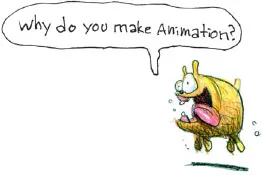
This question may be the most important one in this book. I do a lot of press interviews, but I’m never asked this question: “Why do I make animation?” I believe that a person’s answer to this question has a great bearing on his or her success or failure. There are numerous answers; in fact, there are almost as many possible answers as there are animators: money, awards, approval from family and friends, stardom, self-esteem, creative outlet, childhood fantasy, and so on. They’re all valid reasons.
But I will now give you my (numerous) answers:
1. Boredom—I find it very entertaining and amusing to create cartoons; it keeps life interesting.
2. Fear—Fear of failure, poverty, and unemployment. A wasted life.
3. The sound of laughter—I love making people laugh; it gives me a great feeling, knowing that I’m responsible for people’s enjoyment.
4. Playing God—The high I get from spending all day creating whole worlds from my imagination.
There are other reasons, of course, but those are the main ones.
I often talk to students who believe that once they get a job at Pixar, they’ll be rock-star rich. That’s fine, but I’m not really in it for the money. In fact, I make my own sandwiches for lunch—I’m not a gourmet, just give me food to keep me drawing; all of my clothes are secondhand; I don’t have a car; and I don’t do drugs—all of my profits go into my next feature film.
For me, the biggest reason is that I love to draw! I sometimes draw all day, from 6:00 in the morning to 10:00 at night—and after these all-day sessions, I feel great! Refreshed! Like that was the best day of my life! I’m reborn! I don’t exactly know why, but to me drawing is an exercise in self-discovery—I’m trying to see how good I can get and to experiment with how interesting I can make my drawings and my story.
Gourmets are obsessed with what they put into their mouths—I love what goes into my eyes; you could call me a visual gourmand.
I think that if I were ever arrested (though I can’t imagine what for) and thrown in jail, I would thrive there. I’d finally have some peace and quiet to draw my films. If I did a five-year stretch, I’d emerge from prison with two feature films completed—how cool is that? I’d be the happiest guy in prison.
In fact, I’m so obsessed with the pencil that I fantasize that I will die because of the pencil. I plan out little scenarios of my death. Perhaps I’ll be drawing such long hours that I fall asleep at the drawing board, and my head falls to the table, with the sharp end of the pencil piercing my eye and going into my brain.
Or perhaps I’ll be walking across my studio, I won’t see the pencil on the floor, I’ll step on it, my feet will slip out from under me, and I’ll crack my skull on my art table. Or after working late one night in bed, I’ll fall asleep and roll over, piercing my heart with a discarded pencil.
Ironic, isn’t it? It’s like they say: “You live by the pencil, you die by the pencil.”
Chapter 2
MY HISTORY
Early Influences
My earliest memory of animation—and remember, this was many years ago, and I don’t have a photographic memory—is watching cartoons on TV at the age of 5.
I loved the craziness, the surrealism, and the humor of Bugs Bunny, Daffy Duck, and Popeye. Then along came the Disney shows—The Wonderful World of Disney and The Mickey Mouse Club. (I was a card-carrying member.)
I’m always amazed at the huge influence Walt Disney has had on our culture. If he had only created Mickey Mouse, that would be huge, but he also pioneered animated features and paved the way for the Pixar, DreamWorks, and Blue Sky films of today. He was also one of the first to show how merchandising can significantly increase a studio’s income.
His studio was the first to move full force into television, at a time when all of the other film studios were deathly afraid of electronic media. And, of course, he was the guy who reinvented and reinvigorated amusement parks. Plus, he knew how to synthesize all of these elements—-TV, films, amusement parks, merchandising—into building a huge brand of cartoons and fantasy. Mr. Walt Disney gets my vote as the greatest entertainer of the twentieth century.
So I would draw from memory all of these cartoon characters that I loved so much. But I never had enough paper, and I was forced to steal old envelopes and typing paper from my folks to draw on.
I remember one time very clearly—I must have been around 7 or 8—when my dad gave me one of those phone notepads that was about 4 × 3 inches because I was always running out of paper. I was so excited! Finally, I could draw everything I wanted and never run out of paper! (There were about 100 sheets in the pad.)
So I started with the simple things—cars, trucks, airplanes, houses, animals, trees—and then I got to people, and I realized that there weren’t enough sheets of paper for all my planned drawings. “Wow,” I thought, “I’m going to need a lot more of these notepads.”
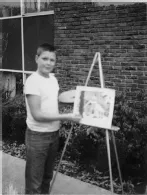
ME AT THE AGE OF 10 WITH MY BIRTHDAY PRESENT, A PAINT SET
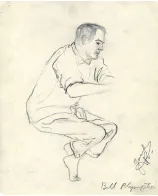
A SKETCH OF MY DAD (MADE WHEN I WAS 15)
Finally, my folks realized that this cartoon habit I had was something serious—a phase that I was never going to outgrow—so they figured they might as well use it to keep me out of trouble. They started buying me stuff like an easel, a paint set, a palette, paper, a drawing board, a pencil sharpener, and other supplies.
I was so excited about creating art that I didn’t know which direction would be the best for me. I loved cartoons, so maybe I’d work for Uncle Walt. I loved the Sunday funnies, so maybe I’d be like Charles Schulz of Peanuts fame. I loved spot gags, so maybe I’d do cartoons for the New Yorker, like Charles Addams. I loved drawing cars, so maybe I’d move to Detroit and draw the cars of tomorrow. I loved painting, so maybe I’d move to New York and become a bohemian painter. I loved illustration, so maybe I’d study at the Art Center in Los Angeles and become an illustrator...
Table of contents
- Cover
- Title
- Copyright
- Preface
- Acknowledgments
- Contents
- Chapter 1 Introduction
- Chapter 2 My History
- Chapter 3 Making an Animated Film
- Chapter 4 Production
- Chapter 5 Storytelling
- Chapter 6 Character Design
- Chapter 7 Storyboarding
- Chapter 8 Voices
- Chapter 9 Animation
- Chapter 10 Postproduction
- Chapter 11 Selling Your Film
- Chapter 12 Self-Distribution
- Chapter 13 Advice to Young Animators
- Afterword
- Index
Trusted by 375,005 students
Access to over 1.5 million titles for a fair monthly price.
Study more efficiently using our study tools.
Frequently asked questions
Yes, you can cancel anytime from the Subscription tab in your account settings on the Perlego website. Your subscription will stay active until the end of your current billing period. Learn how to cancel your subscription
No, books cannot be downloaded as external files, such as PDFs, for use outside of Perlego. However, you can download books within the Perlego app for offline reading on mobile or tablet. Learn how to download books offline
Perlego offers two plans: Essential and Complete
- Essential is ideal for learners and professionals who enjoy exploring a wide range of subjects. Access the Essential Library with 800,000+ trusted titles and best-sellers across business, personal growth, and the humanities. Includes unlimited reading time and Standard Read Aloud voice.
- Complete: Perfect for advanced learners and researchers needing full, unrestricted access. Unlock 1.5M+ books across hundreds of subjects, including academic and specialized titles. The Complete Plan also includes advanced features like Premium Read Aloud and Research Assistant.
We are an online textbook subscription service, where you can get access to an entire online library for less than the price of a single book per month. With over 1.5 million books across 990+ topics, we’ve got you covered! Learn about our mission
Look out for the read-aloud symbol on your next book to see if you can listen to it. The read-aloud tool reads text aloud for you, highlighting the text as it is being read. You can pause it, speed it up and slow it down. Learn more about Read Aloud
Yes! You can use the Perlego app on both iOS and Android devices to read anytime, anywhere — even offline. Perfect for commutes or when you’re on the go.
Please note we cannot support devices running on iOS 13 and Android 7 or earlier. Learn more about using the app
Please note we cannot support devices running on iOS 13 and Android 7 or earlier. Learn more about using the app
Yes, you can access Make Toons That Sell Without Selling Out by Bill Plympton in PDF and/or ePUB format, as well as other popular books in Computer Science & Digital Media. We have over 1.5 million books available in our catalogue for you to explore.