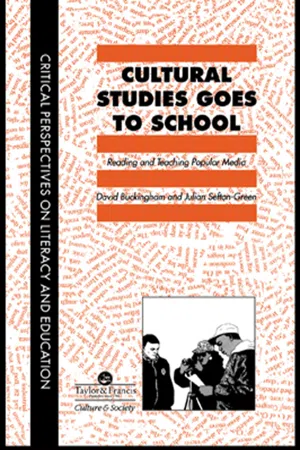
In the context of the growing diversity of contemporary societies and the central importance of the electronic media, the place of popular culture in the school curriculum has become an increasingly controversial political issue. Based on in-depth research in an ethnically mixed, working-class secondary school, Cultural Studies Goes to School is concerned with the relationships between young people's involvement in popular culture outside school and their experiences of media education within the formal school curriculum. The first part of the book provides a detailed analysis of students' readings and uses of popular media, ranging from computer games and soap operas to comics and rap music. It offers a further challenge to received notions of young people as passive victims of ideological manipulation by the media and develops a social theory of reading that acknowledges the complex roles of gender, race and social class. The second part describes a number of classroom projects involving both critical and practical aspects of media education. Through analysis of students' work in a range of media, including photography, video and print, the authors develop a challenging theory of learning about popular culture and its place in the school curriculum. This book offers an exciting and accessible account of young people reading and making popular culture, which challenges many of the political claims and received wisdoms of academic Cultural Studies.
- 244 pages
- English
- ePUB (mobile friendly)
- Available on iOS & Android
eBook - ePub
Cultural Studies Goes To School
About this book
Information
Chapter 1 Introduction: Reading and Teaching Popular Media
I am afraid that the interests of our children are not served either by some of the examination boards. One recently defended the use of a hamburger advertisement in a public exam by claiming that it provided just as important food for thought for children as our great literary heritage.
They’d give us Chaucer with chips, Milton with mayonnaise. Mr Chairman, I want William Shakespeare in our classrooms, not Ronald McDonald.
(Education Secretary John Patten,
speaking at the Conservative Party Conference, 1992)
speaking at the Conservative Party Conference, 1992)
In recent years, the place of popular culture within the school curriculum has become an increasingly controversial political issue. The growing interest in media education at all levels of the education system has re-awakened traditional anxieties about ‘cultural value’ in their most absolutist form. We are regularly asked to express our outrage at teachers who have abandoned Pride and Prejudice in favour of ‘Allo ‘Allo, or who dare to replace comprehension tests with the analysis of soap operas. Such things, it is argued, amount to a conspiracy to subvert Civilised Values. We are urged to choose between Bob Dylan and Keats, Madonna and Mozart, Neighbours and Middlemarch, as though the same set of critical standards could be brought to bear and definitive judgments agreed upon. To enjoy and to study the one, it would seem, is automatically to exclude the other.
As we write, late in 1993, the Conservative Government’s revised proposals for the English curriculum have been temporarily stalled, largely as a result of the concerted opposition of teachers—although it seems unlikely that they have been permanently defeated. Among other things, these proposals would effectively remove any requirement for English teachers to teach about the contemporary media. In their place is a renewed emphasis on ‘our great literary heritage’, a heritage defined in increasingly narrow and prescriptive terms.
On one level, it is not hard to see why the Conservatives might want to prevent children from developing a critical perspective on advertising, as John Patten does here. Yet, his speech was merely one of a series of high-profile statements by education policy-makers which have condemned the negative influence of television and other media, and roundly mocked the idea that anybody might do anything as foolish as teach about them. Thus, Michael Fallon, former schools minister, condemned television for turning children into ‘passive, unimaginative voyeurs’, and called for the popular Australian soap opera Neighbours to be banned. Meanwhile, the National Curriculum Council chairman David Pascall expressed concern about the ‘pervasive diet of cartoons, sloppy speech and soap operas’ that he saw as undermining the ‘cultural development’ of young people. And John Major himself ridiculed the notion of studying soap opera, assuring the Conservative faithful that ‘there’ll be no GCSE in Eldorado’.1
From this point of view, the role of English teaching is clear: it is to maintain and police necessary distinctions between the timeless values of ‘art’ and ‘literature’ on the one hand, and the disposable trivia of popular culture on the other. In these debates, Shakespeare has become the symbolic talisman of cultural value: ‘having read Shakespeare’, being able to talk about Shakespeare, seems to serve as an indispensable component of what it means to be a civilised British citizen. In this struggle for the souls of our nation’s children, Neighbours seems to have been cast as the unlikely villain. The purpose of reading Shakespeare, according to this perspective, is not just a matter of learning to ‘appreciate’ what is self-evidently good: it is also about learning to see through what is self-evidently bad. By contrast, watching Neighbours is condemned as a passive, mindless pursuit, which is at best a waste of time, and at worst a dangerous form of voyeurism. Consuming popular media is seen to require no intellectual or cultural competencies, and thus to develop none.
Yet this debate about education and cultural value, such as it is, needs to be seen as part of a much more long-term historical process. It is perhaps inevitable that the English curriculum should be a focus for much deeper concerns about changes both in the social order and in the national culture—although, to its enormous cost, those concerns have been increasingly defined by the political Right. In order to explain how this has occurred, we need to give a brief sketch of the broader context.2
To some extent, the history of education in Britain in the post-war period could be seen as one of growing teacher autonomy. Although in practice there has been a considerable degree of consensus about what is to be taught, curriculum development and assessment in the 1970s and 1980s were increasingly entrusted to the teachers themselves—an approach which is very different from the centralised, state-controlled systems of many other European countries, for example. However, the late 1970s began to see the emergence of arguments for a core curriculum, and this eventually led to the emergence of a National Curriculum in the late 1980s. It is worth remembering, however, that those arguments did not just arise from the political Right. The liberal Left has also often argued for a core curriculum—albeit more in terms of equality of access and opportunity than in terms of ‘standards’ or the need to preserve the ‘national culture’3 And yet, while there remain fundamental tensions and contradictions in Conservative policy on education, the National Curriculum— and in particular the apparatus of standardised assessment that has accompanied it—undoubtedly represents a powerful assertion of centralised state control.
In terms of the content of the curriculum, however, its implications have been somewhat more ambiguous. Certainly, the definition of some subjects reflects a highly traditional right-wing perspective. History, for example, appears to stop at around 1968(!), and to place its major emphasis on British history, if not quite on a celebration of the glories of empire. Other, more dangerous areas of the curriculum have effectively been excluded altogether: if, as Margaret Thatcher once argued, there is no such thing as society, there is clearly no need for such things as Social Studies.
In the case of English, most teachers had similar fears. The committee that produced the report that established the framework for the English National Curriculum was chaired by Brian Cox, an academic who had been one of the key figures in the right-wing group that produced the Black Papers in the early 1970s.4 owever, the curriculum that emerged was very much in the middle ground. What it offered was a notion of English as a kind of ‘broad church’, which in many ways acknowledged a good deal of the best current practice in English teaching. At least it did not do what many teachers had feared, which was to return to a narrow canon of literary texts, to prescribe a single method of teaching reading or to insist on a very mechanistic notion of literacy skills.
Most significantly from our point of view, the Cox Curriculum also allotted a role for media education, alongside aspects such as drama and information technology. While the compulsory elements of media education were in fact comparatively marginal, and were largely confined to non-fictional media, the Curriculum documents did contain plentiful references to media work, as well as some detailed examples of classroom activities.5 For those of us involved in media education, this represented a major opportunity. Although ‘progressive’ English teachers had been teaching about the media for many years, the Cox Curriculum finally made this a statutory entitlement for all children aged 5–16 years old. In the few years that followed, there were significant increases both in the provision of training and in the publication of books and teaching materials for media education.
In general, most English teachers were justifiably relieved about the Cox Curriculum, although perhaps to the extent that they were rather reluctant to acknowledge its limitations and contradictions—which we would argue were fairly fundamental. Despite the token references to multicultural literature, and to the importance of students’ home cultures, the Cox Curriculum maintains what Ken Jones has termed ‘a resolute blankness towards the cultures of school students and of the communities in which they live’.6 As Jones argues, Cox effectively reduces relationships of power and inequality to mere cultural ‘difference’ (although this is a criticism that we believe also applies to many more ‘progressive’ approaches to English teaching). In this context, it is perhaps not surprising that the broader challenge to English teaching which is posed by media education should have been diluted or ignored.7
More recently, however, the whole terrain on which this debate is being conducted has shifted alarmingly to the Right, to the extent that we have all been forced into a defence of the Cox Curriculum. Far-reaching proposals to revise the English curriculum, largely instigated by a right-wing pressure group, the Centre for Policy Studies, have currently been ‘postponed’ in the light of a more extensive review instigated by the Dearing Report. Nevertheless, the proposals remain representative of current Conservative thinking on education. Essentially, they represent an attempt to return English teaching to a much earlier era. For example, they seek to replace the very subtle and interesting work that was developed, in the wake of the Kingman Report, around the notion of ‘Knowledge about Language’—and which was eventually refused publication by the Government—with the teaching of ‘correct’, formal grammar.8 There is now a much greater emphasis on standard English, to the point where teachers would be required to correct the spoken English of very young children, even when they hear them splitting infinitives out in the playground. There is a prescribed list of recommended texts, weighted much more heavily in favour of pre-twentieth-century authors. And the required approach to the teaching of reading flies in the face of at least 20 years of research about how children learn to read.
Predictably, in the light of statements like those quoted at the start of this chapter, the proposed revisions almost entirely exclude media education, aside from the odd token references—and even these references fail to distinguish between teaching through media and teaching about media. It might still be possible, for example, for students to make a radio programme as part of their work in speaking and listening, but any idea that they might study radio programmes, or consider the conventions of radio presentation, is out of the question. Meanwhile, film, television, popular music, video games—all the media that form the major leisure-time activities of the vast majority of young people—are simply not mentioned.
These developments are obviously part of a much more broad-ranging project of social change which Conservative governments have been engaged in for the past 15 years. They represent an attempt to return to a vision of an earlier society, a vision of unity and stability that is embodied in ‘our great literary heritage’. They reassert a notion of Englishness, of national identity, that ignores the changing, multicultural nature of contemporary British society, not to mention our continuing economic decline. Ultimately, perhaps, they are seeking not to conserve aspects of what currently exists, but to return to a mythical golden age that may never have existed at all.
Clearly, these are tendencies that we wish to oppose. The vast majority of English teachers have always argued for a notion of literacy that is not merely confined to functional skills. They have emphasised that children’s competencies in using language cannot be abstracted from the social contexts and relationships in which they are acquired and used. The development of literacy, in this sense, is an inherently social and cultural process; and as historical and cross-cultural studies have shown, forms of literacy are inevitably plural and diverse.9 Our aim here is to argue that this ‘cultural literacy’ now needs to be even more broadly defined. Contemporary culture is, by and large, electronically mediated culture: the book is no longer the single privileged means of representation that it may have been in earlier times. Literacy in the late 20th century therefore cannot be seen as something that is confined to one particular medium or form of expression.10 It is not simply a matter of learning to read and write print texts, but rather something that applies across a range of media. The competencies and understandings that children are developing in their encounters with media texts, largely outside school, are both valid and important in themselves, and also form part of a continuum that includes, and may be transferred across to, their encounters with books and with print.
For this reason, we would argue that teachers—and particularly English teachers—should be centrally concerned with popular culture, and with the media that children actually read and watch and enjoy. We do not believe (as the Conservatives seem to do) that this is incompatible with looking at ‘literature’, although we would have a rather different view of what literature teaching might be about. We would argue that English teachers should be concerned with the whole range of cultural products, from Shakespeare plays to hamburger advertisements. Any text that we might choose to use in our classrooms will come already surrounded by assumptions and judgments about its cultural value, which students themselves will inevitably articulate and wish to debate. The crux is surely that they should be able to question the processes by which such judgments are made, as well as their social origins and functions, as part of their study of the text. And while we cannot avoid acknowledging the many differences between such cultural products, we do not believe that our primary concern should be to police the distinctions between them in the name of some arbitrary and unquestioned notion of cultural value.
On one level, then, our argument for teaching about popular culture is an argument for a wider notion of English, for something that we might want to call ‘Cultural Studies’, although in the end the term itself is neither here nor there. However, as we shall indicate, this critique of English is not merely about extending the range of objects of study. We ourselves both studied English at élite Universities, and then trained to become English teachers; and we have both taught in departments that include Media Studies alongside English and Drama. Yet in becoming media teachers, and in seeking to make the case for media education in the various institutions in which we have worked, we have inevitably been led to challenge English—not merely on the grounds of its narrow preoccupation with ‘literature’, but also on the grounds of the basic theoretical assumptions that it makes about language, subjectivity and culture.
The work that we describe in this book took place almost exclusively in specialist Media Studies classes at GCSE and A level (school years 10–13). While separate examined Media Studies courses have already existed for more than 20 years in Britain (albeit under a range of different titles), these have recently undergone a considerable expansion. Since the introduction of the GCSE in the mid-1980s, the number of candidates in Media Studies has steadily increased; numbers at A level (which commenced in 1989) are growing by 50 per cent each year. While Media Studies remains an optional subject, it has rapidly moved in from the margins. For example, most of the students whose work is considered here were among the first Media Studies cohort in the school; although by the time they had left, Media Studies had become one of the largest options at GCSE level and the most popular subject at A level.
For the reasons we have indicated, this work proceeds from very different premises than those of mainstream English teaching. In many ways, our approach remains strongly indebted to ‘progressive’ English, particularly in its emphasis on the richness and validity of students’ out-of-school cultures. Yet ultimately, we do not believe that media education is something that English teachers can simply take on board as an additional element that will fit easily alongside poetry or drama. While Media Studies has developed rapidly as a separate subject in its own right, we believe that it represents a challenging, contemporary version of English teaching, that should be at the heart of the subject rather than a mere bolt-on extra. It is in this encounter between English and media education that we hope to offer a much more fundamental reconsideration of the aims and purposes of teaching about culture.
We should emphasise, however, that we are not seeking merely to vindicate media education, or to offer a glowing account of ‘best practice’. Throughout its history, media education has been characterised by some extremely grand assertions about its ability to empower and liberate students, and to revolutionise the curriculum. While these inflated claims may prove inspiring in the short term, we believe that they are ultimately debilitating, not least because they set expectations that can rarely be achieved. Like a good deal of so-called ‘critical pedagogy’, media education often employs a form of utopian rhetoric that can only be sustained by those who remain at a distance from the messy realities of schools and classrooms.
Ultimately, while we would share the notion of media education as a political practice, we also want to raise some difficult questions about its underlying assumptions and motivations. In particular, we want to move beyond the notion of media education as a means of ‘demystifying’ students, or dispelling their ‘false consciousness’, and thereby ensuring their consent to positions that we would define as ‘politically correct’.11 This approach is often based on a view of ideology as a form of ‘misrepresentation’,12 and of young people as merely passive dupes of media ideologies. It sets up the teacher as the bearer of ‘hidden realities’ and of truly ‘objective’ methods of analysis, and assumes that students will merely accept these once they are revealed to them. In many ways, as we shall argue, this approach to texts embodies a pedagogy which has much in common with traditional forms of literary criticism. In our view, it is an approach that largely fails to recognise the nature and extent of students’ existing knowledge of the media, as well as the difficulty and complexity of classroom practice.
In this respect, the origins of this work lie in the book Watching Media Learning: Making Sense of Medi...
Table of contents
- Cover Page
- Title Page
- Copyright Page
- Acknowledgments
- Series Editor’s Introduction
- Chapter 1 Introduction: Reading and Teaching Popular Media
- Part One Reading and Writing
- Part Two Teaching and Learning
- References
Trusted by 375,005 students
Access to over 1.5 million titles for a fair monthly price.
Study more efficiently using our study tools.
Frequently asked questions
Yes, you can cancel anytime from the Subscription tab in your account settings on the Perlego website. Your subscription will stay active until the end of your current billing period. Learn how to cancel your subscription
No, books cannot be downloaded as external files, such as PDFs, for use outside of Perlego. However, you can download books within the Perlego app for offline reading on mobile or tablet. Learn how to download books offline
Perlego offers two plans: Essential and Complete
- Essential is ideal for learners and professionals who enjoy exploring a wide range of subjects. Access the Essential Library with 800,000+ trusted titles and best-sellers across business, personal growth, and the humanities. Includes unlimited reading time and Standard Read Aloud voice.
- Complete: Perfect for advanced learners and researchers needing full, unrestricted access. Unlock 1.5M+ books across hundreds of subjects, including academic and specialized titles. The Complete Plan also includes advanced features like Premium Read Aloud and Research Assistant.
We are an online textbook subscription service, where you can get access to an entire online library for less than the price of a single book per month. With over 1.5 million books across 990+ topics, we’ve got you covered! Learn about our mission
Look out for the read-aloud symbol on your next book to see if you can listen to it. The read-aloud tool reads text aloud for you, highlighting the text as it is being read. You can pause it, speed it up and slow it down. Learn more about Read Aloud
Yes! You can use the Perlego app on both iOS and Android devices to read anytime, anywhere — even offline. Perfect for commutes or when you’re on the go.
Please note we cannot support devices running on iOS 13 and Android 7 or earlier. Learn more about using the app
Please note we cannot support devices running on iOS 13 and Android 7 or earlier. Learn more about using the app
Yes, you can access Cultural Studies Goes To School by David Buckingham,Julian Sefton-Green in PDF and/or ePUB format, as well as other popular books in Pedagogía & Educación general. We have over 1.5 million books available in our catalogue for you to explore.