This book is available to read until 4th December, 2025
- 212 pages
- English
- ePUB (mobile friendly)
- Available on iOS & Android
eBook - ePub
Available until 4 Dec |Learn more
Modern Germany
About this book
First published in 1998. Routledge is an imprint of Taylor & Francis, an informa company.
Frequently asked questions
Yes, you can cancel anytime from the Subscription tab in your account settings on the Perlego website. Your subscription will stay active until the end of your current billing period. Learn how to cancel your subscription.
No, books cannot be downloaded as external files, such as PDFs, for use outside of Perlego. However, you can download books within the Perlego app for offline reading on mobile or tablet. Learn more here.
Perlego offers two plans: Essential and Complete
- Essential is ideal for learners and professionals who enjoy exploring a wide range of subjects. Access the Essential Library with 800,000+ trusted titles and best-sellers across business, personal growth, and the humanities. Includes unlimited reading time and Standard Read Aloud voice.
- Complete: Perfect for advanced learners and researchers needing full, unrestricted access. Unlock 1.4M+ books across hundreds of subjects, including academic and specialized titles. The Complete Plan also includes advanced features like Premium Read Aloud and Research Assistant.
We are an online textbook subscription service, where you can get access to an entire online library for less than the price of a single book per month. With over 1 million books across 1000+ topics, we’ve got you covered! Learn more here.
Look out for the read-aloud symbol on your next book to see if you can listen to it. The read-aloud tool reads text aloud for you, highlighting the text as it is being read. You can pause it, speed it up and slow it down. Learn more here.
Yes! You can use the Perlego app on both iOS or Android devices to read anytime, anywhere — even offline. Perfect for commutes or when you’re on the go.
Please note we cannot support devices running on iOS 13 and Android 7 or earlier. Learn more about using the app.
Please note we cannot support devices running on iOS 13 and Android 7 or earlier. Learn more about using the app.
Yes, you can access Modern Germany by Peter James in PDF and/or ePUB format, as well as other popular books in History & European History. We have over one million books available in our catalogue for you to explore.
Information
1
The new Germany eight years on
Peter James
‘Bonn ist nicht Weimar’ This oft-quoted remark from the mid-1950s1 was meant to indicate that the political system in West Germany, with Bonn as its (provisional) capital after 1949, was different from that of the illfated Weimar Republic (1919–33), Germany’s first attempt at democracy. Experts in German politics2 point out that the Berlin Republic, by which they mean the new Federal Republic of Germany, which has existed since the day of German Unity on 3 October 1990, is also different from the Bonn Republic. It has also been emphasised that Bonn was not built in a day. Neither was Berlin. The new Germany, with Berlin as its capital, was able to make good progress in a relatively short time—although not all its citizens might agree—but it will take many more years yet before the ‘merger’ of the two Germanys is complete.
Following the 1994 federal elections, the eminent Franco-German political scientist Alfred Grosser commented: ‘das Ergebnis zeigt, daß die deutsche Einheit noch nicht vollendet ist’ (the result shows that German Unity is not yet complete) (Focus Wahlspezial 1994: 19). That was a reference to, amongst other things, the very different voting patterns and political cultures between East and West (see Chapter 4). So, despite the numerous changes of the last seven or eight years, which many Germans and outside observers would, on balance, probably view as predominantly positive achievements, two things are quite clear: first, the unification process is still by no means over and, second, Unification brought not only pluses—there were minuses too.
When the former German Democratic Republic, the GDR3 (die Deutsche Demokratische Republik, die DDR)—often referred to simply as East Germany—joined the former Federal Republic of Germany, the FGR, (die Bundesrepublik Deutschland, die BRD)— often referred to simply as West Germany—in the autumn of 1990, the new Germany, retaining the name FRG, was born. It consists of sixteen federal states or Länder: the ten so-called ‘old’ western states, the five ‘new’ eastern states, plus the new capital, a reunited Berlin (see Figure 1.1). Berlin is both a city and, with its surrounding area, a federal state known in German as a Stadtstaat, a city-state.
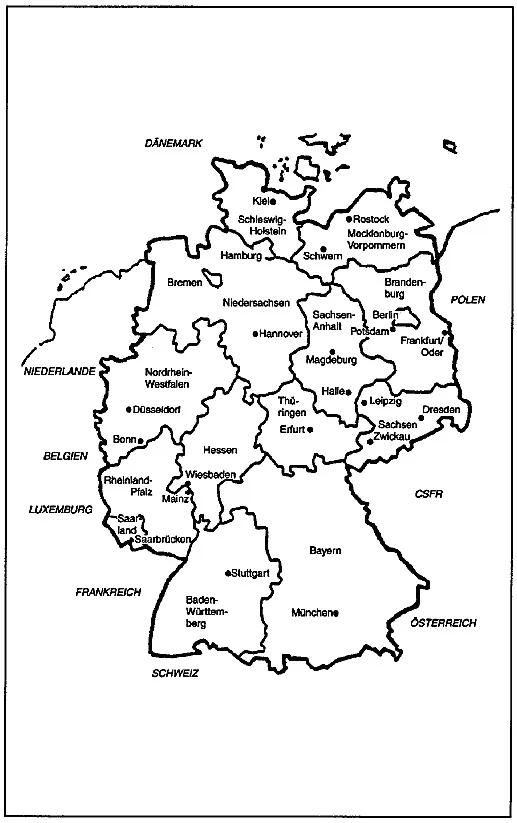
Figure 1.1 The Länder
See Table
The new Germany ought to have been in an ideal position to understand the problems of both Western democracies and the countries of a changing Eastern Europe, following the breakdown of a number of socialist/communist systems. However, in the heady and euphoric days following the fall of the Berlin Wall and the opening of the East Berlin and East German borders, German politicians seemed to be obsessed with the political and economic problems, as they saw them, ignoring almost completely the social, cultural and psychological ones which have since reared their heads in no uncertain terms.
Nevertheless it must be acknowledged that the truly astonishing events of 1989/90, which even at the beginning of 1989 could not have been predicted, brought about the most exciting and far-reaching changes in life and society in Germany since 1945. This book sets out to highlight and explain several key aspects of political, economic, social and cultural life in contemporary Germany.
GERMANY’S NEW ROLE BRINGS NEW PROBLEMS
The first five-year census for the whole of the new Germany, the results of which were published in September 1996, revealed that between 1990 and 1995 the population increased by 1.7 million to a total of 81.6 million. That made Germany, after Russia, the country with the largest population in Europe, even though France and Spain are larger in terms of territory. Germany has borders with nine countries, including the Czech Republic and Poland in the East. It occupies a strategically important geopolitical position in the very heart of Europe; as such, the new, united Germany is ideally situated to influence policy decisions and play a vital role on the ever-changing European stage, as well as to act as an essential link between East and West in both a European and a global context.
In the intervening years since the historic events of 1989 and 1990 many Germans (51 per cent in one survey) spoke, and still speak, of the wall in people’s heads (die Mauer in den Köpfen). This expression implies that, after living for more than forty years in two diametrically opposed systems, many Germans from the East (‘Ossis’) and from the West (‘Wessis’)—according to various surveys reported by the German news magazine Der Spiegel—still feel separated from one other in the new Germany: unified but not united.
In the mid-1990s a report by the respected public opinion researcher Elisabeth Noelle-Neumann, of the Allensbach Institute, asked Germans in the West and the East to compare their economic situation in 1995 with that before Unification. Only 6 per cent of those in the West said they were better off, whilst 32 per cent said they were worse off. In the East, however, 58 per cent reported that they were better off, whilst only 15 per cent thought they were worse off.4 So a stark difference in perception of the effects of German unity in the old and new federal states is evident, and not just from the results of such polls.
In 1990, 47 per cent of East Germans (in the new states) had said in a survey that freedom (Freiheit) was more important than equality (Gleichheit). By 1996 only 35 per cent wanted freedom, whilst 47 per cent maintained that equality was more important (Allensbach survey, reported on in Der Spiegel in November 1996). This demand for equality applied to wages too. Although prices and rents were always much lower in the former GDR, so too were wages. In the initial years after Unification people used to ask why, for example, bus drivers in east Berlin earned considerably less than those in the western half of the city. Towards the end of 1996 a new minimum hourly wage on German building sites was introduced. Although the rates of pay for the old and the new Länder are now much closer, even in 1996 the rate was DM 17 in the West, but only DM 15.64 in the East (Report from the Federal Embassy of the FRG).
Over three-quarters of Germans in the East supported the call for more equality and fewer social differences (Mehr Gleichheit, weniger soziale Unterschiede). Obviously far more changed in the East than in the West, where some cynically claimed that originally only the post codes had changed—another reference to the fact that many citizens in the eastern states felt they had been taken over by the western states. In the survey someone from Halle (in the East) was quoted as saying that the citizens of the new states were ‘the conquered new underclass’ (die besiegten neuen Untertanen).
Clearly, the momentous events beginning on 9 November 1989 with the collapse of the Berlin Wall (built on 13 August 1961) and the fall of the regime in the GDR, accompanied by the collapse of communism in Eastern Europe, had tremendous implications for Germany’s new role, both as a European and a world power. For the first time since Germany was originally unified in 1871, the current borders have been accepted. At most other times in Germany’s eventful history its borders have been the subject of dispute and lively debate. In this sense it can be said that the new Germany is the ‘first non-revisionist state since 1871’ (Smith et al. 1996:10). It could be argued that over the past century Great Britain, France and Germany have been the most powerful states in Europe. Yet Britain and France developed as nation-states much earlier than Germany, whose political history has been one of fragmentation and discontinuity (Paterson and Southern 1991:1).
Amongst the many changes brought by Unification, one highly significant shift of emphasis was achieved simply by taking the decision to return to Berlin as the capital of a united Germany, and later deciding, albeit again by a narrow margin, to adopt the city as the seat of government for both houses of parliament, starting early in the twenty-first century. The geographical and psychological importance of moving from Bonn, situated only 60 kilometres (40 miles) from the Belgian border, to Berlin, about the same distance from the Polish border, was clear for all to see. The strategic significance of the geopolitical position of a united Germany at the centre of Europe, linking East and West, is equally clear.
THE ROAD TO UNITY
The so-called ‘peaceful revolution’ began on 2 May 1989, when the Hungarian authorities started to dismantle the barbed wire on their border fences. Five days later there were widespread protests in the GDR at the manipulation of local election results. In Leipzig over one hundred demonstrators were arrested by the feared and resented East German state security police—the Stasi (der Staatssicherheitsdienst— die Stasi). On 5 June the main newspaper of the ruling party in the GDR, the Neues Deutschland, justified the bloody treatment of the demonstrators in Beijing as ‘the reply to the counter-revolutionary rebellion of an extremist minority’.
In August 1989 hundreds of East Germans fled to the West German embassies in East Berlin, Budapest and Prague. The number wishing to leave the GDR was estimated at around 1 million. A crucial turning-point came when Hungary fully opened its borders with Austria on 11 September, allowing East Germans already in Hungary to travel to the West, via Austria (at that time East Germans were of course allowed to travel only to countries in the Eastern bloc). On 25 September at a peaceful demonstration after Monday prayers for peace in Leipzig—the phrase ‘Monday demonstrations’ (die Mon...
Table of contents
- Cover Page
- Title Page
- Copyright Page
- List of contributors
- Preface
- Introduction
- Acknowledgements
- 1: The new Germany eight years on
- 2: Berlin
- 3: The federal framework
- 4: Government and the political parties
- 5: Investing in Germany: Standort Deutschland
- 6: Social provision
- 7: Education, training and the workplace
- 8: The Nazi legacy
- 9: The media landscape
- 10: Culture
- 11: German language
- 12: Germany and Europe