- 232 pages
- English
- ePUB (mobile friendly)
- Available on iOS & Android
eBook - ePub
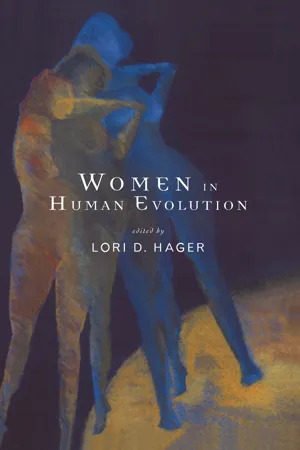
Women In Human Evolution
About this book
This volume, the first of it's kind, examines the role of women paleontologists and archaeologists in a field traditionally dominated by men. Women researchers in this field, have questioned many of the assumptions and developmental scenarios advanced by male scientists. As a result of such efforts, women have forged a more central role in models of human development and have radically altered the way in which human evolution is perceived.
This history of the feminist critique of science, is of profound significance and will be of interest to all those who work in the fields of anthropology, archaeology, paleontology, and human biology.
Information
1
SEX AND GENDER IN PALEOANTHROPOLOGY
Paleoanthropology—the study of human origins—is and always has been a highly visible field of anthropological research. The search for our ancestors is in the forefront of scientific investigations. It is also the focus of considerable popular interest. Many people are curious about the past and are fascinated by the evolutionary path leading to modern humans. Evidence of this past is disseminated to a hungry audience in the scientific literature and in the pages of the New York Times, National Geographic, ScientificAmerican, and other popular publications. As a result, many fossils and “fossil-hunters” have gained considerable notoriety outside the discipline at large. Names like “Leakey,” “Johanson” and “Lucy” are recognizable to a wide variety of people who have never seen a human fossil nor stepped a foot outside of an urban, industrialized context.
The ultimate goal of human origins research is to reconstruct past life ways as fully as possible. In doing so, paleoanthropologists attempt to account for the very nature of what it is to be a modern human—Who were our ancestors ? Why do we look the way we do? Why do we behave the way we do? Why are our brains so large relative to our body size? When did language begin? Are men and women inherently different due to our particular evolutionary past? What social systems did our ancestors practice? By examining events in the past, paleoanthropologists, and the lay public who eagerly follow their work, hope to link the past to the present to better understand who we are.
However, in spite of the avowed goal to understand who we are, the study of human origins has tended to minimize or ignore the role of females in prehistory, or worse, to cast females in the gender stereotypes of the time and place out of which the researcher came. For example, it has traditionally been held that hominid females are responsible for producing and caring for their offspring—but not much else. On the other hand, males have frequently been credited as active agents of evolutionary change—and reproduction is only one of a long list of their achievements.
Both as objects of study and as researchers, women have occupied a low profile in the study of human origins. The history of women as researchers in paleoanthropology is a short one because very few women have been engaged in this field. This is especially evident where field work is concerned.
Fame has, however, come to three females in paleoanthropology. Mary Leakey, renowned archaeologist and the discoverer of several important hominids and stone tools, is well known for her contributions to the discipline. But she is an anomaly in paleoanthropology. The measure of success Mary Leakey has achieved in the study of human origins has generally been reserved for men.
In addition, two ancestral hominids have gained a certain amount of recognition, in part because of their “femaleness.” “Lucy,” a 3.2 million-year-old fossil hominid from Ethiopia, was declared a female since the day “she” was discovered. Interpretations about life 3–4 million years ago have been highly dependent upon the reconstruction of “Lucy” as the diminutive female of a highly sexually dimorphic species.
Another female who has gained a certain amount of fame in paleoanthropology is “Eve,” a hypothetical female who lived in Africa 150–200,000 years ago and is thought to be the progenitor (along with her female kin) of all anatomically modern humans. The “Eve” hypothesis is a matrilineal account of the origins of modern humans that traces mtDNA from mother to daughter over thousands of generations. Rebecca Cann, one of the principal architects of the “Eve” hypothesis (Cann et al. 1987; Wilson and Cann 1992), offers compelling evidence that the “femaleness” of “Eve” has been an important factor in the negative reception of this model (Cann, this volume).
How does the reconstruction of these females’ lives affect us today? It is readily apparent that questions about the origin and meaning of sex roles and gender differences are commonplace in today’s society. Popular books purporting to explain why men and women are different have been hugely successful (e.g., Men Are From Mars, Women Are From Venus by John Gray (1992)). Explanations of sex roles and gender differences that have an evolutionary basis are particularly noteworthy because they supposedly link past behaviors with present ones. The “missing link” is not only the fossil which takes us from ape to human, but also the link between how we behaved in the past and how we behave today. But are past behaviors actually “knowable?”
Fossil hominids represent the remains of real individuals who once lived on the African or Asian or European landscape; hominids who were infants, teenagers and adults; hominids who once breathed, found food and water each day, eluded predators (sometimes), reproduced, raised offspring and eventually died. With some confidence, we can reconstruct what these hominids may have looked like, how long ago they lived, approximately how old they were at the time of death, and even what foods they potentially ate. However, behaviors do not fossilize and the reconstruction of past behaviors is therefore a more difficult task of interpretation.
Based on the principles of the scientific method, “scientific” interpretations are expected to be more than “just stories.” They are intended to be the most logical, plausible and objective explanations of the observable facts. And because paleoanthropology conducts its research within the realm of “science,” it is often assumed that it is objective and bias-free, and that what paleoanthropologists tell us about past behaviors are the “facts” of evolution. Because of this, interpretive narratives, such as those concerning males and females in the past, take on the cloak of fact. To be sure, the “facts” of the evolutionary process for the human lineage do exist, such as the fossils themselves which are indisputable evidence that humans did evolve over millions of years of prehistory. However, the inferential basis on which the structural and functional interpretations of fossils is based is more secure (but still highly controversial) than those contributing to our knowledge of past behavior. It is not that the process of constructing such knowledge is any different, it is simply that the inferences we draw from the evidence are different when we, on the one hand, interpret a fossil bone as a human ancestor, and on the other, interpret a particular morphology as evidence of behavior.
Generally speaking, paleoanthropologists interpret the past by constructing models of human origins based on one or more lines of evidence including comparative anatomical and behavioral studies of nonhuman primates; the chronological and paleoenvironmental context of hominid fossils; the archaeological record; and aspects of modern humans, with special emphasis on genetics and ethnographic analogy. Over the last one hundred years, several models have been constructed which focus on the roles of males and females (see Fedigan 1986 for an excellent review of these models within an historical context; also Falk, this volume; Zihlman, this volume). From Charles Darwin (1871), who portrayed men as “active and ardent” and women as “passive and reclusive,” to the formulation of gender-explicit models such as “Man the Hunter,” “Woman the Gatherer,” and “Man the Provisioner,” the behaviors and relative contributions of males and females in human evolution have been at the core of the discussion on past hominid life ways. That the models of human origins have changed since Darwin put humans into an evolutionary framework is due in large measure to an increase in the data base. But the models have also changed over the years because of changing world views, sociopolitical factors, historical circumstances and changing attitudes of the interpreters. In other words, interpretations, while logical and plausible, have a human aspect. This is why it is so important to reflect on the kind of knowledge being produced and the social and political context of the people producing it.
For example, many models of early hominid life are replete with assumptions about males and females which are based on western views of modern men and women. Unacknowledged stereotypes of modern male/female roles are too often used to interpret the past so that the past becomes a cultural construct steeped in presentist views. Thus, when a link is made from our ancestors to us, behaviors such as sex and gender roles become credible and justifiable since they are then seen as “inherent” or “natural” to the species. These features become identifiable as part of “human nature,” and because of this it is inferred that they cannot be easily modified or altered. Thus, evolutionary models function to reify what may be problematic images of modern men and women, even though a past constructed by reference to the present is problematic in itself. For these reasons, it becomes crucial to examine the inferential bases upon which knowledge of human origins is constructed.
As a means of discussing sex and gender in paleoanthropology, there are two principal questions I will be concerned with: (1) how have females been depicted in reconstructions of past life ways, and (2) how has the inclusion of women as researchers in human origins impacted these reconstructions, especially as they pertain to the portrayal of females? To address these questions, I begin with an overview of how females have been portrayed in prehistory, with special reference to the last 30 years. Second, because the reconstruction of past life ways described by anthropologists is disseminated to the public, I examine briefly how gender stereotypes purportedly based on evolutionary models are perpetuated in the public sphere. Third, I consider a specific example in the reconstruction of early hominid phylogeny and behavior, especially as it relates to females, where the determination of the “femaleness” of the fossil has been critical to the interpretations. For the fossil “Lucy,” I discuss how sex was determined, and then outline the consequences of “Lucy” being female rather than male in these interpretations. Lastly, I consider women as paleoanthropologists. I focus on Mary Leakey’s career in order to explore issues related to being a woman and a paleoanthropologist because she is one of the few women to be successful in this field. The goals of this chapter are to consider how inferences of females in our past have been dependent upon many factors, including “non-scientific” ones, and to show that the past is only as “knowable” as we want it to be.
HOMINID FEMALES IN PREHISTORY
The view of hominid females in prehistory has often been tied to preconceived ideas about what is “natural” to the species. In particular, the role of females in the prehistoric past has focused almost entirely on their reproductive abilities, or perhaps more appropriately stated, their reproductive “duties” to their species and their mates. Many theorists have viewed females as passive participants in evolutionary change, relegated to the bearing, nursing, and transporting of young—and little else. Males, on the other hand, have traditionally been seen as responsible for the many uniquely “human innovations” such as bipedalism, enlargement of the brain, the making of tools, cooperative communication, symbolic representation, and so on.
In the highly influential “Man the Hunter” model of the 1960s, Washburn and DeVore (1961) and Washburn and Lancaster (1968) suggested that the pursuit and acquisition of meat by males accounted for all morphological, technological, and social innovations which were the hallmark of “mankind.” The trials and tribulations of the “hunt” precluded females from participating in such evolutionarily significant activities, so except in the capacity of bearing and raising children, females were seen as peripheral to our evolutionary history.
Given that the seeds of this model were actually sown in the 1950s (see Zihlman, this volume), it is no coincidence that the view of life in the past advocated by Washburn, DeVore, Lancaster and others at this time paralleled the one already in place in western cultures, especially post World War II America: the woman stayed at home having and raising the kids, and the man went out “hunting” for food (“bringing home the bacon”). “Science” was used to bolster the “preferred” image of women in a reproductive, homemaker role.
Particularly ironic with regard to these images of the fifties and sixties woman at home is the active participation of American women in the workforce during World War II. During the war years, and especially by 1942 when much of the male population was overseas fighting, American women were actively recruited to become welders, machinists, bomb-makers, electricians, and other traditionally held “male” jobs (Gluck 1987; Campbell 1984; Wise and Wise 1994; Hartman 1982). Magazine and newspaper advertisements told women how capable and competent they were, how they could be welders, machinists, electricians and the like, and how they were very much needed in the workplace (Honey 1984; Rupp 1978). Special governmentsponsored housing and day care centers were built to encourage women to help out in the war effort. And many women loved it (Gluck 1987; Wise and Wise, 1994; Anderson 1981).
But as the war ended, and the returning GIs needed jobs, the need for women in the workforce declined and their competency was called into question (Campbell 1984; Chafe 1972). Instead of being encouraged to go to work, they were told they were no longer needed and no longer competent to hold jobs that males traditionally held. They were encouraged to return to their “true calling”: as housewives and mothers. The “Man the Hunter” model gave credibility to these late forties, fifties, and sixties sex roles of women as mothers and homemakers. And, perhaps even more importantly, it pointed to the inevitability of these roles because they were “natural” or “inherent” to our species. It is not surprising that the “Man the Hunter” model was so thoroughly embraced at this time.
In part due to increasing numbers of women in primatology and paleoanthropology in the sixties and seventies, some investigators began to consider women in prehistory less as passive reproductive agents than as central participants in human evolution. For example, Sally Slocum (Linton), Adrienne Zihlman, and Nancy Tanner formulated the controversial “Woman the Gatherer” model (Slocum 1975; Tanner and Zihlman 1976; Zihlman and Tanner 1978; Zihlman 1978, 1981). This model counterpoised the starkly androcentric “Man the Hunter” model with an alternative view of prehistoric females. It suggested that these females were more than reproductive receptacles: prehistoric females in fact were major contributors to the diet, they formed the core social unit with their offspring, and they were inventors.
The advocates of the “Woman the Gatherer” model correctly argued that hunting must have come later in our evolutionary history than previously thought, because fossils of early humans predate the oldest stone tools. Therefore, hunting alone co...
Table of contents
- Cover
- Halftitle
- Title
- Copyright
- Contents
- List of illustrations
- List of contributors
- Preface
- List of abbreviations
- 1 Sex and Gender in Paleoanthropology
- 2 Good Science, Bad Science, or Science as Usual? Feminist Critiques of Science
- 3 Is Primatology a Feminist Science?
- 4 Mothers, Labels, and Misogyny
- 5 The Paleolithic Glass Ceiling: Women in Human Evolution
- 6 Brain Evolution in Females: An Answer to Mr Lovejoy
- 7 A Pound of Biology and A Pinch of Culture or a Pinch of Biology and a Pound of Culture? The Necessity of Integrating Biology and Culture in Reproductive Studies
- 8 Female Proto-Symbolic Strategies
- 9 Mobilizing Ideologies: Paleolithic “Art,” Gender Trouble, and Thinking About Alternatives
- Index
Trusted by 375,005 students
Access to over 1.5 million titles for a fair monthly price.
Study more efficiently using our study tools.
Frequently asked questions
Yes, you can cancel anytime from the Subscription tab in your account settings on the Perlego website. Your subscription will stay active until the end of your current billing period. Learn how to cancel your subscription
No, books cannot be downloaded as external files, such as PDFs, for use outside of Perlego. However, you can download books within the Perlego app for offline reading on mobile or tablet. Learn how to download books offline
Perlego offers two plans: Essential and Complete
- Essential is ideal for learners and professionals who enjoy exploring a wide range of subjects. Access the Essential Library with 800,000+ trusted titles and best-sellers across business, personal growth, and the humanities. Includes unlimited reading time and Standard Read Aloud voice.
- Complete: Perfect for advanced learners and researchers needing full, unrestricted access. Unlock 1.5M+ books across hundreds of subjects, including academic and specialized titles. The Complete Plan also includes advanced features like Premium Read Aloud and Research Assistant.
We are an online textbook subscription service, where you can get access to an entire online library for less than the price of a single book per month. With over 1.5 million books across 990+ topics, we’ve got you covered! Learn about our mission
Look out for the read-aloud symbol on your next book to see if you can listen to it. The read-aloud tool reads text aloud for you, highlighting the text as it is being read. You can pause it, speed it up and slow it down. Learn more about Read Aloud
Yes! You can use the Perlego app on both iOS and Android devices to read anytime, anywhere — even offline. Perfect for commutes or when you’re on the go.
Please note we cannot support devices running on iOS 13 and Android 7 or earlier. Learn more about using the app
Please note we cannot support devices running on iOS 13 and Android 7 or earlier. Learn more about using the app
Yes, you can access Women In Human Evolution by Lori Hager in PDF and/or ePUB format, as well as other popular books in Social Sciences & Anthropology. We have over 1.5 million books available in our catalogue for you to explore.