![]()
1
THE EIGHTEENTH CENTURY: THE FRENCH MILITARY AND ITS ENEMIES – THE REVOLUTION BEGINS
The Enlightenment and the French military
The eighteenth–century Enlightenment is generally associated with the philosophes, of whom Jean–Jacques Rousseau had the most influence during the Revolution. However, the army of the ancien régime produced an uncanny number of advocates of military reform and change.
General Charles de Gaulle (president of France, 1959–69) wrote that the Enlightenment “impassioned the army for ideas and for progress.” He named Gribeauval, Guibert, Broglie and Saint–Germain (identified below) as principal figures of the military enlightenment.1 We should add Bourcet, and note that the military intellectuals were also motivated by the disaster (for the French) of the Seven Years War.2
The most radical military reformer was General Jacques–Antoine–Hippolyte de Guibert (1743–90), who served as junior officer in the Seven Years War, and later in the War Ministry. In his Essai général de tactique (1772), he proposed a national militia, motivated by patriotism (instilled by indoctrination). He proposed that it live off the enemy’s land, attack in columns, and rout him by numbers, flexible tactics, and aimed fire. In his Defense du système de guerre moderne (1779) he discarded his militia as politically impossible, and concentrated on tactics. However, in his last book, De la force publique (1790), published after the Revolution had begun, he proposed a militia comprising all healthy male adults, and discussed conscription.3 De Gaulle emphasized Guibert’s proposal to organize all arms into divisions, integrate arms, and decentralize command for speed and flexibility in maneuver. He praised the Maréchal de Broglie’s order that staffs and troops maneuver in various terrains rather than continually parade. Finally, de Gaulle cited Frederick the Great as setting the example for all armies.4
Guibert ultimately touted the battalion column for rapid maneuver, with deployment into line for greater firepower, but he felt that field commanders should decide on such matters. His ideas were formalized in the Drill Regulations of 1791, which became the drill manual of the Republican army, but field commanders adopted whatever formations best suited their troops, whether regular or volunteer.5 The book that influenced Napoleon most was L’Usage de l’artillerie nouvelle dans la guerre de campagne(1778), by Chevalier Jean de Beaumont du Teil, which advocated rapid movement and massing of artillery in battle. However, Bonaparte did not take massing guns to heart until 1809 when the Austrians used a great battery against him at Aspern–Essling.
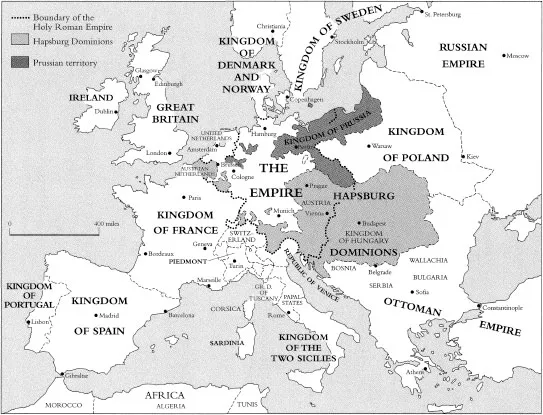
Map 1 Europe in 1789
The Marshal Duke Victor–François de Broglie introduced the division into the French army in 1759. It was the largest unit of maneuver (though not intended for independent combat). By 1780 it was standard, but was not of uniform size. Initially it comprised one or two infantry regiments (1,000 to 1,500 men each), with an artillery battery attached, for a maximum of 3,200 men. By the time the Wars of the Revolution began (1792), the regiment had grown to almost 4,000 men, and “division” (sometimes “corps”) described formations of any size above a regiment, sometimes up to 20,000 men. Napoleon, as we shall see, created the corps of 20,000 to 30,000 men, of which divisions formed the major component, which tended to standardize them at 8,000 to 10,000 men.
In 1743 the Maréchal de Saxe organized light infantry in the French army. Such units were popularized all over Europe by the Essay on the Art of War (1754) of Turpin de Crisse, and many similar studies.6 The Austrians had learned in the wars against Frederick the Great by calling up volunteers from their border troops (on the Turkish border), who were lightly armed, but fast and effective. The British learned from the Indians in the French and Indian War (the American phase of the Seven Years War).
Military education in France
Louis XV founded the École Militaire royale (Royal Military Academy) in Paris in 1751. (Britain had no comparable military academy until 1802; the same year the USMA, West Point, was founded.) The king was influenced by his brainy mistress, Madame de Pompadour, a friend of d’Alembert, co–editor with Denis Diderot of the philosophes’ Encyclopédie. The Comte de Saint–Germain (minister of war 1775–77) persuaded Louis XVI to create twelve écoles royales militaries in the provinces, so that the poorer, mostly rural aristocrats (the backbone of the officer corps) could be educated. The king also decreed that the École Militaire would admit – in addition to the high aristocracy – students rated best by their professors in the lower military schools. (At the provincial école royale at Brienne, Napoleon got his initial training; he was chosen to spend his final year at the École Militaire.)
France also had postgraduate schools for artillery and engineer officers, founded in 1720 and 1748. The Artillery’s school (1720) admitted both artillerymen and engineers. The Engineers (Corps du Génie) formed their own school in 1748. Perforce, merit counted in these arms; education was essential, especially in mathematics. Thus they were the most democratic. In the artillery corps under the ancien régime 14 percent of the officers were commoners; 86 were nobles, but not high nobles. Many were descendants of judicial or financial officers ennobled by the king, including the Comte de Gribeauval.
Weapons of the French and opponents
General Count Jean–Baptiste Vaquette de Gribeauval designed new field cannon for Louis XV, and improved them as Louis XVI’s inspector of artillery. Every gun was standard as to caliber, carriages, and limbers, and had packaged shot and powder (a cartridge), which made for more rapid fire. (Interchangeable parts were engineered by Honoré Blanc, but were rejected as too expensive.) With more accurate casting, it was found that the gun barrels could be made lighter and still deliver the same fire.7 His light, smooth–bore, 12–, 8–, 6–, and 4–pound guns were used by the French armies of the Revolution and Napoleon, and remained the best in Europe until 1825. The Gribeauval guns were lighter by one–third than those of any other country. For example, the Gribeauval 12-pounder’s barrel weighed 2,174 pounds (986 kg); the gun with carriage 4,367 pounds (1,981 kg). The British 12’s barrel weighed 3,150 pounds; gun and carriage about 6,500 pounds. The firing rate for the French 12-pounder (using a cartridge) was one round per minute; for the 8-, 6-, and 4- two a minute was possible. The French 4-pounder required only three horses and eight men to move with the army.
All the powers used 12-pounders; the Prussians had 12s, 6s, 3s, and some 18s; the Austrians 12s, 6s, and 3s; the British 12s, 9s, 6s, 3s, and 1-pounders, all very heavy.
Followers of Gribeauval – engineers and artillerymen – standardized small arms. Their efforts netted the 1777 Charleroi infantry musket, five feet long, muzzle–loading, 0.69 caliber (17.5 mm). The cavalry, engineers, and others carried the 0.69 musketoon or carbine – the same weapon, but ten inches shorter. The standard sidearm was the 0.69 muzzle–loading pistol. A cartridge was furnished for these weapons, but they had to be primed at the breech and fired with a flintlock. The rifle was known, but not used by the French except for snipers and a few skirmishers.8 Though more accurate, military rifles were still muzzle–loading; balls were more difficult to ram home, and a few seconds delay could mean death for a soldier.
The infantry and cavalry weapons of the other powers were similar and of about equal range and effectiveness. Russian muskets and carbines were generally 0.74 caliber; Austrian and Prussian muskets were about 0.74 also. Some Russian, Austrian and Prussian infantry units were equipped with British weapons. The British standard was the “Brown Bess,” 0.75 caliber (with Baker rifles in the 95th Regiment only).
Before the death of Frederick (1786), the Prussians had one regiment of Jäger (light infantry) equipped with rifles – but formed no more. A little later, the British armed a company of the 60th Infantry with rifles, but held up because of the high cost. After they entered the Wars of the French Revolution (1793), however, they formed a regiment, the 95th Rifles, and after Napoleon became their opponent, they issued rifles also to three battalions of the 60th Infantry and some companies of the King’s German Legion
Except for the use of better steel, cavalry sabers changed only in decoration. Typically, light cavalry carried the slightly curved saber with a 33–inch blade; the heavy cavalry saber had a straight, 38–inch blade; specifications varied with the regiment.
The French officer corps
The French army should have had the most professional officer corps in Europe, but to quote Lee Kennett: “French society was . . . far from being militaristic. It was a . . . breach of court etiquette to appear at Versailles in uniform.”9 There was also the obstacle of tradition. The highest–ranking officers – the politically well–connected – often had attended none of the king’s schools. Their ingrained belief was that they were born to lead, and schooling was superfluous. One of these, at the time of the Revolution, was the Marquis de Lafayette.10 Appointed a major–general (at age 20) by the American Congress, he commanded troops in the American Revolution (and survived, thanks to the guidance of George Washington). Before he volunteered to fight in America (1776) he had been a junior officer, assigned at age twelve to a regiment he seldom visited. Lee Kennett says that most officers in the Royal Army were “amateurs,” but that their NCOs were tough veterans of many campaigns and their troops products of six–year enlistments (which encouraged re–enlistment).11
In 1781, the old nobility of the sword (noblesse d’epée), demanded that access to commissions be limited. The result was the reglèment Ségur (22 May 1781) which required four quarterings of nobility to enter the officer corps.12 The same requirement applied to entry into the military schools. That was no obstacle to country nobles, who usually were more than qualified but had lost their fortunes. They benefited most from king’s schools, and were the backbone of the officer corps.
The artillery and engineers welcomed royal school graduates who excelled in mathematics and science (Napoleon was one), but also made officers of qualified commoners (one was Lazare Carnot, the “Organizer of Victory” in the Government of Terror). In September 1792, after Louis XVI was deposed, there was a mass emigration of officers, adding to those who had fled earlier. Only 18 percent of infantry and cavalry officers remained in France, but 42 percent of artillery officers.13
The artillery was the key to the first French victories of the Wars of the Revolution. In exile, Napoleon said: “If France, in 1790, promptly set on foot such good armies, it was because [the army] had a good foundation; the emigration [of noble officers] made it better, not worse"14
Legacy of the “Sun King”
Louis XIV (1643–1715), the “Sun King,” perfected absolute monarchy and presided over the literary and scientific “classical age” in France. However, Louis XIV also gave France a professional army – the largest and best in Europe. The Marquis de Louvois (1641–91), his minister of war for twenty–five years, built a standing army of 200,000, and mustered 400,000 troops in wartime. Further, Louvois created a general staff, the office of chief–of–staff (maréchal général des logis), and appointed inspectors for each arm of service.15 The basic structure was inherited by the armies of the French Revolution and Napoleon.
Louis XIV chose exceptional commanders such as the Vicomte Henri de Turenne and Prince Louis II de Condé.16 His armies won wars and expanded France. The War of the Spanish Succession (1701–14) gave the throne of Spain to his great–great grandson.17 However, Britain won Newfoundland, Nova Scotia, and the Hudson’s Bay area from France; and from Spain, Gibraltar and trade monopolies in her colonies.
Louis XIV had neglected his navy.
The French staff
Under Louis XV (1715–74), Louvois’ general staff became a haven for palace generals, but there were serious members. Pierre de Bourcet proved himself in the wars of 1740–63. During the Seven Years War, generals vied for his services. He originated what came to be called an “estimate of the situation.” It offered commanders alternative courses of action, based on the numbers of friendly and enemy forces, their positions, strengths, and weaknesses. Between 1764 and 1781, Bourcet, then a general, was director of a staff college at Grenoble. While there, he wrote Les principes de la guerre de Montagues, which later influenced Napoleon. In 1766 Bourcet organized a new general staff, the Service d’état–major des logis des armées.18 It had a short life, but was brought back by Philippe de Ségur, minister of war just before the Revolution. Meanwhile, staff officers became common in major commands. Alexandre Berthier, who was on the staff of the Duc de Rochambeau in America, made a reputation during the wars of 1792–95, and became Napoleon’s chief–of–staff in Italy (1796), and afterward in every campaign except Waterloo.
The eighteenth century proper:
Louis XV and XVI
Louis XV and XVI continued to favor the army over the navy. France remained (potentially) the first power in Europe, but lacked leadership – royal and military. Louis XV (1715–74), in five wars, gained only the Duchy of Lorraine (and bought Corsica from Genoa). In the Seven Years War (1756–63) in Europe, France had allies – Austrian, German (the Holy Roman Empire), and Russian. Her enemy, Prussia, under Frederick the Great, had only sporadic aid from Britain. Nonetheless, France lost the major battles, such as Rossbach (5 November 1757), where Frederick, with 20,000 men, routed a French–Imperial army of 64,000 under the Prince de Soubise.19Overseas, Louis XV lost Canada, North America east of the Mississippi, and Senegal to Britain, and ceded Louisiana to his ally Spain. In India, France retained only trading stations at Pondicherry and Chandernagor.
When Britain’s American c...