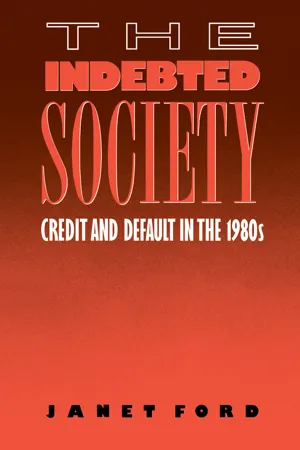
This book is about debt - a situation which affects a large and growing number of people. In Britain alone in 1986 more than 2 million people were sued for debt in the county courts. But debt cannot be understood apart from credit, and the 1980s have seen a substantial increase in the amount of credit available.
In The Indebted Society Janet Ford gives both an overview of the contemporary credit and debt society and a discussion of the borrower's experience and management of debt. As well as providing a critical examination of the growth and changing structure of credit provision, describing the social and economic base for such growth, and considering explanations for the emergence of default and contemporary attitudes to debt, she also presents a detailed study of forty households with mortgage arrears, placing these personal histories within the broader structure of a credit and debt society.
- 223 pages
- English
- ePUB (mobile friendly)
- Available on iOS & Android
eBook - ePub
About this book
Information
Part I
1
Credit, Debt, and Default: An Overview
More and more people in Britain are using credit. In the mid 1960s bank credit cards were unknown. Today approximately 22 million have been issued by Access and Barclaycard, There are thought to be over six million retail store cards in circulation. In addition, credit is granted by finance companies, often in the form of hire purchase or instalment agreements; ninety per cent of mail order sales are credit sales; there are also personal bank loans, credit unions, trading checks, etc. In early 1987 total personal credit granted but still outstanding was in excess of £30,000m (Financial Statistics, 1987). In addition, approximately seven million households have credit for house purchase from the building societies, banks, local authorities, insurance companies, etc. In 1986 the outstanding credit for house purchase totalled £153,666 million (Financial Statistics, 1987).
The use of credit was well established in the nineteenth century, but much of the growth has occurred this century and particularly since the Second World War. The growth has not been smooth, as some of the time credit has been used as a tool of economic management in a stop-go fashion. However, there has been a recent substantial escalation in the amount of credit granted in the 1980s (see chapter 2), and in the number of people using credit.
Considering only consumer credit, in 1986 the average family owed £1,500 and spent 60 per cent of its income servicing the agreements. Currently, however, it appears that a growing number of these users are defaulting on their commitments, and are failing to repay what they owe on time. Estimating the extent of default and the numbers in arrears is difficult but for a number of years now well in excess of two million people have been summonsed in the county courts for non-payment of their credit commitments, and the numbers show an upward trend. These people are summonsed for failing to make due payments on televisions, houses, double glazing, money loans, cars, etc. At least as many more again will be defaulting on their payments but will not have reached the stage where creditors activate the judicial process, although lenders will probably be seeking to recover the money due in other ways such as letters, phone calls, or personal visits.
These individuals only have arrears because they have credit.. That is, they received goods and services in advance of paying for them but with an agreement that the bills will be met. This is a routine situation. Gas, electricity and water are supplied to most of the population on this basis; so unexceptional is it, that generally no alternative form of payment is even suggested or expected. In other areas of consumption, credit arrangements are not so automatic, although widely available and spreading rapidly. For instance, in many shops now there is no assumption that cash will be the medium of exchange, rather the sales staff ask 'How will you pay?' or 'Is it cash or account/credit?' Finally, ask any householder (particularly an owner-occupier) how many mail shots they have received recently offering them credit facilities or count the advertisements for credit in any newspaper. All the evidence suggests that the credit society is here.
Every credit is by definition a debt, something owed. So a credit society is also an indebted society. At the end of 1986 borrowers had over £186,333 million outstanding, not yet repaid to lenders. This in itself is not necessarily problematic just as long as borrowers continue to repay on schedule. The unproblematic nature of a credit society has largely been taken for granted, but is now being challenged by the pattern and extent of social and economic changes: unemployment, a rising divorce rate, redundancy, low wage employment, etc. It may also be the case that growing competition in the credit market has led to 'relaxed' or even 'irresponsible' lending such that borrowers can become financially overcommitted very easily. All these situations contribute to increasing numbers of borrowers having difficulty in meeting their repayments so that many find themselves in arrears.
Credit, then, does not cause default, rather it is neutral, just another means of financial exchange. Credit, though, is a pre-requisite for default and the pattern and terms of credit use set the framework for the pattern of default should it occur. If credit is socially organised so that different social and economic groups have access on different terms, or if they use credit for different things, or deal with creditors of different kinds, then the potential patterns of default will vary. Thus any understanding of the pattern of default needs to be set in the framework of the pattern of credit.
These important changes and developments appear to have passed relatively unnoticed by a number of the social sciences, at least in terms of the issues being documented or becoming the focus of research. Rather, the agenda of issues considered reflects the interests of organisations such as the National Consumer Council (NCC) and advice agencies such as the Citizens Advice Bureau (CAB) and focuses upon matters such as the costs of credit, the style and marketing strategies adopted by creditors, in particular the range of information that is and should be made available to borrowers. In addition, these organisations have contributed to discussions of the regulatory frameworks necessary and to the identification of areas of potential and actual malpractice. As default has grown, these same organisations have provided the impetus for the consideration of what should constitute 'good practice' with regard to both the creditors' and courts' handling of arrears cases, and they have been responsible for commissioning a number of guides and manuals (NCC/WCC, 1983; Doling et al., 1985a).
Some concern and interest has also been expressed by those responsible for the judicial processing of default. A review of the county court system as it pertains to defaulters in England and Wales was initiated by the Lord Chancellor's Department in 1985, as part of the Civil Justice Review. In Scotland, the Scottish Law Commission undertook a similar review in the early 1980s. Finally, the creditors themselves have sometimes addressed the issue of good management with regard to default, as can be seen in the publication by the Building Societies Association Mortgage Repayment Difficulties (1985). Overwhelmingly, then, the interest has reflected consumerist and managerial concerns, and the agenda of issues for discussion and research has been more informed by these interests than by the analytical interests of social scientists.
Frequently the organisations outlined above have commissioned research which now constitutes the major part of the pool of knowledge about credit and default issues. Important examples are the studies of creditors' practice and debtors' attitudes and experiences commissioned by the Scottish Law Commission and the Lord Chancellor's Department (Touche Ross, 1987; School of Advanced Urban Studies, 1987), the NCC (Doling et al., 1985a), the fuel industries (Berthoud, 1981), and central and local government departments and organisations (Duncan and Kirby, 1983; Culley and Downey, 1986). These contributions have been and remain important. Necessarily, much of the work is descriptive, focused upon some aspect of debt managment or characterisations of defaulters, but such studies have provided some basic empirical descriptions that have in themselves challenged a number of implicit public assumptions about who defaults and why, as well as identifying and illuminating the key role creditors can play in prolonging default. In the end, though, the gearing of these studies to certain specific issues and questions initiated by commissioning agents has to be borne in mind. Much of the work on default outlined above has another shared characteristic in that it focuses upon default and defaulters at the judicial stage of debt management. In terms of one of the main objectives of this book, to consider default in its earliest stages, this is an important point. Default at the pre-judicial stage has rarely been considered, yet to rely upon explanations and accounts based on 'judicial' defaulters to provide a general guide to understanding debt at an early stage of development may be questionable.
There are many other questions that have, however, received less attention or have been left on one side entirely. These issues have less to do with immediate practice, with managerial or policy concerns, and more to do with, for example, the development and role of credit within contemporary society as supported or challenged by other structures and institutions, or with changing attitudes and values to different forms of financial transactions. In addition they concern the role of credit and default in relation to social control and social cohesion. Equally, little research has focused upon the impact of default on other aspects of social and economic life. For example, its impact on labour market processes or upon family life, or the maintenance or restructuring of social divisions within society. In addition to these broad questions that link credit to the structure of society, other issues relate to the existing social organisation of credit and debt; to the motivations and influences that inform the practices of creditors and debtors, and the relationship between them.
Taken for granted?
Questions relating to credit and debt have not been central issues within the social sciences as indicated above. This is perhaps surprising in view of some of the themes that have been important since the 1960s. For example, within sociology there has been a concern with the extent, effects, and consequences of affluence, and an associated emphasis upon the consequences of widespread consumerism and conspicuous consumption: cars, washing machines, and, increasingly, home ownership.1 Similarly, discussions about acquisitiveness and the changing values that lie at the centre of self image and social prestige have been important. In examining these and other issues, as Newby et al. (1985) have noted, very few writers ever accepted 'the popular beliefs about the consequences of affluence', but rather 'the "age of affluence" tended to set the terms of the debate' (p.87). Many of the signs of affluence recorded, however, were likely to be a result of the availability and use of credit. The position in Britain accords with that noted by Caplovitz with regard to America: 'One aspect of the affluent society . . . that has largely gone unnoticed by sociologists is the extent to which it rests upon the institution of consumer credit' (1969, p.641).
More recently, the issues or economic change and the recession are the themes that provide the framework for research; for example, unemployment and the restructuring of the labour market;2 the decline in the salience of the world of work and an alternative basis, consumption, informing social identity and allocating social prestige; the debate concerning the creation and meaning of significant divisions around access to consumption items, in particular home ownership.3 Despite the importance of these above themes any systematic consideration of the extent to which the manifestations of affluence rest on credit, or the way credit supports and reinforces acquisitiveness, or the role of credit and the emergence of default as a consequence of the experience and management of economic restructuring, and particularly the experience of unemployment, seems to be lacking. Yet the evidence on the spread of credit would suggest that its use was widespread amongst workers in the 1950s and 1960s (see chapter 2) and that poverty and unemployment have often resulted in a take-up of credit and subsequent experience of default (for example, Stedman Jones, 1971; Tebbutt, 1983; Marsden, 1982; CPAG, 1986).
These comments should not be taken to mean that social scientists are unaware of the use of credit or the existence of arrears, or that there is a complete absence of interest. Indeed, Rock (1973) undertook a study of the processing of defaulters from the perspective of the enforcers, and there has been a small but developing interest in the area of socio-legal studies.4 Those interested in housing have also focused more systematically upon default and in these two latter areas there is a clear move to formulate studies and explanations of default within frameworks that articulate broader linkages within society (see, for example, Rubin and Sugerman, 1984; Ramsay, 1986; Stone, 1975; and Doling et al., 1986). However, the more typical position, particularly within the areas of sociology and social policy, is that where writers do discuss credit and default they do so in passing or as an aside. For example, some of the households examined in depth by Pähl (1985) in his study of the Isle of Sheppey took credit and sometimes defaulted, and felt very uncomfortable about it all. Marsden, in his study of the workless, discusses briefly the kinds of arrears that householders have and the way they manage them. Studies of the experience of unemployment discuss financial hardship but rarely analyse de...
Table of contents
- Cover
- Half Title
- Title
- Copyright
- Contents
- Tables
- Preface
- Acknowledgments
- Part I
- Part II
- Notes
- Bibliography
- Index
Trusted by 375,005 students
Access to over 1.5 million titles for a fair monthly price.
Study more efficiently using our study tools.
Frequently asked questions
Yes, you can cancel anytime from the Subscription tab in your account settings on the Perlego website. Your subscription will stay active until the end of your current billing period. Learn how to cancel your subscription
No, books cannot be downloaded as external files, such as PDFs, for use outside of Perlego. However, you can download books within the Perlego app for offline reading on mobile or tablet. Learn how to download books offline
Perlego offers two plans: Essential and Complete
- Essential is ideal for learners and professionals who enjoy exploring a wide range of subjects. Access the Essential Library with 800,000+ trusted titles and best-sellers across business, personal growth, and the humanities. Includes unlimited reading time and Standard Read Aloud voice.
- Complete: Perfect for advanced learners and researchers needing full, unrestricted access. Unlock 1.5M+ books across hundreds of subjects, including academic and specialized titles. The Complete Plan also includes advanced features like Premium Read Aloud and Research Assistant.
We are an online textbook subscription service, where you can get access to an entire online library for less than the price of a single book per month. With over 1.5 million books across 990+ topics, we’ve got you covered! Learn about our mission
Look out for the read-aloud symbol on your next book to see if you can listen to it. The read-aloud tool reads text aloud for you, highlighting the text as it is being read. You can pause it, speed it up and slow it down. Learn more about Read Aloud
Yes! You can use the Perlego app on both iOS and Android devices to read anytime, anywhere — even offline. Perfect for commutes or when you’re on the go.
Please note we cannot support devices running on iOS 13 and Android 7 or earlier. Learn more about using the app
Please note we cannot support devices running on iOS 13 and Android 7 or earlier. Learn more about using the app
Yes, you can access The Indebted Society by Janet Ford in PDF and/or ePUB format, as well as other popular books in Social Sciences & Economic Conditions. We have over 1.5 million books available in our catalogue for you to explore.