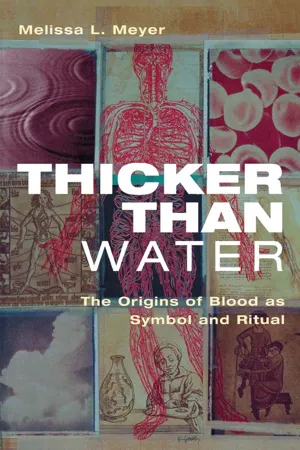
Blood is more than a fluid solution of cells, platelets and plasma. It is a symbol for the most basic of human concerns--life, death and family find expression in rituals surrounding everything from menstruation to human sacrifice.
Comprehensive in its scope and provocative in its argument, this book examines beliefs and rituals concerning blood in a range of regional and religious contexts throughout human history. Meyer reveals the origins of a wide range of blood rituals, from the earliest surviving human symbolism of fertility and the hunt, to the Jewish bris, and the clitoridectomies given to young girls in parts of Africa. The book also explores how cultural practices influence gene selection and makes a connection with the natural sciences by exploring how color perception influences the human proclivity to create blood symbols and rituals.
- 264 pages
- English
- ePUB (mobile friendly)
- Available on iOS & Android
eBook - ePub
About this book
Trusted by 375,005 students
Access to over 1.5 million titles for a fair monthly price.
Study more efficiently using our study tools.
Information
Subtopic
Social HistoryIndex
Social Sciences| CHAPTER | 1 |
Introduction
The Human Inclination
to Symbolize and Ritualize Blood
to Symbolize and Ritualize Blood
Beliefs about blood are among the oldest surviving ideas from the earliest days of humankind.1 Blood symbols and rituals have been so widely distributed among various cultural societies across time as to be nearly universal. Blood metaphors have a primal quality; those who use them, even today, assume their meaning is understood. Now they imply a genetic element, but this was not always so. Though patterned, the meanings attributed to blood varied and did not remain static.
The origins of blood hearken back to the dawn of life on Earth. Evolutionary biologists and geneticists believe that the chemical composition of blood serum (whole blood minus proteins and amino acids) is identical to the primordial sea. Earliest one-celled organisms surrounded seawater with a membrane as they came to encompass their own bodily fluids.
The redness of blood helps explain its power as a symbol and focus for ritual. The fields of neurobiology and cognitive psychology demonstrate that the human brain is “hardwired” to perceive and learn in certain ways. There is a general consensus about the universality of color perception, which stems directly from the rod and cone structure of the eye. Symbolic anthropologists revealed universals in linguistic color codes. According to linguists, all languages use color terms that conform to the same evolutionary sequence: (1) black and white, (2) plus red, (3) plus green or yellow, (4) plus green and yellow, and (5) plus blue. Infants recognize colors in precisely the same sequence. The neurobiological basis for the universality of color perception and classification is the most important primary epigenetic rule for explaining the origins of blood metaphors.2
Red is an emotionally charged color: it is bright and striking. But the color of blood alone does not explain its salience for human beings.
Early symbolic anthropologists thought that blood ought to draw ritualistic attention. Presaging Michel Foucault, Mary Douglas argued that “the powers and dangers credited to social structures” were transposed onto the body, as a symbol of society. Cognitive psychologists showed how bodily orifices tend to be perceived as vulnerable, marginal zones that symbolize the boundaries between internal purity and external danger. Humans invested substances that transgressed these boundaries, such as blood, semen, saliva, tears, urine, and feces, with powerful properties. Rituals marked and mediated these borders.3 Humans have extensively symbolized and ritualized blood as one of the most powerfully meaningful and multivocal bodily substances.
The physiology of circulation makes it appear that blood is central to life and death. Early gatherer-hunter-fishers depended on astute observation to survive. They saw that extensive blood loss led to death. They also noticed that blood stopped flowing at death. Cave paintings in the Pyrenees demonstrate that these early hunters understood that piercing the heart was fatal. Blood spurting from a wounded animal with a still throbbing heart graphically illustrated this. In some parts of the body, a wound gushed pulsating bursts of bright red blood, while darker blood flowed from wounds elsewhere. These hunters surmised that head wounds could be fatal and that spinal injuries brought paralysis or death. Because they regularly skinned and eviscerated game, they observed that the stomach contained undigested bits of the last meal. They saw that the liver held large amounts of blood. Blood naturally appeared to be associated with life and death. Early humans easily made these direct observations. Many have made the connection.4
Blood and the Reproductive Life Cycle
Natural and ritual bloodshed accompanies important junctures of the life cycle. Menarche signals a girl's newborn fertility. Menstrual blood simultaneously signifies the potential for life and death, as in “not a baby.” Many have noted the association between menarche and circumcision. The disappearance of menstruation indicates pregnancy. People nearly everywhere associated vanished menstrual blood with a growing fetus and breast milk. Circumcision and initiation bloodletting were sacrifices performed by men to claim responsibility for birthing. These acts rid boys of the influence of their mother's blood. Men culturally grew boys into men in a rebirth. Other forms of sacrifice have widely been the province almost exclusively of men to perpetuate patrilineages as “birth done better” than women. Thus the biological and cultural bases for humans to signify blood are strong and nearly universal. These hallmarks of the life cycle involving blood, both naturally and culturally, form the central organizing principle of this book.
Viewing ritual as “a symbolic code communicating certain aspects of ideology and social structure,”5 anthropologists have attempted to make sense of a vast array of reproductive rituals since the early years of comparative ethnography and ethnology. Pervasive androcentrism made most theoretical debate “penis driven” and focused on cultural resolutions of Freud's oedipal dilemma believed to be universally central to male psychodynamics. More scholarship has been devoted to circumcision, an unnecessary, symbolic ritual, than to childbirth or menstruation, which happen naturally. For most of the twentieth century, men carried out fieldwork, producing laundry lists of food taboos and rituals rather than considering childbirth in its own right.
Most theoretical interpretations have fallen into one of four dominant discourses: (1) psychoanalytic theory, (2) transition-rite theory, (3) structural functionalism, and (4) feminist critiques of the political dimensions of reproductive rituals.6 Because this book focuses on the human obsession with symbolizing and ritualizing blood, these discourses do not contribute much. My central purpose is to illuminate the far-flung yet patterned ways in which human cultures have symbolized and ritualized blood. Doing so is inherently human.
Studies that focus on discrete reproductive rituals are inherently flawed. They cannot capture the holistic cultural cosmologies that integrate and give meaning to gendered, reproductive rituals throughout the life course. Stripped of their cultural context, reproductive rituals seem eccentric and worth passing note only. Maureen Trudelle Schwarz charged, “Previous studies did not fully explore the complex rules defining who or what can affect what or whom under particular circumstances, or what these effects might tell us about the cultural construction of the human body and personhood in the societies under investigation.” Until quite recently, scholars had left the centrality of the body “assumed and unproblematized, or …largely ignored.”7 This is particularly true for the “pollution approach” to female emissions. Ethnocentric disapproval of restricting or sequestering women in the throes of childbirth or during menstruation has relegated countless cultural systems to a quaint antiquarian heap.8 Anthropologists have noted that women's blood was used in sorcery.9 Researchers have not scrutinized enough the fact that female blood usually had the power to interfere with other productive activities. Some bodily effluvia were thought to have positive effects, which has been even less examined.
Since the 1970s, scholars have situated Western science in its own cultural context. Biomedical constructions of the body, well-being, and ill health have been deconstructed with the aid of Foucault, who has shown how “the clinical gaze is a cultural gaze.” So we are prepared to be open to cross-cultural systems of logic far different from those of the West.10
Rather than being distinct, each rite of passage is linked by a particular cultural logic to a larger symbolic context. Yet very few studies attempt anything like this. The underdeveloped status of the field has hampered my exploration. Efforts to understand the perspectives of those who left few written records are frustrated by the same difficulties that beset “ethnohistorians” over the past several decades, but more so. Childbirth, puberty, sexuality, intercourse, and reproduction are extremely intimate areas. They are decidedly gendered. I am centrally interested in how blood figures into these cultural systems of logic. Reconstructions of complex cosmologies with multiple layers of understanding are rare findings.
Blood is salient for humans and has been treated as much more than just a red fluid. Three metaphorical constructions—(1) homology, (2) complementarity, and (3) synecdoche—can help illuminate cultural constructions of bodies and selves. The principle of homology is that portions of a whole share an analogous design. Often, a menstruating woman had to be entirely contained, body and behavior, not just her blood. Complementarity is the metaphorical principle that wholes are composed of paired, blended elements. The most fundamental social pairing was men and women. They were widely held to be oppositional, yet interrelated. The synecdoche principle suggests that “every part is equivalent to the whole, so anything done to, or by means of, a part is held to take effect upon, or to have the effect of, the whole.” This is the basic principle of ritual: a discrete action here will have an effect there. These metaphorical constructs help clarify the reproductive rituals surveyed herein.11
However, the reproductive life cycle is anchored in physiology.12 The physicality of unaltered human bodies is not socially constructed. Cultural meanings must adhere, in part, to these realities. Women give birth. Differential roles might be assigned to semen, menstrual blood, eggs, or divine spirits, but that biological fact remains. Cultural beliefs might gender parts of women's bodies male, but babies still emerge through the birth canal. The interplay between cultural beliefs and physical realities creates the matrices of bodily symbols.
Between the neurophysiological basis for the universality of color perception and the widespread association of blood with the life cycle, humans have many inherent reasons to signify blood. Humans are drawn to bloods redness. Its close affiliation with the life cycle and with slaying animals adds more dimensions for human interpretation. However, the universality of color perception alone cannot explain the immense range of blood symbols, rituals, and metaphors. The hybrid field of gene-culture coevolution or dual inheritance theory, which draws on the scientific fields of neurophysiology and cognitive psychology, provides greater insights.
Specialists in the field of gene-culture coevolution explain that human culture will be most elaborate where the neurophysiological bases most favor it. The range of blood symbols, rituals, and metaphors attending the reproductive life cycle has been extremely elaborate for millennia. Indeed, I believe that this accounts for the many varied blood rituals according special treatment to the individuals, the life cycle stages, and even the blood itself. It also accounts for the diverse rituals that draw blood, often in imitation of natural processes.
Humans have imposed more symbolic and metaphorical meanings on blood in more ritualized contexts than any other substance. Blood symbolizes life most extensively, death secondarily. All other connotations pale in comparison to these two dominant metaphors. These dual meanings are ambiguous at best, antithetical at worst. Victor Turner would have labeled them “multivocal,” with meanings that are multifaceted and patterned at once.
Fertility and Life
The most widespread metaphorical trope attributes life-giving qualities to blood, both in terms of procreation and agricultural fertility. For the Dogon of Mali, the “central aspect…of female fertility…[was] blood.”13 Ancient and contemporary Mayans have associated blood literally and symbolically with life forces. The gods used their own blood to consciously create humans. Humans, then, sacrificed blood to propitiate the gods and connect with them. Bloodletting ensured that the sun would rise, or be reborn from the evening's death. The Bimin-Kuskusmin of Papua New Guinea buried bamboo tubes full of menstrual blood to ritually fertilize women's crops.14 Blood's life-giving capacity could be transferred to the soil.
In ancient Mesopotamia, Sumerian texts told how gods grew weary of working and empowered the Birth Goddess (who had many names, including Mami, the oldest) to create humans to do the work for them. In two central myths, a goddess mixed a slain god's blood with clay from the primordial ocean to create human beings. This theme recurred through many Sumerian stories, after which humans proliferated by sexual procreation.15
Visible observations of blood's role in reproduction caused many to believe it was central in forming a fetus. From ancient Greeks to Cherokees, this was the most common belief about blood. Believing that menstrual blood formed fetuses is the foundation for most other blood beliefs and rituals. I examine this association in greater detail in chapter 3.
Today's major world religions share the notion that the spirit of the animal or person resided in its blood. This was a widespread cultural motif among native peoples of the Eastern Woodlands culture area of North America. In a Cherokee story, hunters killed a bear, taking its skin and meat and covering its blood with leaves. The bear then reconstituted itself from the blood left behind. Each animal had a certain amount of time to live. If hunters followed the proper rituals, killing an animal did not result in its permanent death. If the animal allowed itself to be taken by properly behaving hunters, it would simply rise again from the blood spilled to live the rest of its life. James Adair, a trader closely affiliated with numerous southeastern native groups, reiterated the native belief that an animal's blood “contains the life, and spirit of the beast.”16 Many others shared this belief that blood held the spirit. In late-twentieth-century Zaire, people objected to blood transfusions because it meant “putting your spirit into another spirit.”17
If blood held the life force, drinking it, applying it to the body, or commingling it with one's own blood might convey the special qualities of that being. In this way one might acquire the strength of a mammoth, the ferocity of a tiger, or the courage and wisdom of an esteemed individual. Novice Scythian warriors drank the blood of the first man they killed to ...
Table of contents
- Cover
- Title Page
- Copyright Page
- Dedication
- Table of Contents
- Acknowledgments
- Chapter 1 Introduction: The Human Inclination to Symbolize and Ritualize Blood
- Chapter 2 Women's Blood and Men's Blood at the Dawn of Human Culture
- Chapter 3 The Blood of Conception, Pregnancy, and Childbirth
- Chapter 4 Initiation Rites: The Role of Blood in Attaining Adult or Group Status
- Chapter 5 Menstruation: The Fundamental Foundation
- Chapter 6 Sacrifice: ‘Birth Done Better’
- Chapter 7 Conclusion: The Patterned Heterogeneity of Blood Symbols and Rituals
- Notes
- Index
Frequently asked questions
Yes, you can cancel anytime from the Subscription tab in your account settings on the Perlego website. Your subscription will stay active until the end of your current billing period. Learn how to cancel your subscription
No, books cannot be downloaded as external files, such as PDFs, for use outside of Perlego. However, you can download books within the Perlego app for offline reading on mobile or tablet. Learn how to download books offline
Perlego offers two plans: Essential and Complete
- Essential is ideal for learners and professionals who enjoy exploring a wide range of subjects. Access the Essential Library with 800,000+ trusted titles and best-sellers across business, personal growth, and the humanities. Includes unlimited reading time and Standard Read Aloud voice.
- Complete: Perfect for advanced learners and researchers needing full, unrestricted access. Unlock 1.5M+ books across hundreds of subjects, including academic and specialized titles. The Complete Plan also includes advanced features like Premium Read Aloud and Research Assistant.
We are an online textbook subscription service, where you can get access to an entire online library for less than the price of a single book per month. With over 1.5 million books across 990+ topics, we’ve got you covered! Learn about our mission
Look out for the read-aloud symbol on your next book to see if you can listen to it. The read-aloud tool reads text aloud for you, highlighting the text as it is being read. You can pause it, speed it up and slow it down. Learn more about Read Aloud
Yes! You can use the Perlego app on both iOS and Android devices to read anytime, anywhere — even offline. Perfect for commutes or when you’re on the go.
Please note we cannot support devices running on iOS 13 and Android 7 or earlier. Learn more about using the app
Please note we cannot support devices running on iOS 13 and Android 7 or earlier. Learn more about using the app
Yes, you can access Thicker Than Water by Melissa Meyer in PDF and/or ePUB format, as well as other popular books in Social Sciences & Social History. We have over 1.5 million books available in our catalogue for you to explore.