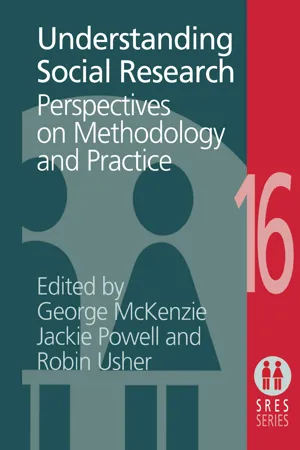
eBook - ePub
Understanding Social Research
Perspectives on Methodology and Practice
- 236 pages
- English
- ePUB (mobile friendly)
- Available on iOS & Android
eBook - ePub
Understanding Social Research
Perspectives on Methodology and Practice
About this book
In 1991 the Economic and Social Research Council (ESRC) published "Postgraduate Taining Guidelines". Throughout the document emphasis is placed on the need for universities to make postgraduate research students aware of the methodological issues that affect their work.; This text explores the relationship between knowledge, methodology and research practice across the broad spectrum of the social sciences in langage that is accessible to researchers at all levels of their research careers. It follows the themes that there is no single practice or correct methodology, and that the diversity and variety in terms of methodology and disciplinary focus are a sign of the sophistication and complexity of the proceses of social research. The text examines socio-cultural contexts of social research and relates them to contemporary shifts in focus such as feminism, critical theory and postmodernism. The importance of selecting the research methodology most appropriate to the subject discipline concerned is emphasized.
Information
1
Introduction
This collection comprises the thoughts of individual social researchers who approach their work from a variety of perspectives. The diverse approaches represented here reflect the diversity of socio-economic problems which are likely to be found amongst any group of social scientists. If this collection has any one single theme that stands out above all others, it is that in the realm of social and economic research there is no single correct practice and no superordinate methodology. This theme is exemplified in the papers. Their diversity and variety both in terms of research methods and disciplinary focus, far from being a sign of weakness, is rather a sign of difference at work. Far from being a matter of regret, it is in our view a matter of celebration and a mark of the sophistication and complexity of the process of social research. Our hope is therefore, that these papers will stimulate processes of exploration and interrogation amongst social researchers.
In order to express this diversity, contributors were left free to develop their chosen topic in their own way, subject only to the condition first, that their contribution should be rooted in their own practice as researchers but that they should try to be as reflexive as possible about this, and second, that they endeavour to highlight the epistemological commitments embedded in their research practice and the methodological choices that follow from these commitments. The hope is, that as a consequence, readers will be better able to understand the connection between epistemology, methodology and research practice, and in doing so enrich their own research. However, it is important to emphasize that this is no DIY manual of research methods since the message that emerges very clearly, taking the contributions collectively, is that there can be no such manual. Methods are not part of some universal algorithm of ‘how to do research’ but are a function of concrete research practice, rooted in research traditions and paradigms.
What can be achieved, and this is clearly revealed in the contributions, is that research methods need to be, and indeed can be, subjected to critical scrutiny. This critical scrutiny is, however, somewhat different from what would be normally understood by this term, for what is most in need of scrutiny is not the outcomes of research (which is the way methods are usually assessed) but also the epistemological commitments of any research. Even if researchers feel confident methodologically and see no need to review their methods, it is increasingly the case that social research now demands not only an evaluation of outcomes, but a reflexive analysis of the research process and of the place of the researcher within that.
Epistemology, in a disciplinary sense, belongs to philosophical discourse where it is understood as the way in which claims to knowledge are justified—to ask epistemological questions is to ask questions about what is to count as knowledge. However, epistemology is not, as it is commonly understood, simply a set of rules about how to decide what is to count. Epistemology itself has a history and is itself socially located. Historically, it evolved as part of the struggle against the medieval Church with its monopoly over learning and its construction of truth in terms of the authority of divine texts. Epistemology constituted a different way of grounding knowledge through the emerging natural sciences and its ‘democratization’ of knowers. Experiment and observation replaced tradition and the divine text, validation became a function of measurement and intersubjective testability, and experience mediated by rationality, the source of knowledge.
Inasmuch as research involves finding out about the world, it is unavoidably about the making of knowledge claims. In making a claim there is an implied preparedness to justify the claim by pointing to the ways in which one knows—in other words, the putting forward of good reasons for knowing so that claims can be intersubjectively tested and thus publicly licensed. Traditionally, these ‘good reasons’ have been defined epistemologically as the ‘objective’ and ‘systematic’ differentiation of valid or legitimate knowledge from apparent knowledge or mere belief. The ‘best’ or strongest kind of knowledge has been taken as that which is the outcome of using scientific method and hence scientific method came to be seen as a set of universal rules for conducting research and the making of publicly licensable knowledge claims—claims guaranteeing that the world was known truly.
Any research, whether in the natural or social sciences, in making knowledge claims inevitably raises epistemological questions. Very often however these are not made explicit, in fact most of the time they are taken for granted. Most researchers in the social sciences (particularly those at the more quantitative end of the spectrum) tend to think only in terms of methods or particular techniques for gathering evidence and very rarely consider the epistemological assumptions of their research. Or if they do, they do so purely in terms of whether they are working ‘scientifically’ or being sufficiently ‘objective’. This is taken as the ‘natural’ thing to do in research, without any recognition that by so doing certain epistemological assumptions are being implicitly made. Thus for instance, being ‘objective’ is implicitly understood in terms of being unbiased, value-neutral and ensuring that personal considerations do not intrude into the research process. Yet to accept this definition of objectivity unproblematically is to implicitly accept a certain epistemology and all the commitments and assumptions that go with that.
There is a powerful tendency in social research either not to take account of epistemology at all or to think of it purely in its positivist/empiricist form—the descendant of philosophy’s struggle against the medieval Church and the authority of tradition. A positivist/empiricist epistemology contains the following assumptions:
1 The world exists independently of knowers, i.e. it is ‘objective’. It consists of events and phenomena which are lawful and orderly. Through systematic observation and correct scientific methods, i.e. by being ‘objective’, it is possible to know this lawfulness—to explain, predict and control events and phenomena.
2 There is a clear distinction between the ‘subjective’ knower and the ‘objective’ world. There is also a clear distinction between facts and values, with the former belonging to the objective world, the latter to the subjective knower. Subjectivity (the concerns, values and particularity of the researcher) must not interfere with the discovery of truth.
3 There is order and reason in the social world, social life is patterned and this pattern has a cause-effect form. Things do not happen randomly and arbitrarily. The goal of research is therefore to develop general and universal laws that explain the social world.
4 Knowledge is arrived at through the use of the senses and the application of reason, through observation enhanced by experiment and measurement. Both experience and language are transparent, thus the senses provide unmediated access to the world and there is a clear correspondence between the world and the words we use to represent it. Sensory experience must, however, be filtered through rationality and since reason is a universal characteristic, different observers exposed to the same data should be able to come to the same conclusions—this is known as intersubjective verification.
5 All the sciences or disciplines are based on the same method of finding out about the world. Thus the natural and social sciences share a common logic and methodology of enquiry.
6 Enquiry and critique into epistemological-ontological commitments that underlie the use of methods is a pointless exercise.
A positivist/empiricist epistemology of research emphasizes determinacy (that there is a certain truth that can be known), rationality (no contradictory explanations, convergence on a single explanation), impersonality (the more ‘objective’ and the less ‘subjective’ the better), the ideal knower (that anyone whose senses are not impaired and whose faculty of reason is fully functioning can be a knower), and prediction (that research should aim for generalizations from which predictions can be made and events/phenomena controlled). In order to be seen as valid, knowledge has to be dehistoricized, detached from its source in experience (since experience could only become knowledge when acted upon by reason) and from the place where it was made. Furthermore, research need not be reflexive or self-critical since the focus is exclusively on methods and outcomes rather than the research process itself. This ignoring of reflexivity leads to seeing research as a ‘technology’ or technicized process.
As we have noted, traditionally epistemology has been concerned with answering questions about who can be a knower, what are the means by which beliefs can be tested in order to count as knowledge, and what kinds of things can be known. The answers that positivism gives to these questions is first, that the ‘ideal knower’ is the rational, value-neutral, transcendental person—for which read ‘man’, for as feminist writers have pointed out women did not count as knowers since their rationality was considered to be impaired (Harding, 1987); second, that the tests for what is to count as knowledge involve the application of scientific method; third, that the kinds of things that can be known are those that are directly observable and quantifiable.
This seems to imply that scientific method is an abstract set of logical rules, independent of the world and its social practices (as it were, ‘made in heaven’), and universal in their applicability, i.e. all knowledge claims can be differentiated in the same way. Critics of positivism argue however, that not only is there no one single epistemology, no one single test or set of rules of what is to count as knowledge, but that epistemology should not be understood as defining a set of universal logical rules. Instead, whatever rules there are should be seen as a cultural artefact, historically-located and value-laden. Rationality is neither universal, culturally neutral nor invariant in its form. Scientific method, as we have seen for instance, has itself evolved historically with the growth of the natural sciences and of Western philosophy. Furthermore, there is no single scientific method, rather it is more aptly understood as ways of working specific to particular research paradigms and to particular disciplinary pursuits.
Different epistemologies provide different versions of how things can be known. Epistemologies in this sense are linked to disciplines with different disciplines having different ways of knowing the world. They are also linked to ontologies, different versions of what kinds of things exist in the world. Any research paradigm or tradition has its own epistemology, its own way of validating its knowledge claims (as the contribution by McKenzie on economic method and Hamlin on political economy show very clearly). Disciplines are located within a paradigm (or in the social sciences more than one paradigm as many of the contributions show). Paradigms delineate what questions can be asked, what can be researched, what is an appropriate methodology, what constitutes data, and what kind of tests enable beliefs to be counted as knowledge. Any research method or procedure is therefore inextricably embedded in commitments to particular versions of the world and to particular ways of knowing it, and the researcher, by using these methods and procedures rather than others, reproduces and strengthens these commitments. Epistemology is not just a technical philosophical procedure but a commitment to a particular way of understanding the world and acting within it through research. It follows from this that there is no means of carrying out research which is neutral and self-validating, any method in the final analysis being dependent on its location in disciplinary paradigms and research traditions and on an epistemological-ontological rationale and position.
Of course, this is not to say that the situation in the disciplines of the social sciences is one of easy-going plurality and the ready toleration of difference. On the contrary, epistemologies in the social sciences are sites of struggle and this is particularly the case in newly emerging disciplines. The contributions by Payne on Nursing and Avison on Information Systems, both newly emerging disciplines, make this very clear. By highlighting the question of where disciplines are to be located within the spectrum of the social sciences, issues to do with boundaries and exclusions are raised in an acute form, both within disciplines and between disciplines.
Some epistemologies have more credibility and dominance that others and this is not so much a matter of their natural goodness in describing the world but because they are powerful. The most powerful is still a positivist/empiricist epistemology that holds up the methods and procedures of the natural sciences as the model for all research and which implicitly understands itself as a universal epistemology. The consequences of the dominance of positivist/empiricist epistemology are by now well-known but are still worth mentioning in this context. First, in the social sciences and in social research a pre-eminent place has been accorded to the production of generalizable knowledge and the discovery of law-like regularities. Second, there has been a privileging of the language, methods and quantification which supposedly characterize research in the natural sciences (Scott’s chapter on qualitative research in education clearly demonstrates the taken-for grantedness and therefore power of quantitative approaches). Third, feminist research has shown that the influence of positivist/empiricist epistemology in the social sciences has been to focus mainly on ‘questions about social life that appear problematic from within the social experiences that are characteristic for men’ (Harding, 1987; p. 16). Hence the tests to which knowledge claims are subjected are always gendered, male definitions prevail of the things in the world that can be known and, as a consequence, the experience of women becomes invisible. In more general terms, Hand in his chapter shows clearly the significance for the research process of the initial question asked.
Of course, the dominance of positivist/empiricist epistemology has not gone unchallenged and the contributors show that there are now a number of counter-epistemologies in the disciplines of the social sciences. For example, hermeneutic/interpretive epistemology argues that the model to be followed is not an idealized and universal logic of scientific discovery and justification because this is an inappropriate model for the social sciences. In social research, it is argued, the test of knowledge should not be generalization and prediction but interpretive power, meaning and illumination. The focus should be on human action and interaction which by its nature is meaningful and hence has to be interpreted. An idealized logic drawn from the natural sciences and a limiting of what can be known to the empirically ‘given’ cannot hope to elucidate these meanings and thus cannot hope to portray the rich diversity of the social world.
Yet concluding from this that an unbridgeable chasm exists between the natural and social sciences may not be the only possibility. Kuhn’s view of natural science as it is actually practised, rather than how it understands itself and is itself understood, emphasizes the importance of normative consensus and commitment within research communities as the means by which a paradigm is maintained and realized in practice. In effect, this means that the natural and social sciences are actually not that different although in a reverse way to that which is normally assumed. The social sciences need not strive to be more like the natural sciences, since the latter might actually be more like the former than we might at first think. Kuhn (1970) helps us to see that the way research in the natural sciences is practised does not follow a positivist/empiricist epistemology—on the contrary, there is a significant hermeneutic/interpretive dimension. The difference, for example, between the natural sciences and the social sciences is not that the former are more ‘objective’ whilst the latter are ‘subjective’. Since any research practice has a hermeneutic dimension, the natural sciences are just as subjective in this sense as the social sciences. Here, it is important to note however that ‘subjective’ does not refer to individual subjectivity but to the subjective as socially defined.
Paradigms are frameworks that function as maps or guides for research communities, whether in the natural or the social sciences. They provide ways of looking at and ways of working in the world. As we have noted earlier, they define the objects, direction and methods of research. To this extent, they provide a ‘social subjective’. Knowledge is not the product of an individual consciousness nor is the latter the means by which knowledge is validated. Rather than research or finding out about the world being a matter of epistemological individualism, we should see it as the outcome of active and historically evolving communities. Furthermore, if research is a social practice carried out by research communities this means that what constitutes ‘objectivity’ and the ‘objective’ will be defined by the community and the paradigm which shapes its work—in other words, it is the community rather than the world or a set of universal rules which decides what is ‘objective’.
Research in the positivist/empiricist mode proceeds from hypothesis formation to data collection and to the verification or disconfirmation of hypotheses in the light of the data. More interpretive approaches such as grounded research and action research (discussed by Avison, Bartlett and Payne, Powell, Payne, Scott and Nandhakumar) start with data and generate hypotheses or theory from the data in a backwards and forwards, or dialectical movement, between theory and data. Here the emphasis is more on searching for order rather than assuming it is already there as a positivist approach does. The feminist approach (as discussed by Pat Usher, Orme and Payne) is concerned with critiquing all research traditions by exposing their roots in androcentrism and patriarchal control and exclusion. This however does not lead to a rejection of existing research methods but rather to a more openended and critical approach where a diversity of methods can be employed within an inter-disciplinary environment
Postmodern research (as discussed by R.Usher) on the other hand, whilst recognizing that there is no postmodern method(s) as such, questions both the assumption of, and the search for, a pre-existing order by highlighting the privileging and exclusion characteristic of all research paradigms and traditions. This emphasizes the need for reflexivity, a recognition of the way in which research ‘constructs’ a world to be researched. Furthermore, in contrast to the positivist’s narrow empiricism, the postmodern ‘empirical’ is much wider, and one with greater potential for the social scientist. Here empirical testing can relate to practice in close and fruitful ways. When the test of a theory is not its correspondence with the empirical but its correspondence with the practical, the empirical includes, rather than excludes, the practical. The merit of a theory then is found in its practical implication and efficacy in solving problems of the discipline. By questioning the hierarchically structuring and rigid binary oppositions, for example between theory and practice, the universal and the local, the abstract and the specific, the rigorous and the relevant, postmodern researchers seek therefore to replace order, homogeneity and determinacy as the prime goal of research with diversity, difference and indeterminacy. By foregrounding the power inherent in all disciplinary-based research they draw our attention to the very ambivalence of ‘discipline’—that it is at one and the same time, both knowledge and social control.
References
HARDING, S. (1987) ‘Introduction—is there a feminist method?’, in HARDING S. (Ed) Feminism and Methodology, Buckingham, Open University Press.
KUHN, T. (1970) The Structure of Scientific Revolutions, Chicago, University of Chicago Press.
2
The Age of Reason or the Age of Innocence?
Introduction
Research is a response to a challenge. It is undertaken in an attempt to solve a problem. We undertake research everyday whether in our personal lives, as students or as part of out professional career. We ...
Table of contents
- Cover
- Halftitle
- Social Research and Educational Studies Series
- Title
- Copyright
- Contents
- Series Editor’s Preface
- 1 Introduction
- 2 The Age of Reason or the Age of Innocence?
- Part 1: The Nature of Enquiry
- Part 2: The Nature of Disciplines
- Part 3: Research Practice
- Notes on Contributors
- Index
Trusted by 375,005 students
Access to over 1.5 million titles for a fair monthly price.
Study more efficiently using our study tools.
Frequently asked questions
Yes, you can cancel anytime from the Subscription tab in your account settings on the Perlego website. Your subscription will stay active until the end of your current billing period. Learn how to cancel your subscription
No, books cannot be downloaded as external files, such as PDFs, for use outside of Perlego. However, you can download books within the Perlego app for offline reading on mobile or tablet. Learn how to download books offline
Perlego offers two plans: Essential and Complete
- Essential is ideal for learners and professionals who enjoy exploring a wide range of subjects. Access the Essential Library with 800,000+ trusted titles and best-sellers across business, personal growth, and the humanities. Includes unlimited reading time and Standard Read Aloud voice.
- Complete: Perfect for advanced learners and researchers needing full, unrestricted access. Unlock 1.5M+ books across hundreds of subjects, including academic and specialized titles. The Complete Plan also includes advanced features like Premium Read Aloud and Research Assistant.
We are an online textbook subscription service, where you can get access to an entire online library for less than the price of a single book per month. With over 1.5 million books across 990+ topics, we’ve got you covered! Learn about our mission
Look out for the read-aloud symbol on your next book to see if you can listen to it. The read-aloud tool reads text aloud for you, highlighting the text as it is being read. You can pause it, speed it up and slow it down. Learn more about Read Aloud
Yes! You can use the Perlego app on both iOS and Android devices to read anytime, anywhere — even offline. Perfect for commutes or when you’re on the go.
Please note we cannot support devices running on iOS 13 and Android 7 or earlier. Learn more about using the app
Please note we cannot support devices running on iOS 13 and Android 7 or earlier. Learn more about using the app
Yes, you can access Understanding Social Research by George McKenzie,Jane Powell,Robin Usher in PDF and/or ePUB format, as well as other popular books in Education & Education General. We have over 1.5 million books available in our catalogue for you to explore.