In this original study of witchcraft, Gibson explores the stories told by and about witches and their 'victims' through trial records, early news books, pamphlets and fascinating personal accounts. The author discusses the issues surrounding the interpretation of original historical sources and demonstrates that their representations of witchcraft are far from straight forward or reliable. Innovative and thought-provoking, this book sheds new light on early modern people's responses to witches and on the sometimes bizarre flexibility of the human imagination.
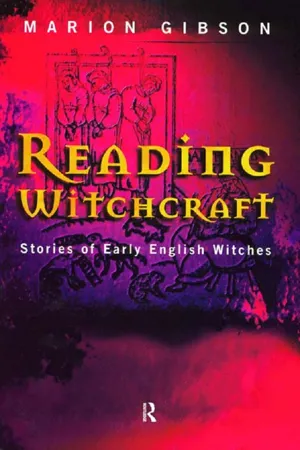
- 256 pages
- English
- ePUB (mobile friendly)
- Available on iOS & Android
eBook - ePub
Reading Witchcraft
Part I
Records
1
Ghost-writers—dialogue, interrogation and the production of the records of witchcraft
In trying to understand witchcraft, the logical place to begin is with the ‘witches’ themselves. These women and men suffered or died because of what they said, or what was said about them, and in examining these words we give them another chance to speak and to be less misunderstood. Defined by their community as ‘witches’, how did they represent themselves, and how (and to whom) did they tell stories of their ‘witchcraft’? This chapter explores the processes of questioning witches, their responses and storytelling, and how these processes were recorded in the magistrates’ ‘examinations’ which appear in witchcraft pamphlets. In doing this we can ask how the forms of question, answer and recording might shape the way that witchcraft was represented. A better understanding of the structure and content of documents about witchcraft is essential to any detailed reading of them, in pamphlets or elsewhere. There are three sections of the debate: first, ‘Questions’ traces possible, largely unrecorded, magistrates’ questions shaping accounts; ‘Answers’ discusses witches’ cooperation with, and resistance to, questioners;1 finally, ‘Writers’ discusses the makers of records, and pamphleteers, who together shape the final, printed, representation of witchcraft. Examinations and the pamphlets which use them emerge as collaborative representations rather than records. If we can begin to analyse these multivocal documents to see who is telling us what about witchcraft and why, we can suggest what witchcraft meant to the different types of people who constructed it. Rather than assessing which elements of documents and pamphlets are ‘factual’, we can decide whose interests were served by each kind of representation of witchcraft, giving a far more sophisticated understanding of the many things people wanted witchcraft to be.
Questions
The circumstances surrounding the questioning of witches can be summarised quite simply. When a community suspected one of its members of witchcraft, the victim or victims of the alleged witchcraft attack, or their friends or relatives, would go to the local magistrate and request action. The victim would give the magistrate a verbal ‘information’ consisting of accusations against the suspect, and the Justice would have it recorded. He would then send for the suspect and question him or her. The suspected witch’s response would be similarly recorded, as an ‘examination’. These examinations are the basis of many early pamphlets. But how were these statements elicited? Witches and magistrates were people like us, with motives like us, and not simply the players of roles—we should look in detail at what these people, as individuals, had to say. In English cases of this period, no torture was used to elicit confessions, and there was apparently no questioning formula encoded for magistrates faced with a suspected witch, as there was in many European legal systems. Questions were, however, the means of getting information, and there do seem to have been recurrent patterns of questioning and response.2 In at least ten out of twenty-nine examinations, judging by the first words spoken by the suspected witch, the first question must have been a variant of ‘How did you become a witch?’3 Essex witch Elizabeth Frauncis is reported as having said:
Fyrst she learned this arte of witchcraft at the age of xii yeres of hyr grandmother whose nam was mother Eve of Hatfyelde Peverell disseased. Item when shee taughte it her, she counseiled her to renounce GOD and his worde, and to geve of her bloude to Sathan (as she termed it) whyche she delyvered her in the lykenesse of a whyte spotted Catte, and taughte her to feede the sayde Catte with breade and mylke and she dyd so, also she taught her to call it Sathan and to kepe it in a basket.4
Elizabeth’s examination begins as a confession of her guilt because it apparently begins after that crucial question. Yet problems of interpretation are immediately apparent. First, the report is in the third person, so the witch’s own words are rewritten by a clerk. Second, knowing for certain whether questions elicited this statement is impossible. Third, how many questions might have produced this passage? Fourth, what were their exact words and tone? Last, since examinations could be written up to two days after they had been conducted, are these ‘answers’ a summary, revised into coherence?5 Probably clerks recorded accurately the basic content and order of statements, but their freedom to edit is demonstrated by their omission of questions, and witches are represented as confessing unprompted and coherently.6 For the legal system, concerned to produce documents which might need to convince in court, witchcraft seems to have been about causal links, narrative coherence and establishing guilt in a clear confession concerned with the origin of malevolent power, the reason why it was used, and the effect on the victim.7 This investigative priority of the judicial system, embodied in the questions which were asked, would determine the stories told and thus our understanding of what witchcraft was.
It is necessary to identify questions, where possible, but it is equally important to consider why they were asked. For example, was the judicial priority of this first question, based on the articulation of cause and effect and the investigation of a higher power beyond the witch, also that of the community, victims and suspects? Anthropological studies like Evans-Pritchard’s or Favret-Saada’s suggest that the wider community is usually uninterested in the origin or precise operation of witchcraft power, and in this period in England, George Gifford’s Dialogue concerning Witches and Witchcraftes was intended to counter the same apathy by explaining the devilish tricks which, he argued, gave witches power to harm and heal.8 The origins of witchcraft power were of primary importance to demonologists like Gifford, and there was much religiously charged discussion of how the devil empowered and marked his servants, with King James even describing the process as a witch’s ‘entresse and prentishippe’ in his or her ‘craft’, systematising and formalising the supposed contract with the devil and the consequence of the witch’s empowerment.9 When one contrasts this learned interest in witchcraft’s origins with the apparent popular unconcern which it was designed to combat, it seems likely that learned men determined the need for inquiry during the examination into the circumstances of a witch’s initiation. These men operated as individuals—Sir James Altham, Brian Darcey, Clement Sisley, Roger Nowell, Henry Fortescue, Sir Henry Gray —rather than as a class, but they were the judges and magistrates who determined in part what witchcraft was seen as. If the question about origins is one of theirs, then they would have asked it for their own benefit, and not that of the victim. In formal terms, the concern with finding a logical beginning for events shaped legal and pamphlet representations of witchcraft, possibly making it seem far more coherent than it was. Given that the suspected witch’s examination was produced through dialogue between witch, questioner and the accusations of informants, it is astonishingly focused, held together by the cause-and-effect arrangement of the inquiry, a format which makes it seem that the suspect believed what he or she said and articulated it easily. In fact the suspect may be articulating the questioner’s beliefs, and responding to his interests and his logic, in a story structured by the order in which his questions were asked. Hence Elizabeth Frauncis begins her account of herself as witch by explaining how she acquired her power.
Which other questions might have shaped Elizabeth’s account of witchcraft, and how would Henry Fortescue’s, the magistrate’s, logic run? If her statement is a clue to her questioning, Elizabeth might have been asked: ‘How did you learn witchcraft? Where does the teacher live? Is she living? What did she teach you?’ These are relatively open questions (except the first, which presupposes criminality) and would allow her to tell her ‘own’ story based on the questioner’s assumption of guilt. But she might have been asked: ‘Did you learn your witchcraft from your grandmother? Did she counsel you to renounce God?’, and so on.10 Possibly Elizabeth is being allowed more input than that, because the writer records her using her own terminology (‘as she termed it’). A fruitful way of asking the first question might be: ‘From whom did you learn your witchcraft?’, a question which assumes guilt and potentially produces another suspect. Linked questions could then follow up the double incrimination. And, since all the other witches who begin their statements with this basic pattern name their teacher, it suggests that the ‘usual’ first question was this ‘From whom…?’, or that this element was included in a cluster of ‘usual’ first questions.11
The concern to know how witchcraft became possible for each witch is a recurrent theme even in examinations which apparently did not begin with the question ‘From whom did you learn your witchcraft?’ Another first question might be ‘From where or whom did you get your familiar spirit?’, possibly producing answers such as: ‘This examinate saith, that one Fustian Kirtle, otherwise called Whitecote, a witch of Barking, came to her house about seaven or eight yeeres agoe and gave her a thing like a Moule…’12 and ‘Fyrst she receyved this cat of this frances wife in ye order as is before sayde, who wild her to cal him Sathan, and told her that yf she made muche of him he would do for her what she wolde have him to do’.13
In a third model of examination, beginning again with the origins of witchcraft power, some witches, instead of naming a human source of skill, describe how they met the devil, a statement which might be prompted by a first question such as that asked by Henry Goodcole in his gaol examination of Elizabeth Sawyer: ‘By what meanes came you to have acquaintance with the Divell, and when was the first time that you saw him, and how did you know that it was the Divell?’14
Possibly unbroken strings of questions were asked here. Goodcole’s composite recording of his questions suggests this, but other witches’ answers may suggest the same. For example, in contrast to Goodcole’s (post conviction) assumption of guilt, Joan Cunny appears to have been asked initially, and apparently uniquely, whether or not she was a witch, in her pre-trial examination. Then she names her teacher, and what Mother Humfrye taught her:
In primis, this examinate saith and confesseth, that she hath knowledge and can doo the most detestable Arte of Witchecraft, and that she learned this her knowledge in the same, of one mother Humfrye of Maplested, who told her that she must kneele down upon her knees, and make a Circle on the ground, and pray unto Sathan the cheefe of the Devills…15
These statements seem well integrated, and perhaps the questions eliciting them were linked to move the suspect’s revelations on, from the teacher to the lesson taught.
This is a logical next step taken in other examinations too. In the examination of Ellen Greene, the suspect says first that Joan Willimot of Goadby came to her in the wolds six years ago, and then explains what Willimot taught her: she ‘perswaded this examinate to forsake God, and betake her to the divel, and shee would give her two spirits…’16 It is difficult to tell whether any eliciting questions were asked singly or as composites. The elements of such composites might be ‘From whom did you learn your witchcraft, when, and what did he or she tell you to do?’ and/or ‘From whom did you get your spirits, when, and what did he or she tell you they would do, and what were you to feed them on?’ However, composite questions might create problems of memory for the suspect, and therefore the apparently composite answers may be a subsequent grouping by the scribe. Again, witchcraft would be represented by him as an intelligible matter, readily defined and confessed by a practitioner, in a way that facilitated prosecution and was then put into print as self-evidently true. But the answers do seem linked by a logic which a questioner might follow rather than a suspect lucidly confess.17 Interestingly for comparison, the three witches who begin by saying they met the devil follow an alternative conventional model of learning witchcraft, which may have come from conventions of questioning also. They might have been asked ‘When, where, and in what shape did the devil come, and what did he say?’, because all three suspects follow this pattern in their stories and finally say that the devil asked for their souls, possibly reflecting another, more specific, question.
The only other significant pattern of statements in examinations, suggesting again a pattern of questioning, occurs at the end, or near the end, of examinations. Presumably, between the establishing questions, if such a model were used, and the concluding ones, the suspect might be freer to speak of what he or she wished. But at the end of the examination, the pattern suggests a desire in questioners to find other witches. In seven cases the last statement or statements made by the witch name other suspects, information possibly elicited to be acted upon. Joan Prentice’s examination ends:
Lastly the said examinate saith, and confesseth, that one Elizabeth Whale, the wife of Michael Whale of Henningham Sibble aforesaid labourer, and Elizabeth Mott, the wife of John Mot of the saide Towne Cobler, are as well acquainted with her Bidd [a spirit] as her selfe is, but knoweth not what hurt they or any of them have doone to any of their neighbours.18
Joan Cunny and Joan Upney both discuss their daughters’ use of their own spirits in the same way (although Cunny’s examination ends with two other questions probably based on informations). Presumably as a result, Margaret Cunny was tried and imprisoned, a woman named Alice Upney was imprisoned but discharged, as were Elizabeth Mott and Elizabeth Whale.19 Ales Hunt named her sister Margery Sammon in her last statement, as having spirits and Margery was questioned in 1582 and probably tried but acquitted in 1584.20 Ellen Greene named another witch later condemned, Joan Willimot, in her penultimate statement, while Elizabeth Fraunces named two women in the last three of four items of confession.21 In Elizabeth Stile’s gaol examination she named four witches in her first four items, but this seems likely to have been due to the circumstances of the examination, which occurred in Reading Gaol and was possibly prompted by a letter from the Privy Council. They might have wanted to know or confirm at once who else was involved. All these statements could have been prompted by questions such as ‘Do you know any other witches?’ or ‘Is anyone else involved in your crimes?’ Sometimes familiars provide the link between the examinate and other suspects—for example between Elizabeth Frauncis and Agnes Waterhouse in 1566, Joan Cunny and her daughters, Joan Upney and hers—suggesting that magistrates might have asked: ‘Where are your familiars now?’ or ‘Did you give your spirits to anyone?’ The recipient could then be asked the ‘usual’ first question about the source of their spirits or skill. In a loose question (actually recorded) inviting as many names as could be given, Anne Chattox was asked finally ‘how many sundry persons have been bewitched to death and by whom’.22 Chattox responded by naming a group of witches of which she was one. Most witches made no connection between themselves and the other witches’ activities, but, like Elizabeth Fraunces in 1579, simply reported what they knew of them. Only in Elizabeth Stile’s gaol examination, and diffused th...
Table of contents
- Front Cover
- Reading Witchcraft
- Title Page
- Copyright
- Contents
- Acknowledgements
- Introduction
- PART I Records
- PART II Pamphlets
- Appendix 1–Sources for patterns of questioning
- Appendix 2–A Rehearsall both straung and true, the Windsor witches and the Privy Council
- Appendix 3–Murder pamphlets
- Notes
- Bibliography
- Index
Trusted by 375,005 students
Access to over 1.5 million titles for a fair monthly price.
Study more efficiently using our study tools.
Frequently asked questions
Yes, you can cancel anytime from the Subscription tab in your account settings on the Perlego website. Your subscription will stay active until the end of your current billing period. Learn how to cancel your subscription
No, books cannot be downloaded as external files, such as PDFs, for use outside of Perlego. However, you can download books within the Perlego app for offline reading on mobile or tablet. Learn how to download books offline
We are an online textbook subscription service, where you can get access to an entire online library for less than the price of a single book per month. With over 1.5 million books across 990+ topics, we’ve got you covered! Learn about our mission
Look out for the read-aloud symbol on your next book to see if you can listen to it. The read-aloud tool reads text aloud for you, highlighting the text as it is being read. You can pause it, speed it up and slow it down. Learn more about Read Aloud
Yes! You can use the Perlego app on both iOS and Android devices to read anytime, anywhere — even offline. Perfect for commutes or when you’re on the go.
Please note we cannot support devices running on iOS 13 and Android 7 or earlier. Learn more about using the app
Please note we cannot support devices running on iOS 13 and Android 7 or earlier. Learn more about using the app
Yes, you can access Reading Witchcraft by Marion Gibson in PDF and/or ePUB format, as well as other popular books in History & Historiography. We have over 1.5 million books available in our catalogue for you to explore.