eBook - ePub
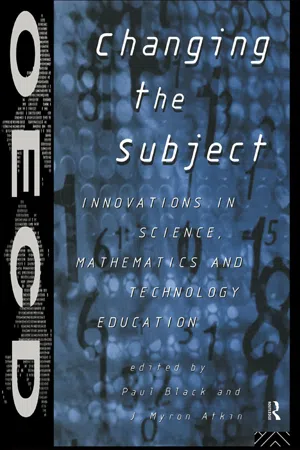
Changing the Subject
Innovations in Science, Maths and Technology Education
- 240 pages
- English
- ePUB (mobile friendly)
- Available on iOS & Android
eBook - ePub
Changing the Subject
Innovations in Science, Maths and Technology Education
About this book
Change in education is too often a process which enthusiasts, ranging from top policy makers to groups of teachers, plan and drive forward, but in which they all find unexpected pitfalls. Every innovation depends on the commitment of schools and teachers to make it work. But often that commitment is lacking, or is less than total, or it turns to fustration as events develop.
This book is based on a set of stories from teachers and education professionals in thirteen OECD countries. Twenty-three case studies of educational innovation in science, mathematics and technology have involved school teachers, inspectors, academics (both subject specialists and educational researchers), policy makers and advisors. The case studies come from Australia, Canada, France, Germany, Ireland, Japan, the Netherlands, Norway, Scotland, Spain, Switzerland and the USA.
Drawing on this rich variety of material the authors concentrate on the origins and purposes of innovation within and across the science, mathematics and technology curricula. They consider the conceptions of the three subjects, along with issues of teaching, learning and assessment, and explore the involvement of both teachers and students. They reflect on the various strategies adopted to cope with or bring about change, and offer valuable insights to advisors, developers, policy makers and practitioners, both in schools and outside.
The writing team includes Paul Black, King's College London; Mike Atkin, Stanford University; Raymond Duval, University of Lille; Edwyn James, Consultant, OECD; John Olson, Queen's University of Kingston, Ontario; Dieter Pevsner, Consultant, London; Senta Raizen, National Centre for Improving Science Education, Washington; Maria Saez, University of Valladolid, Spain; and Helen Simons, Southampton University.
Published in association with the OECD
Trusted by 375,005 students
Access to over 1.5 million titles for a fair monthly price.
Study more efficiently using our study tools.
Information
Topic
EducationSubtopic
Education GeneralChapter 1
What drives reform?
Every country that participated in our international study is dissatisfied with the education of its students in science, mathematics or technology. Every country is trying to make changes. Some of the changes are (at least for the moment) small in scale: for example, the project to improve the participation of girls in the work of one classroom in British Columbia. Others aim to affect a whole region, such as the programme in Ontario to diminish the distinctions between the different subjects within science in all the schools in the province. Several of our initiatives aim to achieve their changes within just a few years, such as Japan's new curriculum in environmental and life sciences for elementary schools. Others assume longer time-lines: even the title of the US 2061 project declares a conviction that significant change takes much longer than is imagined by most policy makers and the public they represent. Every country seems to be more or less unhappy with what it has today.
That fact is important because each nation's vision of the science and mathematics education it desires very much depends on where it perceives its present deficiencies. The late-twentieth-century electorate is distrustful, even angry. When citizens or governments advocate and support educational change, their motive is to correct perceived ills at least as often as to achieve some completely new goal. At any moment, however, each country will be preoccupied by different perceived ills. The Japanese are deeply concerned about the deterioration of their environment. They also believe that Japanese students are not as creative as those in some other countries. The United States is anxious about declining economic competitiveness. The Scots worry that their students are not made to do enough practical work. Each country is fighting its own demons.
But there is a paradox. All the most important pressures and influences that promote change in science, mathematics and technology education in schools keep re-appearing as we move from one country to another. None appears only in a single country, and in that sense little is unique. Yet the countries are different and distinct, because each attributes a different weight to particular problems and to how they combine and interact. No country is ever exactly in phase with any other because each is the creature of its own unique history and evolution.
So what are these pressures for change, and how do they play out? In this book we shall consider the main influences that lead reform in science, mathematics and technology education in two broad categories. First there are some that have an impact on virtually all the people and agencies in a whole society; they are a part of the framework for virtually all social policy. The detail of their impact will be different on different institutions within the society. For example, the needs of the economy bear on patterns of employment, on business operations, on private investment, and on much else. Economic considerations also manifestly influence educational policy and the school curriculum in science, mathematics and technology. In an economic downturn, policy makers will often pursue basic skills: in hard times the public will often say, ‘Stick to essentials’.
Changes in the structure of the family are a feature of late twentieth century industrial societies. They offer another example of a secular influence on school policy and on the curriculum in science, mathematics and technology. More and more of these nations’ students live at home with only one adult, or with two who are both forced to work long hours to make ends meet, and this profound change has implications for education. What support can schools now expect home and family to provide students by way of experiences that relate to their activities in school?
These broad forces for reform are the subject of this chapter: what forms they take, through what institutions they make themselves felt, and what changes they are precipitating in the curricula of schools. In Chapter 2 we shall move the discussion on to the influences that specifically affect science, mathematics and technology, and so on to some of the curriculum innovations themselves.
THE SETTING FOR CHANGES IN SCIENCE, MATHEMATICS AND TECHNOLOGY EDUCATION
Context is almost everything, it has been said. Influences on education can be powerful even when they are indirect. Innovations in education often stem from subtle and diffuse forces. At one level, a country's sense of itself pervades all social policy, education included. If it perceives threats to its historic values and longs for a remembered past, then it will look for educational programmes that promise to re-establish the kinds of curriculum and teaching style that its citizens believe once existed. If it is anxious to catch up with economic competitors, it may try to emulate the curriculum that seems to be advancing those apparently more productive countries.
At another level, almost every industrialized country faces the challenge of educating significant numbers of students whose parents are recent immigrants; attitudes towards the newcomers are a powerful influence on public educational policy. What sort of education should they receive? Should they be given special resources?
At still another level, there are ebbs and flows in the regard with which a nation views its scholars, and in the influence which it allows them in the discussion of what is to be taught in schools.
At the deepest level are a nation's underlying mood and values. It is difficult to fathom precisely what impact these have on educational policy and practice in the classroom; but there is no doubt that the national spirit of any moment colours the perspectives and behaviour of all the actors who shape, and are shaped by, educational policy. In much of what follows, we focus on the forces and the people that make things happen in science, mathematics and technology education. Several of the 23 cases reveal these influences quite explicitly; in others, we shall have to read between the lines. But on one point they all converge. The reasons for changes in education are seldom as simple as they are often portrayed in the popular press, so we shall now try to examine them with some care.
The national economy
Many of our innovations were pushed by serious concern about a country's economic competitiveness. It drove several of the innovations in the United States, and the programme to establish technology as a new core subject for all students aged 5 to 16 in Scotland. In these two cases the concern was national, but in others it stems from local circumstances, as in Tasmania (Australia). The US Urban Mathematics Collaborative Project offers a different example of concerns about curriculum that seem, at least in part, linked to economic interests. Both in Tasmania and in the communities associated with US UMC, teachers and their schools turned to local business communities for help with some of the details of their new curricula.
Sometimes economic concerns become highly specific, as when a curriculum is modified with the express purpose of making graduating students more employable. There is a clear implication in such change: students can no longer assume that by covering the established school subjects they have also developed the skills they will require in employment. Instead, somebody, perhaps the schools themselves, will have to define the key competencies which a productive adult will require. Then each traditional subject will have to state how it can contribute to the development of these skills: the character of the contribution will be an important justification for a subject's claim to space in the school timetable.
We are constantly told that patterns of employment in industrial societies are changing. As a result the skills required in jobs will also change rapidly in the next decades, away from familiar, well-defined but routine skills. By this argument, traditional vocational education will have to give way to some more general and flexible preparation. It is not always clear what this preparation should look like. However, this perceived need is clearly the motive for the shift in the lower-secondary education of the Netherlands from separate tracks to a new basic education for all—and hence the definition of technology as a new core subject in that country for all students (about which, more in the next chapter). In Norway vocational courses were separated at a rather early age. Now a similar shift to a more universal general education has generated sharper expectations for the competencies that the general core subjects might deliver.
Yet another concern is evident in British Columbia (Canada BC): about the number of students qualified for future employment, as well as their quality. The provincial government supported an exploration of gender equity because they thought it crucial that girls should persist with studying the sciences and achieve qualifications. For similar reasons, the government of Ontario (Canada Ontario) decided to change the practice of streaming: their aim was to reduce the drop-out rates in science, mathematics and technology.
Preparing future citizens
Another aim of some of those who want to change education is to promote science, mathematics and technology education as an essential for all. This is very different from the narrow aim of improving economic resources, but not necessarily in conflict with it. The point is made in one of the policy statements for US 2061.
The terms and circumstances of human existence can be expected to change radically during the next human life span. Science, mathematics and technology will be at the centre of that change—causing it, shaping it, responding to it. [Scientific literacy] is essential to the education of today's children for tomorrow's world. (US 2061)
The same purpose finds echoes in policy statements for the reforms in Spain, Tasmania and Germany. The German policy is particularly ambitious, speaking of ‘an orientation towards nature based on responsible action’. Official statements of the US ChemCom project explicitly declare their aim to develop in students the potential for community action. An even broader philosophy underlies the Japanese reforms. A stated aim of their new course for elementary schools level is
…to ensure, keeping the twenty-first century in view, the development of people with rich hearts who will be capable of coping with changes in our society such as internationalization in different sectors and the spread of information media.
(Japan Science)
Later in the document this last statement is expanded. More specific aims are: to emphasize richness of spirit; to promote individuality, to make students capable of self-education and lifelong learning, to enable them to cope positively with change. Along with all this the curriculum is to give students a foundation for creativity and is to nourish their respect for culture and traditions. All of these high aims are indeed reflected in actual practice in classrooms, as we shall see in later chapters.
All these last statements express the belief that science and mathematics can contribute to general education. This Spanish teacher clearly believed that they can contribute to general powers of thinking and judgement.
I try to give them examples from real life in which, as normal citizens, we use reasoning similar to that which we use in science, and this can help us to make life come out better. (Spain)
Technology has a special place in these arguments. At one level, it serves the need to equip a country's citizens for future changes, such as the greater use of computers. But it can also be harnessed to wider purposes. The new curriculum in Scotland accords a unique place to technology. By its emphasis on practical action and its power to give students greater confidence in their own practical capability, the Scottish authorities hope that this subject will redress a perceived imbalance in most other subjects towards the academic and the analytical. The move to technology as a separate subject in the Netherlands is partly motivated by a similar concern: that the traditionally more reflective and academic orientation of their schools may have held back the development of practical capability.
These broad priorities may seem to be at odds with the need to provide future generations of specialists in science, mathematics and technology. In our studies the lower priority given to preparing specialists seems not to have been contentious except in a very small number of cases, such as British Columbia. Perhaps most of our countries are not short of trained men and women. Perhaps the policy makers believe that ensuring the supply of specialists is less of a challenge than giving every student an education that is both effective and attractive. Or, more likely, they believe that motivating every student is the most effective strategy for securing future specialists.
Inclusiveness and equity
Students are different. How can education best serve their diversity? We can hear this as an unspoken question behind several of our innovations, and explicitly in these quotations from two Spanish teachers with responsibility for developing policy.
In compulsory education, it is possible to set too high a standard because by doing so most of the pupils will be lost. So then, what do you evaluate or value most? Skills, habits, how they work—more than simply knowing a set of concepts or assimilating rigid content?
Diversity is a relevant idea as it is the one which combines most of the elements of the insistence on education, above all in the [lower secondary school] where the need to cater for differences in abilities, motivation and interest can clearly be seen. The fact that each child is different means that our teaching should take into account this fact, not as an obstacle but rather as a challenge. This pushes us to think about how we should make our classes not only motivating, but also how we should carry out activities using different techniques so that some students may learn in one way and others in another way.
(Spain)
The changes in Norway, and the Urban Math Project and ChemCom initiatives in the United States all explicitly aim at greater inclusiveness. The same purpose underlies the deferment of specialization in the Netherlands, the new curriculum in Ontario, and the German PING project. These policies recognize that teachers have to work with classes of students with very different abilities, motivations and even family cultures. This is always difficult, but most difficult when a system first gives up tracking or streaming, and some of our cases are designed to help with just these difficulties. The Norwegian development is a case in point, with its emphasis on self-assessment by pupils. Many other projects wanted new methods of assessment to broaden the appeal of subjects, to release students from their traditionally passive role and to give them more attractive parts to play.
Gender equity is a special kind of inclusiveness. The quest for it is more commonly implied than explicit, but in the British Columbia case it was the central purpose. It is interesting that there was no great disparity between girls’ and boys’ performance. The problem was the girls’ reluctance to continue with science when other options were offered. The study also demonstrates that inclusiveness is only one step towards equity.
More than equality of treatment may be required to achieve real equity, and in each different kind of diversity—gender, social class, culture and language of the home, and ability—the road to equity will be different.
Better student learning—and empowering teachers
Many of the projects are informed by new conceptions of learning and the desire to bring them into school classrooms. One of the reasons why the Norwegians wanted to change their science was a perception that new understandings about the nature of learning had passed the country by. Several teachers in Spain spoke of how their knowledge of students’ learning now deeply affected their work. One of them said
I believe we have a whole new conception of how students learn, and I feel that this changes everything. (Spain)
We hear similar sentiments in almost every case study. New ways of looking at student learning are at the heart of the Swiss study, and a central element in Japan and Australia.
In the United States, US Kids Network, the US PreCalc course, and the US NCTM standards all developed under the influence of new views about the nature of learning.
In the United States, US Kids Network, the US PreCalc course, and the US NCTM standards all developed under the influence of new views about the nature of learning.
It is obvious that all educational innovation must involve teachers, but several of our cases are shaped by new views of the role of teachers in reform. They are leading actors in the German PING project. The US UMC project in the United States was based on the conviction that supporting teachers is the best way to improve mathematics in urban schools. They believed that the best support would be mutuality: that making teachers more collegiate would help them to tackle their problems in their own way. The project neither provided nor promoted solutions but aimed simply to make teachers feel less isolated, by helping them to connect with local businesses and higher education institutions. The US PreCalc course was another innovation in which teachers were central; the project was begun and shaped by the mathematics department of a single school.
We shall be looking more comprehensively at these topics—new views about teaching and learning and about the role of teachers—in Chapters 3 and 5, so we shall leave them until then. But it is worth making two major points now. First, the foremost justifications for reforms of science, mathematics and technology education today are based in new ideas about learning. Secondly, today's reforms are in sharp contrast to those of forty years ago in this respect. We now recognize that teachers are not mere agents of the plans of others, but can themselves play a central part in conceiving and shaping reforms.
SYSTEMIC REFORM
The studies show a growing awareness, particularly in the United States, of what policy makers are calling ‘systemic’ reform. One meaning of the term defines a reform that addresses all the key elements of a whole education system. Those who use it tend to believe that reform must be systemic to succeed, and that the most effective strategies must encompass not only new curriculum, but new forms of teaching and teacher education, new approaches to student assessment and new instructional materials. And they believe that every aspect of a reform must be directed towards the same ends. A systemic reform may also be defined as reaching beyond the education system itself, to include all the people and institutions which have any stake in the quality of education.
Th...
Table of contents
- COVER PAGE
- TITLE PAGE
- COPYRIGHT PAGE
- CHANGING THE SUBJECT
- ORGANISATION FOR ECONOMIC CO-OPERATION AND DEVELOPMENT
- THE CERI SCIENCE, MATHEMATICS AND TECHNOLOGY EDUCATION PROJECT
- FOREWORD
- INTRODUCTION
- CHAPTER 1: WHAT DRIVES REFORM?
- CHAPTER 2: CHANGING THE SUBJECT
- CHAPTER 3: TEACHING AND LEARNING
- CHAPTER 4: ASSESSMENT
- CHAPTER 5: TEACHERS AND CHANGE
- CHAPTER 6: CHANGING STUDENTS—CHANGING CLASSROOMS
- CHAPTER 7: NIQUE CONFIGURATIONS
- CHAPTER 8: WHERE NOW?
- APPENDIX SUMMARIES OF THE 23 CASE STUDIES
- THE WRITING TEAM OF OECD CONSULTANTS
- ALSO AVAILABLE FROM OECD
Frequently asked questions
Yes, you can cancel anytime from the Subscription tab in your account settings on the Perlego website. Your subscription will stay active until the end of your current billing period. Learn how to cancel your subscription
No, books cannot be downloaded as external files, such as PDFs, for use outside of Perlego. However, you can download books within the Perlego app for offline reading on mobile or tablet. Learn how to download books offline
Perlego offers two plans: Essential and Complete
- Essential is ideal for learners and professionals who enjoy exploring a wide range of subjects. Access the Essential Library with 800,000+ trusted titles and best-sellers across business, personal growth, and the humanities. Includes unlimited reading time and Standard Read Aloud voice.
- Complete: Perfect for advanced learners and researchers needing full, unrestricted access. Unlock 1.5M+ books across hundreds of subjects, including academic and specialized titles. The Complete Plan also includes advanced features like Premium Read Aloud and Research Assistant.
We are an online textbook subscription service, where you can get access to an entire online library for less than the price of a single book per month. With over 1.5 million books across 990+ topics, we’ve got you covered! Learn about our mission
Look out for the read-aloud symbol on your next book to see if you can listen to it. The read-aloud tool reads text aloud for you, highlighting the text as it is being read. You can pause it, speed it up and slow it down. Learn more about Read Aloud
Yes! You can use the Perlego app on both iOS and Android devices to read anytime, anywhere — even offline. Perfect for commutes or when you’re on the go.
Please note we cannot support devices running on iOS 13 and Android 7 or earlier. Learn more about using the app
Please note we cannot support devices running on iOS 13 and Android 7 or earlier. Learn more about using the app
Yes, you can access Changing the Subject by J. Myron Atkin,Paul Black in PDF and/or ePUB format, as well as other popular books in Education & Education General. We have over 1.5 million books available in our catalogue for you to explore.