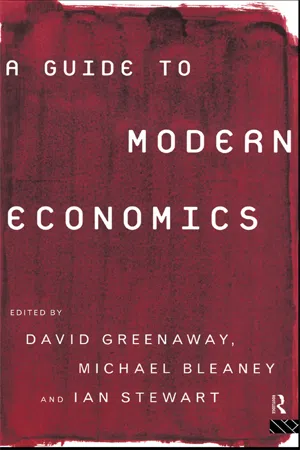
This work provides a valuable review of the most important developments in economic theory and application over the last decade. Comprising twenty-seven specially commissioned overviews, the volume presents a comprehensive and student-friendly guide to contemporary economics.
Previously published by Routledge as part of the Companion to Contemporary Economic Thought, these essays are made available here for the first time in a concise paperback edition. A Guide to Modern Economics will be a valuable guide to all those who wish to familiarize themselves with the most recent developments in the discipline.
- 624 pages
- English
- ePUB (mobile friendly)
- Available on iOS & Android
eBook - ePub
A Guide to Modern Economics
About this book
PREFACE TO VOLUME I
In view of the success of the one-volume Companion to Contemporary Economic Thought, published in 1991, the publishers have decided to reissue it in paperback, in two volumes, of which this is the first. We enthusiastically welcome this decision. The essays remain as relevant today as when they were first published, and stand as eloquent testimony to the achievements (and limitations) of modern economics. Volume I, A Guide to Modern Economics, focuses on the more purely economic sections of the original book. It contains the chapters that appeared in Part II (Economic Theory) and Part III (Applied Economics) of that volume. Volume II, which will be published later, will consist of Part I (Methodological Perspectives) and Part IV (Interfaces), which raise wider issues of the relationship between economics and other disciplines.
David Greenaway
Michael Bleaney
Ian Stewart
Michael Bleaney
Ian Stewart
1
PREAMBLE
DAVID GREENAWAY
At the time of putting the finishing touches to this volume, the world appears to be a very turbulent place. The ‘big’ issues of the day include the unwinding of central planning in Eastern Europe and the transformation to market-based economies; market completion in Western Europe, and the potential for economic and monetary union; the possibility of a fourth oil shock; environmental degradation and the consequences of climatic change; the signing of some kind of agreement from the eighth round of the General Agreement on Tariffs and Trade (GATT) multilateral arrangements, which might yet shore up the multilateralist consensus which has served the world economy so well over the post-war period; and debt-driven stagnation in many developing countries. These are the issues which economists will be called to advise on. They promise to make the 1990s exciting, interesting and perhaps a little less comfortable than the 1980s.
How well placed is the economics profession to respond to such challenges? Have we reason to believe that recent advances in the body of knowledge and technical change put the present generation in a better position than the last generation of economists? Inevitably opinion within the profession is divided. Attitudinal surveys certainly reveal a perception that economics has gained in prestige over the post-war period (Grubel and Boland 1986; Greenaway 1990); and there has been a tremendous expansion in the number of economics programmes in schools and higher education. Definitional problems make it rather more difficult to identify the actual stock of ‘economists’ at a given point in time. Recent debate in the United Kingdom has addressed the question of whether the present stock is in some sense optimal, with as yet no resolution (Sloane 1990; Towse and Blaug 1990). Although we do not have enough hard evidence to resolve the question, we can say with some confidence that the stock has grown significantly over the post-war period. (For an interesting insight into the growth in the government economic service in the United Kingdom, see Cairncross and Watts 1989). Growing numbers, together with changes in technology, have facilitated specialization by subdiscipline. With that specialization have come profound changes in the way we as economists approach our subject.
At the academic level, one of the most obvious symptoms of specialization is the number of specialist journals now available compared with twenty-five or thirty years ago. The growth has been really quite extraordinary. To illustrate the point, of the hundred and thirty or so economics journals listed in Contents of Recent Economics Journals, only about one-quarter go back beyond 1960. Those that do are the classic ‘generalist’ journals, such as the Economic Journal, American Economic Reõiew, Journal of Political Economy, Oxford Economic Papers, Quarterly Journal of Economics and so on. Almost all the new entrants provide a service to a specialist audience. This development has had two effects. On the one hand, it has allowed specialization to take place. Young economists, armed with new techniques and the newest methods for testing their theories, have had a forum for communicating with other researchers interested in similar issues. This has reduced search costs for the specialist. Although it has resulted in some replication, and ‘filling in’, it has also facilitated progress in the sense of allowing a wider menu of models to be examined, a broader range of empirical results to be reported and therefore a more intensive investigation of particular issues. On the other hand, however, it has imposed much higher search costs on the ‘generalist’. Moreover, it confronts any generalist keen to keep abreast of developments in all aspects of the subject with an almost impossible task.
This volume is an attempt to address both of the matters discussed so far; it aims to try and take stock of ‘progress’ in economics and it does so in a way that makes the content of each section and chapter accessible to the specialist who wishes to learn something about what other specialists do. Stocktaking and assessing progress are inevitably judgemental to a degree. The judgements which were made in framing this volume should be explained. We did not set out to have a volume of surveys; nor did we set out to be wholly comprehensive. Surveys have an important role to play. However, even the best surveys tend to be reference works for specialists (see for instance the excellent series of surveys published in the Economic Journal between 1987 and 1990). It is uncertain to what extent such surveys are read by non-specialists, i.e. there is a clear difference between a survey which attempts to be comprehensive in coverage and this book, which is more concerned to convey the flavour of specialists’ work to non-specialists. Besides which, few if any fields can be surveyed thoroughly in the 7,000 words or so that we allowed to each of our contributors. Instead, we asked our authors to overview developments in a particular part of the discipline, showing where possible how this slotted into the wider firmament, as well as commenting on the contribution which the developments have made/are making.
With regard to the content of each part, again we had to exercise judgement. We did not set out to be completely comprehensive. The New Palgrave Dictionary, which runs to 4 million words, is without question the most comprehensive reference work in economics. Even this has been criticized by some reviewers for its omissions (Blaug 1988). Judged by this standard, there are bound to be perceived omissions in the present volume. We as editors are sensitive to this. Given the length constraint, however, to which we had to operate, we did what any other economists would have done and optimized. We hope that readers will find the coverage fairly comprehensive, balanced and up to date. Thus, we have tried to incorporate new issues like environmental economics and public choice theory, and new techniques like experimental economics and microeconometrics, alongside more long-standing issues such as growth theory and cost-benefit analysis. We feel that we have been as comprehensive as could reasonably have been expected in the context of a volume running to forty-one chapters.
Finally, to end where we began: the economics profession will be confronted with many challenges in commenting on the great issues of the day; is it well equipped to cope with those challenges? The work reviewed in this volume is testimony to the vitality of economics as a discipline. It also serves to illustrate the range of issues to which economic analysis can be applied, often with an input from cognate disciplines. This should certainly make the economics profession well positioned in offering informed comment on the great issues of the day.
Note:
This is an edited version of the Preamble which appeared in the original publication, Companion to Contemporary Economic Thought.
REFERENCES
Blaug, M. (1988) Economics Through the Looking Glass, London: Institute of Economic Affairs, Occasional Paper 88.
Cairncross, A. and Watts, N. (1989) The Economic Section, London: Routledge.
Greenaway, D. (1990) ‘On the efficient use of mathematics in economics: results of an attitude survey of British economists’, European Economic Reõiew, 34:1339–52.
Grubel, H. and Boland, L. (1986) ‘On the efficient use of mathematics in economics: some theory,
survey of British economists’, European Economic Reõiew, 34:1339–52.
Sloane, P. (1990) ‘The demand for economists’, RES Newsletter 70:15–18.
Towse, R. and Blaug, M. (1990) ‘The current state of the British economics profession’, Economic Journal 100:227–36.
I.
ECONOMIC THEORY
1
AN OVERVIEW OF EMERGING THEORY
MICHAEL BLEANEY
1.1 INTRODUCTION
One of the characteristics—perhaps in retrospect it will be viewed as the chief characteristic—of theoretical economics over the past decade has been the cooling of controversy and a gradual re-establishment of some form of consensus in the profession for the first time since the mid-1960s. This has undoubtedly been a tentative process, for which the Walrasian term tâtonnement springs to mind, but we have only to think back to the apparently irreconcilable gulf between different schools of macroeconomics in the 1970s to recognize how much movement there has been. In 1981 Daniel Bell and Irving Kristol edited a book of twelve essays entitled The Crisis in Economic Theory (Bell and Kristol 1981). Originally a special issue of the magazine Public Interest, this volume attracted some leading names of the economics profession as contributors, and Bell felt able to state in his Introduction that ‘[t]he twelve theorists represented here accept the fact that the consensus on economic theory has been broken’ (Bell and Kristol 1981:xi). Kristol put it rather more strongly in his essay: ‘It is widely conceded that something like a “crisis in economic theory” exists, but there is vehement disagreement about the extent and nature of this crisis’ (Bell and Kristol 1981:201).
A decade later, it is difficult to conceive of an editor of a book of essays about economics being in a position to write such comments. The atmosphere is more placid, more assured and more reminiscent of recovery from trauma than of trauma itself. A variety of explanations could be put forward to account for this. Theoretical progress may have left the old disputes behind and redefined them as alternative special cases of a more general theory. Alternatively, practical experience might have shown that one side was right and the other wrong. (This, however, would conflict with the well-known maxim that where you have two economists you have three opinions!) A further possibility is that the ‘crisis’ had more to do with the public perception of economics than its actual content, and that with the return to some degree of normality in the macroeconomy the reputation of economists has recovered and with it their self-assurance. In this context we should also mention the spectacular decline of the Soviet model and the apparent wholesale acceptance of market reforms by economists throughout Eastern Europe and the Soviet Union, not to mention China, Vietnam and a growing number of developing countries.
In assessing the progress (if any) of economic theory over the past quarter of a century or so, we cannot avoid these issues. Economics interacts powerfully with social questions, it has (or is widely perceived to have) strong ideological overtones, and economic performance exerts a major influence on the electoral fate of governments. Economists themselves are also voters, consumers, parents. They are paid to get the economy right, and, if they fail to do so, find themselves at the receiving end of public indignation. Economic theory certainly does not exist in a vacuum.
1.2 A NEW SYNTHESIS?
The state of economics in the mid-1960s is often summarized by the term ‘neoclassical synthesis’. Nowadays this expression has some pejorative overtones, implying an ill thought out combination of neoclassical microeconomics and Keynesian macroeconomics, and indeed it will be argued below that much of the recent progress in economic theory has been directly or indirectly concerned with achieving a much better integration of microeconomics and macroeconomics. Nevertheless it is important to recall how much of an advance this ‘synthesis’ represented compared with the state of theory in, say, 1930. The synthesis arose precisely because of the ineffectiveness of fifty years of neoclassical macroeconomics in establishing a simple coherent body of useful theory. We have only to look at the literature on the trade cycle to see this: far from moving towards a consensus view, the trade cycle theory of the 1920s (and this was the only area in which neoclassical theory systematically confronted macroeconomic issues) gave a strong impression of exploding into ever increasing variety. Keynesian theory cut through all this; it wrought profound changes not only in theory but also in political attitudes towards economic management. It provided the intellectual foundation for national income accounting and macroeconomic modelling, which was itself a major innovation made possible only by advanced computing power and new statistical information. The limitations of the ‘neoclassical synthesis’, however, were in part a product of its successes. Macroeconomics seemed to be increasingly driven by model-building, in the sense of obtaining a good statistical fit backed up by ad hoc theorizing, and the limitations of pure theory tended to be papered over by equation-searching. The Phillips curve was probably the most spectacular example of this: it was bolted into macroeconomic models as a robust replacement for the absent theory of the money wage level in the Keynesian system. Microeconomics, on the other hand, continued to assume that firms maximized profits and households maximized utility, but never took account of the quantity constraints that Keynes had suggested might be an important determinant of behaviour.
In the later 1960s the ‘neoclassical synthesis’ began to come apart at the seams, and it was the Phillips curve which proved the weakest point. The combination of inflation and unemployment could be, and often was, attributed to sociological factors underlying wage militancy, but to most economists such sociological influences seemed unpredictable and to a large degree inexplicable. Moreover, whatever their causes, such supply-side shocks found economics wanting in its policy prescriptions: there seemed to be no coherent theory of how to contain them. Keynesian economics was entirely oriented towards demand-side shocks, whilst the neoclassical tradition offered little except a faith in the resilience of markets in the face of a shock of any kind. As in the period 1929–33, a lacuna in economic theory that had previously lain hidden was brutally exposed by events. Theoretical weaknesses were dramatically brought home to economists and the public alike.
The ‘crisis in economic theory’ that emerged in the 1970s was the effect of these developments. Orthodoxy lost its self-assurance, and dissenting voices found more response. Both the radical right and the radical left in economics became more vociferous. With hindsight, however, this appears to have been a temporary phase (at least at the theoretical level). As supply-side shocks waned and a sustained disinflation began from 1982 onwards, publicly expressed dissatisfaction with economists’ policy prescriptions became less frequent. On a theoretical plane, however, what was much more significant was that orthodox economics proved its fundamental resilience. By relaxing some of its more extreme assumptions, such as the availability of complete information, it was able to defend and enrich the basic tenets enshrined by the neoclassical tradition—that agents are motivated by self-interest—whilst Marxist and other radical schools, despite receiving a new lease of life, failed to display a similar level of adaptability and inventiveness (Marxist economics, in particular, was racked by doubts about fundamental principles). After a period of confusion and disorientation, considerable progress was made in remedying the weaknesses of existing theory, and particularly in bridging the chasm that seemed to have opened up between microeconomics and macroeconomics.
However, the most immediate effect of the crisis was a resurgence of neoclassical economics. Apparently killed off for good by wage-earners’ demonstration of market power in the later 1960s, it was able to make a spectacular comeback by the introduction of price expectations into the model. Any nominal wage behaviour could be neatly explained as market clearing with appropri-ate assumptions about price expectations. Friedman (1968) was an early proponent of this view. However, Friedman did not explore the formation of expectations in any detail. But when Lucas (1972) revived the concept of rational expectations first introduced by Muth (1961), and Sargent and Wallace (1975) showed what powerful implications it could have in macroeconomic models, Keynesian economics found itself on the defensive. All the bright ideas seemed to be emerging from the new classical revivalist movement.
An outstanding feature of the Lucas-Sargent-Wallace approach was its drive for theoretical consistency. Its proponents sought to argue, or at least to imply, that this required the employmen...
Table of contents
- COVER PAGE
- TITLE PAGE
- COPYRIGHT PAGE
- CONTRIBUTORS
- PREFACE TO VOLUME I
- 1 PREAMBLE
- I. ECONOMIC THEORY
- 1: AN OVERVIEW OF EMERGING THEORY
- 2: EXPECTATIONS IN ECONOMICS
- 3: POST-KEYNESIAN MACROECONOMICS
- 4 PUBLIC CHOICE THEORY
- 5 UNCERTAINTY IN ECONOMICS
- 6: STRATEGIC TRADE POLICY
- 7: RECENT DEVELOPMENTS IN MONETARY THEORY
- 8: ECONOMICS OF THE ENVIRONMENT
- 9: GAME THEORY AND STRATEGIC BEHAVIOUR
- 10: INTERNATIONAL ASPECTS OF DEVELOPMENT ECONOMICS
- 11: GROWTH THEORY
- 12: OPEN-ECONOMY MACROECONOMICS
- 13: ECONOMICS OF SOCIALISM
- 14: THE LABOUR MARKET: UNEMPLOYMENT AND SEARCH THEORY
- 15: THE INTERNATIONAL COORDINATION OF MACROECONOMIC POLICY
- 16: DETERMINANTS OF INDUSTRY STRUCTURE AND CONTESTABLE MARKET THEORY
- 17: THE GROWTH OF THE PUBLIC SECTOR
- II. APPLIED ECONOMICS
- 18: THE ROLE OF APPLIED ECONOMICS
- 19: TIME SERIES ECONOMETRICS
- 20: THE ROLE OF MEASUREMENT AND TESTING IN ECONOMICS
- 21: EXPERIMENTAL METHODS IN ECONOMICS
- 22: COST-BENEFIT ANALYSIS AND PROJECT APPRAISAL
- 23: APPLIED GENERAL EQUILIBRIUM MODELLING
- 24: MICROECONOMETRICS
- 25: MACROECONOMETRIC FORECASTING
- 26: INTEREST GROUPS AND POLICY FORMULATION
- 27: ECONOMIC ADVICE AND ECONOMIC POLICY
Trusted by 375,005 students
Access to over 1.5 million titles for a fair monthly price.
Study more efficiently using our study tools.
Frequently asked questions
Yes, you can cancel anytime from the Subscription tab in your account settings on the Perlego website. Your subscription will stay active until the end of your current billing period. Learn how to cancel your subscription
No, books cannot be downloaded as external files, such as PDFs, for use outside of Perlego. However, you can download books within the Perlego app for offline reading on mobile or tablet. Learn how to download books offline
We are an online textbook subscription service, where you can get access to an entire online library for less than the price of a single book per month. With over 1.5 million books across 990+ topics, we’ve got you covered! Learn about our mission
Look out for the read-aloud symbol on your next book to see if you can listen to it. The read-aloud tool reads text aloud for you, highlighting the text as it is being read. You can pause it, speed it up and slow it down. Learn more about Read Aloud
Yes! You can use the Perlego app on both iOS and Android devices to read anytime, anywhere — even offline. Perfect for commutes or when you’re on the go.
Please note we cannot support devices running on iOS 13 and Android 7 or earlier. Learn more about using the app
Please note we cannot support devices running on iOS 13 and Android 7 or earlier. Learn more about using the app
Yes, you can access A Guide to Modern Economics by Michael Bleaney,Prof David Greenaway in PDF and/or ePUB format, as well as other popular books in Economics & Econometrics. We have over 1.5 million books available in our catalogue for you to explore.