eBook - ePub
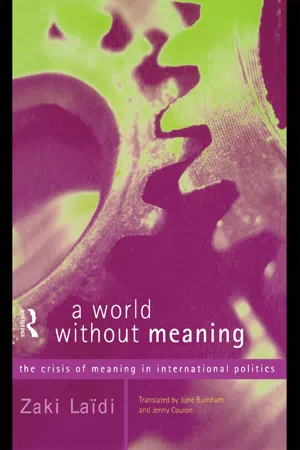
A World Without Meaning
The Crisis of Meaning in International Politics
- 240 pages
- English
- ePUB (mobile friendly)
- Available on iOS & Android
eBook - ePub
A World Without Meaning
The Crisis of Meaning in International Politics
About this book
This sophisticated book by internationally renowned theorist Zaki Laidi, tackles the problem of individual identity in a rapidly changing global political environment. He argues that it is increasingly hard to find meaning in our ever-expanding world, especially after the collapse of political ideologies such as communism.
With the breakup of countries such as the former Yugoslavia, it is clear that people are now looking to old models like nationalism and ethnicity to help them forge an identity. But how effective are these old certainties in a globalized world in a permanent state of flux?
Information
1
The meaning of the Cold War
The more the Cold War fades into the distance, the more we shall be obliged to think of it, re-read it and reinterpret it not only geopolitically but also in cultural terms. We shall discover—doubtless risking over-rationalization of the past— how original this moment in history was in the way it was able, over an exceptionally long period, to reorder the main world issues around a battle for the appropriation of meaning. Within half a century the Cold War managed to ‘encompass’ very large-scale political, economic, social and cultural transformations: the decolonization of the Third World, the growth in economic power of Japan and Germany, the Sino-Soviet split, and the proliferation of bloody regional conflicts. It also managed to incorporate economic and sociological realities as fundamental as the decline of the industrialization strategy to the advantage of the service sector, the erosion of the Keynesian model, the blossoming of individualist values, the development of mass culture and the subsequent atomization of demands.1
A ‘tragic system’
But this ‘moment in history’ was not restricted to channelling the shifts in world power or conscientiously fanning regional conflicts. It enabled the pursuit, strengthening and perhaps completion of the long, slow, linear process of the historical transfer of meaning that, over the centuries, had fixed itself in succession on religion, nationalism and finally ideology, that great ‘mythogenous’ factor of the twentieth century.2 Indeed, it managed to combine two absolutes: meaning, symbolized by the ideological combat between two universal and competing value-systems; and power, carried by the absolute weapon, the nuclear bomb.
Between 1917 and 1945, all the seeds of an ideological confronta tion had unquestionably been sown. At the same time as the Bolsheviks were seizing the Winter Palace, the American president, Woodrow Wilson, was already drafting the contours of a new order that could raise aloft the flag of democracy in the world.3 But the conflict taking shape still lacked a geopolitical structure that could put it into practice and give it dramatic intensity.
American power was just emerging, while Russia had been bled white. The rivalry between the two continental empires, forecast by de Tocqueville long before the Russian Revolution, was showing only its first symptoms. Their confrontation did not yet have a large enough battleground or adequate symbolism. Conversely, the East-West conflict died down after 1989 despite the continued presence of some impressive nuclear arsenals because, once the use of these weapons was no longer linked to a precise doctrine of deployment, as it had been during the Cold War, it was difficult to make them real instruments of power. It is as if the absolute weapon needed an absolute truth, and therefore an absolute meaning, for its potential use to be felt as legitimate or, at least, less intolerable, as though military power required an end to make sense. Power is nothing when it has lost meaning.
The historic originality of the Cold War surely derives from the totally new capacity acquired by two Timons (supreme leaders) to provide themselves with the most modern weapons of mass destruction while simultaneously justifying their planetary confrontation with a teleological perspective. It was the meeting point of mass production, mass culture and weapons of mass destruction.4 Consequently, it could be seen as the most complete and most formalized attempt to add meaning to power, to synthesize world order. This interlinking had the simultaneous effects of magnifying the confrontation and dramatizing what was at stake.
By ‘magnifying’ we mean loading it with a strong emotional content, making it a subjective experience, once the rivalry between two supreme powers started to look less like a private fight between two proud, narrow nationalisms and more like testing out two competing universalisms that each offered the key to modernity. At the American exhibition in Moscow in 1959, at the height of the Cold War, there was a fairly lively exchange of views between a mischievous Khrushchev and Vice-President Nixon, as he then was, on the comparative merits of American and Russian kitchens. The anecdote demonstrates a strong symbolism that the Soviet Union’s subsequent economic setbacks led us to forget: both systems claimed to be bringing modernity to every sphere, including urban planning and interior design.5
Until the end of the 1960s the Soviet challenge seemed to the West to be not just military but global. The USSR’s ability for more than twenty years to deliver a rate of economic growth twice that of the United States fuelled a fear that it was catching up, a fear encouraged by Khrushchev’s propaganda.6 This fear was bolstered by the USSR’s early breakthrough in space and by the perception— however faint and understated in the West—of the greater suitability of the Soviet model—sturdy and exportable, ready to use—to the needs of deprived and politically fragile societies in the emerging Third World. Because Sovietism offered a global meaning, a synthesized representation of the world and its objectives, liberalism was for a long time required to produce a symmetrical counter-discourse, to try to export Locke to check Marx.7
Magnified by the global character of what was at stake, the Cold War was turned into a drama by the rigidity of the game of nuclear deterrence, which left armed confrontation little room for manoeuvre between permanent tension and nuclear fire. It is true that for reasons linked to the evolution of military technology and cyclical variations in East-West relationships, the dramatic representations of the Cold War were not always the same. At the end of the 1960s the relative détente of Soviet-American relations led to less dogmatic interpretations of the Soviet system, while the development of precision weapons helped raise the deterrence threshold.8 But it is striking that from the late 1970s Western representations of the totalitarian system generally went back to what they had been in 1947, giving in retrospect an appearance of a relatively homogeneous moment, of a ‘block’.9
The dramatization of the conflict because of the nuclear factor helped reinforce the political and indeed social cohesion of each block, most curiously in the pluralist Western camp. Because nothing had been permanently decided, mobilization was obligatory. Because the balance could always tip either way, ‘moral rearmament’ remained on the agenda. From this point of view the Cold War well and truly constituted ‘a tragic system’ in Steiner’s sense, that is, a drama that had an assigned end which did not exclude the possibility of a fall or a collapse. ‘Since the French Revolution,’ he wrote in Les Antigones, ‘all the great teleological systems have been tragic systems, for they are all metaphors for the premise of the fall.’10
Far from harming the cohesion of the block or group, the ‘premise of the fall’ justified permanent tension, continual mobilization, and the repression of major domestic opposition. This dialectic was consubstantial with the communist system, until the end of Stalinism at any rate. But, at a lower level that respected pluralism, it was also a characteristic of Western societies. During those years the United States did not escape the development of a culture of social stability, even of cultural conformity that Elaine Tyler May was right to call ‘internal containment’.11
Thus there was within each camp a constant, fluid circulation between meaning and power. They fed off and reinforced each other, accentuating the effect of global symmetry between the blocks. This linkage of meaning and power was expressed in a variety of ways, as shown below.
Meaning as a source of power
The will and capacity of the two Timons to provide meaning indisputably added to their respective power. To ‘provide meaning’ was to convey explicitly their claims to be able to decode, advance and disseminate—to decode the world; to advance beyond present reality, ‘neither halting nor resting’ (Hegel), seeking an end that is deemed better; and to disseminate it to others, not because of plain, simple national ambition, but because of a claim to universalism. To provide meaning is fundamentally to make the world a ‘problem’ to be studied—as Edgar Morin put it so well in relation to Europe—and to advertise a claim to ‘universal validity’ (Habermas).12 It also challenges the disjunction between the ‘plan for oneself’ and the ‘plan for others’, the Good for oneself and the Good for others. The Cold War was thus a sort of teleological ‘issue’ superimposed on a geopolitical structure. To take Isaiah Berlin’s definition of teleology, it was a framework within which everything—or almost everything—was to be understood and described. In particular, inexplicable events did not result from shortcomings in the framework posited, but from our inability to discover the real purpose of those events.13 Thus, if we had misguidedly interpreted a minor ethnic convulsion in Africa as an exclusively endogenous phenomenon, we would be pitied and called to order for not having grasped or appreciated the wider ramifications—whether symbolic (ideology) or material (arms consignments)—that linked these microconflicts to megahistory. In the same way that the French Revolution opened the door to the historicization of the Individual, the Cold War ‘historicized’ the young nation-states, with all the manipulations this appropriation made possible.
The claim to offer meaning generated as a reflex action a strong demand for meaning, which quite naturally helped the USSR and America to hoist themselves even higher up the ladder of nations. This effect was particularly true of the USSR and, to a smaller extent, of Maoist China. In fact the Soviet model of ‘the absolute state’ was very attractive to Third World regimes because it not only offered practical recipes for keeping power, but also gave it legitimacy, placing it within a larger, global ‘context’.14 The Cold War was thus able to quench the thirst for universalism in the most deprived states. The Somalia of the 1970s, which so unexpectedly obliged both Russians and Americans to court it, had a different appearance from the Somalia of 1992 that greeted American troops, who opened the road to humanitarian aid. It is not a total coincidence that the regime of Siad Barre and the Somalian state foundered in 1989, the year the Berlin Wall fell.
In the name of meaning, and because of their respective strength, East and West simultaneously laid out a planetary system of meanings, according to Raymond Boudon’s definition of ‘ideology’: rallying signals and identification symbols.15 These signals and symbols signposted a global ideological market in which political models fully competed but increased their attractiveness by a recourse to ideological dumping.16 In fact, neither East not West, during forty years of Cold War, batted an eyelid at the actual use their allies made of their models—except in Europe. In what was the Third World, the Russians were primarily concerned with keeping up appearances, while the Americans encouraged democratic forces only sporadically. Even in the economic sphere, the use made of the ‘market economy’ label was never seriously regulated— including in Southeast Asia.17
We need to remind ourselves of these salient facts precisely because the end of the Cold War brought about the disappearance of this ideological competition and, consequently, of political models that had not only enabled fragile states to find their place in the world, but also promoted their internal political integration through this access to the universal. It is probably not by chance that the countries or states now tearing themselves apart (India, Algeria), or fragmenting (Yugoslavia) were in the 1960s and 1970s champions of non-alignment; in other words, of the instrumentalization of the East-West conflict. At that time a purely geostrategic interpretation could be put on that game: small countries were increasing their room for manoeuvre by playing and replaying on the active rivalry between the two camps. With hind-sight, this diplomatic posture can be seen to have exercised what was perhaps an even more vital political function: this projection into the planetary game was a source of internal political cohesion because it allowed the state a central role.18
The equalizing power of meaning
By supplementing the power of states, meaning exerted a formidable equalizing force on this very power. In other words, meaning constituted an exceptionally good resource for the group of international actors who compensated for their handicaps by manipulating symbols exposed by the Cold War. This effect was very valuable for the Third World, as we have just seen. But, even more fundamentally, it was the USSR that derived the most decisive advantage. Because the USSR was geographically impressive, militarily threatening and ideologically persuasive, it managed fairly quickly to create an almost perfect symmetry between the two camps, even though economically American power was twice as large as that of the USSR.19 It was meaning especially that made a power of the USSR, in the style of Hegel’s Reason, by producing the (political) circumstances for its own fulfilment.20
France, through the double-game of its nuclear weapons and claim to universality, was to be one of the biggest users during the Cold War of the resource of meaning—to enhance its power and conceal the weaknesses of that power. It not only postulated the theory of the equalizing power of the atom— that the possession of nuclear weapons, even in small quantities, is sufficient to dissuade the enemy from attacking—but also the theory of what could be called by analogy, the equalizing power of meaning: that asserting your will and propounding a message to others is sufficient to be on equal terms with the great. This over-valuation of meaning gave rise to a typically French dialectic between role and rank, analysed so well by Alfred Grosser. This specialization in what Valéry called ‘the sense of the universal’ led to a sort of over-development of rank compared with role, a supercilious and narcissistic fixation on a global order of precedence. The important thing was no longer so much the role, that is, the achievement of French objectives, as the way it portrayed its place in the world and the image it presented to others. ‘The essential was the rank: rank as proclaimed rather than rank as acknowledged by the outside world.’21 The Cold War therefore dramatized international relations by conceding an essential place to the posturing of state actors. For this reason, though humanitarian action appears to be a new product of the pos...
Table of contents
- Cover Page
- Title Page
- Copyright Page
- Preface
- Introduction
- 1 The meaning of the Cold War
- 2 The fall of the Wall
- 3 Out of step with time
- 4 Universalism runs out of steam
- 5 Europe and the crisis of meaning
- 6 The loss of the link between nations
- 7 Global social links (1): conflicts without identity
- 8 Global social links (2): actors without a project
- 9 Can Japan provide meaning?
- 10 The regionalization of meaning
- 11 Europe as meaning
- 12 Asia, or regionalism without a goal
- 13 America as a ‘social power’
- Conclusion The post Cold War, a world of its own
- Notes
- Bibliography
Trusted by 375,005 students
Access to over 1.5 million titles for a fair monthly price.
Study more efficiently using our study tools.
Frequently asked questions
Yes, you can cancel anytime from the Subscription tab in your account settings on the Perlego website. Your subscription will stay active until the end of your current billing period. Learn how to cancel your subscription
No, books cannot be downloaded as external files, such as PDFs, for use outside of Perlego. However, you can download books within the Perlego app for offline reading on mobile or tablet. Learn how to download books offline
Perlego offers two plans: Essential and Complete
- Essential is ideal for learners and professionals who enjoy exploring a wide range of subjects. Access the Essential Library with 800,000+ trusted titles and best-sellers across business, personal growth, and the humanities. Includes unlimited reading time and Standard Read Aloud voice.
- Complete: Perfect for advanced learners and researchers needing full, unrestricted access. Unlock 1.5M+ books across hundreds of subjects, including academic and specialized titles. The Complete Plan also includes advanced features like Premium Read Aloud and Research Assistant.
We are an online textbook subscription service, where you can get access to an entire online library for less than the price of a single book per month. With over 1.5 million books across 990+ topics, we’ve got you covered! Learn about our mission
Look out for the read-aloud symbol on your next book to see if you can listen to it. The read-aloud tool reads text aloud for you, highlighting the text as it is being read. You can pause it, speed it up and slow it down. Learn more about Read Aloud
Yes! You can use the Perlego app on both iOS and Android devices to read anytime, anywhere — even offline. Perfect for commutes or when you’re on the go.
Please note we cannot support devices running on iOS 13 and Android 7 or earlier. Learn more about using the app
Please note we cannot support devices running on iOS 13 and Android 7 or earlier. Learn more about using the app
Yes, you can access A World Without Meaning by Zaki Laidi, June Burnham,Jenny Coulon in PDF and/or ePUB format, as well as other popular books in Politics & International Relations & Communism, Post-Communism & Socialism. We have over 1.5 million books available in our catalogue for you to explore.