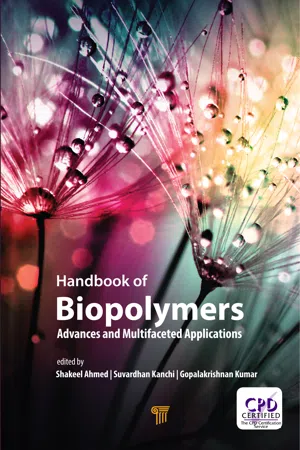
Biopolymers have the potential to cut carbon emissions and reduce carbon dioxide in the atmosphere. The carbon dioxide released when they degrade can be reabsorbed by plants, which makes them close to carbon neutral. Biopolymers are biodegradable and some are compostable, too. This book presents key topics on biopolymers, including their synthesis, characterization, and physiochemical properties, and discusses their applications in key areas such as biomedicine, agriculture, and environmental engineering. It will serve as an in-depth reference for the biopolymer industry—material suppliers and processors, producers, and fabricators—and engineers and scientists who are designing biopolymers or evaluating options for switching from traditional plastics to biopolymers.
eBook - ePub
Handbook of Biopolymers
Advances and Multifaceted Applications
- 308 pages
- English
- ePUB (mobile friendly)
- Available on iOS & Android
eBook - ePub
Handbook of Biopolymers
Advances and Multifaceted Applications
About this book
Information
Preface
1 Biopolymers: Classification and Applications
Arivalagan Pugazhendhi, Karuppusamy Indira, Jaya Mary Jacob, Malavika Mukesh, and Gopalakrishnan Kumar
1.1 Introduction
1.2 Classification of Biopolymers
1.2.1 Natural Polymers
1.2.1.1 Polysaccharides
1.2.1.2 Polyisoprenes
1.2.1.3 Polynucleotides
1.2.1.4 Polyesters
1.2.2 PHAs
1.2.2.1 Applications of PHAs
1.2.2.2 Blends of PHAs
1.2.2.3 Nanocomposites of polyhydroxyalkanoates
1.2.3 Proteins
1.2.4 Synthetic Biopolymers
1.2.4.1 Poly(lactic-co-glycolic acid)
1.2.4.2 Poly(lactic acid)
1.3 Applications
1.3.1 Medicine
1.3.1.1 Drug delivery systems
1.3.1.2 Surgical implants
1.3.2 Agriculture
1.4 Conclusion
2 Bio-Based Biopolymers and Their Potential Applications for Bio- and Non-Bio Sectors
Muhammad Bilal and Hafiz M. N. Iqbal
2.1 Introduction
2.2 Alginate: General Properties
2.3 Chitosan: General Properties
2.4 Biopolymers and Immobilization Engineering
2.5 Biopolymers and Environmental Engineering
2.6 Biopolymers and Biomedical Engineering
2.6.1 Chitosan-Based Applications
2.6.2 Alginate-Based Applications
2.7 Final Remarks and Future Trends
3 3D Printing of Biopolymers: Trends and Opportunities for Medical Applications
Tomy J. Gutiérrez
3.1 Introduction
3.2 Brief History of 3D Printing
3.3 3D Materials Processing Techniques
3.4 Biopolymers Used for 3D Printing
3.5 Advantages of 3D Printing for Medical Applications
3.6 Current Challenges in 3D Printing of Biomaterials
3.6.1 Achieving Target Material Properties and Desired Architectures
3.6.2 Clean and Sterile Manufacturing Environments
3.6.3 Concerns Related to Regulatory Issues
3.6.4 Material-Specific Machines
3.6.5 Future Trends
3.7 Conclusion
4 Proteins and Their Novel Applications
Tanvir Arfin, Shoeb Athar, and Stephy Rangari
4.1 Introduction
4.2 History of Protein
4.3 Structure of Proteins
4.3.1 Primary Structure
4.3.2 Secondary Structure
4.3.3 Tertiary Structure
4.3.4 Quaternary Structure
4.4 Types of Proteins
4.5 Synthesis of Protein
4.6 Cellular Functions
4.7 Novel Applications
4.7.1 Carrier Protein
4.7.2 Biotechnology
4.7.3 Engineering
4.7.4 Biosensors
4.7.5 Electrochemical Biosensors
4.7.6 Optical Biosensors
4.7.7 Bioaffinity Chromatography
4.7.8 Solid-Phase Extraction
4.7.9 Protein Biochips
4.7.10 Protein Nanoparticles
4.8 Conclusions
5 Chitin and Chitosan: The Defense Booster in Agricultural Field
Vijayalakshmi Kumar, K. Sangeetha, P. Ajitha, S. Aisverya, S. Sashikala, and P. N. Sudha
5.1 Introduction
5.1.1 Biopolymers
5.1.2 Origin of Chitin and Chitosan
5.1.3 Modifications of Chitin and Chitosan
5.2 Characteristics of Chitin, Chitosan, and Derivatives
5.2.1 Physicochemical Properties of Chitin, Chitosan, and Their Derivatives
5.2.2 Biological Properties of Chitin, Chitosan, and Their Derivatives
5.3 Recent Research in Applications of Chitin and Chitosan in Agriculture
5.3.1 In Preservation of Agricultural Commodities
5.3.2 In Plant Resistance to Pathogens and Defense Mechanisms
5.3.3 In Biostimulation of Plant Growth and Its Protection
5.3.4 In Enhancing Food Production
5.3.5 In Enhancing Crop Growth
5.3.6 In Enhancing the Production of Plant Metabolites
5.4 Conclusion
6 Chitosan Applications in Microencapsulation
Berta N. Estevinho and Fernando Rocha
6.1 Introduction
6.2 Microencapsulation
6.3 Microencapsulation Methods
6.3.1 Chemical Processes
6.3.1.1 Coacervation
6.3.1.2 Molecular inclusion
6.3.1.3 Co-crystallization
6.3.1.4 Interfacial polymerization
6.3.2 Mechanical Processes
6.3.2.1 Spray drying
6.3.2.2 Spray chilling
6.3.2.3 Extrusion
6.3.2.4 Fluidized bed
6.4 Encapsulating Agents: Biopolymers
6.4.1 Carbohydrates
6.4.2 Proteins
6.5 Microencapsulation with Chitosan
6.6 Controlled-Release Studies
6.7 Conclusions
7 Current Innovative Chitosan-Based Water Treatment of Heavy Metals: A Sustainable Approach
Tanvir Arfin
7.1 Introduction
7.2 Sources of Contamination
7.3 Chitosan
7.4 Heavy-Metal Pollution
7.5 Conventional Procedures
7.6 Heavy Metal Removal
7.6.1 Iron
7.6.2 Copper
7.6.3 Cadmium
7.6.4 Nickel
7.6.5 Chromium
7.6.6 Cobalt
7.6.7 Arsenic
7.6.8 Mercury
7.6.9 Lead
7.6.10 Zinc
7.6.11 Silver
7.6.12 Manganese
7.7 Conclusion
8 Bacterial Cellulose and Its Applications
Thazin Han, Nitar New, and Phyu Phyu Win
8.1 Introduction
8.2 Bacterial Cellulose Production
8.3 Application of Bacterial Cellulose
8.3.1 Applications of Bacterial Cellulose in Food Sector
8.3.2 Applications of Bacterial Cellulose in Biomedical Sector
8.3.2.1 Drug delivery system
8.3.2.2 Bacterial cellulose scaffold for tissue engineering
8.3.2.3 Bacterial cellulose membrane as skin therapy
8.3.2.4 Bacterial cellulose as an artificial blood vessel
8.3.3 Applications of Bacterial Cellulose in Textile Sector
8.3.4 Applications of Bacterial Cellulose in Environmental Treatment Sector
8.3.5 Applications of Bacterial Cellulose in Paper Production Sector
8.3.6 Applications of Bacterial Cellulose in Biocomposite Preparation
8.4 Conclusions
9 Thermal, Mechanical and Degradation Properties of Starch-Based Bio-Nanocomposites
Mohan Turup Pandurangan and Krishnan Kanny
9.1 Introduction
9.2 Starch-Based Bio-Nanocomposites
9.2.1 Starch Bio-Nanocomposites Filled by Whiskers
9.2.2 Starch Bio-Nanocomposites Filled by Starch Nanocrystals
9.3 Structure and Morphology of Starch-Based Bio-Nanocomposites
9.4 Mechanical and Thermal Properties of Starch-Based Materials
9.4.1 Botanical Origin: Amylose/Amylopectin Ratio
9.4.2 Plasticization
9.4.3 Aging
9.4.4 Fillers
9.4.4.1 Cellulose nanocrystals
9.4.4.2 Starch nanocrystals
9.4.5 Mechanical Properties of Nanocomposites Based on Starch and Organic Reinforcements
9.4.6 Thermal Properties
9.5 Barrier and Biodegradation Properties
9.5.1 Barrier Properties
9.5.2 Biodegradation Properties
9.6 Processing and Product Development of Starch-Based Bio-Nanocomposites
9.6.1 Applications of Starch-Based Bio-Nanocomposites
9.6.1.1 Casting
9.6.1.2 Extrusion
9.6.2 Applications of Starch-Based Bio-Nanocomposites
9.6.2.1 Food industry
9.6.2.2 Agricultural industry
9.6.2.3 Medical field
9.7 Conclusion
10 Eggshells: From Waste to Medical Applications
Stanley Chibuzor Onwubu, Shalini Singh, Anisa Vahed, and Krishnan Kanny
10.1 Introduction
10.1.1 Problems Arising from Waste Eggshells
10.1.2 Motivation for the Application of Eggshells
10.2 Overview of Eggshells Structure and Properties
10.3 Synthesis of Hydroxyapatite from Eggshells
10.4 Medical Benefit of Eggshell-Derived Hydroxyapatite
10.5 Eggshells as a Source of Calcium Supplement
10.6 Medical Application of Collagen Extracted from Eggshell Membrane
10.7 Summary and Recommendations
11 Production ...
Table of contents
- Cover
- Halftitle
- Title Page
- Copyright Page
- Table of Contents
Trusted by 375,005 students
Access to over 1.5 million titles for a fair monthly price.
Study more efficiently using our study tools.
Frequently asked questions
Yes, you can cancel anytime from the Subscription tab in your account settings on the Perlego website. Your subscription will stay active until the end of your current billing period. Learn how to cancel your subscription
No, books cannot be downloaded as external files, such as PDFs, for use outside of Perlego. However, you can download books within the Perlego app for offline reading on mobile or tablet. Learn how to download books offline
Perlego offers two plans: Essential and Complete
- Essential is ideal for learners and professionals who enjoy exploring a wide range of subjects. Access the Essential Library with 800,000+ trusted titles and best-sellers across business, personal growth, and the humanities. Includes unlimited reading time and Standard Read Aloud voice.
- Complete: Perfect for advanced learners and researchers needing full, unrestricted access. Unlock 1.5M+ books across hundreds of subjects, including academic and specialized titles. The Complete Plan also includes advanced features like Premium Read Aloud and Research Assistant.
We are an online textbook subscription service, where you can get access to an entire online library for less than the price of a single book per month. With over 1.5 million books across 990+ topics, we’ve got you covered! Learn about our mission
Look out for the read-aloud symbol on your next book to see if you can listen to it. The read-aloud tool reads text aloud for you, highlighting the text as it is being read. You can pause it, speed it up and slow it down. Learn more about Read Aloud
Yes! You can use the Perlego app on both iOS and Android devices to read anytime, anywhere — even offline. Perfect for commutes or when you’re on the go.
Please note we cannot support devices running on iOS 13 and Android 7 or earlier. Learn more about using the app
Please note we cannot support devices running on iOS 13 and Android 7 or earlier. Learn more about using the app
Yes, you can access Handbook of Biopolymers by Shakeel Ahmed, Suvardhan Kanchi, Gopalakrishnan Kumar, Shakeel Ahmed,Suvardhan Kanchi,Gopalakrishnan Kumar in PDF and/or ePUB format, as well as other popular books in Biological Sciences & Biochemistry. We have over 1.5 million books available in our catalogue for you to explore.