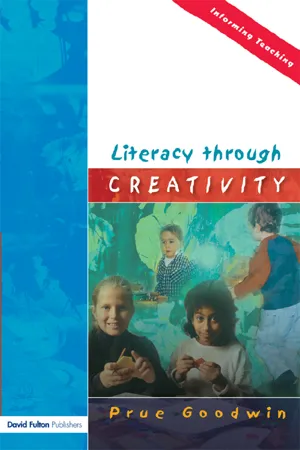
This is a fresh and practical approach to examining the way in which creative arts can be used in the classroom to enhance the learning of literacy in the primary school. It includes case studies and activities that clarify the role of creativity in the literacy teaching and advises how to help develop teaching skills. This is a must-have text for teachers who seek to make literacy learning interesting and fun.
- 160 pages
- English
- ePUB (mobile friendly)
- Available on iOS & Android
eBook - ePub
Literacy through Creativity
About this book
Information
Chapter 1
The arts and literacy in primary classrooms
In 1999 the appearance of All Our Futures: Creativity, Culture and Education, the report from the National Advisory Committee on Creative and Cultural Education (NACCCE) was greeted by those who knew of it (for it was not circulated to all schools!) with relief and delight. Mike Newby, Chair of the Universities Council for the Education of Teachers, told the committee:
‘How exciting it was to read this report. It isn’t often that a document of this kind can stir in me the kinds of feelings this one did – a desire, mainly, to stand on my chair and cheer – but yours hit the spot. At last some fresh thinking about the future, carrying with it the authority of not one but two Secretaries of State.’
As an educator who believes in a truly ‘broad and balanced’ curriculum in primary schools, I was one who shared this delight. If this report were to inform a revision of the National Curriculum, perhaps we could begin to move away from the rigid subject boundaries, the overemphasis on literacy and numeracy to the detriment and often neglect of the ‘less important’ foundation subjects, and the overwhelming prescription which was suffocating teachers’ creativity and imagination. Unfortunately, by the time the committee reported, the revised National Curriculum (1999) was ready so the recommendations were not reflected in the revisions and appeared, until recently, to have sunk without trace.
All Our Futures identifies economic, technological, social and personal challenges which need to be addressed by education, and suggests that we need ‘to develop active forms of learning which engage young people’s creative energies’ (Rogers 2000, p. 4). The report argues that ‘there are important relationships between creative and cultural education, and significant implications for methods of teaching and assessment, the balance of the school curriculum and for partnerships between school and the wider world’ (NACCCE 1999, p. 6). In developing five main themes, the members of the committee consider the challenge to education in establishing new priorities, ‘including a much stronger emphasis on creative and cultural education and a new balance in teaching and in the curriculum’. They believe that all people have creative abilities, that these are different for all of us and that when we find our creative strengths ‘it can have an enormous impact on self-esteem and on overall achievement’ (p. 7). They stress that they are not advocating an undisciplined ‘free for all’; the encouragement of greater creativity in education requires ‘a balance between teaching skills and understanding and promoting the freedom to innovate and take risks’ (p. 10). Alongside and related to creative development is the need to foster cultural understanding: ‘Education must enable [pupils] to understand and respect different cultural values and traditions and the processes of cultural change and development’ (p. 7).
The NACCCE, in this report, emphasises that creativity is not confined to the Arts but is to be found and nurtured in the whole curriculum: ‘One of our aims in this report is to emphasise the importance of the arts and their essential place in creative development. But creativity is not unique to the arts. It is equally fundamental to advances in the sciences, mathematics, technology, in politics, business and in all areas of everyday life’ (p. 27). Nevertheless, there is particular concern that aspects of the Arts and humanities are being neglected because ‘the curriculum is already over-full’ (p. 14). The conventional academic curriculum, as it is taught in many schools, does not generally encourage the development of pupils’ social, spiritual and emotional needs nor does it encourage questioning, experimentation or originality, all of which are essential to nurturing creativity. The curriculum, as it stands, defines a body of knowledge which is to be ‘delivered’ to learners. Although it is possible to make links across subject boundaries and to create learning contexts which make sense to pupils, most schools are so preoccupied by the need to cover the prescribed ground that such links have barely been explored. There are schools and teachers who have sustained a balanced curriculum, who have fostered the Arts and humanities and have shown that this can also enable pupils to achieve high levels of literacy and numeracy. In a recent (2002) Ofsted survey of successful primary schools the Chief Inspector identified important factors in their success; they tailored the curriculum to the needs of their own pupils and they were flexible but clear about learning objectives and approaches to teaching. ‘There was also a strong emphasis on enquiry, problem-solving and practical work such as taking part in live theatre, because the head-teachers knew that these were powerful ways to engage pupils in learning’ (Bell 2002).
Such approaches are likely to allow pupils to demonstrate achievement which is different from that identified in strictly academic contexts. All Our Futures also argues that creative and cultural education are relevant and necessary in contributing to raising academic standards:
Every child has capabilities beyond the traditionally academic. Children with high academic ability may have other strengths that are often neglected. Children who struggle with academic work can have outstanding abilities in other areas. Equally, creative and cultural education of the sort we propose can also help to raise academic standards. The key is to find what children are good at. Self confidence and self esteem then tend to rise and overall performance to improve. High standards in creative achievement require just as much rigour as traditional academic work. (p. 13)
Primary teachers, who teach all aspects of the curriculum to their classes, are ideally placed to provide contexts in which all pupils can flourish because ‘subjects’ do not need to be taught separately. They are generally aware of their pupils’ differing learning styles and areas of strength and, given the freedom to do so, can plan both content and teaching approaches which meet the needs of individuals. Teachers know that ‘intelligence is multifaceted’ (Gardner 1993) and that children are not necessarily ‘less able’ because they do not perform well in the academic tasks related to words and numbers (reading, writing and numeracy) so valued in schools. A broad curriculum which includes opportunities for all children to work at what they are ‘good at’ is essential, especially at the primary level when the skills foundation is laid. Teachers need to maintain confidence in their own professionalism and understanding of how children learn and be prepared to take risks. Such teachers are generally imaginative and creative themselves and set out to provide activities which draw on children’s existing knowledge and experiences and which are interesting. They have clear aims for what they hope children will learn and also have high expectations of the children’s achievement.
‘Creative teachers … need techniques that stimulate curiosity and raise self esteem and confidence. They must recognise when encouragement is needed and confidence threatened. They must balance structured learning with opportunities for self-direction and the management of groups with attention to individuals. They must judge the kinds of questions appropriate to different purposes and the kinds of solutions it is appropriate to expect.’
(All Our Futures, p. 95)
In classrooms with teachers like this, there is generally a lot of talk, not just from the teacher, but by children who are working collaboratively, discussing problems and sharing ideas both with each other and with the teacher. Children are given time to pursue interests and ideas; they may sometimes take a whole day to work on a project or theme. There may often be self-directed, exploratory play with materials and resources such as musical instruments, computer programs, clay, paint, or textiles – what author Philip Pullman, in a recent speech to graduates at Roehampton University of Surrey, termed ‘fooling about’ – to enable children to explore the qualities and potential of material they are working with, as well as their own hypotheses and ideas, without heavy direction from the teacher. These classrooms will reflect Britain’s rich cultural and linguistic diversity, celebrating the variety of story and literature, art and music around them and demonstrating that the cultural experiences and traditions of all children are valued.
The English and Literacy curriculum in these classrooms is lively and imaginative. Teachers’ knowledge of and enthusiasm for children’s literature is at the heart of the teaching. Their wide knowledge of a range of literature enables them to select texts which provide real contexts for teaching aspects of the literacy curriculum, where ‘connections between text, sentence and word level knowledge (are made) explicit to children’ (Effective Teachers of Literacy, (see Medwell and Wray), p. 2). One such teacher commented in an article in the Times Educational Supplement (Brown 2003), that the use of The Wreck of the Zanzibar (Michael Morpurgo) as the basis for several weeks’ work with a Year 5 class not only covered the NLS framework for this year group but also ‘stimulated cross-curricular topics and discussions’.
From turtles to self sufficiency, sibling rivalry to worship, there was hardly an area of the primary curriculum that it did not touch upon. We found it almost indecently easy to cover all the remaining objectives in the literacy framework for Y5 term 3, but with not an extract in sight.
(Brown 2003)
The Programme of Study for English in the National Curriculum (1999) states that, at Key Stage 1, ‘pupils should be taught to respond imaginatively in different ways to what they read’ and, at Key Stage 2, in addition to this, they should ‘evaluate ideas and themes that broaden perspectives and extend thinking’. In order to meet these requirements there must be links to other areas of the curriculum such as art and design and music, as well as much talk and discussion. Other chapters in this book demonstrate clearly the ways in which children can ‘respond imaginatively’ to literature through art, music and dance. Aidan Chambers (1991, 1993), among others, has shown the ways in which children’s thinking and understanding of, sometimes challenging, themes in texts can be developed through discussion. An element of guided reading sessions in the literacy hour, especially at Key Stage 2, should be discussion about what is being read, with opportunities for children to express responses to events and characters, to articulate what they have inferred from the text and to listen to and perhaps disagree with others’ interpretations.
Understanding and response can be developed even more fully in drama sessions. A recent research project by the Centre for Literacy in Primary Education, written up as The Reader in the Writer: The links between the study of literature and writing development at Key Stage 2 (Barrs and Cork 2001), documents the use of drama both as preparation for reading texts and as a means of developing children’s understanding and ideas before they begin writing. Whilst the texts themselves and the approaches used to teach writing were clearly major factors in enabling children to produce high quality writing, the use of drama with the children was a further contribution to their success. Susanna Steele and Fiona Collins, who led the drama sessions with the children, commented:
‘Working with drama prior to reading a text can develop an engagement with the characters and events that can inform, sustain and enrich children’s commitment both to investigating the language, form and structure of the text and their subsequent writing. Drama offers an interactive way of working that enables children to use their own knowledge, understanding and experience in conjunction with the events in the narrative. The emphasis is on collaborative work using individual, group and whole class strategies that enable children to bring their understanding to the text initially in an active rather than discursive way.’
Inspired by this work, Year 2 teacher, Gabriella Wraight, decided to investigate the potential of such an approach with younger children. Among other books, she used The Tunnel (Anthony Browne) as a book which offered, in both text and illustration, possibilities for discussion and a context the children could explore through drama. Browne’s work frequently conveys more to readers through the illustration than does the written text and children often perceive more than adult readers of the issues addressed. This was certainly true of these children. Having explored the relationship between brother and sister in their drama, they were able to write very effectively in role as one of the characters, successfully sustaining the first-person narrative stance, as this example shows (the child’s spelling is unaltered):
The story of Rose
My name is Rose. My brother Jack dose not get along with me. It started off when me and my brother were arguing and mum told us off. She replied ‘go out and think about your behaveyour.’ So we went to the wast ground. It had lots of rubish on the floor. And my brother said ‘why did you have to follow me?’I said ‘its not my fult we are in this arful place.’ Jack went to exsplor. And behind the bushis was a tunnel. ‘Hey’ said Jack. ‘There is a tunnel’. He went in the tunnel. I was scerd but I had to save my brother even when he was being nasty to me. I went in the tunnel. The tunnel was sticky, slimy and dark. At the end of the tunnel was a wood. It was quiet. Suddenly the wood turned into a forest. I ran as farst as I could. I ran like the wind because I was scerd. At the end of the forest I saw my brother still as a pile of stone. And I huged him and cried and he turnd back to normule. He said ‘I knew you would come’. We went throght the woods then the tunnel and the wastground and back home. My mum was seting the table. She said if everything was alright. I smiled at Jack and he smiled back to me. I felt happy because my brother didn’t get heurt.
Having the opportunity to discuss their writing with both the teacher, in writing conferences, and each other, as writing partners, as it proceeded also contributed to the quality of the writing. Many of the children involved had not been confident writers before this change of approach. Over several months both confidence and achievement increased because of the constant discussion and feedback from the teacher, as well as their work in drama.
More creative and imaginative approaches to teaching both reading and writing require rigorous monitoring by the teacher, so that teaching can be adapted in the light of children’s progress and needs. Formative assessment, with constant feedback directly related to the tasks in hand, is essential if children are to be fully enga...
Table of contents
- Cover
- Halftitle
- Title
- Copyrights
- Contents
- Dedication
- Acknowledgements
- Contributors
- Introduction: Creativity and literacy learning
- 1 The arts and literacy in primary classrooms
- 2 The body of learning: the eight senses in literacy and creativity
- 3 Discovering creativity on the playground
- 4 Literacy, creativity and popular culture
- 5 DARE to Quack
- 6 Creativity and picture books
- 7 Creative readers at Key Stage 2
- 8 What could happen next? The potential of the talking book
- 9 Closely observed poems
- 10 Drama and writing: enlivening their prose
- 11 Dance and the literacy curriculum
- 12 The potential and possibilities of musical and physical literacies
- 13 Looking to be literate
- 14 Literacy, creativity and moving image media
- Index
Trusted by 375,005 students
Access to over 1.5 million titles for a fair monthly price.
Study more efficiently using our study tools.
Frequently asked questions
Yes, you can cancel anytime from the Subscription tab in your account settings on the Perlego website. Your subscription will stay active until the end of your current billing period. Learn how to cancel your subscription
No, books cannot be downloaded as external files, such as PDFs, for use outside of Perlego. However, you can download books within the Perlego app for offline reading on mobile or tablet. Learn how to download books offline
Perlego offers two plans: Essential and Complete
- Essential is ideal for learners and professionals who enjoy exploring a wide range of subjects. Access the Essential Library with 800,000+ trusted titles and best-sellers across business, personal growth, and the humanities. Includes unlimited reading time and Standard Read Aloud voice.
- Complete: Perfect for advanced learners and researchers needing full, unrestricted access. Unlock 1.5M+ books across hundreds of subjects, including academic and specialized titles. The Complete Plan also includes advanced features like Premium Read Aloud and Research Assistant.
We are an online textbook subscription service, where you can get access to an entire online library for less than the price of a single book per month. With over 1.5 million books across 990+ topics, we’ve got you covered! Learn about our mission
Look out for the read-aloud symbol on your next book to see if you can listen to it. The read-aloud tool reads text aloud for you, highlighting the text as it is being read. You can pause it, speed it up and slow it down. Learn more about Read Aloud
Yes! You can use the Perlego app on both iOS and Android devices to read anytime, anywhere — even offline. Perfect for commutes or when you’re on the go.
Please note we cannot support devices running on iOS 13 and Android 7 or earlier. Learn more about using the app
Please note we cannot support devices running on iOS 13 and Android 7 or earlier. Learn more about using the app
Yes, you can access Literacy through Creativity by Prue Goodwin in PDF and/or ePUB format, as well as other popular books in Education & Education General. We have over 1.5 million books available in our catalogue for you to explore.