First published in 1954, Human Society in Ethics and Politics is Bertrand Russell's last full account of his ethical and political positions relating to both politics and religion. Ethics, he argues, are necessary to man because of the conflict between intelligence and impulse – if one were without the other, there would be no place for ethics. Man's impulses and desires are equally social and solitary. Politics and ethics are the means by which we as a society and as individuals become socially purposeful and moral codes inculcate our rules of action.
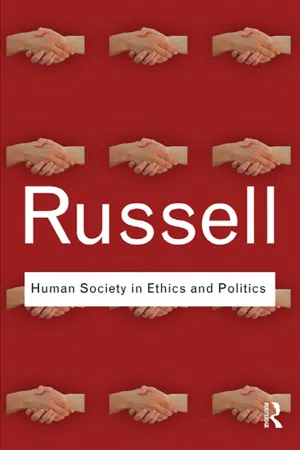
- 244 pages
- English
- ePUB (mobile friendly)
- Available on iOS & Android
eBook - ePub
Human Society in Ethics and Politics
About this book
Information
Part I
Ethics
1
SOURCES OF ETHICAL BELIEFS AND FEELINGS
Ethics differs from science in the fact that its fundamental data are feelings and emotions, not percepts. This is to be understood strictly; that is to say, the data are the feelings and emotions themselves, not the fact that we have them. The fact that we have them is a scientific fact like another, and we become aware of it by perception, in the usual scientific way. But an ethical judgment does not state a fact; it states, though often in a disguised form, some hope or fear, some desire or aversion, some love or hate. It should be enunciated in the optative or imperative mood, not in the indicative. The Bible says “thou shalt love thy neighbour as thyself”, and a modern man, oppressed with the spectacle of international discord, may say “would that all men loved one another”; these are pure ethical sentences, which clearly cannot be proved or disproved merely by amassing facts.
That feelings are relevant to ethics is easily seen by considering the hypothesis of a purely material universe, consisting of matter without sentience. Such a universe would be neither good nor bad, and nothing in it would be right or wrong. When, in Genesis, God “saw that it was good” before He had created life, we must suppose that the goodness depended either upon His emotions in contemplating His work, or upon the fitness of the inanimate world as an environment for sentient beings. If the sun were about to collide with another star, and the earth were about to be reduced to gas, we should judge the forthcoming cataclysm to be bad if we considered the existence of the human race good; but a similar cataclysm in a region without life would be merely interesting. Thus ethics is bound up with life, not as a physical process to be studied by the biochemist, but as made up of happiness and sorrow, hope and fear, and the other cognate pairs of opposites that make us prefer one sort of world to another.
But when the fundamental ethical importance of feeling and desire has been admitted, it still remains a question whether there is such a thing as ethical knowledge. “Thou shalt not kill” is imperative, but “murder is wicked” seems to be indicative, and to state something true or false. “Would that all men were happy” is optative, but “happiness is good” has the same grammatical form as “Socrates is mortal”. Is this grammatical form misleading, or is there truth and falsehood in ethics as in science? If I say that Nero was a bad man, am I giving information, as I should be if I said that he was a Roman Emperor, or would what I say be more accurately expressed by the words: “Nero? Oh fie!”? This question is not an easy one, and I do not think that any simple answer is possible.
There is another closely related question, and that is as to the subjectivity of ethical judgments. If I say that oysters are good, and you say they are nasty, we both understand that we are merely expressing our personal tastes, and that there is nothing to argue about. But when Nazis say that it is good to torture Jews, and we say that it is bad, we do not feel as if we were merely expressing a difference of taste; we are even willing to fight and die for our opinion, which we should not do to enforce our view about oysters. Whatever arguments may be advanced to show that the two cases are analogous, most people will remain convinced that there is a difference somewhere, though it may be difficult to say exactly what it is. I think this feeling, though not decisive, deserves respect, and should make us reluctant to accept at all readily the view that all ethical judgments are wholly subjective.
It may be said that if hopes and desires are fundamental in ethics, then everything in ethics must be subjective, since hopes and desires are so. But this argument is less conclusive than it sounds. The data of science are individual percepts, and these are far more subjective than common sense supposes; nevertheless, upon this basis the imposing edifice of impersonal science has been built up. This depends upon the fact that there are certain respects in which the percepts of the majority agree, and that the divergent percepts of the colour-blind and the victims of hallucinations can be ignored. It may be that there is some similar way of arriving at objectivity in ethics; if so, since it must involve appeal to the majority, it will take us from personal ethics into the sphere of politics, which is, in fact, very difficult to separate from ethics.
The separation of ethics from theology is more difficult than the analogous separation in the case of science. It is true that science has only emancipated itself after a long struggle. Until the latter half of the seventeenth century, it was commonly held that a man who did not believe in witchcraft must be an atheist, and there are still people who condemn evolution on theological grounds, but very many theologians now agree that nothing in science can shake the foundations of religious belief. In ethics the situation is different. Many traditional ethical concepts are difficult to interpret, and many traditional ethical beliefs are hard to justify, except on the assumption that there is a God or a World Spirit or at least an immanent cosmic Purpose. I do not say that these interpretations and justifications are impossible without a theological basis, but I do say that without such a basis they lose persuasive force and the power of psychological compulsion.
It has always been one of the favourite arguments of the orthodox that without religion men would become wicked. The nineteenth-century British freethinkers, from Bentham to Henry Sidgwick, vehemently repudiated this argument, and their repudiation gained force from the fact that they were among the most virtuous men that have ever existed. But in the modern world, which has been shocked by the excesses of totalitarians who professed themselves unbelievers, the virtues of Victorian agnostics seem less conclusive, and may even be attributed to imperfect emancipation from the Christian tradition. The whole question whether ethics, in any socially adequate form, can be independent of theology, must therefore be re-examined, with more awareness of the deep possibilities of evil than was to be found among our grandfathers, who were kept cozy by their comfortable belief in rational progress.
Ethical beliefs, throughout recorded history, have had two very different sources, one political, the other concerned with personal religious and moral convictions. In the Old Testament the two appear quite separately, one as the Law, the other as the Prophets. In the middle ages there was the same kind of distinction between the official morality inculcated by the hierarchy and the personal holiness that was taught and practised by the great mystics. In our own day the same duality persists. When Kropotkin, after the Russian Revolution, was able to return from his long exile, it was not the Russia of his dreams that he found being born. He had dreamed of a loosely knit community of free and self-respecting individuals, but what was being created was a powerful centralized State, in which the individual was regarded merely as a means. This duality of personal and civic morality is one of which any adequate ethical theory must take account. Without civic morality communities perish; without personal morality their survival has no value. Therefore civic and personal morality are equally necessary to a good world.
In all known human communities, even the most primitive, ethical beliefs and feelings exist. Some actions are praised, others are blamed; some are rewarded, others are punished. Some acts of individuals are thought to bring prosperity, not only to the individuals, but to the community; others are thought to bring disaster. The beliefs concerned are in part defensible on rational grounds, but in primitive communities there is a preponderance of purely superstitious beliefs, which often inspire, at first, even those prohibitions which, later, are found to be capable of a reasoned justification.
One of the chief sources of primitive morality is tabu. Certain objects, especially those belonging to the chief, are imbued with mana, and if you touch them you will die. Certain things are dedicated to a Spirit, and must only be used by the medicine man. Some foods are lawful, others unlawful. Some individuals, until purified, are unclean; this applies especially to such as have some taint of blood, not only those who have committed homicide, but also women in childbirth and during menstruation (see Leviticus xv, 19–29). There are often elaborate rules of exogamy, making a large proportion of the tribe tabu to the opposite sex. All these tabus, if infringed, are liable to bring disaster upon the guilty, and indeed upon the whole community unless appropriate purificatory ceremonies are performed.
There is no pretence of justice, as we understand it, in the punishment following an act forbidden by a tabu, which is rather to be conceived as analogous to death as the result of touching a live wire. When David was transporting the Ark on a cart, it jolted over a rough threshing floor, and Uzzah, who was in charge, thinking it would fall, stretched up his hand to steady it. For this impiety, in spite of his laudable motive, he was struck dead (II Samuel vi, 6–7). The same lack of justice appears in the fact that not only murder, but accidental homicide, calls for ritual purification.
Forms of morality based on tabu linger on into civilized communities to a greater extent than some people realize. Pythagoras forbade beans, and Empedocles thought it wicked to munch laurel leaves. Hindus shudder at the thought of eating beef; Mohammedans and orthodox Jews regard the flesh of the pig as unclean. St. Augustine, the missionary to Britain, wrote to Pope Gregory the Great to know whether married people might come to church if they had had intercourse the previous night, and the Pope ruled that they might only do so after a ceremonial washing. There was a law in Connecticut—I believe it is still formally unrepealed—making it illegal for a man to kiss his wife on Sunday. In 1916 a clergyman from Scotland wrote a letter to the Press attributing our lack of success against the Germans to the fact that the Government had encouraged the planting of potatoes on Sundays. All these opinions can only be justified on a basis of tabu.
One of the best examples of tabu is the prevalence of laws or rules prohibiting various forms of endogamy. Sometimes a tribe is divided into a number of groups, and a man must take his wife from a group other than his own. In the Greek Church, godparents of the same child may not marry. In England, until recently, a man might not marry his deceased wife’s sister. Such prohibitions are impossible to justify on the ground that the forbidden unions would do any harm; they are defended solely on the ground of ancient tabu. But further, those forms of incest which most of us still regard as not to be legally sanctioned are viewed, by most people, with a horror which is out of proportion to the harm that they would do, and which must be regarded as an effect of pre-rational tabu. Defoe’s Moll Flanders is far from exemplary, and commits many crimes without a qualm; but when she finds that she has inadvertently married her brother she is appalled, and can no longer endure him as a husband although they had lived happily together for years. This is fiction, but it is certainly true to life.
Tabu has certain great advantages as a source of moral behaviour. It is psychologically far more compelling than any merely rational rules; compare, for instance, the shuddering aversion from incest with the calm reprobation of such a crime as forgery, which is not viewed superstitiously because savages cannot commit it. Moreover a tabu morality can be perfectly precise and perfectly definite. True, it may prohibit completely harmless acts such as eating beans, but it probably also prohibits genuinely harmful acts such as murder, and does so more successfully than any other ethical method open to primitive communities. It is useful also in promoting governmental stability.
There’s such divinity doth hedge a king,
That treason can but peep the thing it would,
Acts little of his will.
That treason can but peep the thing it would,
Acts little of his will.
Since the assassination of a king usually leads to civil war, this “divinity” must be considered a beneficial effect of the tabus surrounding the Chief.
When the orthodox argue that rejection of theological dogmas must lead to a decay of morals, the strongest consideration on their side is the usefulness of tabu. When men cease to feel a superstitious reverence for ancient and venerable precepts, they may not be content with marrying their deceased wives’ sisters and planting potatoes on Sundays; they may advance to even more heinous sins, such as murder, treachery, and treason. This happened in classical Greece and in Renaissance Italy, both of which, in consequence, suffered political disaster. In each case men whose grandfathers had been pious and orderly citizens became anarchic criminals under the influence of free thought. I do not wish to underestimate the weight of such considerations, more particularly in the present day, when dictatorships are largely an almost inevitable reaction against the diffused anarchic tendencies of men who have thrown off tabu morality without acquiring any other.
The arguments against reliance on tabu morality are, however, to my mind, considerably stronger than those in favour, and as I am engaged in the attempt to expound a rational ethic I must set forth these arguments in order to justify my purpose.
The first argument is that, in a modern educated and scientific society, it is difficult to preserve respect for what is merely traditional except by a tight control over education designed to destroy capacity for independent thought. If you are brought up as a Protestant, you must be kept from noticing that Saturday, not Sunday, is the day on which it is wicked to plant potatoes. If you are brought up as a Catholic, you must remain ignorant of the fact that, in spite of the indissolubility of marriage, Dukes and Duchesses can have their marriages annulled by the Church on evidence which would not be thought adequate for an obscure couple. The necessary degree of stupidity is socially harmful, and can only be secured by means of a rigidly obscurantist régime.
The second argument is that, if moral education has been confined to the inculcation of tabus, the man who throws over one tabu is likely to throw over all the rest. If you have been taught that all the Ten Commandments are equally binding, and you then come to the conclusion that work on the sabbath is not wicked, you may decide that murder also is permissible, and that there is no reason why any one act should be thought worse than any other. The general moral collapse which often follows a sudden irruption of free thought is attributable to the absence of a rational basis for the traditional ethical code. There was no such collapse among freethinkers in nineteenth-century England, largely because they believed that utilitarianism afforded a non-theological ground for obedience to those moral precepts which it recognized as valid, which were in fact all those that contributed to the welfare of the community.
The third argument is that, in every tabu morality that has hitherto existed, there have been some precepts that were positively harmful, sometimes in a high degree. Consider, for example, the text: “Thou shalt not suffer a witch to live” (Exodus xxii, 18). As a result of this text, in Germany alone, some 100,000 witches were put to death during the century from 1450 to 1550. Belief in witchcraft was peculiarly prevalent in Scotland, and was encouraged in England by James I. It was to flatter him that “Macbeth” was written, and the witches are part of the flattery. Sir Thomas Browne maintained that those who deny witchcraft are a sort of atheists. It was not Christian charity, but the spread of the scientific outlook, that, from about the time of Newton, put an end to the burning of harmless women for imaginary crimes. The tabu elements in conventional morality are less fierce in our day than they were 300 years ago, but they are still in part obstacles to humane feeling and practice, for example in the opposition to birth control and euthanasia.
As men begin to grow civilized, they cease to be satisfied with mere tabus, and substitute divine commands and prohibitions. The Decalogue begins: “God spake these words and said”. Throughout the Books of the Law it is the Lord who speaks. To do what God forbids is wicked, and will also be punished; it would still be wicked even if it were not punished. Thus the essence of morality becomes obedience. The fundamental obedience is to the will of God, but there are many derivative forms which owe their sanction to the fact that social inequalities have been divinely instituted. Subjects must obey the king, slaves their master, wives their husbands, and children their parents. The king owes obedience only to God, but if he fails in this he or his people will be punished. When David took a census, the Lord, who disliked statistics, sent a plague, of which many thousands of the children of Israel died (1 Chron. xxi). This shows how important it was for everybody that the king should be virtuous. The power of p...
Table of contents
- CONTENTS
- PREFACE
- INTRODUCTION TO THE 1992 EDITION
- Part I Ethics
- Part II The Conflict of Passions
- NOTES
- INDEX
Trusted by 375,005 students
Access to over 1.5 million titles for a fair monthly price.
Study more efficiently using our study tools.
Frequently asked questions
Yes, you can cancel anytime from the Subscription tab in your account settings on the Perlego website. Your subscription will stay active until the end of your current billing period. Learn how to cancel your subscription
No, books cannot be downloaded as external files, such as PDFs, for use outside of Perlego. However, you can download books within the Perlego app for offline reading on mobile or tablet. Learn how to download books offline
Perlego offers two plans: Essential and Complete
- Essential is ideal for learners and professionals who enjoy exploring a wide range of subjects. Access the Essential Library with 800,000+ trusted titles and best-sellers across business, personal growth, and the humanities. Includes unlimited reading time and Standard Read Aloud voice.
- Complete: Perfect for advanced learners and researchers needing full, unrestricted access. Unlock 1.5M+ books across hundreds of subjects, including academic and specialized titles. The Complete Plan also includes advanced features like Premium Read Aloud and Research Assistant.
We are an online textbook subscription service, where you can get access to an entire online library for less than the price of a single book per month. With over 1.5 million books across 990+ topics, we’ve got you covered! Learn about our mission
Look out for the read-aloud symbol on your next book to see if you can listen to it. The read-aloud tool reads text aloud for you, highlighting the text as it is being read. You can pause it, speed it up and slow it down. Learn more about Read Aloud
Yes! You can use the Perlego app on both iOS and Android devices to read anytime, anywhere — even offline. Perfect for commutes or when you’re on the go.
Please note we cannot support devices running on iOS 13 and Android 7 or earlier. Learn more about using the app
Please note we cannot support devices running on iOS 13 and Android 7 or earlier. Learn more about using the app
Yes, you can access Human Society in Ethics and Politics by Bertrand Russell in PDF and/or ePUB format, as well as other popular books in Philosophy & Ethics & Moral Philosophy. We have over 1.5 million books available in our catalogue for you to explore.