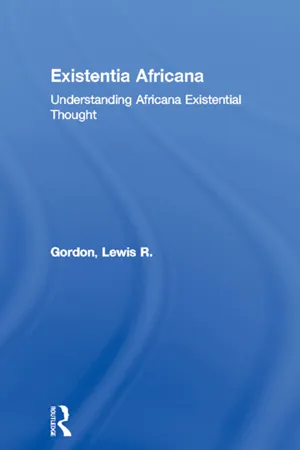
The intellectual history of the last quarter of this century has been marked by the growing influence of Africana thought--an area of philosophy that focuses on issues raised by the struggle over ideas in African cultures and their hybrid forms in Europe, the Americas, and the Caribbean. Existentia Africana is an engaging and highly readable introduction to the field of Africana philosophy and will help to define this rapidly growing field. Lewis R. Gordon clearly explains Africana existential thought to a general audience, covering a wide range of both classic and contemporary thinkers--from Douglass and DuBois to Fanon, Davis and Zack.
The intellectual history of the last quarter of the twentieth century has been marked by, among many developments, a growing influence of Africana thought in the U.S. academy. Africana thought, as I will be using it in this book, refers to an area of thought that focuses on theoretical questions raised by struggles over ideas in African cultures and their hybrid and creolized forms in Europe, North America, Central and South America, and the Caribbean. Africana thought also refers to the set of questions raised by the historical project of conquest and colonization that has emerged since 1492 and the subsequent struggles for emancipation that continue to this day. These latter questions and struggles have been characterized by Enrique Dussel, the Latin American philosopher, historian, and theologian, as those that reflect modernity’s “underside.” They are marked by the contrast between how the modern is often characterized in the Western academy— through, say, philosophical treatment of ideas, from René Descartes to Immanuel Kant, or perhaps Michel Foucault’s locating of modernity in nineteenth-century European thought— and how it has been lived by those on its periphery. The periphery, what Dussel means by underside and what Gayatri Spivak has called the “subaltern,” regard Western modernity more as a march of sword and Bible than reason and moral persuasion. C. L. R. James, in his classic, award-winning The Black Jacobins, summed up this perspective well when he wrote:
Christopher Columbus landed first in the New World at the island of San Salvador, and after praising God enquired urgently for gold. The natives, Red Indians, were peaceable and friendly and directed him to Haiti, a large island (nearly as large as Ireland), rich, they said, in the yellow metal. He sailed to Haiti. One of his ships being wrecked, the Haitian Indians helped him so willingly that very little was lost and of the articles which they brought on shore not one was stolen.
The Spaniards, the most advanced Europeans of their day, annexed the island, called it Hispaniola, and took the backward natives under their protection. They introduced Christianity, forced labour in mines, murder, rape, bloodhounds, strange diseases, and artificial famine (by the destruction of cultivation to starve the rebellious). These and other requirements of the higher civilization reduced the native population from an estimated half-a-million, perhaps a million, to 60,000 in 15 years (pp. 3–4).
James’s narrative then examines the kidnapping of Africans, the development of the slave trade in the Caribbean, and the Haitian revolution, which ironically included French Enlightenment appeals to rights and fraternity in addition to West African humanism. Although works by thinkers like James exemplify a highly critical position on Western modernity, their exemplification is ironic. This is because they face the lived, existential reality of the day-to-day situation of their denied humanity and the historical irony of their emergence in a world that denied their historicity. For example, G. W. F. Hegel denied that black people had (or were capable of having) any historical significance, but subsequently black theorists (including James) addressed both the historical transformation of Africans into blacks and the dialectical struggle to transform the historical moment of global conquest into a period of freedom in Hegelian and Marxist terms. Such thinkers find themselves in a situation akin to Caliban’s struggle with Prospero’s colonization of his island in William Shakespeare’s Tempest. Thinking through the periphery, the underside, the subaltern could as well be characterized as “Caliban studies,” if we will, where the focus is study through which Prospero’s language can be decentered.
Africana thought, as a form of Caliban studies, raises ironic self-reflective, metatheoretical questions. Think, for example, of the importance of writing as a form of intellectual production. Because of the emancipatory aims of Africana thought (as a form of Caliban studies), the activity of writing ascends here to the level of praxis. Although many of the major contributors to Africana thought are gifted orators who emerge from strong, so-called oral traditions (think, for example, of David Walker, Maria Stewart, Frederick Douglass, Alexander Crummell, Edward Blyden, Anna Julia Cooper, Marcus Garvey, Aimé Césaire, Martin Luther King Jr., Malcolm X, Kwame Ture, Angela Y. Davis, bell hooks, Cornel West), the theoretical explorations that dominate today’s formulations emerge through engagement with writing, including orations brought to inscription. Yet, like Caliban, modern Africana thinkers’ use of Prospero’s language is infused with forces of magic: They represent disruptions and rupture. We could imagine an alternative reading of Caliban as a being who had his mother’s knowledge, which he could fuse with Prospero’s knowledge. This fusion could offer what James has characterized as “creative universality,” that which, because it always raises possibility, constitutes freedom. Writing is one among many activities with creative universal potential, and it is the theorist’s work not only to articulate this in the body of literature left behind by prior theorists, but also to draw out creative dimensions for subsequent generations, the effect of which, in each stage, is the complex symbiosis of epistemological, historical, and ontological possibilities. As Sylvia Wynter, echoing Africana and other Caliban theorists who have preceded her, has articulated this project in her wonderful essay “Is ‘Development’ a Purely Empirical Concept or also Teleological?,” it’s the liberation writer’s effort to contribute to the construction of new forms of life.
We have, then, a symbiotic dualism. On the one hand, there is the identity question. Who, in a word, are Africana peoples? And then there is the teleological question: For what ought such people be striving? This latter concern often takes a liberatory form: How might the peoplehood of dehumanized people be affirmed? There are also metatheoretical identity and teleological concerns: What is Africana thought and what should be its methodology? All these questions have been struggled with throughout the nineteenth, and most of the twentieth, centuries. In the nineteenth century, they were perhaps best articulated by W. E. B. Du Bois, whose ideas in “Conservation of the Races” and “The Study of the Negro Problems” forcefully reemerge at the dawn of the twentieth century in The Souls of Black Folk, which examined these trajectories through race (identity), policy (emancipation), and a humanistic sociology. A humanistic sociology, in Du Boisian terms, meant a way of studying oppressed people without denying their humanity. Africana philosophical thought has struggled through Du Bois’s concerns throughout the rest of this century. Alain Locke, for example, queried the possibilities of a “New Negro” while he tried to develop a pluralistic axiology that could address the lived reality of values. The lived reality of values was needed to position the centrality of an “inner life” of black folk. This concern was also taken up by Frantz Fanon, whose search for a “postcolonial,” “post-racist” society led to his articulation of the lived experience of blacks in the face of sociogenic sedimentations of their identity and political possibilities. For Fanon, blacks are locked in a situation that demands a struggle with social structures that make ethical demands on transformation futile, if not irrelevant and silly. The black (Caliban) raises too many anxieties over the goodness of the modern systems he occupies. As Du Bois argued that the U.S. black faces both the justice and injustice of American society through the two souls the black exemplifies— being an American and being America’s uniquely American racial outsider— Fanon realized that the more he asserted his membership in Western civilization the more he was pathologized, for the system’s affirmation depends on its denial of ever having illegitimately excluded him; he is, as in theodicy, a reminder of injustice in a system that is supposed to have been wholly good.
Africana philosophy, especially in its African American variety, has continued Du Bois’s, Locke’s, Fanon’s, and James’s legacy through works that are beginning to have an impact outside of Africana philosophy. Du Bois, James, and Fanon, for example, are not only taught in Africana studies courses. Fanon’s writings are now taught in literature, cultural studies, political science, anthropology, and sociology programs and departments, and his influence on the development of postcolonial studies and philosophies of liberation and liberation theology is without question. Edward Said’s Orientalism and Paulo Freire’s Pedagogy of the Oppressed owe an extraordinary debt to his ideas. There are, in addition, contemporary voices with field-transcending influence. Cornel West and bell hooks, for instance, are two Africana thinkers with extraordinary influence in the contemporary U.S. academy. West’s and hooks’s writings are rooted squarely in the Africana humanistic traditions. West in the 1980s, as is well known, had taken up identity and teleological questions through an effort to synthesize pragmatism, Christianity, and Marxism with African American humanism to present a prophetic appeal to “deliverance” (emancipation). In his later writings he has moved away from the Marxist element of his trinity toward a form of radical democratic liberalism, primarily because of his position on the identity question— that it is American society that he is attempting to transform, which requires an explication of what is supposedly the best of its tradition. For hooks, it has been a project of postmodern oppositional politics rooted in a pedagogy of liberation (drawn from her mentor, Paulo Freire, and, hence, from Fanon). It is, however, in cultural studies that West and hooks have had more influence than in any other area outside of Africana studies. There, the methodological question of how Caliban should be conducting Calibanistic thought comes to the fore.
Africana existential philosophy is a branch of Africana philosophy and black philosophies of existence. By black philosophy what is meant is the philosophical currents that emerged from the question of blackness. I distinguish Africana philosophy and black philosophies because the latter relate to a terrain that is broader than Africana communities. Not all black people are of African descent: indigenous Australians, whose lived reality is that of being a black people, are an example. Similarly, problems of blackness are but a part of Africana philosophy. The divide is not only philosophical— where black philosophy’s normative and descriptive concerns may be narrower than Africana philosophy’s— but also cultural: although there are Africana cultures, it is not clear what “black culture” is. There are black communities whose cultural formations show a convergence of many cultural formations— from Africa, Europe, Asia, Australia, and the Americas— but there the focus may be Africana, or on something more than race. That being so, the turn to Africana carries a similar divide. In Africana philosophy, there is focus on the unique features of Africana cultural experience on the one hand, and the reality that Africana people are a black people and hence are impacted by the significance of race and racism on the other.
What is Africana existential philosophy? Perhaps its features will best be understood through an anecdote about my putting together a project some years ago. In 1994, I issued a call for papers on black existential philosophy. Responses ranged from discussions of the African roots of black existential philosophy to the liberating struggles of blacks in a racially hostile world. There were, however, a few mysterious abstracts. There is no black existential philosophy, these argued, since existentialism is a European phenomenon addressing European experience. Looking for thought, from Søren Kierkegaard to Simone de Beauvoir, one would find more bourgeois Angst than material conditions of black misery. To this criticism, I wrote letters with the following retort: The body of literature that constitutes European existentialism is but one continent’s response to a set of problems that date from the moment human beings faced problems of anguish and despair. That conflicts over responsibility and anxiety, over life affirmation and suicidal nihilism, preceded Kierkegaardian formulations of fear and trembling raised questions beyond Eurocentric attachment to a narrow body of literature. Existential philosophy addresses problems of freedom, anguish, dread, responsibility, embodied agency, sociality, and liberation; it addresses these problems through a focus on the human condition.
The human condition occasions many questions, but two recurring ones are: “What are we?” and “What shall we do?” These are also questions of identity and moral action. They are questions, further, of ontological and, as we earlier observed, teleological significance, for the former addresses being and the latter addresses what to becom— in a word, purpose. Such questions can be further radicalized through reflection on their preconditions: how are such questions, in a word, possible?
In my replies to the skeptics, I asked them if slaves did not wonder about freedom; suffer anguish; notice paradoxes of responsibility; have concerns of agency, tremors of broken sociality, or a burning desire for liberation. Do we not find struggles with these matters in the traditional West African proverbs and folktales that the slaves brought with them to the New World? And more, even if we do not turn to the historical experiences of slaves of African descent and the body of cultural resources indigenous to the African continent, there are also the various dialogical encounters between twentieth-century Africana theorists and European and Euro-American theorists.
Problems of existence address the human confrontation with freedom and degradation. In the nineteenth century, these concerns took similar and different forms on both sides of the Atlantic. In Europe, there were both anxiety over the future and boredom over passions that were dying. In North America, there were other concerns. For white America there was a present and a future to conquer. There wasn’t much room for boredom, and since it was self-assured, there seemed little room for anxiety. To find anxiety and dread, one needed to look beyond white America, and since North America wasn’t populated solely by white people, finding these sources of concern wasn’t difficult. As Anna Julia Cooper’s AVoice from the South, W. E. B. Du Bois’s Souls of Black Folk, Ralph Ellison’s Going into the Territory, Frantz Fanon’s Black Skin,White Masks, and Toni Morrison’s Playing in the Dark have shown us, anxiety, dread, and despair were on the modern world’s underside, in the blackness that it often sought to hide in its theoretical and aesthetic moments of self-representation. Few topics have brought on New World anxiety more than these questions of color. Such questions continue to forge the divide in modern loyalties. Who knows how many interracial friendships have fallen prey to those moments of candor?
So, racial problems serve a dominating role. In Africana existential philosophy, this reality has meant detailed explorations of this dominating factor in the lived experience of Africana people. It has meant an exploration of their lived experience of blackness.
The racial problematic for Africana people is twofold. On the one hand, it is the question of exclusion in the face of an ethos of assimilation. On the other hand, there is the complex confrontation with the fact of such exclusion in a world that portends commitment to rational resolutions of evil. With regard to this latter concern, we could paraphrase Du Bois, from The Souls of Black Folk and Darkwater: What does it mean to be a problem, and what is to be understood by black suffering?
These questions of problematic existence and suffering animate the theoretical dimensions of black intellectual existential productions. It is what signals the question of liberation on one level and the critique of traditional (read: European) ontological claims on another. Together they inaugurate Africana liberation thought and Africana critical race theory. The former finds its fountainhead most poignantly in Frederick Douglass. His answer, in 1857, was straightforward: “The whole history of the progress of human liberty shows that all concessions yet made to her august claims, have been born of earnest struggle. This struggle may be a moral one, or it may be a physical one, and it may be both moral and physical, but it must be a struggle. Power concedes nothing without demand. It never did and it never will.”
The latter ontological question was examined by many philosophers and social critics of African descent in the nineteenth century, including such well-known and diverse figures as Martin Delany, Maria Stewart, Anna Julia Cooper, and (early) Du Bois. It was not until the 1940s, however, that a self-avowed existential examination of these issues emerged, ironically through the work of a European philosopher— namely, ...
Table of contents
Cover
Half Title
Full Title
Copyright
Dedication
Contents
Preface, with Acknowledgments
1 Africana Philosophy of Existence
2 A Problem of Biography in Africana Thought
3 Frederick Douglass as an Existentialist
4 What Does It Mean to Be a Problem?
5 Mixed Race in Light of Whiteness and Shadows of Blackness
6 Can Men Worship?
7 Recent Africana Religious Thought
8 Existential Borders of Anonymity and Superfluous Invisibility
9 Words and Incantations
Notes
Works Consulted
Index
Trusted by 375,005 students
Access to over 1.5 million titles for a fair monthly price.
Study more efficiently using our study tools.
Frequently asked questions
Yes, you can cancel anytime from the Subscription tab in your account settings on the Perlego website. Your subscription will stay active until the end of your current billing period. Learn how to cancel your subscription
No, books cannot be downloaded as external files, such as PDFs, for use outside of Perlego. However, you can download books within the Perlego app for offline reading on mobile or tablet. Learn how to download books offline
Perlego offers two plans: Essential and Complete
Essential is ideal for learners and professionals who enjoy exploring a wide range of subjects. Access the Essential Library with 800,000+ trusted titles and best-sellers across business, personal growth, and the humanities. Includes unlimited reading time and Standard Read Aloud voice.
Complete: Perfect for advanced learners and researchers needing full, unrestricted access. Unlock 1.5M+ books across hundreds of subjects, including academic and specialized titles. The Complete Plan also includes advanced features like Premium Read Aloud and Research Assistant.
Both plans are available with monthly, semester, or annual billing cycles.
We are an online textbook subscription service, where you can get access to an entire online library for less than the price of a single book per month. With over 1.5 million books across 990+ topics, we’ve got you covered! Learn about our mission
Look out for the read-aloud symbol on your next book to see if you can listen to it. The read-aloud tool reads text aloud for you, highlighting the text as it is being read. You can pause it, speed it up and slow it down. Learn more about Read Aloud
Yes! You can use the Perlego app on both iOS and Android devices to read anytime, anywhere — even offline. Perfect for commutes or when you’re on the go. Please note we cannot support devices running on iOS 13 and Android 7 or earlier. Learn more about using the app
Yes, you can access Existentia Africana by Lewis R. Gordon in PDF and/or ePUB format, as well as other popular books in Philosophy & Existentialism in Philosophy. We have over 1.5 million books available in our catalogue for you to explore.