CHAPTER 1
What is primary science?
In this chapter we will explore:
- why science is an important subject in the curriculum;
- how scientists think and work;
- how children think and work scientifically.
Why science is an important subject in the curriculum
Have you ever thought about why science is in the school curriculum? Did you like science at school? Do you have any science qualifications? What do you think of scientists? Do you know anyone who is a scientist? The aim of this chapter is to encourage you to reflect on your understanding of science in relation to your role of supporting science in the classroom.
What do children think of scientists?
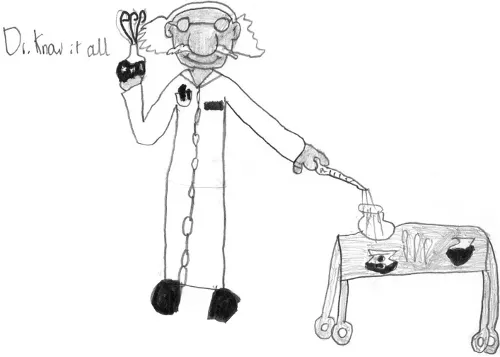
Look at the picture of a child’s image of a scientist. Where do you think children get their ideas about scientists from?
Figure 1.1 How a child might picture ‘a scientist’
Children develop their concept of the ‘eccentric male scientist’ from media such as comic books, films and television. But rather than have children think of ‘mad scientists’, it would be better if they thought of scientists as people from everyday life, such as doctors, nurses, engineers, pharmacists, electricians, aunties, uncles. It would be even better if, when they drew a picture of a scientist, they drew a picture of themselves! Science education aims to develop children’s understanding that science is all around them and that people who engage in science come from all walks of life.
Why should children be taught science?
Why do you think science is such an important subject in the school curriculum?
SOMETHING TO THINK ABOUT
Jot down your ideas about why science is an important part of the school curriculum.
Science is an important part of the curriculum for many reasons:
- to help children understand the world they live in;
- to encourage children to be curious about their world;
- to help children appreciate how awesome the world is;
- to engage and use children’s natural interest in and curiosity of the world around them;
- to develop the potential of those children who are interested in science to become the scientists, technicians, doctors, pharmacists, nurses of the future.
Most importantly, we teach science at school so as to develop a future generation that has some understanding of the key ideas in science and the way scientists work and can apply scientific knowledge and skills. We expect children to be literate and numerate; we should also expect them to be scientifically literate.
We should expect children to be able to make sense of scientific information so that they will be able to make appropriate and informed decisions as adults.
Those decisions might relate to:
- personal health;
- public health, such as the risk of catching bird flu or mad cow disease;
- supporting environmental groups;
- engaging in a science based hobby such as gardening, astronomy;
- just enjoying making sense of the world around them;
- helping their children with their science school work!
Science and everyday life
Science is such an important part of everyday life. Your doctor uses his or her scientific knowledge to make a diagnosis; an electrician makes sure your house is safe; you know that bleach needs to be kept away from children because it is dangerous.
Scientists work every day to extend human knowledge of the world, developing new medicines, materials and even food. Just think, without science we would not have some of the following:
- frozen food
- aeroplanes
- mobile phones
- insulin.
FROZEN FOOD
Clarence Birdseye was born in 1886 in Brooklyn, New York, and invented a way to freeze food and deliver it to the public.
AEROPLANES
The American Wright brothers flew the world’s first powered aeroplane, on 17 December 1903.
MOBILE PHONES
Dr Martin Cooper is considered the inventor of the first mobile phone. Cooper made the first call on a portable cell phone in April 1973.
INSULIN
In 1922, the Canadian physiologists Fred Banting and Charles Best discovered insulin.
Science is essential to everyday life and it is therefore important that children develop their understanding of the world and of how scientists work.
How scientists think and work
Let’s consider what scientists do and how they think. Here are some of the things they have to think about and do when they are engaged in their work.
| What scientists think about | What scientists do |
| • What to research, questions to ask | • Find someone to work with |
| • How to answer a question | • Talk toother people |
| • How to set up an experiment | • Make decisions |
| • What they will do | • Try things out |
| • What equipment they will need | • Choose equipment |
| • How to make sure it is a fair test | • Take measurements |
| • What information they might need | • Write their results in a table |
| • Who they might need to help them | • Draw a graph |
| • What they think will happen | • Clear away |
| • What to measure | • Talk about what they did |
| • How accurate they need to be | • Tell other people about their work |
| • How to record their results | • Go on the internet to find information |
| • What conclusions should they draw | • Reflecting on and evaluating their work |
| • Read books to find information | • Use a computer |
How children think and work scientifically
Look at the lists of what scientists have to think about and do. Have you seen children ‘think like a scientist’ or ‘do things like a scientist’ when you have been working with them? Jot down your ideas about this.
You have probably seen children do most of the things scientists do, which means that they can think and work like scientists. Primary science is based on how scientists work. It focuses on developing children’s ability to think and work like scientists. It demands that teachers provide opportunities for children to engage in activities that are designed to help them:
- take an interest in science;
- think scientifically;
- develop scientific subject knowledge;
- work scientifically.
Taking an interest in science is about developing positive attitudes and awe and wonder in science. Thinking scientifically is about developing an ability to think like scientists – asking questions, finding ways to answer questions and solve problems, looking at information and evidence that has been collected and making decisions and drawing conclusions. Developing scientific subject ...