Convergence Media History explores the ways that digital convergence has radically changed the field of media history. Writing media history is no longer a matter of charting the historical development of an individual medium such as film or television. Instead, now that various media from blockbuster films to everyday computer use intersect regularly via convergence, scholars must find new ways to write media history across multiple media formats. This collection of eighteen new essays by leading media historians and scholars examines the issues today in writing media history and histories. Each essay addresses a single medium—including film, television, advertising, sound recording, new media, and more—and connects that specific medium's history to larger issues for the field in writing multi-media or convergent histories. Among the volume's topics are new media technologies and their impact on traditional approaches to media history; alternative accounts of film production and exhibition, with a special emphasis on film across multiple media platforms; the changing relationships between audiences, fans, and consumers within media culture; and the globalization of our media culture.
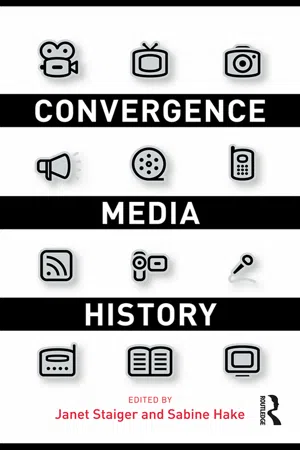
- 212 pages
- English
- ePUB (mobile friendly)
- Available on iOS & Android
eBook - ePub
Convergence Media History
Part II
New Subjects
Chapter 6
Provincial Modernity?
Film Exhibition at the 1907 Jamestown Exposition
Kathryn H. Fuller-Seeley
In what ways did motion pictures, which film scholars have associated with urban modernity, play an ideological role at a provincial event, 1907’s Jamestown Tercentennial Exposition? The seven-month-long Exposition commemorated the 300th anniversary of the founding of English colonies in America with the establishment of the Jamestown, Virginia, settlement in April 1607. Unlike the era’s other major expositions in Chicago, Buffalo, and St. Louis, this deliberately historical, provincially focused exposition, held outside the small Southern city of Norfolk, Virginia, explicitly did not promote ideologies of upcoming prospects such as industrial manufacturing, consumer product innovations, visions of the future, or solutions to the challenges of the urban metropolis (Love 1907; Rydell 1984). The rurally situated festival focused on everything that was the opposite of the fast-paced life of the Big City. It dwelt on white colonial heritage and celebrated a mythical past of pioneers conquering wilderness, eradicating Indians, and bringing civilization and American ideals to new lands. It celebrated military heritage and the exploits of the US Navy’s Great White Fleet in the Pacific (as Norfolk was a naval and shipbuilding center). It danced uneasily around optimistic visions of the New South, focusing more on the dominance of agriculture in the Southern economy than on any promises of industrial growth or racial equality. The only Big City represented at the fair was destroyed daily (shaken and burned to the ground at the “San Francisco Earthquake and Fire” exhibit).
Nevertheless, the new technology of motion pictures was there. Entrepreneurs commissioned two one-reel films, Pocahontas: Child of the Forest (1907, Edwin S. Porter) and Scenes in Colonial Virginia (1907, Porter), to be produced by the Edison Company. These were shown in a small brick theater located in the fair’s entertainment zone, the Warpath. The films were especially designed, as Hayden White (1978) reminds us all histories are, to represent America’s founding myths in particular ways. While the Exposition’s subjects reinforced traditional themes of the Anglo-Saxon foundation of American civilization, I will nevertheless argue that the film narratives opened up small spaces for readings that allowed modernity to be adapted to provincial tastes and some modern ideas to slip quietly in through the back door.
Aspects of these film narratives moved beyond the traditional male- and white-dominated history that most US Americans learned in school at that time. Instead, they emphasized family building by the pioneers over the exploits of individual male pioneers. Pocahontas, a woman, energetically rescued lovers and colonists, anticipating the movie serial heroines to come. “Great white men” triumphed not due to natural inevitability, but through trickery, the labor of African slaves, and with the partnership of spunky wives and Indian maidens. Such representations indicate different attitudes toward women and Native and African Americans than those held in the nineteenth century, ones more in line with women suffragette and civil rights themes to flourish in the 1910s and 1920s. Overtly labeling these “modern,” however, is troublesome since suffragette movements often based their demands for women’s votes on exceptionally traditional views of women and families as well as specters of racial others taking control of the United States (Staiger 1995, 29–53; Schuyler 2006). Still, centering narratives on strong, independent women and showing white men not at their best presented new images of the past.
This chapter asks us to re-evaluate exhibition and reception practices at the dawn of the “transitional era” of American cinema, when scenic tableau films coexisted and competed with narrative films, whose form was growing in complexity and length. At the same time in American society, nineteenth-century ideals coexisted and competed with twentieth-century ones (Fuller 1997; Fuller-Seeley 2008). As Ben Singer suggests, the transitional era of American cinema (and, I would argue, the interactions of cinema and modernity) were a “complex, dynamic process in which disparate forces—competing paradigms and practices—overlap and interact” (2004, 76). Film scholars contend that motion pictures embodied the idea of modernity produced by urban cultural change (Charney and Schwartz 1995). If so, then at the Exposition, this cinema intermingled change with cultural continuity, in a melding of new media form and cultural/ideological tradition. The films exhibited turned old stories into new ones, and linked the past with the speed, dislocations, and dangers of the present for the provincial middle-class audiences who viewed them.
The 1907 Jamestown Tercentennial Exposition did not emphasize commerce or consumer culture in the manner of most world fairs. In this unsettled time of rapid industrial growth, some were wary of the wholesale rush into the “modern” world of goods, and the Jamestown Fair was a moment to discuss it, as one commenter noted:
The very best thing about it [Jamestown] perhaps is that it is not a “tomato can” exposition. By the tomato can exposition is meant the enormous aggregations of canned fruits and other mercantile products, familiarly known as “exhibits”, which have bordered miles and miles of aisles and aisles in previous fairs.
(Love 1907)
Here the spotlight was to be on linking the English founding of the settlement to the strengths of contemporary US American heritage and culture.
Not only the historical rather than commercial focus but also the geographic location and challenges of transportation and cost of attending the Exposition influenced the profile of Jamestown Fair attendees. Although aimed at a nationwide audience, the fair was located more than 200 miles south of Washington, DC, which made travel difficult for any but the middle class and upper class. In comparison, St. Louis, site of the 1904 Louisiana Purchase Exposition, was a city of over 600,000, and fair organizers had invested $40,000,000; Norfolk’s and Richmond’s populations combined were 150,000, and Exposition participants invested only $10,000,000, excluding the warships that the US and international governments lent to the event (Jones 1907, 305). Making easy or repeated attendance even more difficult, the fairgrounds, six miles outside of Norfolk on several hundred acres of swampy riverside fields—the Jamestown settlement, fifty-two miles further up the James River, had been abandoned 200 years earlier—were accessible only by special railroad line or automobile (Jones 1907, 306). Construction delays meant that many exhibits, special attractions, and hotels were not ready on opening day, and drainage difficulties and hot weather brought outbreaks of disease. Early reviewers focused on the problems and deficiencies, nicknaming it the “Jamestown Imposition,” further retarding attendance (Inglis 1907; Gleach 2003). The Jamestown Exposition achieved only modest success—it reported 2.75 million visitors, but 41 percent had been admitted free (Keiley 1909, 721). The majority of visitors were probably from the upper South and mid-Atlantic states. It is doubtful that many Southern mill workers and sharecroppers could attend.
Despite the many factors that limited the exhibits at the Jamestown Exposition to ideas and modes of expression that were traditional and conservative, nevertheless one recent technological innovation, cinema, was readily accepted at the Exposition. Movies were included without controversy (and largely without comment) as educational materials, representations of history, effective storytellers, and amusement fit for small-town families, women, and children. Several travelogs and factory-tour films shown at government and consumer product manufacturers’ booths joined the two historical films. Movies were the equal of other spectacles at the Jamestown Exposition: fireworks, parades, flotillas, large-scale battle re-enactments, historical recreations, and Wild West shows.
Information about the genesis of Pocahontas and Scenes in Colonial Virginia is, however, scarce. In Spring 1907, a group called the Colonial Virginia Company commissioned the Edison Manufacturing Company, which produced numerous films for private organizations and industrial manufacturers, to create special films to exhibit at the Jamestown festival (Brownlow 1992, 232–233, 266–268; Fuller 1997, 78–82). Charles Musser located receipts in the Edison Company records documenting that director Edwin S. Porter produced 2,285 feet of film at a total cost of $1,866.24 for ten days of studio work (1991, 333, 424, 526). One newspaper article describing the upcoming Exposition noted,
Colonial Virginia will be represented in a building which will be a copy of the old House of Burgesses in Williamsburg, as far as information about that structure is obtainable. This is a moving picture drama in which the old worthies will appear in characteristic costume, a reproduction of them, so far as is possible, as they walked in life in the olden times. Many dramatic incidents will be incorporated and the production, it is said, will be of genuine historic and artistic interest.
(“Going” 1907)
Frustratingly for the historical researcher, these films received almost no attention in the motion picture trade press or in Exposition publicity materials in 1907 despite their substantial cost and the elaborate exhibition space in which they were shown. The 800-page Official Blue Book history of the Exposition devoted one small paragraph to the attraction. However, the Jamestown exhibitors’ thriftiness ultimately extended the life of these two films; at the Exposition’s conclusion, the Colonial Virginia Company sold the negatives back to the Edison Company for $150. The Edison studio commercially released the films in fall 1908, generating synopses, advertising copy, and reviews in the film trade press. As only small fragments of the films exist in archives, we must rely on the Edison publicity materials for descriptions of the films.
Pocahontas, Child of the Forest retold the legend of the meeting of Captain John Smith and an Indian princess in ways that reshaped traditional narratives (“Stories” 1908a). The film turned this story of the founding of British America into a one-reel melodramatic romance. In a plot which shared much in common with another Edison fictional history film released that year, Daniel Boone, Or Pioneer Days in America (1907, Porter), the power of white AngloSaxon males was not emphasized. Smith escapes execution not through physical might or superior weapons but through trickery and through Pocahontas’s repeated intervention. She is an active heroine; her assertive sexual desire for John Smith and her centrality to the film’s plot marked her as a far more complexly realized character than schoolbook histories owned. The eight-scene film, as described in the Edison Company synopsis, opens with a prologue that presents Captain John Smith as a heroic, honored figure, a “hardy adventurer, sailor, soldier and traveler, he founded Jamestown in 1607. Made friends of the Indians. This story tells of his meeting Pocahontas” (“Stories” 1908a). Next is “The Treaty of Peace,” a scene in which a group of Indians, led by Chief Powhatan, arrives at Jamestown to sign an agreement with the British. His daughter Pocahontas takes the initiative to look over Captain Smith with a frankly admiring gaze, which immediately triggers jealousy in her Indian lover Kunder-Wacha, a character added by the film’s scenario writer.
Smith is shown quelling mutiny among the English colonists, establishing order at Jamestown, and then mounting an expedition into the wilderness. Kunder-Wacha trails the company. The Indians capture the English, killing all but Smith, whom they take as captive to the Indian camp. Smith relies on his wits to avoid torture, fascinating the Indians with a compass. Imagining him to be a powerful Medicine Man, the Indians lead him to Powhatan, where their previous acquaintance is renewed. Pocahontas also welcomes him warmly, and her renewed attentions further inflame Kunder-Wacha’s hatred. The spurned lover argues to the Indian Council that Smith must be killed, and as they prepare to execute the Captain Pocahontas demands that he be spared. While the film claims that Pocahontas’s romantic feelings for Smith move her to save him, the synopsis also shows Powhatan citing her legal rights (“Indian Law in her favor”) to enable Smith’s release.
As the Captain returns to Jamestown, Kunder-Wacha shoots him, and Pocahontas appears to bind his wounds. Smith then sails for England, but soon afterward the Jamestown settlement turns chaotic and famine threatens. Pocahontas appears again with emergency food rations for the British settlement. There, a new character, John Rolfe, breaks the news that Smith is dead; she grieves and Rolfe comforts her, forming a new romantic relationship. This quickly leads to a climactic struggle in which Kunder-Wacha attacks the new lovers, but Rolfe finally dispatches the vengeful Indian.
The final scene depicts the historic wedding of Rolfe and Pocahontas, with all members of the English and Indian settlements joyfully celebrating. “Grand wedding. Colonists happy and prosperous,” notes the final line of the synopsis, as the film’s ending gives the impression that with this romantic union, the “Indian problem” is solved and the British could proceed to build their fortunes in Virginia.
The second film commissioned from the Edison studio by the Jamestown exhibitors was titled “Scenes in Colonial Virginia” (“Stories” 1908b). Unlike the Pocahontas film’s attempt to tell a continuing narrative focusing on individual characters, this motion picture is a series of tableaux, a form that still characterized many films of 1907. The film consists of eight scenes visualizing historic events in the founding of the Jamestown settlement. Serious depictions of historical events are interspersed with humorous incidents that work to undercut the idea of unquestioned Anglo-Saxon male authority and allow brief moments to think about the roles of women and family building, and to question the history of race relations.
First, the English adventurers’ three ships are shown arriving in Chesapeake Bay, carrying “a party of fortune seekers, including gentlemen and mechanics.” A mon...
Table of contents
- Cover Page
- Title Page
- Copyright Page
- List of Figures
- Preface
- Acknowledgments
- PART I New Methods
- PART II New Subjects
- PART III New Approaches
- PART IV Research Issues
- Bibliography on Media Historiography
- List of Contributors
Trusted by 375,005 students
Access to over 1.5 million titles for a fair monthly price.
Study more efficiently using our study tools.
Frequently asked questions
Yes, you can cancel anytime from the Subscription tab in your account settings on the Perlego website. Your subscription will stay active until the end of your current billing period. Learn how to cancel your subscription
No, books cannot be downloaded as external files, such as PDFs, for use outside of Perlego. However, you can download books within the Perlego app for offline reading on mobile or tablet. Learn how to download books offline
Perlego offers two plans: Essential and Complete
- Essential is ideal for learners and professionals who enjoy exploring a wide range of subjects. Access the Essential Library with 800,000+ trusted titles and best-sellers across business, personal growth, and the humanities. Includes unlimited reading time and Standard Read Aloud voice.
- Complete: Perfect for advanced learners and researchers needing full, unrestricted access. Unlock 1.5M+ books across hundreds of subjects, including academic and specialized titles. The Complete Plan also includes advanced features like Premium Read Aloud and Research Assistant.
We are an online textbook subscription service, where you can get access to an entire online library for less than the price of a single book per month. With over 1.5 million books across 990+ topics, we’ve got you covered! Learn about our mission
Look out for the read-aloud symbol on your next book to see if you can listen to it. The read-aloud tool reads text aloud for you, highlighting the text as it is being read. You can pause it, speed it up and slow it down. Learn more about Read Aloud
Yes! You can use the Perlego app on both iOS and Android devices to read anytime, anywhere — even offline. Perfect for commutes or when you’re on the go.
Please note we cannot support devices running on iOS 13 and Android 7 or earlier. Learn more about using the app
Please note we cannot support devices running on iOS 13 and Android 7 or earlier. Learn more about using the app
Yes, you can access Convergence Media History by Janet Staiger,Sabine Hake in PDF and/or ePUB format, as well as other popular books in History & Historiography. We have over 1.5 million books available in our catalogue for you to explore.