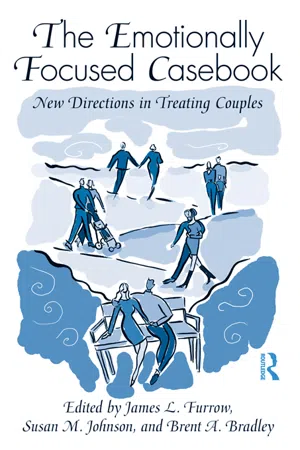
There is currently no single resource that compiles the various applications to the many clinical populations being served by Emotionally Focused Therapy today. The Emotionally Focused Casebook fills that void as a substantive reference for clinicians, students, professors, and supervisors using and teaching EFT. Each chapter utilizes a hands-on case study approach with concrete guidelines and illustrations for the adaptation and application of EFT with specific treatment populations. This Casebook is the perfect practical resource for professionals and students looking for examples of specific theoretical, conceptual, and treatment applications of EFT.
eBook - ePub
The Emotionally Focused Casebook
New Directions in Treating Couples
- 416 pages
- English
- ePUB (mobile friendly)
- Available on iOS & Android
eBook - ePub
The Emotionally Focused Casebook
New Directions in Treating Couples
About this book
Information
II APPLICATION OF EMOTIONALLY FOCUSED COUPLE THERAPY
DOI: 10.4324/9780203818046-5
Four Depression
Enemy of the Attachment Bond
DOI: 10.4324/9780203818046-6
INTRODUCTION
Depression is the leading cause of disability worldwide (World Health Organization, 2001). It is estimated that during a given year, nearly 7% of adults in the United States will experience a serious episode of depression and nearly 6 in 10 of those will experience severe or very severe impairment (Kessler et al., 2003). Over a 15-year span, people with unipolar depression have been found to be virtually unable to carry out their work functions for 21% of the time (Judd et al., 2008). In the United States, less than a quarter of people with serious depression receive adequate treatment, whether medication or psychotherapy (Kessler et al., 2003). Clearly, there is a great need for effective treatments of depression. Emotionally focused therapy (EFT) for couples (Johnson, 2004) offers a unique approach to alleviating the suffering of those struggling with depression and their partners, who share in this isolating journey.
IMPROVING THE TREATMENT OF DEPRESSION
Sadly, it is widely accepted that the results from studies to date with treatments of depression, while highly effective for some, are generally disappointing. Results from the STAR*D study, one of the largest studies of depression treatments ever conducted in real-world practice settings (Rush et al., 2004), illustrate this concern. Over 4,000 patients suffering with major depressive disorder were enrolled in the study from multiple clinical sites across the United States. If participants did not reach remission from an initial treatment, they received up to three additional courses of treatment. Treatments were primarily medication, although a relatively small number of participants received cognitive therapy. Overall rates of remission from depression were 37% for Step 1, 31% for Step 2, 14% for Step 3, and 13% for Step 4 (Warden, Rush, Trivedi, Fava, & Wisniewski, 2007). With each ensuing step, a lower percentage of patients reached the desired goal of freedom from depression. Overall, 30% of patients who remained in the study through all four levels of treatment—a period of nearly 1 year—never achieved remission (Warden et al., 2007).
A person receiving state-of-the-art depression treatment with either medication or psychotherapy has less than a 50% chance of being free of depression upon completion of treatment. Discouraging statistics have recently led the director of the National Institute of Mental Health (NIMH) to conclude that “with optimal care…too many people will not recover” (Insel, 2009, p. 129). In response, the NIMH has developed a new strategic plan charting a research course that may hold promise for new approaches (National Institute for Mental Health, 2008). The strategic plan lists four opportunities for progress, including the development of personalized treatment approaches (as opposed to studies where everyone receives the same treatment) and fully harnessing the untapped power of psychosocial treatments (Insel, 2009).
Not every person with serious depression is in a relationship and not all in a relationship are experiencing relational discord. However, for those people experiencing both serious depression and relational discord, evidence is emerging that emotionally focused couples therapy may be a useful addition to a personalized approach to treatment selection (Denton, Wittenborn, & Golden, 2010; Dessaulles, Johnson, & Denton, 2003).
Relationship Discord and Depression Go Hand in Hand
Depression can be devastating on relationships, and relationship discord can have deleterious effects on mood. The association between depression and relational discord is well established (Whisman, 2001). There is evidence to support the belief that depression can lead to relational discord and, conversely, that relational discord can lead to depression. Relational distress puts individuals at risk for depression. In a random community sample of 904 people, those with relational discord were nearly three times more likely to be in a major depressive episode 1 year later than those without relational discord (Whisman & Bruce, 1999). The authors also found that when all participants were included—those without relationships and those with nondiscordant relationships—nearly 30% of new major depressive episodes over the course of the year were associated with marital dissatisfaction.
People who have experienced an episode of major depression are significantly more likely to experience divorce (Kessler, Walters, & Forthofer, 1998). Relationships with a depressed partner are often characterized by more negative communication, such as blame, withdrawal, and verbal aggression. These relationships also exhibit less positive communication, such as self-disclosure, problem solving, smiling, and eye contact (reviewed in Rehman, Gollan, & Mortimer, 2008). Depressive symptoms such as irritability, loss of motivation, loss of the ability to experience pleasure, and loss of sexual interest can create serious strain in any relationship. Living with a depressed person can itself lead to depression (Coyne et al., 1987). The impact of depression on a couple’s relationship and the higher incidence of relational distress suggests that couple therapy would be useful to many people suffering from depression, yet few clinical treatments focus on the unique issues couples face in dealing with depression.
How Depression Is Diagnosed
The current standards for diagnosing clinically relevant depression focus on symptoms such as disturbed sleep or appetite, loss of energy, poor concentration, etc. In the Diagnostic and Statistical Manual of Mental Disorders, Fourth Edition, Text Revision (DSM-IV-TR) (American Psychiatric Association, 2000), which is widely used in the United States, this condition is referred to as “major depressive disorder.” Other parts of the world may use the International Classification of Diseases, which utilizes a similar symptom-based classification (World Health Organization, 1992).
It would be more accurate to say “major depressive syndrome” than “disorder” because the classification describes, but does not explain, the phenomenon of serious depression. There is evidence to support that the same clinical condition may be associated with different brain abnormalities (Walsh et al., 2008) and, undoubtedly, the symptoms of depression have different etiological sources in different people. Nonetheless, a term is needed to distinguish clinically relevant depression from ordinary depressive feelings not requiring professional intervention. We will use the term “major depressive disorder” here due to common professional usage.
The Many “Causes” of Depression
The “cause” of major depressive disorder in final analysis is unknown. Undoubtedly, it results from the interplay of environmental/psychosocial and genetic/biological factors. Understanding depression is an emerging area of neuroscience research that has moved beyond simplistic notions of “chemical imbalance.” Current conceptualizations focus on understanding altered functioning within complex neuronal networks (Insel, 2007). These efforts are hampered, however, by our limited ability to study the functioning of the brain, even with the most advanced brain imaging technologies currently available. Thus, it appears that it will still be years before neuroscience research will add meaningfully to our ability fully to understand and treat depression.
This is not to say that depression is “caused” by brain prob-lems; indeed, stressful life events often precede an episode of major depression (Kendler, Karkowski, & Prescott, 1999). Further, it is increasingly recognized that the environment can change the brain. Only in the last 10–20 years have scientists accepted that the adult human brain grows new functional neurons—a process referred to as neurogenesis (Gross, 2000). There is evidence to suggest that impaired neurogenesis in the hippocampus is associated with depression (Eisch et al., 2008; Thomas & Peterson, 2008) and stress has been found to cause impairment in hippocampal neurogenesis (Mitra, Sundlass, Parker, Schatzberg, & Lyons, 2006).
Studies such as these suggest a mechanism by which psychosocial stress, such as relationship discord, can be translated into the experience of depression (Dranovsky & Hen, 2006). This research also does not mean that only biological treatments will be indicated in the future—take exercise, for example. Exercise is a behavioral intervention that has antidepressant activity found to increase hippocampal neurogenesis (Ernst, Olson, Pinel, Lam, & Christie, 2006). For our purposes, consider couple therapy with EFT. Might it be that strengthening the attachment bond leads to the growth of new brain cells in partners struggling with depression? This is an intriguing speculation that we hope will be tested someday.
Fortunately, even though the cause or causes of depression are unknown, there are treatments that can help people with depression, and EFT is one of them (Denton et al., 2009; Dessaulles et al., 2003).
Attachment Issues Are Related to Both Relational Distress and Depression
Attachment separation or distress and a partner’s habitual ways of regulating this distress play a major role in an EFT understanding of the creation and maintenance of relationship problems (Johnson, 2004). For example, when Darrell feels Sherri’s loss of interest in him, he becomes flooded with anxiety and then masks his initial vulnerable feelings of loss by hurling angry and demeaning comments at her. These responses push Sheri away and her withdrawal, coupled with threats of divorce, increases Darrell’s desperate rage and his sense of loss. He feels helplessness fueling deeply held fears about his own adequacy. This then triggers a depressive episode. As Darrell either explodes or withdraws into depression, the relationship slides toward divorce.
Attachment injuries in childhood or adolescence (e.g., trauma, neglect, or loss) are a risk factor for the later development of major depression (Kendler, Kessler, Neale, Heath, & Eaves, 1993; Sjoholm, Lavebratt, & Forsell, 2009). If Darrell is also a survivor of childhood abuse, the threat to his connection to Sherri is even more likely to trigger an onset of depressive symptoms. Depression is more common among persons with more anxious and avoidant attachment styles as compared to control groups (Lemmens, Buysse, Heene, Eisler, & Demyttenaere, 2007; Mickelson, Kessler, & Shaver, 1997). Attachment distress is a lynchpin in the strong association between relationship distress and depression.
EFT Impacts Depression
There have been two randomized clinical trials utilizing EFT in the treatment of couples where one partner is diagnosed with major depressive disorder (Denton et al., 2010; Dessaulles et al., 2003). These studies provide preliminary but promising evidence for the efficacy of the use of EFT with couples as a depression treatment. There is also emerging evidence that emotion-focused therapy for individuals is an efficacious treatment of depression (Greenberg & Watson, 1998; Watson, Gordon, Stermac, Kalogerakos, & Steckley, 2003). While EFT for individuals will not be covered in this chapter, it is an empirically supported option for individuals seeking psychotherapeutic treatment of depression.
Both studies utilizing EFT in the treatment of couples were of women with major depressive disorder who were also experiencing relational discord. In the first study, participants were randomly assigned to either EFT alone or antidepressant medication (Dessaulles et al., 2003). Twelve participants completed the study and were included in the analysis. EFT treatment consisted of 14 conjoint sessions and one individual session for each partner, for a total of 16 weekly sessions. Participants randomly chosen to receive medication were treated for 16 weeks with desipramine, trimipramine, or trazadone. At the end of treatment, women in both groups had experienced a significant improvement in their level of depressive symptoms. The women in the EFT group actually had a lower level of depressive symptoms than the women receiving medication, but, due to the small sample size, this difference did not reach statistical significance.
The women were reevaluated 6 months after completing treatment and again there was no significant difference between the two groups. The women in the EFT group, however, experienced a significant improvement in depressive symptoms during this post-therapy period. The women in the medication group had no change in symptoms during these months and actually had a nonsignificant trend toward worsening of their depressive symptoms. (It should be noted that medication was stopped at the end of the 16 weeks.) Thus, it appears that the benefits of EFT for depression were continuing to build even after treatment was over.
In a second study, EFT was examined as an adjunctive treatment to antidepressant medication (Denton et al., 2010). Twenty-four women with both major depressive disorder and relational discord were randomized to either antidepressant medication alone or antidepressant medication combined with EFT. Med ica tions utilized were bupropion sustained release, escitalopram, sertraline, and venlafaxine extended release. Medications were selected clinically and could be changed during the course of the 6-month treatment if they were not efficacious or tolerable. EFT was delivered in 15 weekly conjoint sessions. Both groups significantly and equally improved in depressive symptomatology. Women receiving EFT, however, experienced significantly greater improvement in relationship quality than did the women receiving medication alone (Den...
Table of contents
- Cover Page
- Half-Title Page
- Title Page
- Copyright Page
- Table of Contents
- Contributors
- Introduction
- SECTION I Foundations for Innovation
- SECTION II Application of Emotionally Focused Couple Therapy
- Section III Specific Treatment Populations and Emotionally Focused Couple Therapy
- Index
Trusted by 375,005 students
Access to over 1.5 million titles for a fair monthly price.
Study more efficiently using our study tools.
Frequently asked questions
Yes, you can cancel anytime from the Subscription tab in your account settings on the Perlego website. Your subscription will stay active until the end of your current billing period. Learn how to cancel your subscription
No, books cannot be downloaded as external files, such as PDFs, for use outside of Perlego. However, you can download books within the Perlego app for offline reading on mobile or tablet. Learn how to download books offline
Perlego offers two plans: Essential and Complete
- Essential is ideal for learners and professionals who enjoy exploring a wide range of subjects. Access the Essential Library with 800,000+ trusted titles and best-sellers across business, personal growth, and the humanities. Includes unlimited reading time and Standard Read Aloud voice.
- Complete: Perfect for advanced learners and researchers needing full, unrestricted access. Unlock 1.5M+ books across hundreds of subjects, including academic and specialized titles. The Complete Plan also includes advanced features like Premium Read Aloud and Research Assistant.
We are an online textbook subscription service, where you can get access to an entire online library for less than the price of a single book per month. With over 1.5 million books across 990+ topics, we’ve got you covered! Learn about our mission
Look out for the read-aloud symbol on your next book to see if you can listen to it. The read-aloud tool reads text aloud for you, highlighting the text as it is being read. You can pause it, speed it up and slow it down. Learn more about Read Aloud
Yes! You can use the Perlego app on both iOS and Android devices to read anytime, anywhere — even offline. Perfect for commutes or when you’re on the go.
Please note we cannot support devices running on iOS 13 and Android 7 or earlier. Learn more about using the app
Please note we cannot support devices running on iOS 13 and Android 7 or earlier. Learn more about using the app
Yes, you can access The Emotionally Focused Casebook by James L. Furrow, Susan M. Johnson, Brent A. Bradley, James L. Furrow,Susan M. Johnson,Brent A. Bradley in PDF and/or ePUB format, as well as other popular books in Psicología & Salud mental en psicología. We have over 1.5 million books available in our catalogue for you to explore.