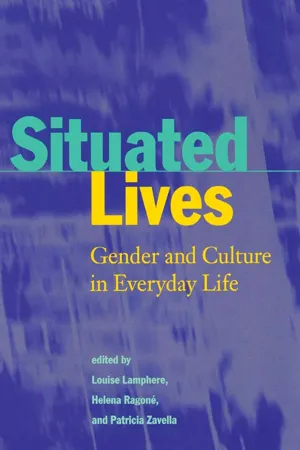
Situated Lives brings together the most important recent feminist and critical research that situates gender in relationship to the historical and material circumstances where gender, race, class and sexual orientation intersect and shape everyday interaction. Contributors include: Barbara Babcock, Jean Comaroff, Sarah Franklin, Faye Ginsburg, Matthew Gutmann, Faye V. Harrison, Louise Lamphere, Ellen Lewin, Jos^'e Lim^'on, Iris Lopez, Emily Martin, Mary Moran, Kirin Narayan, Aihwa Ong, Devon G. Pe^~na, Beatriz Pesquera, Helena Ragon^'e, Rayna Rapp, Judith Rollins, Leslie Salzinger, Denise Segura, Carol Stack, Ann Stoler, Donald D. Stull, Brett Williams, Patricia Zavella.
eBook - ePub
Situated Lives
Gender and Culture in Everyday Life
- 500 pages
- English
- ePUB (mobile friendly)
- Available on iOS & Android
eBook - ePub
Situated Lives
Gender and Culture in Everyday Life
About this book
Information
Part One
The Power of Representation
Gendered Ethnography in Practice
1 How Native Is a “Native” I Anthropologist?
How “native” is a native anthropologist? How “foreign” is an anthropologist from abroad? The paradigm polarizing “regular” and “native” anthropologists is, after all, part of received disciplinary wisdom. Those who are anthropologists in the usual sense of the word are thought to study Others whose alien cultural worlds they must painstakingly come to know. Those who diverge as “native,” “indigenous,” or “insider” anthropologists are believed to write about their own cultures from a position of intimate affinity. Certainly, there have been scattered voices critiquing this dichotomy. Arguing that because a culture is not homogeneous, a society is differentiated, and a professional identity that involves problematizing lived reality inevitably creates a distance, scholars such as Aguilar (1981) and Messerschmidt (1981a:9) conclude that the extent to which anyone is an authentic insider is questionable. Yet such critiques have not yet been adequately integrated into the way “native” anthropologists are popularly viewed in the profession.
In this essay, I argue against the fixity of a distinction between “native” and “non-native” anthropologists. Instead of the paradigm emphasizing a dichotomy between outsider/insider or observer/observed, I propose that at this historical moment we might more profitably view each anthropologist in terms of shifting identifications amid a field of interpenetrating communities and power relations. The loci along which we are aligned with or set apart from those whom we study are multiple and in flux. Factors such as education, gender, sexual orientation, class, race, or sheer duration of contacts may at different times outweigh the cultural identity we associate with insider or outsider status. Instead, what we must focus our attention on is the quality of relations with the people we seek to represent in our texts: are they viewed as mere fodder for professionally self-serving statements about a generalized Other, or are they accepted as subjects with voices, views, and dilemmas—people to whom we are bonded through ties of reciprocity and who may even be critical of our professional enterprise?
I write as someone who bears the label of “native” anthropologist and yet squirms uncomfortably under this essentializing tag. To highlight the personal and intellectual dilemmas invoked by the assumption that a “native” anthropologist can represent an unproblematic and authentic insider’s perspective, I incorporate personal narrative into a wider discussion of anthropological scholarship. Tacking between situated narrative and more sweeping analysis, I argue for the enactment of hybridity in our texts; that is, writing that depicts authors as minimally bicultural in terms of belonging simultaneously to the world of engaged scholarship and the world of everyday life.
The Problem in Historical Perspective
The paradigm that polarizes “native” anthropologists and “real” anthropologists stems from the colonial setting in which the discipline of anthropology was forged: the days in which natives were genuine natives (whether they liked it or not) and the observer’s objectivity in the scientific study of Other societies posed no problem. To achieve access to the native’s point of view (note the singular form), an anthropologist used the method of participant-observation among a variety of representative natives, often singling out one as a “chief informant” (Casagrande 1960). A chief informant might also be trained in anthropological modes of data collection so that the society could be revealed “from within.” As Franz Boas argued, materials reported and inscribed by a trained native would have “the immeasurable advantage of trustworthiness, authentically revealing precisely the elusive thoughts and sentiments of the native” (Lowie 1937:133, cited in Jones 1970:252). Or better yet, a smart and adequately Westernized native might go so far as to receive the education of a bona fide anthropologist and reveal a particular society to the profession with an insider’s eye. Ordinary people commenting on their society, chief informants friendly with a foreign anthropologist, or insiders trained to collect indigenous texts were all in some sense natives contributing to the enterprise of anthropology. Yet, it was only those who received the full professional initiation into a disciplinary fellowship of discourse who became the bearers of the title “native” anthropologist.
Even if such a “native” anthropologist went on to make pathbreaking professional contributions, his or her origins remained a perpetual qualifier. For example, writing the foreword to M. N. Srinivas’s classic monograph on the Coorgs, Radcliffe-Brown emphasized that the writer was “a trained anthropologist, himself an Indian” and went on to add that he had “therefore an understanding of Indian ways of thought which it is difficult for a European to attain over many years” (Srinivas 1952:v). As Delmos Jones has charged, it is likely that “natives” who could get “the inside scoop” were first admitted into the charmed circle of professional discourse because they were potential tools of data collection for white anthropologists (Jones 1970:252). Admittedly, in an era prior to extensive decolonization and civil rights movements, that “natives” were allowed to participate at all in professional discourse was remarkable. In this context, calling attention to, rather than smoothing over, “native” identity perhaps helped to revise the ingrained power imbalances in who was authorized to represent whom.
Viewed from the vantage point of the 1990s, however, it is not clear that the term native anthropologist serves us well. Amid the contemporary global flows of trade, politics, migrations, ecology, and the mass media, the accepted nexus of authentic culture/demarcated field/exotic locale has unraveled (Appadurai 1990, 1991; Clifford 1992; Gupta and Ferguson 1992). Although many of the terms of anthropological discourse remain largely set by the West, anthropology is currently practiced by members (or partial members) of previously colonized societies that now constitute the so-called Third World (Altorki and El-Solh 1988; Fahim 1982; Kumar 1992; Nakhleh 1979; Srinivas, Shah, and Ramaswamy 1979). These scholars often have institutional bases in the Third World, but some have also migrated to Europe and the United States. Furthermore, in the First World, minority anthropologists also hold university positions and their contributions to ongoing discourse have helped to realign, if not overthrow, some of the discipline’s ethnocentric assumptions (Gwaltney 1981; Jones 1970; Limón 1991). Feminist scholarship questioning the formulation of “woman as Other” has underscored the differences between women and the multiple planes along which identity is constructed, thus destabilizing the category of “Other” as well as “Self” (Abu-Lughod 1990; Alarcon 1990; Lauretis 1986; Mani 1990; Mohanty and Russo 1991; Strathern 1987). It has also become acceptable to turn the anthropological gaze inward, toward communities in Western nations (Ginsburg 1989; Ginsburg and Tsing 1990; Martin 1987; Messerschmidt 1981b; Ortner 1991). The “field” is increasingly a flexible concept: it can move with the travels of Hindu pilgrims (Gold 1988), span Greek villagers and New Age American healers (Danforth 1989), or even be found in automobile garages of South Philadelphia (Rose 1987). In this changed setting, a rethinking of “insider” and “outsider” anthropologists as stable categories seems long overdue.
Multiplex Identity
“If Margaret Mead can live in Samoa,” my mother is reputed to have said when she moved to India, “I can live in a joint family.” The daughter of a German father and American mother, she had just married my Indian father. Yet these terms—German, American, Indian—are broad labels deriving from modern nation-states. Should I instead say that my mother, the daughter of a Bavarian father and a WASP mother who lived in Taos, New Mexico, became involved with her fellow student at the University of Colorado: my Indian-from-India father? Yet, for anyone familiar with India shouldn’t I add that my father’s father was from the Kutch desert region, his mother from the dense Kathiawari forests, and that while he might loosely be called “Gujarati” his background was further complicated by growing up in the state of Maharashtra? Should I mention that Mayflower blood supposedly mingles with that of Irish potato famine immigrants on my maternal grandmother’s side (I’m told I could qualify as a “D. A. R.”), or that as temple builders, members of my paternal grandfather’s caste vehemently claimed a contested status as Brahman rather than lower-ranking carpenter? Should I add that my father was the only Hindu boy in a Parsi school that would give him a strictly British education, inscribing the caste profession-based title “Mistri” (carpenter) onto the books as the surname “Contractor”? Or would it better locate my father to say that he remembers the days when signs outside colonial clubs read “No Dogs or Indians”? Also, is it useful to point out that my mother—American by passport—has now lived in India for over 40 years (more than two-thirds of her life) and is instructed by her bossy children on how to comport herself when she visits the United States?
I invoke these threads of a culturally tangled identity to demonstrate that a person may have many strands of identification available, strands that may be tugged into the open or stuffed out of sight. A mixed background such as mine perhaps marks one as inauthentic for the label “native” or “indigenous” anthropologist; perhaps those who are not clearly “native” or “non-native” should be termed “halfies” instead (cf. Abu-Lughod 1991). Yet, two halves cannot adequately account for the complexity of an identity in which multiple countries, regions, religions, and classes may come together. While my siblings and I have spent much of our lives quipping that we are “haylf” (pronounced with an American twang) and “hahlf” (with a British-educated accent), I increasingly wonder whether any person of mixed ancestry can be so neatly split down the middle, excluding all the other vectors that have shaped them. Then too, mixed ancestry is itself a cultural fact: the gender of the particular parents, the power dynamic between the groups that have mixed, and the prejudices of the time all contribute to the mark that mixed blood leaves on a person’s identity (cf. Spickard 1989).
Growing up in Bombay with a strongly stressed patrilineage, a Hindu Indian identity has weighed more than half in my self-definition, pushing into the background the Pilgrim fathers and Bavarian burghers who are also available in my genealogical repertoire. This would seem to mark me as Indian and, therefore, when I study India, a “native” anthropologist. After all, researching aspects of India, I often share an unspoken emotional understanding with the people with whom I work (cf. Ohnuki-Tierney 1984). Performing fieldwork in Nasik on storytelling by a Hindu holy man whom I called “Swamiji,” I had the benefit of years of association with not just Swamiji himself but also the language and wider culture. Since Nasik was the town where my father grew up, a preexisting identity defined by kinship subsumed my presence as ethnographer (cf. Nakhleh 1979). Similarly, researching women’s songs and lives in the Himalayan foothills, I bore the advantage of having visited the place practically every year since I was 15, and of my mother having settled there. All too well aware of traditional expectations for proper behavior by an unmarried daughter, in both places I repressed aspects of my cosmopolitan Bombay persona and my American self to behave with appropriate decorum and deference (cf. Abu-Lughod 1988).
In both Nasik and in Kangra, different aspects of identity became highlighted at different times. In Nasik, when elderly gentlemen wearing white Congress caps arrived and Swamiji pointed me out as “Ramji Mistri’s granddaughter,” my local roots were highlighted, and I felt a diffuse pride for my association with the Nasik landmark of the Victorian bungalow that my grandfather had built in the 1920s. Visiting Nathu Maharaj, the barber with buckteeth and stained clothes, to discuss interpretations of Swamiji’s stories, I felt uncomfortable, even ashamed, of the ways in which my class had allowed me opportunities that were out of reach for this bright and reflective man. My gender was important in the observance of menstrual taboos not to touch Swamiji or the altar—injunctions that left me so mortified that I would simply leave town for several days. Borrowing the latest Stevie Wonder tapes from one of “the foreigners”—a disciple from New Jersey—I savored a rowdy release, becoming again a woman who had lived independently in a California university town. When Swamiji advised that in written texts I keep his identity obscure (“What need do I have for publicity?”—yet his doctor took me aside to advise that I disregard such modesty and identify him by name, “so people abroad will know his greatness”), I felt my role as culture broker with the dubious power to extend First World prestige to Third World realities. Yet, when Swamiji challenged my motives for taking his words on tape “to do a business,” I was set apart from all planes of locally available identification, thrown outside a circle of fellowship forged by spiritual concerns, and lumped instead with academics who made it their business to document and theorize about other people’s lives (Narayan 1989:59–62).
For my second extended research project in the Himalayan foothills region of Kangra, I had no deep local roots. I was unmoored from a certain base for identification, and the extent to which others can manipulate an anthropologist’s identity came into dizzying focus (Dumont 1978; Stoller 1989). Explaining my presence, some of the village women I worked with asserted that I was from such-and-such village (where my mother lives), hence local. At other times I was presented as being “from Bombay,” that is, a city dweller from a distant part of the country although still recognizably Indian. A wrinkled old woman I once fell into step with on an outing between villages asked if I was a member of the pastoral Gaddi tribe (to her, the epitome of a close-by Other). At yet other times, and particularly at weddings where a splash of foreign prestige added to the festivities, I was incontrovertibly stated to be “from America … she came all the way from there for this function, yes, with her camera and her tape recorder!” In the same household at different times, I was forced to answer questions about whether all Americans were savages (jangli log) because television revealed that they didn’t wear many clothes, and to listen as a member of a spellbound local audience when a dignified Rajput matron from another village came by to tell tales about how she had visited her emigrant son in New Jersey. In the local language, she held forth on how, in America, people just ate “round breads” of three sizes with vegetables and masalas smeared on top (pizza); how shops were enormous, with everything you could imagine in them, and plastic bags you could rip off like leaves from a tree; how you put food in a “trolley” and then a woman would press buttons, giving you a bill for hundreds and hundreds of rupees! Bonded with other entranced listeners, my own claims to authoritative experience in this faraway land of wonders seemed to have temporarily dropped out of sight.
Now it might ...
Table of contents
- Cover
- Half Title
- Title Page
- Copyright Page
- Table of Contents
- Introduction
- Part One The Power of Representation
- Part Two Reproducing the Body
- Part Three Constructing Family
- Part Four Consciousness, Transformation, and Resistance at Work
- Part Five Colonizing Gender and Sexuality
- Index
Trusted by 375,005 students
Access to over 1.5 million titles for a fair monthly price.
Study more efficiently using our study tools.
Frequently asked questions
Yes, you can cancel anytime from the Subscription tab in your account settings on the Perlego website. Your subscription will stay active until the end of your current billing period. Learn how to cancel your subscription
No, books cannot be downloaded as external files, such as PDFs, for use outside of Perlego. However, you can download books within the Perlego app for offline reading on mobile or tablet. Learn how to download books offline
Perlego offers two plans: Essential and Complete
- Essential is ideal for learners and professionals who enjoy exploring a wide range of subjects. Access the Essential Library with 800,000+ trusted titles and best-sellers across business, personal growth, and the humanities. Includes unlimited reading time and Standard Read Aloud voice.
- Complete: Perfect for advanced learners and researchers needing full, unrestricted access. Unlock 1.5M+ books across hundreds of subjects, including academic and specialized titles. The Complete Plan also includes advanced features like Premium Read Aloud and Research Assistant.
We are an online textbook subscription service, where you can get access to an entire online library for less than the price of a single book per month. With over 1.5 million books across 990+ topics, we’ve got you covered! Learn about our mission
Look out for the read-aloud symbol on your next book to see if you can listen to it. The read-aloud tool reads text aloud for you, highlighting the text as it is being read. You can pause it, speed it up and slow it down. Learn more about Read Aloud
Yes! You can use the Perlego app on both iOS and Android devices to read anytime, anywhere — even offline. Perfect for commutes or when you’re on the go.
Please note we cannot support devices running on iOS 13 and Android 7 or earlier. Learn more about using the app
Please note we cannot support devices running on iOS 13 and Android 7 or earlier. Learn more about using the app
Yes, you can access Situated Lives by Louise Lamphere, Helena Ragone, Patricia Zavella, Louise Lamphere,Helena Ragone,Patricia Zavella in PDF and/or ePUB format, as well as other popular books in Social Sciences & Anthropology. We have over 1.5 million books available in our catalogue for you to explore.