Whilst an increasing amount of attention is being paid to law's connection or involvement with National Socialism, less attention is focused upon thinking through the links between law and the emergence of antisemitism. As a consequence, antisemitism is presented as a pre-existent given, as something that is the object, rather than the subject of study. In this way, the question of law's connection to antisemitism is presented as one of external application. In this ironic mimesis of the positivist tradition, the question of a potentially more intimate or dialectical connection between law and antisemitism is avoided. This work differs from these accounts by explaining the relationship between law and antisemitism through a discussion of these issues by critical thinkers from the mid-nineteenth century to the present; that is, from Marx to Agamben through Nietzsche, Sartre, Adorno and Horkheimer, Arendt and Lyotard. Despite the variety that exists between each thinker, one particular common critical theme unites them. That theme is the connections they make, in diverse ways, between legal rights as an expression of modern political emancipation and the emergence and development of the social phenomenon of antisemitism.
- 138 pages
- English
- ePUB (mobile friendly)
- Available on iOS & Android
eBook - ePub
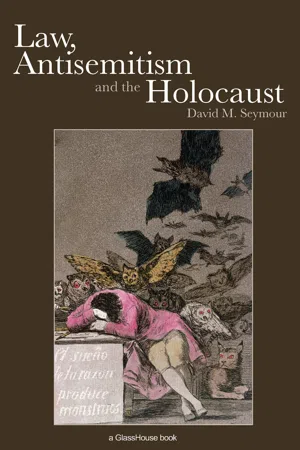
Law, Antisemitism and the Holocaust
About this book
Information
Publisher
Routledge-CavendishYear
2007Print ISBN
9780415420402
9781904385431
Edition
1eBook ISBN
9781135309558
Chapter 1
Karl Marx: dissolving the Jewish question
I begin this study with On the Jewish Question by Karl Marx (1818–1883). Aside from it being one of the earliest contributions, the themes addressed by Marx continue to form the contours of the debate. Most important amongst these strands are, first, Marx’s insistence that critical thinking bring to light the historical and social underpinnings of what appear as natural phenomena. Second, is the equivocal attitude he adopts to rights as an expression of modern emancipation and the open possibilities of the future. Third, is the presentation of antisemitism as an expression of ressentiment against the Jews as the representatives of the modern era.
Karl Marx’s contribution to a critical theory of antisemitism consists of the two essays that together comprise his article On the Jewish Question. I will argue that in defending the cause of Jewish emancipation, Marx seeks to dissolve the Jewish question into one aspect of a critique of the nature of political emancipation in general. Marx criticises the leading Berlin left Hegelian, Bruno Bauer, for seeking to exclude Jews from entry into the modern nation state. He illustrates that the reasons upon which Bauer relies to exclude the Jews apply equally to those whom Bauer deems deserve entry. I also argue that despite his critique of political emancipation Marx does not abandon it. Finally, I will argue that the nature of Marx’s defence of Jewish emancipation points to the potentiality for a modern and virulent form of anti-Jewish hostility – antisemitism.
Even though Marx had intended to contribute to the debate on the Jewish question for at least a year prior to the publication of On the Jewish Question, his immediate motivation was provided by the publication of two anti-emancipationist and antisemitic tracts by Bruno Bauer.1 Consequently, Marx’s article can be read as an attack on Bauer’s leftist antisemitism and Bauer’s work provides the reason why Marx’s On the Jewish Question presents itself as a critique of the idealism of the Young Hegelians.
In The Jewish Question, Bauer argued against the Jews being granted either political rights (the Rights of the Citizen) or civil rights (the Rights of Man) on three grounds. First, he said the granting of rights depends upon the Jews renouncing their religious beliefs and adopting atheism. Second, he said that, were the Jews to be emancipated as Jews, their ‘particularism’ (their ‘restricted nature’) would always dominate over the universalism that he saw as the essence of political and civil rights. Third, he claimed that the Jews had remained outside the historical development that led from Christianity to ‘Christianity in dissolution’ to human emancipation. In this way, Bauer produced a critique of the Jewish question that rests ultimately on a critical theology and the idealism that such a method implies.
In criticising the first of Bauer’s arguments, Marx challenges that which Bauer identifies as a specifically Jewish situation. Bauer wrote:
[T]he Jew will recede behind the citizen and be a citizen, in spite of the fact that he is a Jew and is to remain as Jew; i.e. he is and remains a Jew in spite of the fact that he is a citizen and lives in universal human conditions, his Jewish and restricted nature always triumphs in the long run over his human and political obligations. The prejudice remains, even though it is overtaken by universal principles. But if it remains, it is more likely to overtake everything else … The Jew could only remain a Jew in political life in a sophistical sense, in appearance; if he wanted to remain a Jew, the mere appearance would therefore be the essential and would triumph, i.e. his life in the state would be nothing more than an appearance, or a momentary exception to the essential nature of things and to the rule.
(quoted in Marx, 1992, p 214; emphasis in the original)
Marx agues that this ‘mere appearance’ is in fact a universal condition and arises, not for any theological reason, but is a consequence of the (secular) nature of political emancipation itself. Consequently, Bauer’s anti-Jewish stance applies as much to those to whom he grants the right to have rights as it does to the Jews themselves. In this way Marx begins his task of dissolving the Jewish question by denying a specific ‘nature’ of the Jews.
We humanise the contradiction between the state and a particular religion, for example Judaism, by resolving it into the state and particular secular elements, and we humanise the contradiction between the state and religion in general by resolving it into the contradictions between the state and its own general presuppositions.
(Marx, 1992, pp 218–19; emphasis in the original)
In achieving the dissolution of the Jewish question, Marx reformulates the question of the relationship of the Jews to political emancipation:
Bauer asks the Jews: Do you from your standpoint have the right to demand political emancipation? We pose the question the other way round: Does the standpoint of political emancipation have the right to demand from the Jews the abolition of Judaism and from man the abolition of religion.
(Marx, 1992, p 216; emphasis added)
To his own question, Marx answers in the negative.
Drawing on the example of certain North American states, Marx illustrates that the political emancipation of religion does not entail the emancipation of man from religion, but rather the emancipation of the state from religion. This apparent contradiction, Marx explains, arises because political emancipation is not synonymous with human (that is, social) emancipation (through which humanity would have thrown off the conditions that makes religion a possibility in the first place). Thus, political emancipation represents an individual’s freedom from religion only in an indirect, mediated and abstract manner:
The attitude of the state, especially the free state to religion is still only the attitude to religion of the men who make up the state. It therefore follows that man liberates himself from a restriction through the medium of the state, in a political way, by transcending this restriction in an abstract and restricted manner, in a partial manner, in contradiction with himself.
(Marx, 1992, p 216)
Marx explains the nature of this contradiction with reference to the institution of private property. On the one hand, private property is abolished politically when it ceases to be relevant as a qualification for the right to vote. However, this does not mean that private property itself is abolished; it continues to exist and exert its influence but remains in the realm of civil society where it is perceived as a private (that is, apolitical) matter. Marx implies the same is the case for religious belief, be it Judaism or Christianity.
In this way, the contradiction that Marx notes in Bauer’s work, ‘the state can have emancipated itself from religion even if the overwhelming majority is still religious’ (Marx, 1992, p 218) has been explained by the secular nature of political emancipation. Consequently, Marx has countered Bauer’s antisemitic idea that the Jews cannot be emancipated as Jews and that they must first renounce their own religious affiliation. He illustrates, first, that one’s religious belief in general is no bar to membership in the state, to a person being granted the Rights of the Citizen, and, second, that of itself, religion does not represent a unique problem, but is expressive of a general contradiction between the state and civil society.
Bauer’s further claim, that the Jew’s alleged ‘particularism’ will always dominate over ‘his human [i.e. universal] and political obligations’ so that his ‘life in the state would be nothing more than an appearance, or a momentary exception to the essential nature of things and to the rule’ (quoted in Marx, 1992, p 214; emphasis in the original) is also dissolved by Marx through his discussion of a further general condition of political emancipation. Here he points to the nature of the relationship between the realm of the state (the public realm) and the realm of civil society (the private realm).
Marx observes that the state’s characteristic as the realm of universality or human freedom (what Marx terms as ‘species-life’) only arises through its opposition to the sphere of private and particular interests. Comparing this relationship with that between heaven and earth Marx alludes to the idea that, from the perspective of civil society in which the individual is burdened with a life of toil and struggle, existence in the realm of the state appears as an ideal of freedom that is, as yet, unattainable. However, even though this state of freedom now appears in the secular world,
[t]he relationship of the political state to civil society is just as spiritual as the relationship of heaven is to earth. The state stands in the same opposition to civil society and overcomes it in the same way as religion overcomes the restrictions of the profane world, i.e. it has to acknowledge it again, reinstate it and allow itself to be dominated by it.
(Marx, 1992, p 220)
Thus, the member of civil society is also, at one and the same time, a member of the state. In this way, Marx argues, this divided individual, ‘leads a double life … not only in his mind, in his consciousness, but in reality’ (Marx, 1992, p 220).
He lives in the political community, where he regards himself as a communal being, and in civil society, where he is active as a private individual, regards other men as means, debases himself to a means and becomes a plaything of alien powers.
(Marx, 1992, p 220)
However, since political emancipation leaves civil society ‘uncriticised’, the bourgeois2 perceive their material life (that is, their life in civil society as private individuals) as their real and natural existence. In this way, their life in the state, their life as citizens will always appear to them as an ideal, as something that could only occur once they have left the conditions of their individuality behind. In other words, the bourgeois see their own citizenship in ideal and abstract terms. Thus, on the one hand, where the individual:
regards himself and is regarded by others as a real individual he is an illusory phenomenon. In the state, on the other hand, where he is considered to be a species-being, he is the imaginary member of a fictitious sovereignty, he is divested of his real individual life and filled with an unreal universality.
(Marx, 1992, p 220)
Through this analysis of the relationship of the state to civil society, Marx has illustrated that the situation that Bauer attributes solely to the Jews as a consequence of their particularist ‘restricted n...
Table of contents
- Contents
- Acknowledgements
- Preface
- Introduction
- Chapter 1 Karl Marx: dissolving the Jewish question
- Chapter 2 From critique to positivism: domination and the naturalisation of antisemitism
- Chapter 3 The absence of contradiction and the contradiction of absence: law, ethics and the Holocaust
- Chapter 4 Antisemitism and emancipation: the ressentiment of loss
- Chapter 5 The slave, the noble and the Jew: reflections on section 7 of On the Genealogy of Morals
- Chapter 6 The jurisprudence of Nazi monumental architecture
- Chapter 7 Conclusion: Hannah Arendt – the genealogy of antisemitism
- Bibliography
- Index
Trusted by 375,005 students
Access to over 1.5 million titles for a fair monthly price.
Study more efficiently using our study tools.
Frequently asked questions
Yes, you can cancel anytime from the Subscription tab in your account settings on the Perlego website. Your subscription will stay active until the end of your current billing period. Learn how to cancel your subscription
No, books cannot be downloaded as external files, such as PDFs, for use outside of Perlego. However, you can download books within the Perlego app for offline reading on mobile or tablet. Learn how to download books offline
Perlego offers two plans: Essential and Complete
- Essential is ideal for learners and professionals who enjoy exploring a wide range of subjects. Access the Essential Library with 800,000+ trusted titles and best-sellers across business, personal growth, and the humanities. Includes unlimited reading time and Standard Read Aloud voice.
- Complete: Perfect for advanced learners and researchers needing full, unrestricted access. Unlock 1.5M+ books across hundreds of subjects, including academic and specialized titles. The Complete Plan also includes advanced features like Premium Read Aloud and Research Assistant.
We are an online textbook subscription service, where you can get access to an entire online library for less than the price of a single book per month. With over 1.5 million books across 990+ topics, we’ve got you covered! Learn about our mission
Look out for the read-aloud symbol on your next book to see if you can listen to it. The read-aloud tool reads text aloud for you, highlighting the text as it is being read. You can pause it, speed it up and slow it down. Learn more about Read Aloud
Yes! You can use the Perlego app on both iOS and Android devices to read anytime, anywhere — even offline. Perfect for commutes or when you’re on the go.
Please note we cannot support devices running on iOS 13 and Android 7 or earlier. Learn more about using the app
Please note we cannot support devices running on iOS 13 and Android 7 or earlier. Learn more about using the app
Yes, you can access Law, Antisemitism and the Holocaust by David Seymour in PDF and/or ePUB format, as well as other popular books in Law & Holocaust History. We have over 1.5 million books available in our catalogue for you to explore.