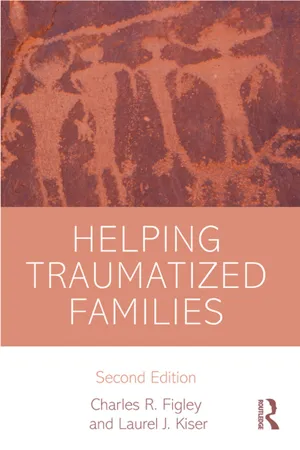
The new edition of the classic Helping Traumatized Families not only offers clinicians a unified, evidence-based theory of the systemic impact of traumatic stress—it also details a systematic approach to helping families heal by promoting their natural healing resources. Though the impact of trauma on a family can be growth producing, some families either struggle or fail to adapt successfully. Helping Traumatized Families guides practitioners around common pitfalls and toward a series of evidence-based strategies that they can use to help families feel empowered and ultimately to thrive by developing tools for enhancing resilience and self-regulation.
eBook - ePub
Helping Traumatized Families
- 176 pages
- English
- ePUB (mobile friendly)
- Available on iOS & Android
eBook - ePub
Helping Traumatized Families
About this book
Information
Understanding the Impact of Trauma on Families
one
The Family as a Living System
Family as a Dynamic System
Throughout nature, plants, insects, animals, and humans join together to form systems. Take for example a stand of trees (as excerpted from “The way we stand” by Susan Griffin, 1991):
The way we stand, you can see we have grown up this way together, out of the same soil, with the same rains, leaning in the same way towards the sun. See how we lean together in the same direction. How the dead limbs of one of us rest in the branches of another. How those branches have grown around the limbs. How the two are inseparable . . . and in the way we stand, each alone, yet none of us separable, none of us beautiful when separate but all exquisite as we stand, each moment heeded in this cycle, no detail unlovely.
For human beings, families are the most obvious of social systems. Social systems are webs of relationships that form predictable patterns of interactions with numerous, measurable byproducts that represent the will of the system or a significant subsystem.
All systems are dynamic. In a stand of trees, when one tree falls, all of the other trees are changed. Family is a similar kind of dynamic system connected not by roots and branches but by interpersonal relationships that account for changes in behaviors of family members. Families and trees must adapt to changes—be they sudden and dangerous or gradual but profound. This is one way to illustrate how families are living systems (Kiser, 2008). We view families as strong and resilient systems able to change and adapt to most of life’s circumstances. We also know that some life circumstances can overwhelm a family system. When trauma occurs, some families will have trouble adapting in healthy and sustainable ways.
As stated in the Preface to the 1989 Edition, we have three main objectives for this book: (1) to review what we know about families who have experienced trauma, including definitions of some important concepts and several theoretical models that clarify them; (2) to discuss the typical ways families cope with trauma, by presenting a model of family adaptation to trauma; and (3) to describe a comprehensive approach to treating a variety of families suffering from the aftershocks of their trauma.
We have worked with families impacted by trauma over several decades and have felt their pain, marveled at their resilience, and celebrated with them as they recovered. We hope that this book will provide a way to view and help both the person and the family (or other social system) as they cope with their trauma experiences.
The Systemic Nature of Family Trauma
We would like to introduce you to the Murrays. They will be your guide through this book as we review their case and their progress through family trauma treatment.
The Murray Family
Mary Murray (all names here are fictitious) was jolted from her thoughts by a coworker’s announcement: “Mary, Tammy’s principal needs to speak with you right away.” Mr. Perez informed Mary that her eleven-year-old daughter had been overheard saying she was planning to commit suicide.
After consultation with the school counselor, Tammy was referred to a local psychotherapist for evaluation. After one session with the therapist, it was recommended that the rest of the family join her: her parents, John and Mary, and her nine-year-old brother, Tim. The clinician determined that Tammy was under considerable stress from the pressures of school and home. At the same time the clinician hypothesized that the family was in a state of shock, traumatized by a series of stressful jolts that had been building for months and were now culminating in Tammy’s suicide talk.
John, the father, had recently sought treatment for “exhaustion,” although by all previous indications he had been the model of a happy and productive executive. But in the last six weeks his life had been in shambles. He had been able to sleep only a few hours each night. He had missed more work this past month (because of various minor illnesses) than at any time in his life. He felt jumpy and irritable and fluctuated between feeling apathetic and enraged. According to Mary, his wife of fifteen years, he was no longer interested in the things that once brought him joy: his children, Little League coaching, fishing, and photography.
What was most troublesome to John, however, was his re-experiencing of several troubling memories of past events. These events had occurred over fifteen years ago when he was a corpsman in the war in Vietnam. Although he had not thought much about the war since returning home, he was now experiencing both daydreams and nightmares of the war almost daily. He had tried to talk about these experiences with Mary. She listened and tried to encourage John to put his memories behind him for the good of his family and himself. He tried to forget the past but could not. Moreover, he was unable to recall certain periods of time during his yearlong tour of duty in the war. He was frightened, confused, and concerned that his boss and coworkers would think he was unable to function effectively in his extremely responsible position.
In the last few years Mary had threatened divorce, was frequently depressed, had difficulty sleeping, and was probably abusing alcohol. Both Tim and Tammy had been extremely upset and were more and more depressed about what had been happening to their family. They both were doing poorly in school, tending to avoid being at home with their father, and fighting among themselves more frequently. Both felt that, if they were better children, they could help their family and parents out of this situation.
The family had struggled along this way for weeks, until Tammy’s depression led to her thoughts about suicide. The family assembled for treatment, at first to focus their attention on Tammy’s depression. Soon, however, they would be dealing with other stressors that had culminated in a family system impacted by trauma.
Fortunately, the clinician was able to see beyond Tammy’s suicide talk to recognize that it might be symptomatic of a traumatized family.
Most often families who have been traumatized go unnoticed. They are viewed as the “victim’s family.” Families who have experienced trauma often feel alone and reluctant to seek help outside the family. In the last decade human service systems have recognized that, unless we attend to the social network of the victim, the victim will not recover quickly from her or his stressful experiences. Yet, as a result of the traumatic experiences, the network (most often the “victim” is the family) can barely handle routine matters and may be unable to help members struggling to recover emotionally.
The Murray family illustrates how systems, particularly family systems, work. Even though much of the trauma can be traced to the father’s experiences and in particular to the family’s reactions to his efforts to handle his memories, it is none the less traumatic for each family member. As with so many families, the struggles of each member of the Murray family are easy to see but are much more complex and effectively helped when viewed in a broader family context.
Viewing Families Impacted by Trauma
Families who have been traumatized are those who are attempting to cope with an extraordinary stressor or stressors that have disrupted their normal life routine in unwanted ways. The connectedness of family members with one another is why they are so vulnerable to stress, particularly traumatic stress. When one person in a family—or any semi-closed system, such as a fraternity or sorority, a card club, or a submarine crew—is upset, this upset is sensed by others in the system. Almost immediately efforts are made to correct the problem: eliminate the stressor, ease the distress, or find an effective coping method. So it is with families coping with trauma.
A family impacted by trauma, then, is struggling to recover from and to cope with an injury or wound to its system. As will be noted later, this “injury” can happen in many different ways and at various levels of intensity. The “injury” could range from a seemingly small incident that would be a minor annoyance to another family to the death or extraordinary abuse of one or more family members. What is most critical, however, is the fact that the trauma experienced by one family member may be experienced by the entire family system. Thus, families who have been traumatized are injured systemically and are vulnerable to a wide variety of systemic dysfunction.
Family trauma is also complicated by the fact that it is not uncommon for the family or another family member to be responsible for the trauma, as in the case of incest. In this case, the “injury” is caused by the family. Trauma is both a cause and a consequence, and the family can either be a source of support and healing (see Chapter two) or cause additional harm (for example, when they refuse to believe the abuse happened or blame the victim for what happened). The bulk of the material in this book focuses on the system of the family who has been traumatized and on how best to detect and help these families.
Most importantly, trauma represents in families their shared memories of experiencing one or a series of sudden and overwhelming adversities requiring adaptation and management. Critical to the family’s reaction are the beliefs, points of view, perceptions, frames of reference, or cognitive appraisals of family members—both separately and collectively.
Helping families who have been traumatized, then, is empowering the family collectively to process or take into their awareness what they have experienced. By doing so they eventually figure out a way to work out conflicts, fears, and intentions within the family; the family can exchange perspectives that enable them sufficiently to understand, accept, and adapt to others’ reactions collectively (as a system, as a family).
Conclusion
There has been extraordinary growth in the field of traumatology, the study and treatment of trauma, especially in the areas of individual assessments (Wilson & Keane, 2004), evidence-based treatments (Ursano et al., 2004), and the evidence-based models that guide them (Figley, 2002a). Growth in understanding families impacted by trauma has been modest and slow to translate into practice.
What accounts for this slow growth and development in helping families dealing with trauma is that most funding sources and treating practitioners are trained to work with individuals. Hospitals, clinics, schools, and all things government are oriented to people not systems. But the most important reason why development has been slow is the complicated nature of studying families generally. Families are far more difficult to understand, predict, and help. They are far more than a collection of individuals. Families, no less families who have been traumatized, are fascinating, and every one is unique (Figley, 1978, 1998).
Many term-laden systemic concepts have emerged over the years, particularly in family therapy theory, to identify the various components and functions within the family system. We have consciously tried to avoid such terms and other professional jargon. In addition to wanting the most coherent book possible on helping families who have been traumatized, we also wish to write one that appeals to colleagues from various disciplines, theoretical orientations, cultures, and languages. We hope that this chapter is an indication that what we are trying to do with this second edition is to make it as accessible as possible to all.
two
Individual Responses to Trauma
When families experience high stress and trauma, the whole family system reacts. Individual family members are affected, as are all the other parts of the family. Yet the primary focus of researchers and practitioners in traumatology is on individual trauma experiences and reactions. To appreciate the importance of families in the context of individual experiences of trauma and recovery, it is critical first to understand how individuals respond to trauma.
Interestingly, the study of traumatic stress began with the earliest medical writings in 1900 B.C. in the first discussion of what would later be described as hysteria (Veith, 1965). Trimble (1981) has provided an important history of traumatic stress that demonstrates the intense interest in this area, particularly within Western culture from the sixteenth century to the present.
The area of stress and coping seemed to evolve separately from that of traumatic stress, however, with Claude Bernard’s (Selye, 1956) focus on the milieu intérieur, or internal environment, of a living organism, the importance of which remains fairly constant irrespective of its external environment. Walter B. Cannon (1939) built on the concept of “homeostasis,” the ability of the body to remain in a constant state, providing staying power.
Hans Selye (1956), in one of the earliest conceptualizations of stress, defined stress as the “state manifested by a specific syndrome which consists of all the nonspecifically-induced changes within a biologic system” (p. 64). Later he defined stress more simply: “The nonspecific response of the body to any demand made upon it” (Selye, 1974, p. 14). Even more helpful than his attempts to define stress was Selye’s discovery of the biological stress syndrome, or general adaptation syndrome (GAS), which describes the body’s general method of coping with any type of stressor. Briefly, the syndrome includes three phases. The alarm reaction involves the body’s initially reacting to a stressor. Most often the body adjusts and, through the resistance phase, draws on its energy reserves to cope with the stressor. All indicators of stress exhibited in the alarm phase have disappeared. However, with repeated exposure to a stressor, the body enters the final phase, exhaustion. Here the body exhausts its adaptive energy; the signs of the alarm phase reappear, but now they are irreversible, and unless something is done quickly death may occur.
Trauma is defined as “an injury (as a ...
Table of contents
- Cover Page
- Half-title Page
- Series Page
- Title Page
- Copyright Page
- Dedication Page
- Table of Contents
- Series Editor's Foreword
- Preface to the 1989 Edition
- Preface
- Acknowledgments
- Part One—Understanding the Impact of Trauma on Families
- Part Two—Empowering Families
- Part Three—Empowering Family Trauma Therapists
- References
- Index
Trusted by 375,005 students
Access to over 1.5 million titles for a fair monthly price.
Study more efficiently using our study tools.
Frequently asked questions
Yes, you can cancel anytime from the Subscription tab in your account settings on the Perlego website. Your subscription will stay active until the end of your current billing period. Learn how to cancel your subscription
No, books cannot be downloaded as external files, such as PDFs, for use outside of Perlego. However, you can download books within the Perlego app for offline reading on mobile or tablet. Learn how to download books offline
Perlego offers two plans: Essential and Complete
- Essential is ideal for learners and professionals who enjoy exploring a wide range of subjects. Access the Essential Library with 800,000+ trusted titles and best-sellers across business, personal growth, and the humanities. Includes unlimited reading time and Standard Read Aloud voice.
- Complete: Perfect for advanced learners and researchers needing full, unrestricted access. Unlock 1.5M+ books across hundreds of subjects, including academic and specialized titles. The Complete Plan also includes advanced features like Premium Read Aloud and Research Assistant.
We are an online textbook subscription service, where you can get access to an entire online library for less than the price of a single book per month. With over 1.5 million books across 990+ topics, we’ve got you covered! Learn about our mission
Look out for the read-aloud symbol on your next book to see if you can listen to it. The read-aloud tool reads text aloud for you, highlighting the text as it is being read. You can pause it, speed it up and slow it down. Learn more about Read Aloud
Yes! You can use the Perlego app on both iOS and Android devices to read anytime, anywhere — even offline. Perfect for commutes or when you’re on the go.
Please note we cannot support devices running on iOS 13 and Android 7 or earlier. Learn more about using the app
Please note we cannot support devices running on iOS 13 and Android 7 or earlier. Learn more about using the app
Yes, you can access Helping Traumatized Families by Charles Figley,Laurel Kiser,Charles R. Figley,Laurel J. Kiser in PDF and/or ePUB format, as well as other popular books in Social Sciences & Mental Health in Psychology. We have over 1.5 million books available in our catalogue for you to explore.