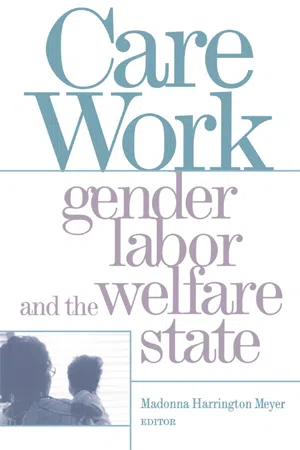
Care Work is a collection of original essays on the complexities of providing care. These essays emphasize how social policies intersect with gender, race, and class to alternately compel women to perform care work and to constrain their ability to do so. Leading international scholars from a range of disciplines provide a groundbreaking analysis of the work of caring in the context of the family, the market, and the welfare state.
- 432 pages
- English
- ePUB (mobile friendly)
- Available on iOS & Android
eBook - ePub
About this book
Information
1 Introduction
Madonna Harrington Meyer. Pam Herd, and Sonya Michel
The Right to—or Not to—Care
E ach of us has moments of dependency, moments when we rely on the kindness or generosity of others to provide for our most basic needs. Most often, our needs are met by our family members—the mother who tends to her child’s cut knee, the husband who massages his wife’s back during childbirth, the daughter who delivers lunch to her mother as she recovers from a hip replacement. For those with sufficient resources, many moments of dependency are handled via market-based services—the day-care provider who tends to a child’s cut knee, the mid-wife who massages the back of a laboring mother, the home care provider who delivers lunch to the client recovering from a hip replacement. But many citizens, particularly children, poor disabled adults, and a significant proportion of the frail elderly, lack the resources to draw on market-based services. They rely instead on their families. Sometimes, however, the dependency is simply too great for family members, who must also juggle paid work, care of other family members, and their own physical and mental health. Where do we, in our respective societies, want to locate the burden of this dependency?
Historically, most societies have placed the burden of dependency squarely on the shoulders of families—and most notably the women within those families. Architects of welfare states that aim to locate the burden of dependency on individual families develop very few welfare programs that would spread that burden across society more generally. In the United States in particular, families were, and continue to be, seen as the primary source of care, regardless of the consequences for either the care provider or care receiver. By contrast, Scandinavian countries have long adhered to a philosophy that a key role of the state is to socialize the burden of dependency by creating welfare state programs that provide a wide array of options for those who need assistance at various stages of life. Taken together, the papers in this volume explore this question of how best to locate the burden of dependency. What are the complexities, strengths, and weaknesses of emphasizing families, market-based solutions, or welfare state programs? How might we best create a mixture of options that balances the burden across all three spheres?
The scholarly and public policy literature on the complexities of care work is extensive, but much of it takes for granted the reigning emphasis on family-based rather than market-or welfare state-based solutions. Even the frequently used term caregiver takes for granted that families, particularly women within families, willingly provide care, regardless of the personal consequences. As best we can tell, the term caregiver was coined in the gerontological literature in an attempt to distinguish care providers from care receivers. But the term has taken on a political and economic meaning with problematic consequences. Caregiver implies that the care is given freely, either at no cost or at a cost that the giver is willing and able to shoulder. Implicit in the term is the notion of choice. But as we take stock of several decades of literature on care work, it is clear that individual choices regarding care work are highly restricted by a persistent ideology about the gendered nature of care work, conflicting demands and expectations regarding paid and unpaid labor, the paucity of affordable market-based options, and the instability of social supports implemented via welfare states.
In an attempt to set the stage for serious reform of care work policies and practices across the globe, the papers in this volume steer clear of conventional assumptions that care work is inherently women’s work, or that care work is cost-free if the fees are not enumerated in public-spending spreadsheets. We focus instead on an integrated analytical framework that encompasses the paid as well as unpaid care work of individuals, families, communities, and social service agency employees. We also emphasize the complexities of care work across the globe and across the life course. Ultimately, we assess the range of family, market, and welfare state supports that are— or could be—available to care workers.
It is our belief that the range of supports must create an environment in which families, most notably women, have the right and ability to perform care work—as well as the right or ability to be free of care work. This principle emerged as the central theme at the conference on “Gender, Citizenship, and the Work of Caring” held in November 1997 at the University of Illinois at Urbana-Cham-paign under the aegis of the Women’s Studies Program. Twenty-five scholars from across North America and Northern Europe gathered to discuss the nature of care work and the impact of social policy on the quality of care and on the recognition and compensation care workers receive. The consensus among the authors is that care work must become a recognized component of citizenship, for both women and men. The current state of affairs is that many who wish to provide care for loved ones are either unable to do so or are compelled to do so under untenable conditions. Alternately, many who are unable or unwilling to provide care find precious few alternatives to which they can turn.
Central to the analyses included in this volume are issues of gender, race, ethnicity, and class. We explore and challenge historical assumptions, prevalent in both private and public arenas, that the provision of care work is more naturally suited to women or best performed by unpaid family members rather than trained professionals. We also assess the gender, race, ethnic, and class implications of dynamic and unstable welfare state supports in the United States and abroad. We document how failed attempts to implement universal child care, long term care, or other forms of family supports have proved particularly problematic for families who are poor, minority, or immigrant. And we applaud the successes of a foster care program that placed many poor, black, and Latino children into permanent family and educational arrangements where their chances of flourishing are maximized.
The authors contributing to this volume come from various disciplines and perspectives, including women’s studies, sociology, political science, economics, history, and public policy. Our effort to develop a multidisciplinary perspective opens the way for comparative analyses of the systems and networks of care that have emerged in North America, Western Europe, and Scandinavia. Recognition of international variation in the degree of support for care work provides common intellectual ground for chapters focusing on subspecialties such as elder care, child care, and care for the chronically ill and disabled. On the one hand, the volume addresses the failure of care workers in both public and private spheres to reap adequate rewards for their work. Care workers pay a financial, physical, and emotional price that frequently remains unaccounted for and unnoticed. On the other hand, the volume addresses the inability of certain groups of women to give priority to care work because of economic and other structural barriers. Simply, they do not have the option to care. As a collective, the chapters suggest movement in a direction that permits families, mainly women, the capacity to provide care when they choose to do so—as well as the right to sidestep unpaid care work when they choose instead to emphasize paid labor.
Opponents of welfare programs that would promote and stabilize care work argue that providing the needed supports to care workers would be too expensive. As the articles in this volume contend, however, it is too expensive not to provide this support. The costs of unacknowledged and uncompensated care work are enormous, particularly for women, the poor, and persons of color. Socializing the costs of dependency through welfare state programs represents a great opportunity to ameliorate inequalities. By contrast, locating dependency within individual families serves as yet another method that sustains, and even magnifies, socioeconomic inequalities.
The lack of support for care work adversely affects care providers and care recipients alike. Bureaucratization and stinting on resources deprives recipients of good care— jeopardizing the ability of our most vulnerable constituents to receive even the most basic of social rights. Moreover, inadequate recognition of, and compensation for, care work bars providers from participating as full citizens with full opportunities in political, social, and economic institutions. Given that the vast majority of us will either require care work or be compelled to provide care work at some time in our lives, it is in the best interest of the care worker in each of us to actively pursue stable supports for care work.
Gendering Care Work
Gendering Care Work
C are work is an act that, for the most part, women do; it is a gendered activity. The articles in Part I challenge the gendered construction of care by viewing care and its connection with women as a socially constructed phenomenon. The myth that women have a natural capacity and desire to care has proved to further reinforce gender inequalities by disproportionately burdening women with unpaid or low-paid care work (Abel 1990; Hooyman and Gonyea 1995). But what are the processes that led to, and continue to reinforce, the construction of care work around women? The authors in this section attempt to answer this question by looking to history, and particularly to motherhood and fatherhood.
In examining women’s care for sick and disabled family members and friends in the United States between 1850 and 1940, historian Emily Abel shows how not only gender, but class and race differences as well, shape the construction of care work. Specifically, while middle-class white women were often forced to perform care work, poor women and women of color were often not allowed to care for the people they loved. Historically, white middle-class women in the late eighteenth and early nineteenth centuries participated in the medicalization of care work, helping to debase the nurturing aspects of care work and construct poor, immigrant, and black women who focused on the emotional or spiritual dimensions of caring as irrational.
The nurturing aspects of care work, most often associated with women and rarely associated with men, are often debased. The question is, why? In an historical piecethat parallels Abel’s, sociologists Scott Coltrane and Justin Galt trace the historical development of fatherhood, revealing how men increasingly moved away from, and women became largely accountable for, primary parenting responsibilities. Their essay argues that men can and should perform the nurturing aspects of care work. Just as caring for children may play a pivotal role in defining motherhood, and women more broadly, they argue that caring for children may play a pivotal role in defining fatherhood, and men more generally.
Subsequent chapters present more contemporary tensions that shape and reshape lines between motherhood and care work. They look to the ways mothers organize in the public sphere, and how that affects the intertwining threads of motherhood, caring, gender, and class. Traditional notions of motherhood can reinforce class inequalities among women, historian Sonya Michel argues, when middle-and upper-class stay-at-home mothers fail to advocate for subsidized day-care policies that would allow poor women similar choices. These notions also can guide changing gender identities for women who choose to move toward work outside of the home. In sociologist Ann Herda-Rapp’s analysis of stay-at-home mothers who became politically active, she found that many mothers justified their participation in the toxic waste movement, and their decision to downsize unpaid domestic responsibilities, by stating they were working to make a safer and healthier world for their children. In both of these pieces, women’s roles as mothers and/or care workers shape the types of activities they do and do not do. In turn, these activities serve to reshape their roles as mothers and/or care workers.
In the end, it appears that care work is defined and redefined across history and across continents as women’s work, and particularly low-income women’s work, at least in part because this arrangement is perceived of as maximally beneficial to those with substantial resources. Isolated from the day-to-day rigors of care work, many middle-and upper-class men and women rarely devote their time or economic or political clout toward developing a more realistic or humane care work system. Overwhelmed by the day-to-day rigors of providing care, care workers rarely have the time, or economic or political clout, to pursue policies that would ease their burdens.
2 A Historical Perspective on Care
Emily K.Abel
D uring the past few years I have been studying the history of women caregivers for sick and disabled family members and friends in the United States, specifically in the period between 1850 and 1940. My original intention was to challenge how researchers and policy analysts use the past. Highlighting the growth of the frail elderly population, some argue that the demands for informal care are greater today than ever before. Nadine F.Marks (1996:27), for example, recently wrote that “demographic changes have now increased the relative risk of becoming a caregiver at some time—or even multiple times—during a lifetime.” Cling-ing to a romantic vision of a vanished world, others argue that the nineteenth century was the golden age, because women delivered care selflessly and sensi-tively. The implication is that we should return to nineteenth-century methods of care.
As expected, although nineteenth-century women had relatively few elder-care responsibilities, obligations for birthing women and sick, disabled, and dying people of all ages were constant and unremitting. Some women complained bitterly that caregiving confined them to the home, caused serious physical and emotional health problems, and added to domestic labor, which was grueling even in the best of times (see Abel in press).
Historical inquiry has highlighted both the social forces compelling women to provide care for intimates and the social conditions preventing women from doing the same. Most of the feminists writing about care have been white andmiddle-class women; many belong to the generation brought up to be wives and mothers rather than full-time workers. Therefore, it is perhaps not surprising that a major theme in our writing has been the oppressive ideological and material forces compelling women to deliver care. In a study of present-day adult daughters caring for frail elderly parents, I noted that the absence of universal long term care services in the United States means that many women lack the power to determine when they will begin to care for elderly relatives, to control the intru-sions of caregiving in their lives, and to relinquish responsibilities that have become overwhelming (Abel 1991).
It is equally important to point out that poor women, especially women of color, historically have had to struggle to be able to care for intimates. Although a host of illnesses ravaged slave quarters in the antebellum South (see Savitt 1978:49–82), enslaved women could eke out time to care for their families only when they returned at night, exhausted from work in the fields or big house. Fannie Moore, a former slave, told interviewers that when her younger brother was dying, “Granny she doctah him as bes’ she could, evah time she git away from de white folks’ kitchen. My mammy nevah git chance to see him, ‘cept when she git home in de evenin’.” When the mother learned one night that her son had died, she knelt “by the bed and cry her heart out.” Shortly afterward, the boy’s uncle buried him. The mother “just plow and watch ‘em put George in de ground” (Rawick 1972:130–31). Slaves also were vulnerable to loss of children through sale.
Waged work prevented many poor women from delivering care during the late nineteenth and early twentieth centuries. Some women with caregiving responsibilities found remunerative work they could do at home, such as taking in laundry, boarders, and piecework, but such work consumed time and energy needed for care. The mother of a severely disabled seven-year-old boy, in a letter to Eleanor Roosevelt in 1938, complained that when she added sewing for pay to her normal housework, she lacked “time to give him the attention & care that he needed” (C.R.S. 1938). Women working outside the home sometimes left sick or disabled family members alone. In 1907, a dressmaker asked a physician to send her two young tubercular sons to a sanatorium where they previously had resided. Although the boys “were well for some time after coming home,” she now found them “as bad as ever.” “Having no mother during the day,” they ran “wild” and returned each night with wet feet (C.E. 1907). A physician employed in the New York City Department of Health noted in 1916 that some working mothers locked children with whooping cough in the home (Dickson 1916:19–20). By the turn of the century, caregiving increasingly included transport-ing family members to medical appointments and visiting hospitalized patients. But those tasks, too, were impossible for many women in the labor force: Most offices and clinics were open only during regular working hours. In 1903, the mother of a blind 15-year-old boy in New York City rejected a clinic appointment for him because she worked full time, and he could not go alone (Community Service Society 1888–1918). Hospital visiting hours also conflicted with laborers’ working day (Peter Brent Brigham Hospital 1931).
The difficulty of caring for sick and disabled family members was especially great for domestic servants. Between the mid-nineteenth century and 1930, more women entered domestic service than any other occupation (Glenn 1986:99). Ex-cluded from many forms of paid employment, African-American, Mexican-American, and Japanese-American women were especially likely to work as servants (Glenn 1992). As Phyllis Palmer (1989:87) notes, “Domestics were envisioned as single women, young or old, cut off from any attachments except those to the employer’s family.” Servants who lived in had virtually no opportunity to provide care. An African-American southern woman stated, “I see my own children only when they happen to see me on the street when I am out with the [employer’s] children or when my children come to the ‘yard’ to see me” (quoted in Hunter 1997:106). Day laborers, too, complained about their long hours. One wrote to the National Association for the Protection of Colored People in 1931, “I leave home quarter of 7 every morning. I finish 9:30 P.M. When I get home it is 10 o’clock. The people treat me as one of their family and I suppose I should not kick. But I certainly would like to know more about Domestic rules and laws if there be any” (quoted in Palmer 1989:87). Essays by Pierrette Hondagneu-Sotelo and Stacey Oliker in this volume remind us that the problems of reconciling paid employment and caregiving responsibilities remain formidable for poor women, immigrant women, and women of color.
Historical research also helped to illuminate another theme that dominates feminist analyses of care—the paltriness of the rewards caregivers receive. Although the social fabric relies ...
Table of contents
- Cover Page
- Title Page
- Copyright Page
- Acknowledgments
- 1 Introduction
- Gendering Care Work
- Public Markets/Private Caring
- Welfare States: Unstable Supports?
- Organizing and Reorganizing Care Work
- Notes/References
- Contributors
Trusted by 375,005 students
Access to over 1.5 million titles for a fair monthly price.
Study more efficiently using our study tools.
Frequently asked questions
Yes, you can cancel anytime from the Subscription tab in your account settings on the Perlego website. Your subscription will stay active until the end of your current billing period. Learn how to cancel your subscription
No, books cannot be downloaded as external files, such as PDFs, for use outside of Perlego. However, you can download books within the Perlego app for offline reading on mobile or tablet. Learn how to download books offline
Perlego offers two plans: Essential and Complete
- Essential is ideal for learners and professionals who enjoy exploring a wide range of subjects. Access the Essential Library with 800,000+ trusted titles and best-sellers across business, personal growth, and the humanities. Includes unlimited reading time and Standard Read Aloud voice.
- Complete: Perfect for advanced learners and researchers needing full, unrestricted access. Unlock 1.5M+ books across hundreds of subjects, including academic and specialized titles. The Complete Plan also includes advanced features like Premium Read Aloud and Research Assistant.
We are an online textbook subscription service, where you can get access to an entire online library for less than the price of a single book per month. With over 1.5 million books across 990+ topics, we’ve got you covered! Learn about our mission
Look out for the read-aloud symbol on your next book to see if you can listen to it. The read-aloud tool reads text aloud for you, highlighting the text as it is being read. You can pause it, speed it up and slow it down. Learn more about Read Aloud
Yes! You can use the Perlego app on both iOS and Android devices to read anytime, anywhere — even offline. Perfect for commutes or when you’re on the go.
Please note we cannot support devices running on iOS 13 and Android 7 or earlier. Learn more about using the app
Please note we cannot support devices running on iOS 13 and Android 7 or earlier. Learn more about using the app
Yes, you can access Care Work by Madonna Harrington Meyer in PDF and/or ePUB format, as well as other popular books in Social Sciences & Social Policy. We have over 1.5 million books available in our catalogue for you to explore.