- 240 pages
- English
- ePUB (mobile friendly)
- Available on iOS & Android
eBook - ePub
The Survival Guide for Business Families
About this book
Meet the JacMar family: successful, committed, and--like every other business family--trying to strike a balance between their professional and personal lives. The JacMars are a composite of actual business families. As Gerald Le Van follows them from the bedroom to the board room, he identifies the key issues and problems faced by every business family today. Le Van, a highly sought-after speaker and consultant, has helped many business families successfully navigate through times of turbulence and transition. In The Survival Guide for Business Families, he makes his secrets available to the public for the first time. He leads the reader step-by-step through thirty-nine questions that everyone involved with a family operated business must address in order to plan for the future. Designed as a self-help book, The Survival Guide for Business Families teaches families to recognize the emotional and organizational work that only they--and not their lawyers, accountants or financial advisors--can do to secure their future. It gives them the communication and coping skills to get through crises, such as a leadership transition. Le Van shows that business families are not alone in their struggle, and that they can not only survive, but prosper.
The JacMar Business Family
1
Introducing the JacMars
Like most teenagers if my parents had said, "This is what you are going to do," I would have replied, "No it is not."
—John W. Marriott III, General Manager, Marriott Corporation1
As his troop ship neared San Francisco, Jack made himself three promises:
- He would become an engineer.
- He would marry Margaret as soon as possible.
- He would never again take orders from incompetent persons like he had met in the Army.
Jack had been drafted into the Army in 1953, near the end of the Korean War. Assigned to a construction battalion, it became clear that Jack could fix almost anything—with or without the official spare parts.
The oldest of four children, Jack had little time for sports, dates, or other extracurricular activities. Jack worked all he could, contributed his earnings to the family, and helped care for his younger brother and sisters. Jack's father worked only intermittently, his mother worked at home, sometimes taking in laundry and ironing.
After his discharge from the Army, Jack married Margaret and entered college, financed by the G.I. Bill of Rights. Their first son, Jack Jr.,"JJ," was born during Jack's midterm examinations the following year. At one point Jack held three part-time jobs to help support his family. By the time Jack graduated with honors in mechanical engineering, he was the proud father of his second son, Frank.
Jack landed his first job as a junior engineer with a large engineering consulting firm whose principal clients were military suppliers. Almost immediately, he knew he had made a mistake. In Jack's view, his employer was trying to help civilian incompetents deal with military incompetents. Jack was miserable. He would submit his work but seldom see it again, he got little feedback, his supervisor was incompetent, and Jack argued with him frequently. After a particularly violent quarrel, Jack was fired.
Almost thirty years old, with a wife, two small boys, and little savings, Jack was unemployed. But he was determined to show them. Fascinated with several unsolved engineering problems at his former firm, Jack began tinkering with them, first in his garage, then in a rented warehouse. He developed some solutions, patented the processes, formed JacMar Corporation, and went into business.
Jack the Entrepreneur
Jack's work style is fairly typical of successful entrepreneurs. Until recently Jack always enjoyed good health and blinding energy—gifts that are almost universal among entrepreneurs. For most of his life, Jack has worked sixty to seventy hours per week. He lacks respect for others who don't work hard and long. His sons have much more relaxed work styles, and this causes problems.
Jack is brilliant but also highly intuitive. He listens to his gut, to his instincts. Sometimes he struggles to explain why he made a particular business decision, but Jack is not a good teacher; to him, the lessons are obvious. He lacks patience with those who don't understand him the first time he speaks. This too causes problems with his sons.
Although there is no stereotypical "entrepreneurial personality," biographies of famous entrepreneurs like Henry Ford or An Wang reveal striking parallels in their personalities, work styles, successes, and shortcomings.
The JacMar Organization
Organizationally, JacMar Corporation is fairly primitive—in some respects, downright sloppy. Although Jack inspires his people, he is poor at delegation. Jack is very "hands on," very controlling, watching everything and everyone. A functional organization chart would look like a spider web with Jack in the middle, reacting to every vibration. There is little depth of management in the company except for Al, the general manager who took over during Jack's heart surgery three years ago, and Jack's sons JJ and Frank.
What JacMar Corporation lacks in organization, it more than makes up for in talent. Jack's stable of gifted technical people is the envy of his competitors. Gifted people challenged by a gifted leader—this is the success story of JacMar Corporation
Inside Your Business Family . . .
Who was the founder of your family business? What were the circumstances of its founding? Was there a single precipitating event? Is there a file or scrapbook containing the founding documents, such as your original corporate charter, newspaper stories, photographs? Do your family members know the story of how your business was founded? Do your key employees know the story?
If you were going to produce a videotape about the founding of your business, what would you want the viewers to see? Who would you want to see your videotape?
2
JacMar’s Business Profile
Lillian and Fred complement each other perfectly—one is a classic entrepreneur, the other a professional manager.
—Gordon Muckler, Vice President of Marketing, Lillian Vernon Corporation 2
Most entrepreneurial enterprises go through four definable stages (see Figure 2).
Stage One: Start-up. The first five years or so are the "start-up" years. Nearly 80 percent of all businesses fail during the start-up phase, many because of inadequate capitalization (in other words, they run out of money). Like many other entrepreneurial founders, the start-up phase for Jack involved years of ceaseless work, risk, connivance, and ingenuity. Jack learned how to survive. During those tough early years, Jack teetered several times on the brink of bankruptcy and almost lost the business. But he persevered, and he succeeded. It was Jack's financial savvy that made the difference.
During those early years Margaret worked in the business, doing jobs that Jack didn't have time for or couldn't afford to hire someone to do. She was never paid for her services to JacMar Corporation, and she still resents that. Near the end of the frantic first phase, their daughter, Karen, was born. Margaret quit working for JacMar Corporation. With Jack's long hours and frequent travel, Margaret felt she needed to be at home to hold the family together.
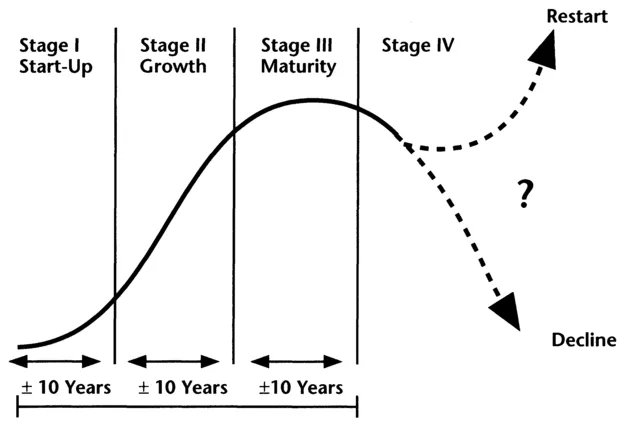
Figure 2
The Four Stages of a Company's Life Cycle
The Four Stages of a Company's Life Cycle
Stage Two: Growth. The next ten years or so—Stage Two—are exhilarating. The business has taken hold, and sales and profits are taking off. During the growth phase, JacMar Corporation blossomed because its patented processes were much in demand, and because of Jack's uncanny ability to attract and motivate gifted technical employees. Jack was demanding and exacting, driving his people to solve customers' problems "on time and under bid." JacMar's 200 employees are fiercely loyal, and each feels personally attached to Jack. They both love and fear him. Jack has the "charismatic" personality of a born leader.
Employees have always known where they stood with Jack, although it might be uncomfortable. Jack was always looking for fresh approaches, new options, and his creativity excited his employees to discover new and better ways of doing things. A restless visionary Jack was always changing things. The work environment was chaotic, but always exciting. In spite of past accomplishments, Jack's restless imagination drove others to do better. During its phenomenal growth stage, JacMar Corporation was featured in Inc. Magazine.
Stage Three: Maturity. After about twenty years or so, a successful entrepreneurial business matures. Growth slows down, market share and profits stay relatively flat; depreciation overtakes research and development, and the family takes more out of the business. Over the last five years, JacMar's gross sales have increased from $24.6 million to $30 million, an average of 5 percent per year. Earnings before interest, taxes, depreciation, and amortization (EBITDA) grew from $2.5 million five years ago to $3.4 million two years ago, but dipped to $2.1 million last year because of outside factors (mostly due to a recession). The EBITDA calculation allows investors to compare the "earnings stream" of a company to the earnings stream of other investments. The value of a company can be stated as a multiple, e.g., six times EBITDA. The reciprocal fraction (EBITDA divided by six) is the rough equivalent of a price/earnings ratio used to value publicly held companies.
The life cycle of an entrepreneurial company often parallels the life cycle of its founder. This may be happening at JacMar Corporation. Margaret has noticed some changes in Jack since his heart surgery three years ago. He is less communicative and seems preoccupied. They have vacationed in Florida for the past several years, last year for more than a month. At times Jack seemed to enjoy Florida, but he became restless, calling the office several times a day. Margaret helped him reduce his calls to a few per week. At the office, however, no one wanted to make decisions without Jack's approval, since he has a way of reversing whatever others decide in his absence.
Jack never took the time to develop hobbies, although he had some golf lessons and went fishing with friends several times. As a result, his vacation time with Margaret weighed heavily on both of them. It's pretty clear neither wants Jack to retire and come home. For Jack, work is life, and he is afraid of retirement: too many of his friends have died after they quit work. Not to work would seem like suicide—yet Jack is slowing down; nature is taking care of that. The life cycle of JacMar Corporation is following Jack's own life cycle.
During the first ten years, Jack was all vigor and ingenuity; his company survived. During the second ten years, Jack was all vision and genius, and JacMar Corporation became a major player. Now, during its third decade, Jack seems to have lost his edge, his daring, his drive for - "we can do better." Jack senses this crisis, and it worries him greatly. Margaret has picked up the signal, and JJ is worried also. Will there be enough left of JacMar Corporation to prosper in his generation?
Stage Four: Restart or decline. A business can remain "mature" only for a limited time. It will decline unless restarted. The mature JacMar company reflects Jack's aging. Although the company made its reputation on the cutting edge of technical expertise, research and development are declining. Sales are flat, and JacMar's market share is not growing. The family is taking more out of the company, so depreciation is overtaking investment.
Today, Jack and Margaret are in a "savoring mode," enjoying the recognition that comes with entrepreneurial success. They are pleased with their reputation in their local community and are proud of the company logo on the water tower, on their trucks, in trade magazines. Jack is a long-time director of their principal bank, although JacMar Corporation has no long-term bank debt. Jack served many years on the board of their industry trade association, including two terms as chairman. However, he and Margaret no longer look forward to the annual conventions.
The JacMars read "horror stories" in the business press about destructive lawsuits among warring business families. They hear about the distressing failure rate of family businesses—a widespread but discredited statistic that only one in three family owned businesses survives successfully in the second generation.
The Issue Facing JacMar
Mature companies like JacMar Corporation dare not rest on past accomplishments. Either JacMar Corporation reorganizes and restarts, or it begins to sink rapidly. Jack has built a marvelous launch pad for the next generation, but if the launch isn't made soon, JacMar Corporation will ultimately go out of business. Jack senses this dilemma, that his company needs a reorganizational jump start, but he lacks the motivation to lead it. To guide JacMar Corporation safely through its fourth phase will require different leadership that he cannot provide. Margaret insists that one of their sons can provide that leadership ... eventually.
But not right now.
Inside Your Business Family . . .
Which of the typical stages describes your family business? Stage Two? Stage Three? Stage Four? Review your annual earnings for the past five years.
Calculate your EBITDA—earnings before interest and taxes. Project your EBITDA over the next three years.
How is your company owned? In the margin, list the numbers of shares outstanding in each class of stock, the names of each shareholder, the number and percentage of shares in each class owned by each shareholder. Are you a Subchapter S corpor...
Table of contents
- Cover
- Half Title
- Title
- Copyright
- Contents
- Preface
- Introduction
- The 39 Critical Questions
- PART ONE THE JACMAR BUSINESS FAMILY
- PART TWO THE 39 CRITICAL QUESTIONS
- Appendix A Lawyers, Families, and Feelings
- Appendix B Estate Planning for the Family Business Owner
- Notes
- Suggested Reading
- Index
Trusted by 375,005 students
Access to over 1.5 million titles for a fair monthly price.
Study more efficiently using our study tools.
Frequently asked questions
Yes, you can cancel anytime from the Subscription tab in your account settings on the Perlego website. Your subscription will stay active until the end of your current billing period. Learn how to cancel your subscription
No, books cannot be downloaded as external files, such as PDFs, for use outside of Perlego. However, you can download books within the Perlego app for offline reading on mobile or tablet. Learn how to download books offline
Perlego offers two plans: Essential and Complete
- Essential is ideal for learners and professionals who enjoy exploring a wide range of subjects. Access the Essential Library with 800,000+ trusted titles and best-sellers across business, personal growth, and the humanities. Includes unlimited reading time and Standard Read Aloud voice.
- Complete: Perfect for advanced learners and researchers needing full, unrestricted access. Unlock 1.5M+ books across hundreds of subjects, including academic and specialized titles. The Complete Plan also includes advanced features like Premium Read Aloud and Research Assistant.
We are an online textbook subscription service, where you can get access to an entire online library for less than the price of a single book per month. With over 1.5 million books across 990+ topics, we’ve got you covered! Learn about our mission
Look out for the read-aloud symbol on your next book to see if you can listen to it. The read-aloud tool reads text aloud for you, highlighting the text as it is being read. You can pause it, speed it up and slow it down. Learn more about Read Aloud
Yes! You can use the Perlego app on both iOS and Android devices to read anytime, anywhere — even offline. Perfect for commutes or when you’re on the go.
Please note we cannot support devices running on iOS 13 and Android 7 or earlier. Learn more about using the app
Please note we cannot support devices running on iOS 13 and Android 7 or earlier. Learn more about using the app
Yes, you can access The Survival Guide for Business Families by Gerald Le Van in PDF and/or ePUB format, as well as other popular books in Business & Business General. We have over 1.5 million books available in our catalogue for you to explore.