1 Overview of the CDM Regulations
What are the CDM Regulations?
History of the CDM Regulations
Health and safety in the construction industry
Health and Safety legislation in the UK
The Health and Safety at Work etc. Act 1974 (HSWA)
Regulations
Approved Code of Practice
Guidance notes
Enforcement of the CDM Regulations
Application of the CDM Regulations
Interpretation
When notification is required
CDM duty holders and their responsibilities
The client
The CDM co-ordinator
The designer
The principal contractor
The contractor
General management duties on all
Project hazard management
Hazard management concepts
Risk assessment and hazard management
Pre-construction information
The construction phase plan
The health and safety file
What are the CDM Regulations?
History of the CDM Regulations
As a member state of the European Union the UK is subject to legal directives, which it must interpret and implement. Such directives impose a duty on each member state to:
- make regulations to conform with any directive
- enforce those regulations.
The Construction (Design and Management) Regulations are, therefore, the UK’s response to EU Directive 92/57 EEC ‘The Management of Health and Safety Requirements at Temporary or Mobile Construction Sites’. Although, arguably, existing health and safety legislation was already in place to cover many of the areas it was hoped CDM would address, such as the Health and Safety at Work etc. Act 1974 and the Management of Health and Safety at Work Regulations 1992 (now 1999), it was deemed necessary to provide additional impetus for construction safety. The regulations became effective on 31 March 1995 and marked a new era in construction health and safety management.
Then, following a thorough and lengthy consultation process involving the Health and Safety Commission (since merged with Health and Safety Executive) and the construction industry itself, the CDM Regulations were revised in an attempt to further engage the project team and improve clarity, and were reintroduced with several significant modifications on 6 April 2007 as the Construction (Design and Management) Regulations 2007.
An Approved Code of Practice to support the regulations was then published which attempted to offer advice and guidance on practical implementation of the regulations. The construction industry also initially produced a series of guidance documents on specific areas of CDM to assist those having to implement the new legislation. The legal status of the Approved Code of Practice and the industry guidance documents will be clarified elsewhere in this chapter.
The current regulations place a heavy emphasis on the general principles of competence, co-operation and co-ordination across the team and the principles of risk management. They also provide the respective duty holder with the confidence to apply an appropriate health and safety management approach and avoid an overly bureaucratic strategy. The Approved Code of Practice offers the following comfort:
The effort devoted to planning and managing health and safety should be in proportion to the risks and complexity associated with the project. When deciding what you need to do to comply with these Regulations, your focus should always be on action necessary to reduce and manage risks. Any paperwork produced should help with communication and risk management. Paperwork which adds little to the management of risk is a waste of effort, and can be a dangerous distraction from the real business of risk reduction and management.
Health and safety in the construction industry
The construction industry is quite simply the largest industry in the UK and constitutes approximately 9 per cent of the UK’s gross domestic product. It has been estimated that over 2 million people work in the construction industry.
Given the industry is so diverse and wide-ranging, it is generally regarded as a relatively high-risk industry to work in. For example, Health and Safety Executive statistics remind us that:
- since 1985 2,800 people have died from injuries received as a result of construction work;
- asbestos-related diseases cause an estimated 4,000 deaths each year;
- an estimated 11.6 million working days a year are lost to work-related muscular skeletal disorders, many of which are in the construction industry
(http://www.hse.gov.uk/statistics).
There has been a major move by the industry itself to improve the appalling levels of fatalities, major injuries and incidences of ill health over the last few years. The first construction summit was held in February 2001 where the industry decided to set targets for reducing the rate of fatal and major injury to workers by 66 per cent by 2009/10. The summit was seen as an opportunity to raise the profile of construction health and safety and the bold targets set there showed an impressive intent. Other important initiatives include, Revitalising Health and Safety, Rethinking Construction (the Egan Report), and Achieving Excellence in Construction.
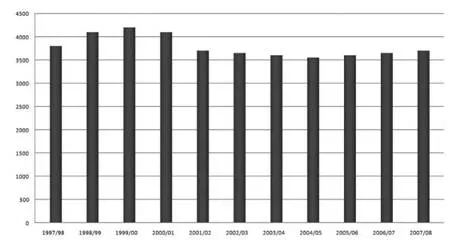
Figure 1.1 Number of major injuries in the construction industry, 1997-2007
The introduction of the CDM Regulations themselves must also be viewed as a major opportunity for the project team to further focus on the specific health and safety issues. The following quotation from John Egan is very much in line with the ideology that CDM is striving to achieve:
I [. . .] passionately believe in the importance of tackling the industry’s health and safety problems. Pre-planned, well designed projects, where inherently safe processes have been chosen, which are carried out by companies known to be competent, with trained work forces, will be safe: they will also be good, predictable projects. If we are to succeed in creating a modern, world class industry, the culture of the industry must change. It must value and respect its people, learn to work in integrated teams and deliver value for clients’ money.
Sir John Egan, Accelerating Change, 20021
Health and safety legislation in the UK
In order to appreciate the significance of the CDM Regulations in legal terms we will now, albeit briefly, look at the legal framework in the United Kingdom as well as our obligations as a member state of the European Union.
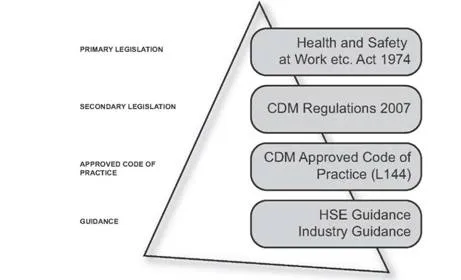
HIERARCHY OF HEALTH AND SAFETY LEGISLATION
Figure 1.2 Legal framework
The Health and Safety at Work etc. Act 1974 (HSWA)
This is the primary source of health and safety legislation in the United Kingdom. It was introduced to unify existing legislation and raise awareness of occupational health and safety. It aimed to move the focus on to ‘people at work’ in an attempt to reduce the general apathy that surrounded the subject of health and safety at the time.
The Act provided bold general duties for employers, the self-employed and even employees. For example:
It shall be the duty of every employer to ensure, so far as is reasonably practicable, the health, safety and welfare at work of all his employees.
HSWA section 2(1)
The Act also makes it necessary for employers to conduct their undertakings in such a way as to ensure, as far as is reasonably practicable, that persons not in their employment who may be affected thereby are not exposed to risk to their health and safety. The health and safety of the general public would be a good example of a cohort that an employer must consider.
Significantly, the Act also established both the Health and Safety Commission and the Health and Safety Executive (now merged into a single entity under the latter name). The former was established to primarily make arrangements to ensure the health and safety of people and work and those affected by that work. This is achieved through the proposal of new legislation and standards, instigating and conducting research and providing information and advice.
The Act also has the ability to make specific health and safety regulations, which serve to strengthen and support the principles of the primary legislation.
Regulations
The Health and Safety Executive (HSE) will, from time to time, propose additional legislation to facilitate its work. This is generally achieved through a regulation that would be brought into force under the Act. The proposal is made to, and introduced by, the appropriate government minister.
Regulations are seen as an appropriate means of setting new health and safety standards in a relatively quick timescale. A proposed regulation will automatically become law 21 days after submission to Parliament if no objections are made.
However, before the Executive proposes any new legislation it will consult with all interested parties, such as relevant industry bodies and trade unions.
Regulations are also used as a tool to implement the requirements of EU directives, as indeed was the case with the CDM Regulations.
There are numerous other health and safety regulations that are potentially relevant to the construction industry over and above CDM. Effectively, it could be argued that CDM sits above many of these other regulations as a management platform for their successful implementation and consequent risk reduction. It would be of value for a construction professional to have a general grounding in the most relevant regulations.
Examples of Health and Safety Regulations (that can be relevant to construction work) include:
- Management of Health and Safety at Work Regulations 1999
- Work at Height Regulations 2005
- Control of Substances Hazardous to Health Regulations 2002 (COSHH)
- Control of Asbestos Regulations 2006
- Lifting Operations and Lifting Equipment Regulations 1998 (LOLER)
- Provision and Use of Work Equipment Regulations 1998 (PUWER)
- Manual Handling Operations Regulations 1992
- Control of Noise at Work Regulations 2005
- Control of Vibration at Work Regulations 2005
- Health and Safety (First Aid) Regulations 1981
- Personal Protective Equipment Regulations 1992
- Reporting of Injuries, Diseases and Dangerous Occurrences Regulations 1995 (RIDDOR).
Approved Code of Practice
If it is felt that further clarity and practical guidance are necessary to facilitate compliance with a regulation, then it may be necessary to introduce an Approved Code of Practice (ACoP). It is important to understand the legal status of an ACoP. It is not a legal requirement to follow the information provided by any ACoP. However, failure to adopt the recommendations of the document in practice may be taken by a court in any criminal proceedings as evidence of failure to comply with the regulation to which it relates. Only if the defendant has demonstrated compliance by an alternative equally effective measure will this not count against them.
In terms of the CDM Regulations 2007, an ACoP was introduced immediately to assist with providing advice and guidance with the practical application of the regulations. This publication, Managing Construction for Health and Safety (L144), was well received by the industry with increased clarity and examples of good practice.
Guidance notes
One of the main reasons, therefore, for th...