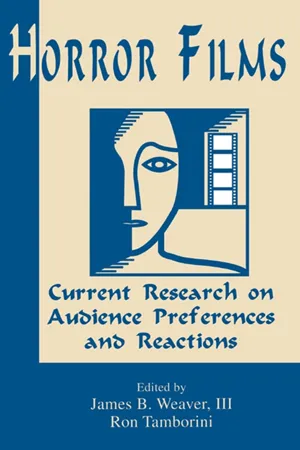
Why do so many of us enjoy being told frightening stories? What are some of the consequences that result from such exposure? In light of the considerable popularity of horror films over the last three decades, these questions have become the focus of growing attention for many scholars. However, research on audience preferences for, and reactions to, horror films has been performed eclectically by investigators from varied theoretical and methodological backgrounds. As a result, the information has not been effectively integrated. This volume was written to address this problem and to position the study of audience responses to frightening fiction as a significant research topic.
eBook - ePub
Horror Films
Current Research on Audience Preferences and Reactions
- 216 pages
- English
- ePUB (mobile friendly)
- Available on iOS & Android
eBook - ePub
Horror Films
Current Research on Audience Preferences and Reactions
About this book
Information
Chapter
1 |  |
Frightening Entertainment: A Historical Perspective of Fictional Horror
Ron Tamborini
Michigan State University
James B. Weaver, III
Auburn University
It can be hard to understand the “nature of the beast” when we are always running away from it. So it seems as we attempt to define the modern horror genre. Indeed, as we looked for a clear, precise definition of the horror genre, we discovered instead a deeply entangled and controversial concept. It is not uncommon, for instance, for scholars to be centuries apart when identifying the genre’s inception. Some trace the ancestry of horror to early cave drawings and primitive rituals (see Zillmann & Gibson, chap.2, this volume). Others put its roots in the mid-18th century beginning with the “Age of Reason” (Edwards, 1984; Twitchell, 1989), and mock those who would describe horrid fiction “in mythic, legendary terms, as if there were any resemblance between a postindustrial American teenager, screaming in delight at a monster movie, and some medieval peasant who trembled in the dark for fear a ghost would get him” (Kendrick, 1991, p. xxii). Still others suggest that the modern horror genre originated only in the early part of this century when scholars first began to write anthologies on horrid fiction, or, perhaps when critics affirmed it by decree (Joshi, 1990).
There is some merit in each of these perspectives depending on the facet of horror considered. If one begins with an interest in the functions served by horror (such as Zillmann & Gibson, chap.2, this volume) we might assume that certain needs associated with these stories have not changed since prehistoric times, whereas other needs may be associated with much more recent developments. In the same manner, interest in the genre’s form might focus on characteristics of horror that have been a part of frightening narratives since preliterate times, or focus on characteristics of frightening fiction that have distinguished modern horror from other related genres since the middle of the 18th century.
Whichever perspective is embraced, little appears to have changed as the telling of horrific tales has moved from campfire fables to pulp fiction to the modern film. This chapter offers a brief historical overview of the development of frightening entertainment.
DEFINING HORROR
One problem associated with defining horror is confusion about the nature of the threat implied. Separate examinations have made similar attempts to distinguish the sensation experienced in the face of physical danger from that experienced as a form of supernatural threat (Barclay, 1978; Derry, 1977; Prawer, 1980). Lovecraft (1923/1973) suggested that horror found in weird tales of this type:
Has something more than secret murder, bloody bones, or a sheeted form clanking chains according to rule. A certain atmosphere of breathless and unexplainable dread of outer, unknown forces must be present; and there must be a hint, expressed with seriousness and portentousness becoming its subject, of that most terrible conception of the human brain—a malign and particular suspension or defeat of those fixed laws of Nature which are our only safeguard against the assaults of chaos and the demons of unplumbed space. (p. 15)
Edwards (1984) suggested that the clear separation between horror and fear lies in the distinction between external threat and the idea of threat, but to this she added that terror is associated with extreme fear, whereas horror couples extreme fear with disgust. Thus, one may feel terrified by the impending danger that could result in death, but horrified by the thought of being dead and the disgust of corruption and decay. This designation of horror is similar to that found in literature on emotion (Lazarus, 1991) and used elsewhere in this volume (see Tamborini, chap. 7, this volume). It implies that horror is characterized by fear of some uncertain threat to existential nature and by disgust over its potential aftermath, and that perhaps the source of threat is supernatural in its composition.
Defining horror in this manner provides a starting point for understanding the complexities of the phenomenon. A more detailed conception might be gained by examining the typologies consistent with this definition that have been developed to distinguish the concept. Penzoldt (1965) suggested that horrid fiction can be categorized as a Gothic tale, science fiction, or psychological horror; Derry’s (1977) typology includes horror of the demonic, the horror of Armageddon, and the horror of personality; and Joshi (1990) proposed classes including supernatural horror, quasi-science fiction, and nonsupernatural horror. Although the typologies were created for various purposes and the nomenclature seems to differ, much in common can be found in three dimensions that are shared by each typology. The terminology of Joshi (1990) is employed here for its more broadly inclusive features.
Supernatural, Gothic, or horror of the demonic all begin with the assumption that the real world is governed by “natural law” and we live our lives according to this belief. Lovecraft (1923/1973) suggested that horror is created when some “natural law” is violated. When this occurs, life as we once knew it starts to function according to laws we do not understand and over which we have no control. We are at the mercy of supernatural forces that appear to have malicious intent.
Quasi-science fiction, science fiction, or the horror of Armageddon once again begins with the assumption that the real world is governed by forces that are well understood, even though the impossible seems to have occurred. In this case, however, the violations are accounted for in some rational manner. Quasi-science fiction presupposes that the impossible is an issue of epistemology, and not an issue of ontology. The impossible is accounted for not as a function of reality being violated, but as a function of our inability to yet understand the reality that we know to exist. As such, although the violation may appear supernatural at present, it is implied that we will be able to explain the phenomenon in the future. Nonetheless, again we are confronted by malevolent powers beyond our understanding or control, and the threat it presents is horrifying.
Nonsupernatural, psychological, or horror of the personality has been the most difficult to classify as part of the genre. Joshi (1990) suggested that nonsupernatural horror has two autonomous divisions: pseudonatural, in which events that appeared to violate natural law are later shown to be the account of an abnormal state of mind; and conte cruel, a tale of inhuman brutality. Lovecraft (1923/1973) and others believed that attempts to integrate the nonsupernatural, particularly conte cruel, confuse understanding of fictional horror; however, denying its inclusion would eliminate materials central to many audience conceptions of the genre. Classics like Psycho and other nonsupernatural horrors would have to be left out. In order to avoid limiting our concept to one unrelated with these audience experiences, a broader meaning that incorporates nonsupernatural horror seems appropriate in this situation. Although the divisions may appear somewhat blurred, this inclusion seems appropriate if psychological horrors can be considered part of the supernatural. For example, in Psycho, Norman Bates is classified as schizoid. If this diagnosis is taken to mean that as yet we really do not understand what is going on in the person’s mind, these stories of unexplainable forces with malicious intent fit more easily within the genre (Twitchell, 1989). In either account, when stories of this type center on the provision of extremely loathsome images they seem more compatible with horror than with affiliated genres predominantly owing to their attempt to disgust.
Exploring these typologies helps us clarify different meanings of horror employed by audiences today, but viewing archaic thoughts on horror according to this conceptualization is unlikely to give us an accurate account. Clearly, these categories are inappropriate for understanding the phenomena prior to the 18th century when prevailing ontological assumptions would have provided no meaning for categories like supernatural, psychological, and science fiction. Perhaps today it is still the case that each of these is just a function of uncontrollable fear from an unknown existential threat, and that this understanding has not changed across time.
Nevertheless, in order to comprehend modern horror, it is important to understand something of its origins. As such, when considering the development of entertaining horror as we know it today, there is good reason to look back as far as recorded history. The horrific images we find in today’s graphic films can be traced to their origins in visual and verbal media. Although the form differs somewhat, the context is essentially unchanged. We are frightened by forces we do not completely understand and by things that go bump in the night.
THE FABLED PAST
Stories of preposterous violence are apparent in the earliest cave paintings, and are likely to have been in existence for much longer. Frightening fiction has a legacy as old as recorded time, and its genealogy can tell us much about the role it plays in our daily lives. Historians like to trace horrid fiction to a tradition so primordial that it might be considered a part of human nature. Throughout the ages, they suggest, people have gathered in circles to frighten each other with horrifying tales. This image is not a hard one to accept based on available evidence. For centuries, archaeologists have collected antiquated fables and primitive tales from all cultures and corners of the earth. The stories are enough to raise goose flesh on those who listen to them without disbelieving ears.
The monsters, demons, and maniac killers of the modern horror genre have clear-cut predecessors. These legends and fables from centuries ago may provide us with clues to their attraction. Lovecraft (1923/1973) traced the heritage of what he termed “the weird tale” to archaic ballads, chronicles, and sacred writings. The similarity between the themes found in these ancient artifacts and those found in modern weird tales provides a clear indication that the form and functions of today’s horrid fiction have been with us since an earlier time.
Support for this notion can be seen in the recurrent themes found in myths. Kluckhorn (1960) maintained that universal themes are contained in the legends of widely diverse cultures, and it is apparent that many of these themes are standard in the subject matter of today’s horrid fiction. Fables of witchcraft and tales of hideous monsters can be found in most if not all cultures studied. The appearance of these forms across time and cultural divisions suggests functional equivalence in the motives that lead to their popularity.
The functions served by frightening myths and scary stories have been the focus of much scholarly speculation. It has been suggested that fables are often employed as a substitute for fact when people are attempting to explain mysteries beyond their understanding (Levin, 1960). The legends and fables provide an acceptable explanation for the events they are attempting to understand. The telling of fairy tales, even repulsive stories about hideous demons and fiendish killers, functions to provide children with the opportunity to confront their fears through ritualized exposure in a protected environment (Bettelheim, 1976).
Learning to master our fears is an important part of development, and rituals can play a big role in this learning process. Perhaps that is why ritual has always been such an important part of horror and the fear that we associate with this genre. For centuries, the conquest of fear has been accomplished by rituals and rites that require the direct confrontation of the threat (see Zillmann & Gibson, chap. 2, this volume). At the same time, however, many rituals confront threats using a symbol to represent the source of fear. From simple representations of early cave drawings to graphic depictions of 18th-century intaglio engravings, symbolic representations have allowed us to face our fears in rituals that help us cope with different threats. Myriad examples of graphic violence and horror can be found in classic literature from Homer to Shakespeare as small segments inserted in larger stories. Although feature-length horrid novels did not emerge until the 19th century, the attraction to such themes appears to be very old (Kendrick, 1991).
FACT OR FICTION
Certain aspects of horror as we know it today are generally accepted as descending from early legends and fables, but changed attitudes about death in the mid-18th century altered the nature of how these stories were perceived. When we consider the genre along divisions of supernatural, nonsupernatural, and quasi-science fiction, we are dealing with an understanding of horror that did not develop until the concept of fiction began to acquire its present form (Daniels, 1975).
The change that occurred in perception of horrid stories during the 18th century can be identified by a growing disbelief in things that could not be observed. Although many features of these stories remained relatively unchanged from ancient legends and fables, the audience attitude toward them was different. The 18th century “Age of Reason” brought a skepticism toward the supernatural that before had not been seen. Because the supernatural was accepted as a part of reality, there was no “violation” of natural law before the 18th century. With the incursion of empiricism, the fantastic was now curtailed or accounted for in most narratives. Tales in literature were introduced as stories related to the author by a source claiming the report to be true (Brockett, 1964). The crumbling settings and loathsome violence were still present and frightening, but increasingly were looked on with disbelief.
Whereas change in 18th-century attitudes toward horror are characterized by disbelief, change in the format of horror came as result of technological advances. Twitchell (1989) suggested that attitudes toward violent death were influenced by developments in printing that provided a thrilling new form of “mimic” aggression. Much has been said about advances in stereography that made typesetting more efficient and inexpensive. These advances, no doubt, had an impact on the availability of literature for those who knew how to read. At the same time, however, other developments in print technology may have been more influential on illiterate audiences. When the labor-intensive techniques of early relief printing methods were replaced by intaglio engraving, the inexpensive production of illustrated copies became a possibility. Many early attempts to profit from this technology came in the form of gruesome images.
One of the first attempts to find a mass audience for this type of graphic imagery can be found in the work of Horgarth during the latter half of the 18th century (Paulson, 1970). Horgarth created a strong impact by connecting illustrations to relate a short story in pictures. Because verbal literacy was limited to the educated upper class, a larger audience could be reached by telling the tale through his drawings. Although the story lines were often simple morality tales, they provided a forum for explicit images of sadistic brutality and gruesome retaliation. His illustrations were so popular, that soon he started to hire other artists to help produce illustrations for his tales. Some, like The Four Stages of Cruelty, which featured the savagery of a fiend named Tom Nero, were so successful that they were followed by sequels (Twitchell, 1989). In much the same manner that monstrous killers now return until audience members lose interest, Tom Nero appears a forerunner of today’s film demons. He was a nonsupernatural sociopath, a Mr. Hyde without a Dr. Jekyll.
The rigid curtailment of the supernatural in literature was swept away in the late 18th century and replaced by a style that would have a lasting impression on traditional supernatural horror. As the romantic movement began to take root, the drive toward rationality was supplanted by reliance on intuition. The fantastic was once again a topic accepted in polite circles, and in demand by the general public. With a middle class growing in number and economic strength, it was not long before the supernatural was back in full swing. This time, however, the stories were listened to quite differently than they had been by audiences for early myths and fables. Although tales of the supernatural were fascinating to many, they were taken now as a form of fiction. The eerie tales filled with crumbling buildings or decaying graveyards still put a chill into their patrons, but the patrons now had their doubts (Barclay, 1978).
Castle of Otranto (Walpole, 1764/1840) is believed to be one of the first examples of modern supernatural horror (Lundwall, 1977). Otranto, subtitled A Gothic Story, is often acknowledged for founding the Gothic genre, yet no...
Table of contents
- Cover
- Title page
- Copyright page
- Contents
- Contributors
- Preface - James B. Weaver, III and Ron Tamborini
- 1 Frightening Entertainment: A Historical Perspective of Fictional Horror - Ron Tamborini and James B. Weaver, III
- 2 Evolution of the Horror Genre - Dolf Zillmann and Rhonda Gibson
- 3 Content Trends in Contemporary Horror Films - Barry S. Sapolsky and Fred Molitor
- 4 The Economics of the Horror Film - Douglas Gomery
- 5 Developmental Differences in Responses to Horror - Joanne Cantor and Mary Beth Oliver
- 6 Gender-Socialization Theory of Reactions to Horror - Dolf Zillmann and James B. Weaver, III
- 7 A Model of Empathy and Emotional Reactions to Horror - Ron Tamborini
- 8 An Activation-Arousal Analysis of Reactions to Horror - Glenn G. Sparks
- 9 Sensation Seeking and the Taste for Vicarious Horror - Marvin Zuckerman
- 10 A Uses and Gratifications Analysis of Horror Film Preference - Patricia A. Lawrence and Philip C. Palmgreen
- 11 Horror’s Effect on Social Perceptions and Behaviors - Ron Tamborini and Kristen Salomonson
- Author Index
- Subject Index
Trusted by 375,005 students
Access to over 1.5 million titles for a fair monthly price.
Study more efficiently using our study tools.
Frequently asked questions
Yes, you can cancel anytime from the Subscription tab in your account settings on the Perlego website. Your subscription will stay active until the end of your current billing period. Learn how to cancel your subscription
No, books cannot be downloaded as external files, such as PDFs, for use outside of Perlego. However, you can download books within the Perlego app for offline reading on mobile or tablet. Learn how to download books offline
Perlego offers two plans: Essential and Complete
- Essential is ideal for learners and professionals who enjoy exploring a wide range of subjects. Access the Essential Library with 800,000+ trusted titles and best-sellers across business, personal growth, and the humanities. Includes unlimited reading time and Standard Read Aloud voice.
- Complete: Perfect for advanced learners and researchers needing full, unrestricted access. Unlock 1.5M+ books across hundreds of subjects, including academic and specialized titles. The Complete Plan also includes advanced features like Premium Read Aloud and Research Assistant.
We are an online textbook subscription service, where you can get access to an entire online library for less than the price of a single book per month. With over 1.5 million books across 990+ topics, we’ve got you covered! Learn about our mission
Look out for the read-aloud symbol on your next book to see if you can listen to it. The read-aloud tool reads text aloud for you, highlighting the text as it is being read. You can pause it, speed it up and slow it down. Learn more about Read Aloud
Yes! You can use the Perlego app on both iOS and Android devices to read anytime, anywhere — even offline. Perfect for commutes or when you’re on the go.
Please note we cannot support devices running on iOS 13 and Android 7 or earlier. Learn more about using the app
Please note we cannot support devices running on iOS 13 and Android 7 or earlier. Learn more about using the app
Yes, you can access Horror Films by James B. Weaver, Ron Tamborini, James B. Weaver,Ron Tamborini in PDF and/or ePUB format, as well as other popular books in Psychology & Communication Studies. We have over 1.5 million books available in our catalogue for you to explore.